Nature vs. Nurture: Consider the Spragues, Part 3

In this final part of my blog about the Sprague family, I’ll highlight descendants of Ralph Sprague, the oldest of the three brothers who came to the Massachusetts Bay Colony in 1628.

In the books written about Ralph Sprague and his family, Ralph is most highly regarded for his service to the Massachusetts Bay Colony.

In The Founding of Charlestown by the Spragues, A Glimpse of the Beginning of the Massachusetts Bay Settlement (1910), written by Henry H. Sprague, the author quotes the earlier historian Richard Frothingham, Jr., who wrote of Ralph Sprague in The History of Charlestown (1845):

He was a prominent and valuable citizen – active in promoting the colony.

The Spragues of Malden, Massachusetts (Hingham Historical Society archives)

And in The Spragues of Malden, Massachusetts, by George Walter Chamberlain, this is written about Ralph’s contributions:

Ralph Sprague served as a Deputy to the General Court from Charlestown, then including Everett, Malden, Melrose, Stoneham and Somerville, etc., in at least sixteen sessions and served on important committees many times. The fact that Mr. Sprague served with the most distinguished men of the Massachusetts Bay Colony so long indicates that he was a man of sound judgment and remarkable ability. His influence in the Colony was great.

While Ralph first built a home for his family in Charlestown, he was later given more land:

In 1638 the Town of Charlestown made a record of twelve lots of land which were granted to him. Five of these lots were on Mystic Side, out of which the town of Malden was formed in 1649.

Within a decade, Ralph Sprague was helping to establish the Town of Malden.

On 1 Jan. 1648/9, Lt. Ralph Sprague and nine other freemen . . .  petitioned the General Court of Massachusetts Bay Colony, for a separation from Charlestown, and Misticke side became a distinct town of the name Maulden, 11 May 1649.

This post is intended to focus on historically prominent descendants of Ralph Sprague of Charlestown and Malden who were 19th and 20th century scientists, inventors, and industrialists. But permit me a diversion first to highlight some of Ralph’s descendants who made their mark during their time, though they are less remembered now:

Dr. John C. Sprague (1754-1803) of Malden, a descendant of Ralph’s son John Sprague, did military service as a surgeon, was twice captured by the British, and was imprisoned for a time in Ireland. After the War for Independence, he became a schoolteacher and also was involved in Malden Town government, serving on a wide range of Committees. At a special Town Meeting in 1797, Dr. Sprague was elected both to a committee on education and to a committee to raise money for the encouragement of singing. In noting this specific service, the author of The Spragues of Malden adds: “Thus was Dr. Sprague identified with the best things of his native town in the reconstructive period following the Revolutionary War.”
Phineas Sprague (1777-1869) of Malden—the 5th in a line of men named Phineas descended from Ralph’s son John, was a delegate to the Constitutional Convention of Massachusetts in 1820, at which he spoke on the Declaration of Rights, saying: “It is tyranny in the highest degree to compel a man to worship in a manner contrary to the dictates of his conscience. Religion is an affair between God and our own souls.”

Phineas’ liberal views regarding religion, like those we in Hingham associate with the minister at First Parish, Ebenezer Gay (1696-1787) in the early days of what was first known as the Arminian movement, eventually led Phineas to withdraw from First Parish of Malden. Phineas later would be involved in establishing a Universalist church in Malden.

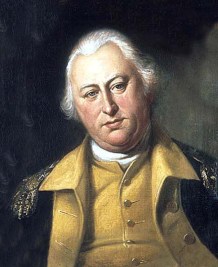
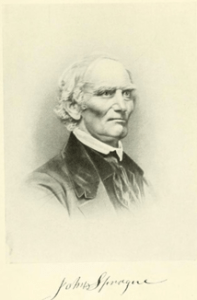
Dr. John’s son, John Sprague (1781-1852) of Malden, like his cousin Phineas, espoused liberal views of religion at a time when religious congregations in New England were dividing due to differing theological views during what would be known in Protestantism as the Great Awakening, and then due to differing political views: Federalism vs. States Rights. (In Hingham, these political divisions led to the founding of New North Church by a group of Federalist-leaning residents including Major General Benjamin Lincoln.)
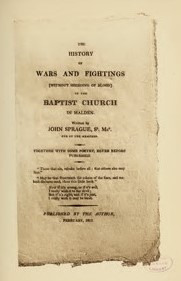
John was an original member of the First Baptist Church of Malden but later found himself unwelcome in the church due to his Arminian views vs. the Calvinist doctrines of the minister at the time. In 1812, John Sprague wrote and self-published a pamphlet that caused quite a stir: The History of Wars and Fightings (Without Shedding of Blood) in the Baptist Church in Malden. A subtitle reads “Together with Some Poetry, Never Before Published.”

On April 12, 1812, the members of the Baptist church based his exclusion from the congregation on the publication of this book. While John Sprague was a shoemaker by trade, he enjoyed writing poetry—and a few of his humorous poems are included in the The Spragues of Malden. 

John was selected by the town of Malden for many committees, among them: the Bunker Hill Monument Association formed to raise money for the monument’s construction, and the committee formed by the town in 1844 to choose the best path through Malden for what was then called the Maine Railroad.  I think many of those who serve on Town Committees in Hingham today would have enjoyed the company of shoemaker John Sprague of Malden.

Horatio Sprague Sr. (1784-1848), a descendant of Ralph’s son John, was born in Boston, but most associated with Gibraltar, where he permanently resided from 1815 until his death. Horatio was a merchant and ship owner in Gibraltar, a British territory on the tip of the Iberian Peninsula, when he was chosen to be U.S. Consul there in 1832.  His duties, largely tied to facilitating commerce, were not onerous, but his health declined.

His son, Horatio Jones Sprague Jr. (1823-1901), who was born in Gibraltar and spoke several languages, was appointed after his father’s death as U.S. Consul in Gibraltar and served in that post for 53 years. His consular workload was greater than his father’s due to the opening of the Suez Canal in 1870, and two wars that had an impact during his tenure: the Civil War in the U.S. (1861-65) and the Spanish-American War (1898.) Horatio Sprague Jr. also broadened the business portfolio he’d developed with his father when he became an importer of tobacco to Gibraltar. Horatio died in 1901, and would be succeeded as U.S. Consul by his son, Richard Sprague (1871-1934.) 

Details about this now-unusual Sprague diplomacy dynasty is on this website, serving fans of James Joyce. Why would such a James Joyce website include information about the Spragues of Gibraltar? I was surprised to learn that James Joyce’s famous work Ulysses (first serialized beginning in 1918, then published as a book in 1922) has a Horatio Sprague Jr. reference, as “old Sprague the consul”:

. . . when general Ulysses Grant whoever he was or did supposed to be some great fellow landed off the ship and old Sprague the consul that was there from before the flood dressed up poor man and he in mourning for the son.

While James Joyce’s Ulysses is a work of fiction, this reference to Ulysses Grant visiting Gibraltar is based on historic fact. The then former president, Ulysses Grant visited Gibraltar as part of a world tour in 1878, when the U.S. Consul there was Horatio Jones Sprague, Jr.

Now, on to those descendants of Ralph Sprague who made lasting contributions to science, innovation, and industry in the 19th and 20th centuries.

Charles H. Sprague (1827-1904) of Malden descended from Ralph’s son Phineas (1637-1690), who was among the Malden men who fought in King Philip’s War.
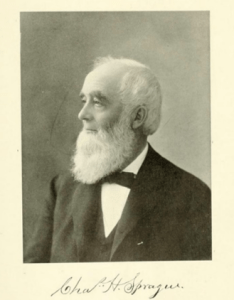
Charles served his local community as a member of the Malden City Council, following in the public service tradition of many Spragues over the centuries. And like other notable Spragues, Charles was a scientist as well as a prominent business leader.

In 1849, Charles Sprague was appointed by the United States Government to the editorial staff of the American Ephemeris and Nautical Almanac, where he reported on astronomical observations. He held this position for fifteen years. American Ephemeris and Nautical Almanac was published, under the authority of the Secretary of the Navy, from 1855 to 1980, containing information necessary for astronomers, surveyors, and navigators.  The Preface tothe 1855 edition reports “the preparation of this work was begun in the latter part of the year 1849, in accordance with an act of Congress, approved on the 3d of March of that year.” The publication continues now as The Nautical Almanac.

Charles went on, in 1870, to establish the Charles H. Sprague Company, a privately-held power company focused on the market for coal during the early part of the industrial age. During World War I, the company became the major supplier of coal to America’s European allies. To facilitate the shipment of coal across the Atlantic, he also founded the Sprague Steamship Company which operated a large fleet of vessels serving many company-owned terminals.
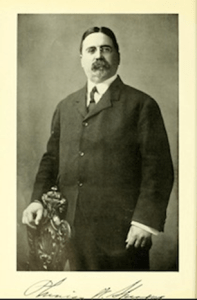
Charles’ son and Malden native Phineas Warren Sprague (1860-1943) had been a partner of what had become C.H. Sprague & Son, and after his father’s death he assumed full control of the business. The company would later expand into oil and be renamed Sprague Energy. In 1942, the U.S. Government selected Sprague Energy to manage its wartime coal shipment program.
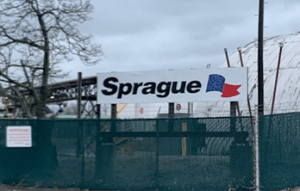
Sprague Energy, Quincy, Mass.

Charles’ grandson, Phineas Sprague Jr. (1901-1977) joined company management after World War II service in the Navy, from which he retired as a Lieutenant Commander. While the family sold its remaining interests in the company in 1970, the Sprague Energy brand is still in use, and has expanded into natural gas—including here on the South Shore, where the Sprague Energy brand is emblazoned at an oil terminal on Southern Artery along the Town River in Quincy, MA.

Frank Julian Sprague (1857-1934), another descendant from Ralph’s son John, was born in Milford, CT., was raised in North Adams, MA by an aunt and other relatives after his mother’s death when he was 9 years old. As a boy, Sprague became fascinated by the textile mills and related manufacturing operations in North Adams. He did quite well in school and went on to Annapolis where he studied electrical engineering. He worked briefly with Thomas Edison, but his major contributions came after he began working on his own inventions, for the electric motor, electric railways and electric elevators. His patented inventions made the electric streetcar a reliable means of transit for emerging “streetcar suburbs.” I enjoyed reading the biography: Frank Julian Sprague, by William D. Middleton, MD., published by Indiana University Press in 2009 (cover shown here), which chronicles his life as well as his many inventions.
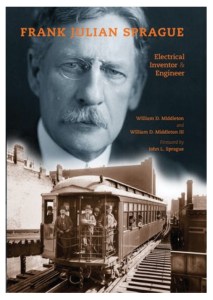
Frank lived with his family in New York City for much of his life. As a graduate of the Naval Academy and former Naval Officer, Frank was buried at Arlington National Cemetery.

Robert (1900-1991) and Julian (1903-1960) Sprague, sons of Frank Julian Sprague, became the co-founders, in 1926, of one of the largest electric components companies of its time. The Sprague Specialties Company, founded by the brothers in Quincy, MA, moved to North Adams, MA in 1930.  They chose North Adams due to their father’s fondness for his boyhood there. In 1942 the company changed its name to the Sprague Electric Company.

The company expanded in 1942—buying the factory buildings that previously housed the Arnold Print Works textile firm. The 16 acres of grounds on the Hoosic River in North Adams, Massachusetts, encompass a vast complex of 19th-century mill buildings and occupy nearly one-third of the city’s downtown business district. This was the home of Sprague Electric Company until 1985. At its peak, Sprague Electric was one of the largest electronic component manufacturers in the world.

John Louis Sprague, Sr. (1930-2021), Robert’s son, would be the last Sprague to head the Sprague Electric Company.  John Sprague was a chemist who joined the company soon after completing his PhD at Stanford in the late 1950s. He would spend 11 years as president of Sprague Electric. John’s son, John Sprague Jr., wrote a blog, available at www.spraguelegacy.com about his dad’s role with the company. The website also chronicles the history of the Sprague Electric Company.

The Sprague Electric Company was sold in 1976. John Sprague was still president (under the new ownership) in 1984 and 1985 when company owner Penn Central moved the company’s international headquarters from the Berkshires to Lexington and eliminated 700 Sprague jobs in North Adams.  That move, the Berkshire Eagle later reported, “left a legacy of bitterness in the city,” even though Sprague didn’t completely leave North Adams until the early 1990s.

Innovation and the Arts
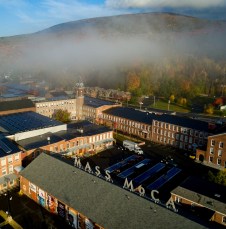
(Photo courtesy of MassMoCA.org)

Given the history of this family in both the arts and sciences, it seems so appropriate that what was the Sprague factory complex in North Adams has become Mass MOCA—an art museum, known for its embrace of innovation across the visual arts and, in more recent history, performing arts as well.

After years of planning, fund-raising and some additional construction on the former factory site, MASS MoCA celebrated its opening in 1999, as the center’s website says: “marking the site’s launch into its third century of production, and the continuation of a long history of innovation and experimentation.”

That “long history of innovation and experimentation” certainly applies to the contributions over generations of the creative Sprague family as well. Perhaps both nature and nurture played a role. An impressive legacy.

SOURCES not otherwise referenced:

Portraits of John, Charles H., and Phineas W. Sprague from Historic Homes and Places and Genealogical and Personal Memoirs Relation to the Families of Middlesex County, Massachusetts, vol. III (Cutter, ed., 1908)

Obituaries of Charles H. Sprague published in the Boston Daily Globe, July 1, 1904; and the Springfield Republican (Massachusetts) June 30, 1904.

The History of Malden, Massachusetts 1633-1785

Malden Past and Present: 1649-1899, pub. May, 1899.

The website www.spragueenergy.com

Special thanks to my friend Paula Bagger who provided many of the images of items from the Hingham Historical Society archives–for part 2 of this blog in particular.

                                                                                                           ################
Nature vs. Nurture: Consider the Spragues, Part 2

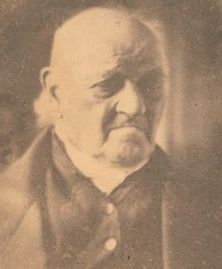
A rare photo of a Revolutionary War veteran [courtesy of findagrave.com]

William Sprague’s line of the family achieved prominence in the arts—from botanical illustration to poetry.

In this “Rev 250” period of commemoration of the War for Independence, I need to first mention that William’s great-great grandson, Samuel Sprague, born in Hingham in 1753, was a Revolutionary War Patriot who also participated in the Boston Tea Party, as discussed in a 2020 post on this blog.  Samuel’s pension states that he crossed the Delaware with George Washington!  (That tidbit is courtesy of the recently published book, Revolutionary War Patriots of Hingham, Ellen Stine Miller & Susan Garrett Wetzel, 2024, copies of which are available from the Hingham Historical Society.

Portrait of Charles Sprague, the “Banker Poet,” by Matthew Sprague (Hingham Historical Society)

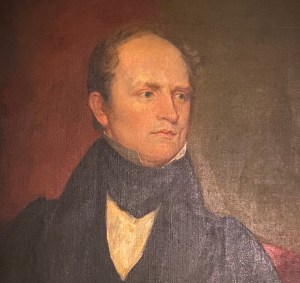
Charles Sprague (1791-1875) —Samuel’s son, Charles, was born in Boston, where his father Samuel earlier had relocated as an apprentice mason.  Charles had success both in the banking business and as a poet and became well known as the “Banker Poet of Boston.” He is considered one of America’s earliest native-born poets. Some of his poems suggest an affinity for transcendentalism, a movement associated with Charles’ contemporaries Ralph Waldo Emerson, Henry David Thoreau, and Margaret Fuller, all of Massachusetts. One example of Charles’ poetry can be read here.

This portrait of Charles hangs in the hallway of the Hingham Historical Society’s General Benjamin Lincoln House (Charles’ granddaughter Helen Amelia Sprague married Lauriston Scaife, a Lincoln descendant).  A modern notation on the back of the canvas attributes the painting to “Matthew Sprague”–another talented Sprague?

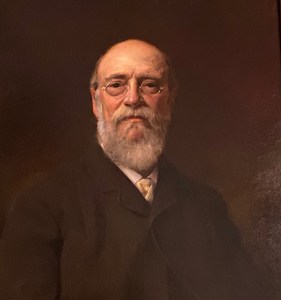
Charles James Sprague (1823-1903), like his father, was a banker and a poet but he left his mark in the field of botany.  His portrait,  looking very much like a respectable banker, also hangs in the Benjamin Lincoln House.  It was painted by his nephew, Charles Sprague Pearce, a well-known painter of the 19th century.

Portrait of Charles James Sprague by Charles Sprague Pearce (Hingham Historical Society)

Charles James Sprague was known for his study and illustrations of lichens. More info about the Sprague Herbarium of Fungi can be found here.

Based on his scientific and literary contributions, Charles James Sprague was elected to the American Academy of Arts and Sciences in 1856.

Hosea Sprague (1779-1843) — A grandson of Isaac Sprague, Sr. (1709-1789) another Revolutionary War Patriot of Hingham, Hosea first trained as a printer in Boston. He then returned to Hingham where he worked as a bookseller and became known as a wood engraver.

A few of his engravings from the Hingham Historical Society archives are shown here.

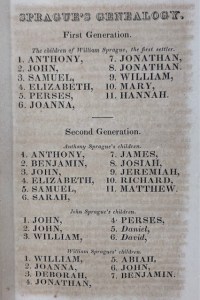
Hosea also was the compiler of The Genealogy of the Spragues in Hingham, published in 1828, an excerpt from which is show here.    The Hingham Library also has an original edition in its Sprague family archive. This genealogy is notable as it was published well-before the popularity of genealogies in the late 19th/early 20th century, following the 1876 U.S. centennial and the 1890 launch of the Daughters of the American Revolution, when charting colonial ancestry became quite popular.

In the 1840s, Hosea published several issues of a periodical of his observations about life, history, and weather: “Hosea Sprague’s Chronicle.” In an October 18, 1888, feature story, published in the Hingham Journal, Hingham’s Luther Stephenson (a Civil War general, who had both maternal and paternal Sprague grandmothers) wrote about his cousin Hosea:  “He had great respect for the first settlers of Hingham, and spent much time in deciphering and copying in his bold hand the early records of the town…”

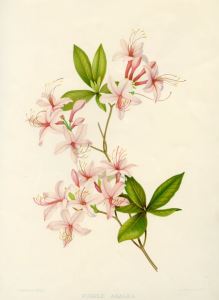
Isaac Sprague (1811-1895)—A great grandson of Isaac the Revolutionary War Patriot, Isaac was born in Hingham. He became an Artist Assistant to the well-known illustrator John James Audubon, joining Audubon’s expedition to Montana in 1843. Isaac then began his successful career in Cambridge as a botanical illustrator, working with influential botanist Asa Gray and others. In recognition of Isaac’s Hingham roots, the Hingham Heritage Museum treasures its collection of several of Isaac’s beautiful artworks and the Society sponsored an exhibit of his work in 2016.

Here are some of the prints in our collection:

Isaac’s work has been the subject of two posts on this blog, —in 2016 and 2017:

In addition to poets and artists, the William Sprague line includes skilled craftsmen known as coopers—artisans in woodenware-making including boxes, buckets, and wooden toys, during the long period when Hingham was known to many as “Bucket Town.” This history is documented and beautifully illustrated in the book Bucket Town, Woodenware and Wooden Toys of Hingham, Massachusetts, 1635-1945, written by Derin T. Bray and published by the town’s Hingham Historic Commission in 2014.

In 2014-15, Old Sturbridge Village featured an exhibit titled “Bucket Town: Four Centuries of Toy-Making and Coopering in Hingham.” The Hingham Heritage Museum’s inaugural exhibition in 2017 was Boxes, Buckets, and Toys: the Craftsmen of Hingham.”

Among the Hingham Sprague family members who were coopers/ woodenware makers are:

  • Isaac Sprague, Sr. (1709-1789), the Revolutionary War Patriot, by trade a set-work (or bucket/barrel making) cooper; his son Isaac (1743-1800) also a set-work cooper; and Isaac Sprague, Jr.’s sons Peter (1773-1859) and Isaac (1782-1826) both of whom were box coopers. Peter’s son, Peter (1801-1868) also worked as a box cooper.
  • Amos Sprague (1747-1838) a box cooper; and his son Amos (1774-1830) also a box cooper.
  • Blossom Sprague (1784-1860), a carriage painter who was also an award-winning maker of wooden toys.
  • Reuben Sprague (1785-1852), whose son Reuben O. Sprague (1811-1898) used his woodworking skills as a stair builder with a shop in Boston.
  • Adna Sprague (1790-1860) a box cooper who also served in town government as a Selectman.
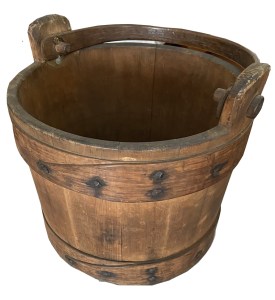
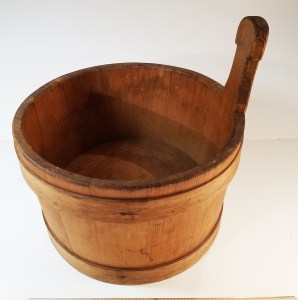
  • Bela Sprague (1804-1878), a brother of engraver Hosea, a “white cooper,” or maker of buckets, pails, and other household containers. Bela’s work is featured in the Bucket Town book. We have some examples of Bela’s work in our Hingham Historical Society collection, including this bail-handled pail and a small pail with a handle, known as a “piggin.”
  • Samuel Sprague (1809-1882), cooper, whose son Samuel (1833-1900) was a stair builder; and
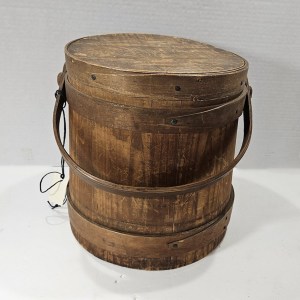
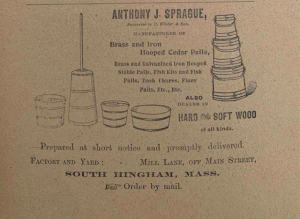
  • Anthony J. Sprague (1855-1921), who ran the ad shown here for his woodenware business in the 1894 Hingham-Hull Directory. One of Anthony J. Sprague’s buckets is this firkin from the Historical Society’s collection.

Women of the 18th-mid 20th century were generally less recognized for their contributions to the arts, but we are fortunate to have examples of the illustrations of Lydia Sprague (1832-1907), a cousin of Isaac, and a daughter of box cooper Adna Sprague. Several examples of Lydia’s artistry are included in Joan Brancale’s two-part post on our blog from 2014:

Also in our collection are some wonderful samplers by Sprague women – created when they were in school.

  • First, this sampler where nature and a structure (perhaps Derby Academy) are prominently featured, embroidered by Mary Sprague (1804-1871.) Mary was a daughter of Peter Sprague and Mary Whiton. She married Elijah Burr in 1828.
  • Next, a genealogical sampler, which tells us in embroidery that the creator is a then 8-year-old Jane Sprague, who stitched it on May 1, 1820. As spelled out in stitches, Jane is a daughter of David Sprague and Mary Leavitt Gardner. Jane (1811-1878) married Thomas Cushing in 1836.

Before concluding this short visit with members of the William Sprague family line, a note about descendants who are an important part of the history of Rhode Island. William’s son William, born in Hingham in 1650, moved to Rhode Island around 1710. His grandson William, born in Cranston in 1795, started
a grist and sawmill in Cranston along the Pocasset River. The next generation built on that foundation, and much wealth was created in the process due to the success of A & W Sprague, which grew to become, for a time, the largest cotton textile manufacturer in the country. Their business success made members of this line quite wealthy and propelled some of the family into politics: two became Governors of Rhode Island in the 19th century. One of these, another William, born in 1830, also became a US Senator, and built an enormous estate in Narragansett, RI in the 1860s, named Canonchet.

Part 3 of this blog will focus on the descendants of Raph Sprague, older brother of Charlestown and Hingham settler William, — and this line’s lasting contributions to science, technology and related businesses.

Nature vs. Nurture: Consider the Spragues

While doing research for the Hingham Historical Society’s 2023-24 lecture series, Suburbia: The American Dream, I learned of the important contribution of late 19th/early 20th century electrical engineer and inventor Frank Julian Sprague to the electric streetcar—an engine critical to early suburban development in the U.S.  The name Sprague caught my attention.

In his landmark book, Crabgrass Frontier: The Suburbanization of the United States, Kenneth Jackson pointed to the importance of the contributions of Franklin Julian Sprague:

By the turn of the century, half the streetcar systems in the United States were equipped by Sprague, and 90 percent were using his patents.

The Brothers Ralph and William Sprague (Hingham Historical Society archives)

Could this engineer and inventor, born in Connecticut and for most of his life a New Yorker, be part of the same family that produced the 19th century botanical illustrator Isaac Sprague and other notable Sprague family members here in Hingham? I needed to know more.

What my research revealed was a fascinating multi-generational story of an innovative, creative family. I was struck by the significant contributions made to both the arts and sciences by the descendants of the two-family lines–those of Ralph and William Sprague–that began with brothers who were among the original settlers of Charlestown in the Massachusetts Bay Colony. The impressive examples of creativity and innovation in these two Sprague lines got me thinking about the influences of both nature and nurture, as well as the close relationship between the creative arts and scientific inquiry and invention. Perhaps the story of this family will get you pondering too.

The Story Begins Along the Wey River in England

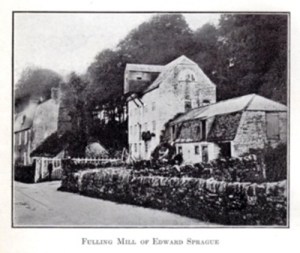
Brothers Ralph (1599-1650), Richard (1605-1668) and William Sprague (1609-1675), were sons of Edward Sprague (1576-1614), who operated a fulling mill on the river Wey, in Upwey, located between Dorchester and Weymouth, in the county of Dorset, England. (Edward’s mill, shown here, no longer exists.) After their father’s death, the three brothers joined a party of colonists emigrating for the Mass Bay Company to settle what became Charlestown, Massachusetts. It is unclear if religion was part of the Sprague brothers’ motivation to leave England. They arrived in Salem in 1628, then soon traveled on to Charlestown.
Fulling mills (“fulling” is part of the cleansing and thickening process when making cloth from sheep’s wool) were also common in the New England colonies, and there were three fulling mills in Hingham in 17th and 18th centuries: one on Crooked Meadow River in South Hingham, at what became known as Fulling Mill Pond; one off South Pleasant Street (near present-day Fulling Mill Road); and one at what was known as Beechwoods River or Mill River, flowing northeast from Accord Pond. As detailed in the 1893 History of the Town of Hingham, Massachusetts, these mills were operated by the Jacob and Cushing families, closely aligned through marriage.

Ralph Sprague emigrated, at 25, with his wife, Joanne Warren, and 4-year-old son John. He had trained as a fuller with his father in England, but apparently took up farming here. He also became a Selectman of Charlestown in 1637 and was elected Representative that same year, serving in both positions for several years. (Source: The History of Charlestown.) Just before Ralph died in 1650, he joined with others to petition successfully with for their own lands on the Mystic River side of Charlestown, later to  be known as Malden.  Ralph and his wife had several children. For generations, Ralph’s descendants lived in and around Charlestown and Malden.

The Spragues of Malden, Massachusetts (Hingham Historical Society archives)

In the early 20th century, two books, both focused on documenting the genealogy, were written about Ralph Sprague’s family line:

  • The Ralph Sprague Genealogy, written by descendant Edward George Sprague and published in 1913, covered 10 generations who had lived by that time.
  • The Spragues of Malden, written by the then-Secretary of the Malden Historical Society, George Walter Chamberlain, M.S., in 1928. A copy of this book, originally “printed for private circulation only” is in the collection of the Hingham Historical Society.

Richard Sprague, 23 at the time they left England, married in Charlestown in 1632. Richard became a merchant and owned a considerable amount of farmland and salt marsh and had shares in a couple of ships. He was a founding member of the church in Charlestown and a Selectman, Overseer of Highways, and Captain of the Military (local militia then.) Richard and his wife Mary Sharp had no children.

William Sprague, just 19 when he emigrated, married in 1635, while still in Charlestown, and moved to Hingham with his wife Millicent Eames 1636.  There they joined others from England who were just one year into founding a town here. William and Millicent would have 11 children, 8 of whom would survive into adulthood. Some descendants stayed in Hingham for generations.

Genealogy of the Spragues in Hingham (Hingham Historical Society archives)

The book Sprague Families in America, written by descendant Warren Vincent Sprague, M.D., and published in 1913, includes a section on the genealogy of William Sprague and his descendants up to that time. The author credits The Ralph Sprague Genealogy, published the same year, for providing valuable family data; he apparently had not seen the earlier Genealogy of Spragues in Hingham, published in 1828 by Hingham’s Hosea Sprague (1779-1843), about whom you’ll learn more in the next part of this blog.

The connection between colonists in Charlestown and the early settlers of Hingham was established at the time of the town’s founding. In the 1827 History of the Town of Hingham, Plymouth County, Massachusetts, author Solomon Lincoln, after listing inhabitants who started to arrive in Hingham as early as 1633, noted:

. . . The others settled at Charlestown, and in 1635 removed to this place. . . .  It was in June of that year that Rev. Peter Hobart arrived at Charlestown, and soon after settled in this place.

. . . In 1636, [there arrived] John Beal, senior, Anthony Eames, Thomas Hammond, Joseph Hull, Richard Jones, Nicholas Lobdin, Richard Langer, John Leavitt, Thomas Lincoln, Jr., miller, Thomas Lincoln, cooper, Adam Mott, Thomas Minard, John Parker, George Russell, William Sprague, George Strange, Thomas Underwood, Samuel Ward, Ralph Woodward, John Winchester, William Walker.

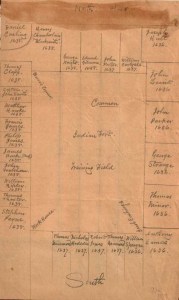
Division of Land Plots to Early Settlers (Hingham Public Library History Collection)

The Anthony Eames in this latter group was the father of William Sprague’s wife Millicent, and they would soon be granted adjacent parcels of land for their homes—as shown in the lower right corner of this 19th century plot chart created by local historian George Lincoln in his “Sketch of the Division of Land Plots to the Early Settlers of Hingham.”

From Ralph Sprague, of Charlestown and Malden, and William Sprague, of Charlestown and Hingham, descended a remarkably talented collection of 18th, 19th and 20th scientists/inventors/industrial innovators and artists/poets/craftsmen. The family lines have distinctions—with Ralph’s line most prominent as scientists and inventors while Wiliam’s descendants stand out as artists and poets and craftsmen.

Part 2 of this blog will focus on William’s line—and its noteworthy creators:  poets, a maker of woodcut engravings, a botanical illustrator, several woodenware craftsmen and more.  

Memorial Day in Hingham

Memorial Day arose in the aftermath of the Civil War, to honor the Union war dead.  It was frequently called “Decoration Day” because flowers were laid at the graves of those who had died for the Union cause.  The Grand Army of the Republic (GAR), an organization of Union veterans which at its height had nearly half a million members, was influential in establishing one specific day—May 30—for commemoration of the North’s Civil War dead.  It is said that this day was selected because the flowers for decorating graves would by then be blooming throughout the country.  By the 1890s, all of the northern states observed Memorial Day each year on May 30.  (The states of the former Confederacy commemorated their war dead on a different date.)

In 1870, Hingham held an elaborate day of remembrance on June 17—the day the Town dedicated a monument to the memory of its Civil War dead. A thirty-foot obelisk of Quincy granite, the Soldiers and Sailors Monument stands on a hilltop in the center of Hingham Cemetery.  It bears the names of 74 Hingham men who lost their lives in the war.  Before the trees filled in, its site offered commanding views of the Harbor, World’s End, and Harbor islands, as can be seen from the early photograph and contemporaneous engraving above.

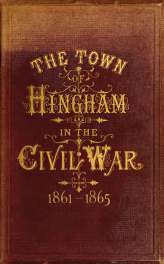
The details of the ceremony can be found in The Town of Hingham In the Late Civil War, by Fearing Burr, Jr., and George Lincoln, published in 1876.  A “procession” during the dedication ceremonies was elaborate and inclusive.  It was led by the Hingham police, two regiments of the state militia, the Weymouth Brass Band, and a drum corps.  There followed three “divisions,” each of which followed a different route through town, first to Agricultural Hall to hear an oration by local luminary Solomon Lincoln (1804-1881), and from there to the cemetery.  The procession included politicians, clergy, business leaders, schoolchildren, veterans, fraternal societies, police, firefighters, three brass bands, “citizens on foot,” “citizens in carriages,” and, poignantly, “orphans of deceased soldiers.

Solomon Lincoln was a well-known lawyer, Hingham’s representative in the General Court, and the author of Hingham’s first town history, published in 1827.  Lincoln opened his speech acknowledging that “[w]e have assembled to-day with mingled emotions of sorrow and joy—sorrow for the patriot dead who gave their lives to their country, and joy in the triumph of the cause for which they fought.”  Continuing with this theme, Lincoln added up the estimated 300,000 Union dead, 300,000 Confederate dead, and 400,000 “crippled or permanently disabled” to conclude that the war had a devastating personal impact on 1 million young men.  But, he noted:

notwithstanding these painful facts, carrying sorrow and calamity into so many families, and cutting down the flower of the young men of the land, we are permitted to rejoice in the success of the great struggle for which they gave their lives to their country. In the providence of God, the great cause of the rebellion was irrevocably removed, and every inhabitant of the land thus redeemed can enjoy the pure air of freedom. Our martyred president seemed to have been an instrument in the hands of the Almighty to purify this nation, and by his emancipation proclamation to breathe into it the breath of life, and to stamp his own with immortality.

Ever the local historian, Lincoln noted that he was speaking on the 95th anniversary of the Battle of Bunker Hill and evoked Hingham’s role in prior wars:

I have said that this is a historic day. The erection of the Monument to the memory of our soldiers and sailors in the place where it stands, has an appropriateness which harmonizes well with our local historical associations. It stands amid the graves of our ancestors, the first settlers of the Town, whose valor was displayed at an early date in our history, in defending our infant settlement from hostile attacks. The men who, in Provincial times, united with the forces of the mother country to repel the incursions of the French, repose almost beneath its shadow. The heroes and patriots of the Revolution, in considerable numbers, found their final resting-place within its limits. That distinguished general whose name is conspicuous in our annals, and who merited and enjoyed the confidence of Washington, rests in this consecrated ground. . . .  There, also, are the graves of many who bore arms in the war of 1812, by some called our second war of Independence.

Lincoln’s speech provides a hint that Hingham observed some form of Decoration or Memorial Day as early as 1870. When speaking of the Civil War graves near the new monument, he mentions that it has been “[b]ut a few days since the beautiful service was performed of decorating their burial places with flowers.”


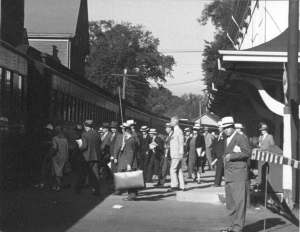
No matter when Hingham started observing Memorial day, its services, speeches, and parades were well-established by the early 1900s, when we start to see photographic evidence.  The Hingham Journal described the events of Memorial Day 1918, occurring as it did while the United States was at war—World War I would not end until six months later, in November 1918.

MEMORIAL DAY, 1918, passed down into history as one of deep significance. Everything seemed permeated with a deeper feeling than usual. The speeches, the parade, the prayers, were all filled with things reminding us of the great world conflict. The courtesy shown by Commander Wallace in sending a detachment of Marines, and of Captain Edgar in sending a platoon of blue jackets, was appreciated, and helped to make the parade a success. It was the largest and best parade seen in the town for many years.

One of the “blue jackets” was Howard Henderson (1895-1982), a young man from Hingham who graduated college in 1917 and enlisted in the United States Naval Reserves.  Henderson exhaustively documented his life and his town in a series of photograph albums digitized and donated to the Society in 1996.  These albums include pictures of the 1912 Hingham Memorial Day Parade (above) as well as the 1918 parade, in which he marched with his unit.

World War I (with 116,000 soldier deaths) changed Memorial Day from a commemoration of the Union dead to a remembrance of all those who died in the military service of the United States.  This in turn transformed it into a holiday that was national in its appeal. In 1967, an Act of Congress made “Memorial Day” a federal holiday which one year later, in 1968, was moved from May 30 to the last Monday in May.


Hingham continues to observe Memorial Day every year and the 2022 ceremony will be held at Hingham Town Hall, starting at 11am.

To My Children

After recuperating from a wound suffered during the Saratoga Campaign at his home in Hingham, Massachusetts, Major General  Benjamin Lincoln of the Continental Army was well enough to rejoin George Washington in New York in early August 1778.  Although he did not yet know it, he would be given the command of the Southern Division of the Continental Army in September 1778.  He would not be home again for any period of time for five years.
When General Lincoln left Hingham, his wife Mary was recovering from smallpox.  His eldest son, Benjamin, Jr., was 22 and away from home, studying the law.  Six children were at home:  Molly, 20; Elizabeth, 19; Sarah, 17; Theodore, 15; Martin, 9; and Hannah, 5.  Molly, the oldest daughter, who is referenced in this letter, was intellectually disabled and lived with her parents throughout her adult life.

On July 28, 1778, en route to New York, the General penned this letter to his children:

My Children:

The ill health of some of you, joined to my great hurry, prevented my making some general observations to you relative to your future conduct before I left home—some of which are of the greatest importance.

In the first place you will never forget your God—the duty you owe to him as your creator, preserver and best benefactor.   The duty you owe to your neighbor and to your selves you will learn from divine revelation, which you will attentively study, and the example of our dear redeemer.

I must mention to you the peculiar state of your mother whose cares and burdens are greatly increased by my absence. I need not urge; I am sure your own feelings will always suggest to you the propriety of your lessening her cares, lightening her burden, and treating her with every mark of tenderness, duty. and respect.  Never wound her by doing a wrong action. You may safely confide in her advice.

I must in the next place recommend to your constant notice your sister Molly. Consider who made you to differ.  You owe her every attention.  Make her life as happy as in your power. Some are made strong to bear the infirmities of the weak.

You will love each other.  Those of you who are grown up will counsel those who are not. Never set an ill example before the little ones.  Encourage them to every act of goodness, charity, and benevolence by precept and example.

As our happiness is connected with the happiness of those about you, always watch over yourselves; let your deportment at all times be such, if possible, that even the malicious shall be constrained to acknowledge its fitness.

I am in haste, must close ,but cannot do it without saying again remember your God, love your fellow creatures, injure no person.

I am, with every wish for your present and future happiness, your affectionate father,

B. Lincoln


Three Herrings and a Pung Ride

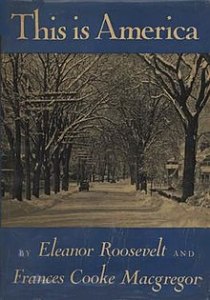
When settlers first arrived in New England they had a lot to learn.  One of the first things was how to grow corn.  Native Americans taught the new settlers how to fertilize soil for the corn with “three herrings to a hill,” as Eleanor Roosevelt tells us in This is America, the 1942 photodocumentary she wrote with Hingham resident Frances Cooke Macgregor.

Mrs. Roosevelt and Mrs. Macgregor worked together on the book at the suggestion of the publisher, G.P. Putnam Sons of New York.   The text was written by Mrs. Roosevelt and the photographs were taken by Mrs. Macgregor.  In January 1942 Eleanor came to Hingham to meet with Mrs MacGregor at her Stoddard Street home.  Frances Cooke Macgregor was a published author and photographer.  She had already taken many photographs for the book and she and Eleanor together decided upon those they both felt would be most effective.  The United States had just entered the Second World War and their hope was to produce a book that showed life in small town America and to help Americans understand what it was they were fighting for.

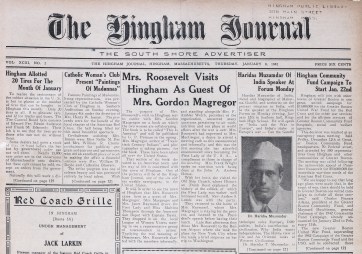
While in Hingham, according to an account of her visit in the Hingham Journal of January 8th 1942, Mrs. Roosevelt dropped in on a League of Women Voters meeting, chatting informally with members and answering their many questions at this time of uncertainty in the country.  The First Lady found Hingham’s architecture, a mix of old colonial mansions, gingerbread Victorians, and charming Cape Cod cottages, to be delightful and much copied in other parts of the country.  She is reputed to have described Hingham Main Street as the most beautiful Main Street in America.

When Mrs. Roosevelt saw Hingham, she felt she had found “a picture in miniature of the whole nation.”  One purpose of the book was to affirm what it meant to be an American, regardless of ethnicity, and Eleanor was thrilled to discover that the Hingham High School football squad that year had players whose families had come from eight different parts of the world and that Hingham was home to Dutch and Polish farmers, Italian shoe makers, and a German harness maker, amongst many others. In 1942 Hingham had a population of 8,000.  It still had 50 farms—but it also had a commuter train., and much of its population now travelled to work in Boston.  There were, of course, schools, churches of all kinds, and a public library with 28,000 volumes.  The Loring Hall movie theater would be showing Citizen Kane the following week.
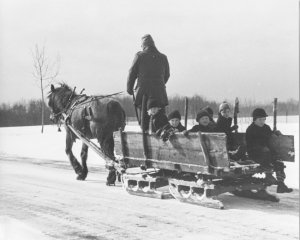
Children played outside in the still plentiful open spaces.  A favorite winter activity was known here as pung-riding, a term unknown in most of the rest of the country.  A pung was a low box sleigh drawn by a horse. Often hay would be placed inside and the children would snuggle down to enjoy the ride.  The more adventurous would ride on the runners, jumping off one pung and onto another while both were gliding swiftly over the snow.

With Mrs. Roosevelt’s words and Mrs. Macgregor’s photographs, the women wanted to portray American ideals.  They hoped that all across the country ordinary people would recognize themselves in the descriptions of Hingham and its citizens and understand that their values and aspirations were also true of them.

A collection of Frances Cooke Macgregor’s photographs of Hingham—which she personally selected and gave to the Historical Society in the early 1990s—are currently on display at the Hingham Heritage Museum. A presentation of “Tea With Eleanor’ with the actress Sheryl Faye in the persona of Eleanor Roosevelt will take place at Hingham Heritage Museum on Saturday, November 16th at 3:00 pm.  Please click here to purchase tickets on-line or buy in advance at the Hingham Heritage Museum:  seating is limited.  We hope you’ll take advantage of the both of these opportunities to learn more about these remarkable women and their connection to Hingham.

The Lincoln Chair Returns

IMG_4895

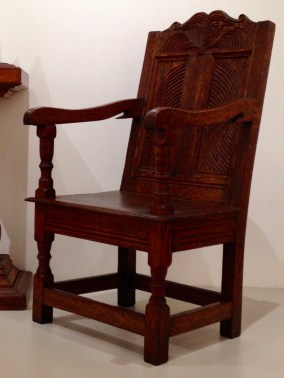
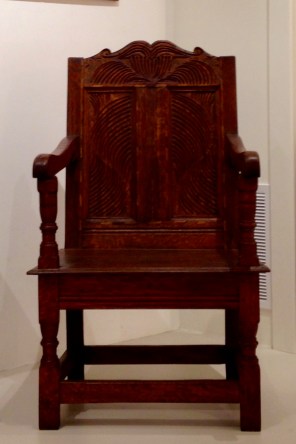
The “Lincoln Chair” has returned to Hingham after a sojourn in the Arts of the Americas wing of the Museum of Fine Arts, Boston.

Tradition holds that this joined armchair, made of red oak with walnut inlays, belonged to Thomas Lincoln “the cooper,” one of Hingham’s original settlers. It was long thought to have been constructed in England, but microanalysis of the wood in the early 2000s revealed that the chair was made in North America. This information makes the chair even more of a rarity than formerly believed, as only about two dozen examples of 17th century New England joined chairs exist.

Of a type often called a “wainscot” chair, the Lincoln Chair has a plank seat and carved panel back. The series of elongated S- and reverse S-curves are thought to have been inspired by classical design.

The chair descended in the Lincoln family until 1914. In 1908, as the Town’s 275thanniversary approached, a national campaign was launched to raise funds for a bell tower in memory of Hingham’s first settlers. When the Memorial Bell Tower was dedicated in November 1912, an interior chamber, the “Peter Hobart Room,” was created and furnished with furniture and artifacts from mid-17thcentury England. Hingham’s Lincoln family donated the chair to the Memorial Bell Tower to furnish the Peter Hobart Room.

IMG_4897 (1)The chair was moved into Old Ship Church in 1933 and remained there until 2008, when it was loaned to the Museum of Fine Arts for display with other First Period furniture.

But now, the Lincoln Chair has returned home to Hingham. We are grateful to the Town of Hingham and Hingham’s First Parish for their stewardship of the chair over many years and for their decision to loan the Chair to the Society for display at the Hingham Heritage Museum.

Hingham Bird Carving Artistry: Duck and Shore Bird Decoys and Avian Miniatures

Our “Boxes, Buckets, and Toys” exhibit at the Hingham Heritage Museum has celebrated the craftsmanship of Hingham’s coopers and box and toymakers. Another area in which the woodworkers of Hingham excelled was the carving of duck and shorebird decoys, as well as decorative miniatures.

Picture1

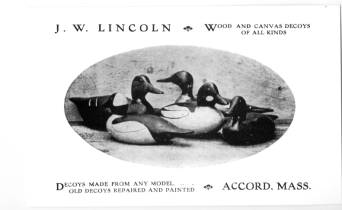
Joseph Lincoln’s trade card

Life-like wooden decoys are used by duck and shorebird hunters to attract live birds: groups or “rigs” of wooden birds are set in or near the water to lure birds flying by to stop and join them.  The coastal areas and freshwater ponds of the South Shore were popular shooting locations for both sportsmen and market gunners and making wooden decoys became a cottage industry at which a few local practitioners excelled.

Picture3

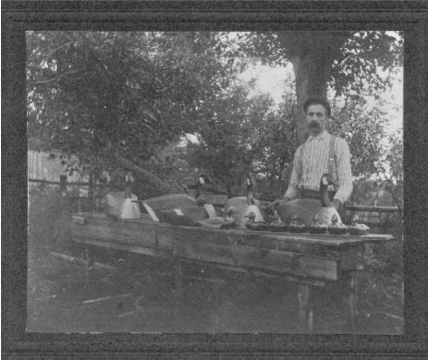
Joseph Lincoln with his decoys

The most famous of our local decoy artists was Joseph Whiting Lincoln (1859–1938), who lived and worked beside Accord Pond on the Hingham-Rockland border.  After working in a shoe factory, Lincoln undertook a variety of occupations before settling into a career as a decoy carver in the 1870s.  In what had been his uncle’s cooperage, Lincoln created decoys that were shipped all over the East Coast and are highly sought after today for their artistry.  This “no nonsense” Yankee  made some miniatures, almost always in decoy style, but generally referred to his miniature carvings as “toys.”

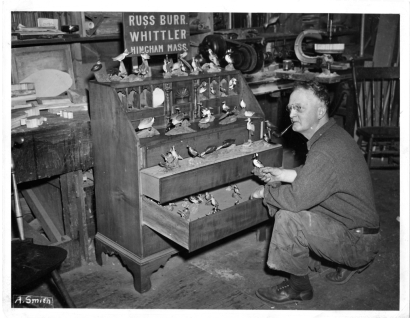
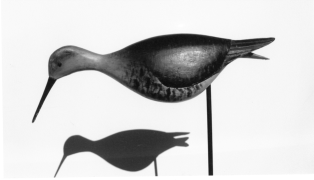
Elisha Burr (1839-1909), a box maker whose Civil War canteens and woodenware are collectibles today, and his son Russ Burr (1887-1955), were also well-known decoy artists.  Like Lincoln’s, their work is highly sought after by collectors today. Russ Burr is also well known for his miniatures, two of which are on display in the Kelly Gallery at the Hingham Heritage Museum.

Picture2

Russell Burr, “whittler,” with some of his miniatures.  Photo courtesy of Bob Mosher

Alston “Shorty” Burr (1910-1979), Russ Burr’s nephew, continued the family carving tradition using his Uncle Russ’ patterns for avian miniatures.  Two of Shorty’s miniatures, similar but cruder than his uncle’s, are also on display in the Kelly Gallery.

Picture4

A Russ Burr shore bird decoy.  Image courtesy of Bob Mosher

There is much to appreciate in these bird carvings, whether considered as hunting tools or one of the few purely American art forms.  According to Bob Mosher, a contemporary Hingham carver and decoy historian, the difference between Lincoln and Burr decoys is instructive.  Lincoln made “working birds”—even his miniatures were made as little decoys, and his work is simple and impressionistic.  Burr’s style, on the other hand, is more detailed and “busy,” creating an “active, alive” carving.

Contemporary carving by Mosher and Hingham carver W.D. Sarni can be viewed and purchased in our Museum Shop on the 1st Floor of Old Derby Academy.


Origins of the Quacum Sisters: Founding Mothers of Wilberforce Colony, Ontario

Marshfield, MA sisters Vilana, Rosana, and Salome Quacum, with their husbands, were founding members of the Wilberforce Colony, established near London, Ontario, in 1829 by and for free African Americans. This fascinating blog post from “Of Graveyards and Things,” reviews history and genealogy–including their Hingham connections James Tuttle and Lucretia Leonard.  Follow the link to read more.

mblauss's avatar

Sisters Vilana, Rosanna, and Salome Quacum were born at the turn of the 19th century on the south shore of Massachusetts, the daughters of a multiracial family with African, Mattakeeset (Massachuset) Indian, and Herring Pond (Wampanoag) Indian heritage. Although they had lived as free New England women, they each married husbands in the 1820s who were fugitive slaves. After spending several years in their hometown of Marshfield, Plymouth County, Massachusetts and Boston, Suffolk County, Massachusetts, each of the married sisters made the decision to leave their extended family behind and become founding members of the Wilberforce Colony in Ontario, on land which was owned and governed by African Americans, and thus offered security to the Quacum sisters’ husbands from American slave catchers, as well as the possibility of living in a more welcoming community with black governance.

The Origins of the Quacum Sisters

Their father Thomas Quacum was a resident…

View original post 2,986 more words

Hingham’s Unbuilt Highways, Part 2

As discussed in our prior post, Hingham’s Unbuilt Highways, Part 1, traffic has been an issue for the Town of Hingham for nearly 100 years.  This has been particularly true for Main Street.  Each time the State proposed a plan to solve the problem, though, concerned citizens have stepped forward to oppose what they saw as a threat to the town’s character.

When Route 128 was extended into Hingham (heading to Nantasket Beach) in the late 1920s,  increased complaints about traffic on Main and East Streets led the State, by the mid-1930’s, to promise a bypass route for traffic relief.  The route that it proposed followed Gardner Street, starting at Whiting Street, crossing Main Street, and eventually turning north through the less developed eastern part of town into Hull. Funding issues stalled any actual construction, however. In 1938, the State offered a “temporary fix,” offering to build a rotary in Hingham Centre at the intersection of Main, Short, and Middle Streets.

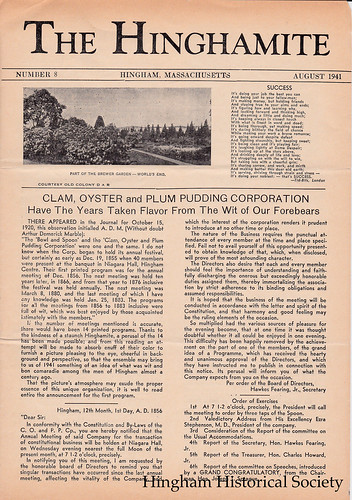
The Hinghamite, August 1941

August 1941 issue of The Hinghamite, a monthly newspaper published by Albert L. Pitcher during the 1940s

As reported in August 1941 issue of The Hinghamite, the rotary plan, which probably would have resulted in several historic buildings being torn down, was halted by the efforts of Mrs. David T. Whiton and Miss Ethel H. Studley, owners of some of potentially effected properties.  They gathered a petition of nearly 250 names and packed a public hearing which convinced the State to back down. The Town did agree to better signage, more traffic islands, and other measures to help ease traffic problems.

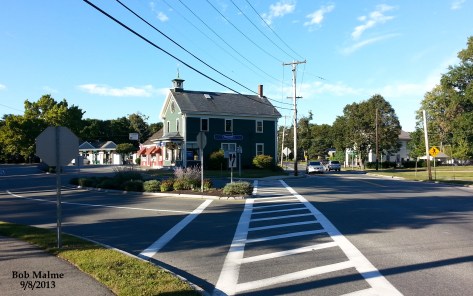
View of Hingham Centre from corner of Main and Short Streets, 9/8/13

Hingham Centre, as seen from the corner of Main and Short Streets in September 2013. Some of these buildings might have been torn down if the State’s rotary proposal had gone forward. Photo by Robert H. Malme

By the 1950’s and the dawn of America’s freeway age, renewed efforts were made to take traffic off Main Street, this time with a proposed relocated Route 128 expressway. Highway surveyors were for time a constant presence in several parts of town.  Leavitt Street resident Carl Burr (whose diary we have blogged about previously) mentioned being visited due to his property being in the potential path of the new highway. By the time the State got serious about the project in the late 1960s, the southern end of Route 128 had been pushed back to Braintree, and the route running through Hingham to Hull was renumbered Rote 228. On February 29, 1968 the State held a public hearing at Hingham High School to describe its proposal for a relocated Route 228:

Proposed Relocation of Route 228 in Hingham-Norwell-Hull

The State’s proposal was an 8-mile, four-lane expressway (250 to 400 feet wide) from Route 3 to George Washington Blvd. in Hull.  According to the State, this would fulfill three specific goals: to stimulate residential development and recreational activities for the towns along its route, to provide traffic relief to local streets, and to provide safety, comfort and reduced travel times to motorists. The State offered three alternatives for this proposed expressway’s route through the southern and middle parts of Hingham.

Proposed Relocation of Route 228 in Hingham, Norwell and Hull

The “Gardner Line” alternative began at an interchange with Route 3 in vicinity of today’s Derby Street Shoppes, taking the route across Whiting Street and south of Gardner Street, across Main Street then turning north in the vicinity of Prospect Street. The two other alternatives, the “Pond Line” and the “Webster Line” started at Route 3 in Norwell and ran north to Prospect Street.  From Prospect Street, all three proposed routes proceeded north along a “Common Line” running parallel to the border of today’s Wompatuck State Park.  North of Free Street (where an interchange was planned), three alternative routes were again proposed north to Hull.  Two of these proposed routes, the “Western” and “West Central” Lines would have required “relocating” Triphammer Pond and the Weir River.  The “Eastern Line” would have run east of Triphammer Pond but would have skirted Turkey Hill.

All three proposed routes intersected with Route 3A (with a large interchange) at between Summer Street and today’s Weir River Farm. Any of the alternatives would have condemned 17 to 26 houses and requiring those living in them to move and would have cost $12 to $15 million (in 1968 dollars).

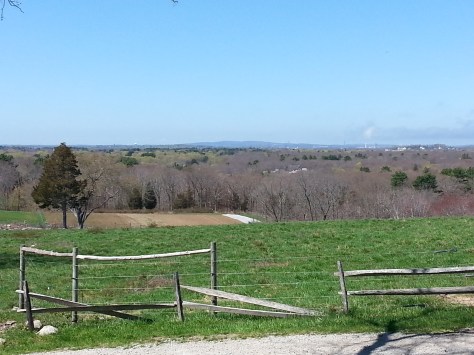
View from Top of Turkey Hill

View from top of Turkey Hill–which would have been much different if the Route 228 expressway had been built.  Photo by Robert H. Malme, May 2015

Many Town officials were receptive to the plan, provided that the State chose one of the Norwell routes. The Selectmen even asked the State to add an interchange at Rockland Street in the event the Eastern Line was chosen. In the spring of 1968, however, Norwell rejected the proposed routes within its borders due to their proximity to the municipal water supply, and the State indicated that the Gardner Line would probably be its recommended southern alternative.

At a Special Town Meeting held on September 30, 1968, Hingham voters rejected the State’s plans by a narrow vote of 559-506.  (A second article, requiring the Selectmen to insist upon the Pond-Common-Eastern Line configuration if the State moved forward with a highway despite the Town’s vote, passed 422-231). Since neither Norwell nor Hingham would approve a southern route through their respective towns, no construction was started. By the early 1970s, with continued opposition and with overall sentiment for expressway-building waning in the metro Boston area waning (a trend exemplified by the cancellation of the Southwest Expressway in Boston), the State abandoned the plan.

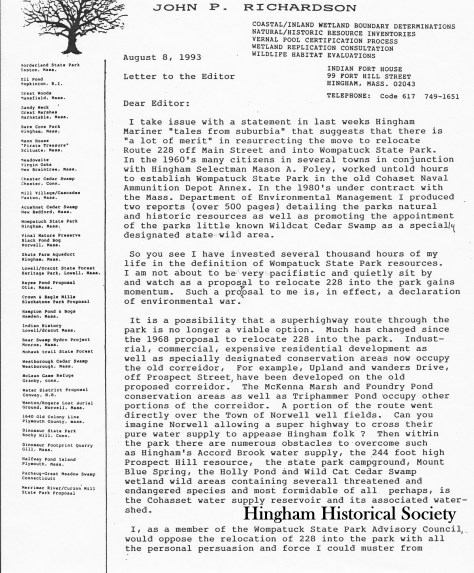
Continued traffic problems on Main Street, however, revived the idea of building a relocated Route 228 in the early 1990s. Several frustrated Main Streets resident asked Selectmen to reconsider the State’s 1960s plan. This time, however, a large majority of town citizens and the town’s officials stood up against this idea. Their sentiments were best summed up in a letter which John P. Richardson wrote to the editor of the Hingham Mariner on August 8, 1993, arguing that any such highway would ruin one of the town’s gems, Wompatuck State Park.

richardsonletter8893

Letter to the Editor of the Hingham Mariner, written by John P Richardson on August 8, 1993.

The idea died quietly and has not been revived. Current sentiment with building new roads to solve traffic problems can best be summed up by the response of the Town Traffic Committee to the complaint of a frustrated Main Street resident, as reported in the July 29, 1993 Hingham Mariner.  When the Main Streeter asked what could be done for relief from the traffic noise, the response was, “Move to Plymouth.”