A Tale of One Family

A Review of Meg Ferris Kenagy’s Book The House on School Street: Eight Generations. Two Hundred and Four Years. One Family.

Not many people can say their family lived in the same house for eight generations, and even fewer strive to uncover the lives of these ancestors. Meg Ferris Kenagy is one of these rare individuals as she dives head first into this challenge and presents her discoveries in her book The House on School Street: Eight Fenerations. Two Hundred and Four years. One Family. Kenagy brings the history of her family’s house to life through numerous stories about her ancestors. We experience their lives and deaths, births and marriages, and the resulting joys and heartaches that accompany each event.
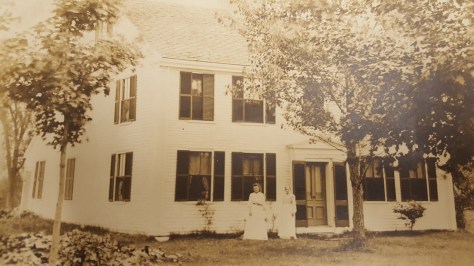
74 School (c) 1890
Martha Sprague Litchfield, left, and Sarah Trowbridge Litchfield. Circa 1890. Photo courtesy of the Hingham Historical Society.

Kenagy’s vivid descriptions of her family, the house, and Hingham make it feel like she is sitting down with us and flipping through pages of a photo album while sharing her family’s story. We see Colonel Charles Cushing building the house in 1785 after fighting in the Revolutionary War, and we watch subsequent generations move into and out of the family home. We learn of the successes and struggles of the family as they find ways to make a living in a changing world. As Kenagy shifts the narrative’s focus to each owner chapter after chapter, she recognizes the unique relationship each family member had with the house on School Street. She successfully sees the house through each of their eyes.

Although Kenagy admits there are gaps in her family’s story that research cannot fill, she does not let this obstacle frustrate her. Instead, Kenagy embraces what she does not know and proposes answers to the questions she cannot answer. By doing so, she becomes more attuned to the motivations, fears, and struggles of her ancestors. When Kenagy does know the answer to certain questions, she occasionally quotes letters and other sources to add another layer to her family’s story.
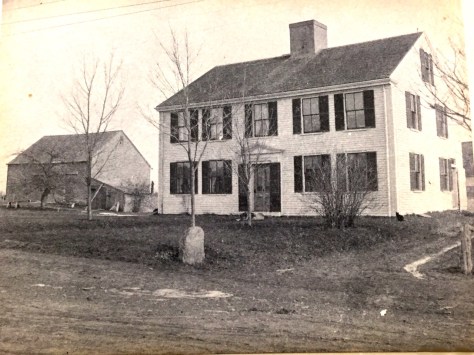
74 School Street 1889.jpeg

A large barn can be seen to the left of the house in this 1889 photo. A carriage house is to the right of the house. Photo courtesy of the Hingham Historical Society.

While this book presents the story about eight generations of a family, it also provides an overview of the history of Hingham. Through Kenagy’s detailed descriptions, we see Hingham’s transformation from a small village to a bustling wartime shipyard. Selected quotes from sources like the History of the Town of Hingham, Massachusetts and the Hingham Journal bring the town’s history to life. By acknowledging the history of the town, we can clearly recognize the family’s influence on Hingham’s community.

You can sense writing this book was a deeply personal experience for Kenagy. Not only does it document how she confirms family stories, but also how she uncovers family secrets. We are excited to learn more about Meg Kenagy’s experience writing this book and researching her family’s history when she comes to the Hingham Heritage Museum at Old Derby for a talk and book signing on Saturday, October 27, 2018 at 3:00pm. Please join us!
Hingham Bird Carving Artistry: Duck and Shore Bird Decoys and Avian Miniatures

Our “Boxes, Buckets, and Toys” exhibit at the Hingham Heritage Museum has celebrated the craftsmanship of Hingham’s coopers and box and toymakers. Another area in which the woodworkers of Hingham excelled was the carving of duck and shorebird decoys, as well as decorative miniatures.

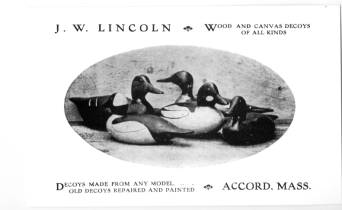
Picture1

Joseph Lincoln’s trade card

Life-like wooden decoys are used by duck and shorebird hunters to attract live birds: groups or “rigs” of wooden birds are set in or near the water to lure birds flying by to stop and join them.  The coastal areas and freshwater ponds of the South Shore were popular shooting locations for both sportsmen and market gunners and making wooden decoys became a cottage industry at which a few local practitioners excelled.

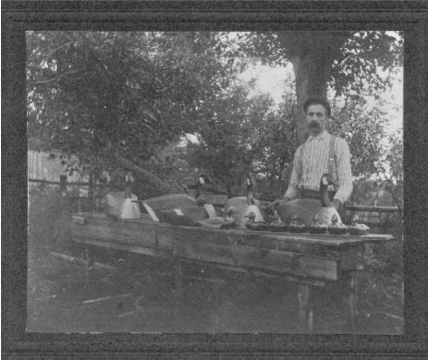
Picture3

Joseph Lincoln with his decoys

The most famous of our local decoy artists was Joseph Whiting Lincoln (1859–1938), who lived and worked beside Accord Pond on the Hingham-Rockland border.  After working in a shoe factory, Lincoln undertook a variety of occupations before settling into a career as a decoy carver in the 1870s.  In what had been his uncle’s cooperage, Lincoln created decoys that were shipped all over the East Coast and are highly sought after today for their artistry.  This “no nonsense” Yankee  made some miniatures, almost always in decoy style, but generally referred to his miniature carvings as “toys.”

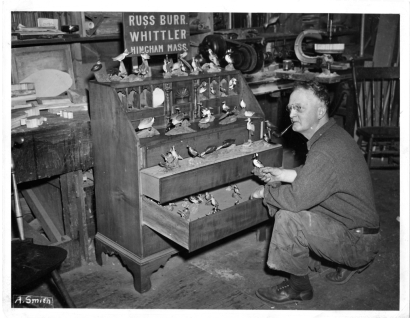
Elisha Burr (1839-1909), a box maker whose Civil War canteens and woodenware are collectibles today, and his son Russ Burr (1887-1955), were also well-known decoy artists.  Like Lincoln’s, their work is highly sought after by collectors today. Russ Burr is also well known for his miniatures, two of which are on display in the Kelly Gallery at the Hingham Heritage Museum.

Picture2

Russell Burr, “whittler,” with some of his miniatures.  Photo courtesy of Bob Mosher

Alston “Shorty” Burr (1910-1979), Russ Burr’s nephew, continued the family carving tradition using his Uncle Russ’ patterns for avian miniatures.  Two of Shorty’s miniatures, similar but cruder than his uncle’s, are also on display in the Kelly Gallery.

Picture4

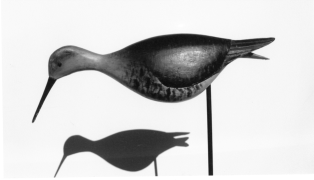
A Russ Burr shore bird decoy.  Image courtesy of Bob Mosher

There is much to appreciate in these bird carvings, whether considered as hunting tools or one of the few purely American art forms.  According to Bob Mosher, a contemporary Hingham carver and decoy historian, the difference between Lincoln and Burr decoys is instructive.  Lincoln made “working birds”—even his miniatures were made as little decoys, and his work is simple and impressionistic.  Burr’s style, on the other hand, is more detailed and “busy,” creating an “active, alive” carving.

Contemporary carving by Mosher and Hingham carver W.D. Sarni can be viewed and purchased in our Museum Shop on the 1st Floor of Old Derby Academy.


The “Precedent” and the Birth of Fire Fighting in Hingham

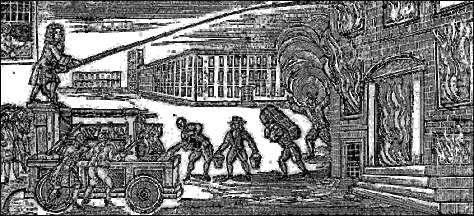
In 1802, the Town of Hingham authorized the construction of firehouses at Little Plain (Hingham Centre) and Broad Bridge (Hingham Square), although the responsibility to acquire the fire engines themselves rested with private citizens—the proprietors of Engine Companies No. 1 and 2.  The “hand tub” engines that they commissioned and paid for were large wooden tubs placed on carts for mobility and filled by hand from the nearest water source. Once the bucket was full, firemen pushed long wooden bars (“brakes”) up and down, setting in motion a piston in the tub that pumped the water out through a hose and nozzle.

hpwood

Francis H. Lincoln wrote in the 1893 History of the Town of Hingham:

If one were to imagine a fire in those days he would see a company of perhaps fifteen men at work upon the brakes and attending to the hose and pipe, while a line of men and women stretched away to the nearest water, which they passed from hand to hand in buckets, emptying it into the tub, passing the empty buckets back by another line to be filled again.

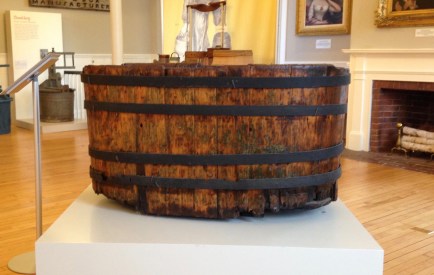
IMG_4495This wooden tub is from the Little Plain Engine, No. 1, nicknamed the “Precedent” because it was the first of what would ultimately be four such engines to be completed.  It was manufactured by local craftsmen: Peter Sprague made the tub from cedar furnished by Thomas Fearing. The ironwork was by the local firm of Stephenson and Thomas.
In 1830, the Town’s first suction apparatus, the “Hingham,” was acquired and “hand tubs” or “bucket tubs” such as the Precedent became obsolete.

The tub was reassembled and stabilized in recent years by Dick Kenney of the Bare Cove Fire Museum. It is currently on display at the Hingham Heritage Museum, on loan from the Bare Cove Fire Museum, 45 Bare Cove Park Drive, Hingham, MA 02043.


Hingham Community Band & “the old-time melodies which everyone loves”

“Sound drums and trumpets!
Farewell sour annoy!
For here, I hope, begins our lasting joy.” – William Shakespeare

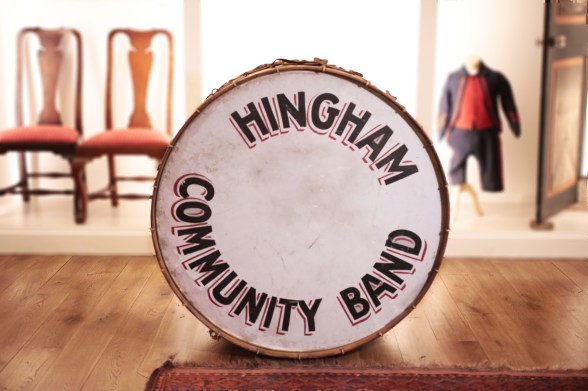
Once a dependable and generous keeper of time, William Goodwin’s bass drum, on display in the Kelly Gallery at Old Derby, is a charming keepsake of Hingham’s lively past. The drum is a sizable and early relic, cased in birchwood, balancing on the rope tension while exhibit lighting illuminates it’s face. The periphery of the double-sided calfskin head, where impressions of countless striking remain, reads “Hingham Community Band”. A uniformed, marching ensemble comprised of traditional woodwind, brass and percussion instrumentation, the Hingham Community Band was organized during the first decade of the 1900s.

It was somewhere between 1920-1930 when William Eleazar Goodwin (1891-1952) was the chief director of the rhythmic beats essential to the collective timbre of the Community Band. Goodwin was born in Foxborough, Massachusetts to Charles, a railroad conductor from Groveland, and Mary Lovett. By age 19 he was living in Dorchester where he married Elizabeth Daly of Boston, daughter of Irish immigrants, in 1915. He later settled with wife and two, school-age daughters, Dorothy and Elizabeth, in West Hingham where he was a meat purveyor in a grocery under his ownership at North and Thaxter Streets.

While the drum is light of weight, it’s bulky volume requires a party of two to maneuver if the player is not sized to carry it comfortably on his chest. Since all the instruments in a marching band are to be played while mobile, the sturdy leather handle on the outer front of the drum’s case would be held by another band member.

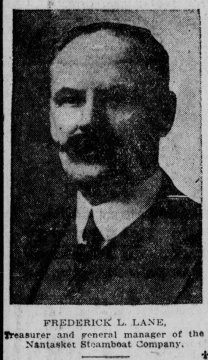
Frederick L. Lane | General Manager of the Nantasket Steamboat Co | Boston Post Sun 26 Jun 1921

Boston Post Sun, 26 Jun 1921

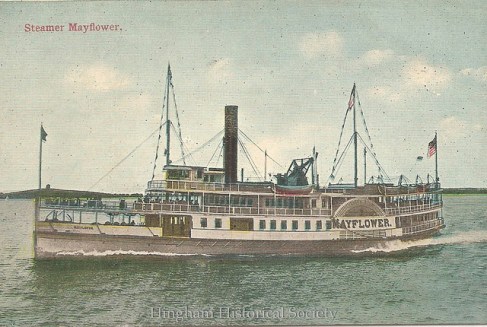
Led by musical director Frederick Leavitt Lane (1872-1943), the band appeared in parades and celebrations, civil and religious ceremonies and played at sporting events including boxing matches throughout Greater Boston and the grand opening of the Boston Garden in 1928. Each member of the band was a trained musician and resident of Hingham. At times there were 80 marching members with a range of ages from 16 to 72. As the Boston Herald noted in 1928, “The Hingham Community Band has specialized in the rendition of favorite compositions; the old-time melodies which everyone loves”. Lane was treasurer of the Nantasket Beach Steamboat Line under company president and Hingham native Ebed Ripley. Designated the oldest ferry company in the country, the Boston and Hingham Steamboat Co. was founded in 1831. After 50 years the firm restructured and was renamed Nantasket Beach Steamboat Lines. The service provided excursion passenger transit between Rowes Wharf, Boston and Nantasket Beach, the “Coney Island of Boston”, from the 1890s through the 1930s. Lane began with the company as a bookkeeper and quickly ascended to general manager and treasurer in 1912. Due to Lane’s authority, the Hingham Community Band would perform on the Steamboat company’s crafts including the legendary “Mayflower” where on the foredeck they held concerts during the summer months. MayflowerA steam-powered, side wheel vessel, the Mayflower was the lone survivor of a wharf fire that destroyed 4 other Nantasket Steamboat passenger boats in 1929. After over 40 years, she was taken out of service and while grounded on Nantasket Beach, lived nearly 40 more years as the nightclub “Showboat”. Frederick Lane was also the owner of the Pear Tree Hill Dairy, purveyors of high grade milk, cream and butter located on Main St. in Hingham. Lane passed away in Warner, New Hampshire in July of 1943. He is buried in Hingham Cemetery.
In 1952, at the age of 61, William Goodwin died in Hingham. Though remaining in Hingham until passing in 1980, his wife Elizabeth sold the property at North and Thaxter in 1954. Both are interred in St. Paul’s Cemetery.

Preserved in a delightful bass drum at the Heritage Museum is Hingham’s musical identity in the contributions of spirited and ambitious residents Frederick Lane and William Goodwin.

A Hurricane in Hingham

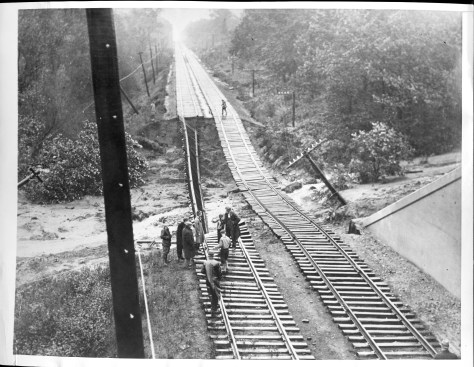
2016322-large-2On September 18, 1933, under the headline, “Railroad Tracks Washed Out During Storm Last Sunday,” the Hingham Journal reported:
Fully 500 feet of the New Haven tracks running from Hingham to Cohasset under the bridge of the Cohasset-Hingham new road were washed out and all trains held up during the height of the heavy gale and rain storm on last Sunday afternoon.

The break in the track was discovered by Daniel Magner, who told his grandfather, Thomas Magner, who in turn notified the railroad officials.  The last train over the line before it gave way was at 11:02 A.M.  The 2:52 P.M. from Boston carried just one passenger, who was transferred at the washout in an automobile. A downpour of water carried away enough roadbed to undermine about 50 feet of track.  Part of the track hung suspended in the air and part gave way. A full wrecking crew was called into action at once and work was continued all Sunday night. . . .  The force of the water took telegraph poles along with it, temporarily causing telephone disruption.  This was speedy repaired so that little inconvenience was caused.

The scene was viewed by thousands, police being on duty at the bridge to keep traffic moving.

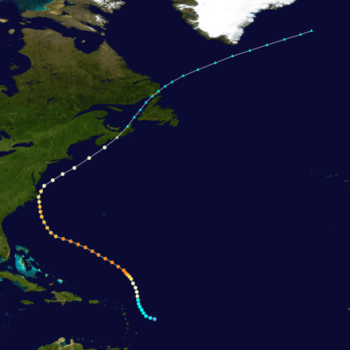
440px-1933_Atlantic_hurricane_13_trackThe storm that took out the railroad embankment is not as locally famous as the Hurricane of 1938 or 1954’s Hurricane Carol, both of which devastated the Northeast.  Later named the “1933 Outer Banks Hurricane,” it travelled from the Caribbean up the East Coast and into Canada between September 8-18, 1933.  It was the 13th storm of the Atlantic hurricane of the season that year.  The 1933 Atlantic hurricane season was one of the most active recorded, with the highest aggregate combined accumulated cyclone energy score (a measure used by NOAA to express cyclone activity through an approximation of wind energy) from 1851 (when hurricane activity was first recorded) to date.
Steppin’ Out

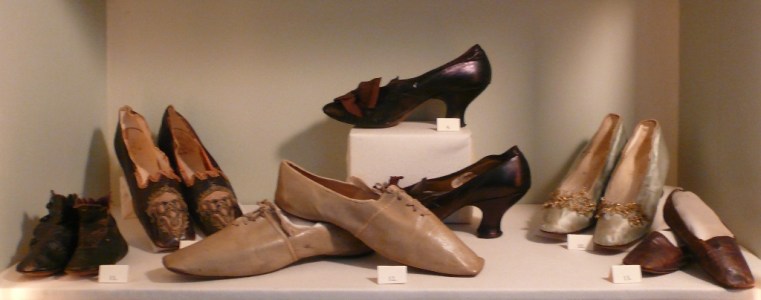
[The photos and text are from a 2011 exhibit put together by Mary Fitzmaurice and Suzanne Buchanan to showcase shoes, boots, and other footwear in our costume collection.]

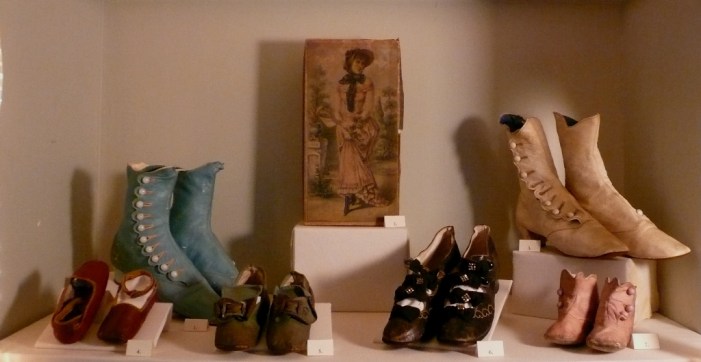
After farming, shoemaking was the most common occupation listed in the 1893 Hingham Genealogy.  Like aprons and stockings, the shoes that people wore every day rarely survived. They simply wore out. That explains why most of the shoes on display here are in pretty good condition. They probably were worn only on special occasions or by people who could afford more than one or two pairs of shoes.

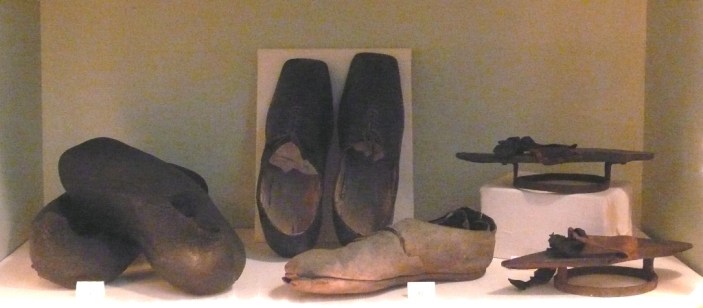
The well-worn working man’s shoe in the center of the bottom picture is the one exception to that rule. It is one of thousands of shoes that were hidden in chimneys and walls by New England families when they built new homes in the 1700s and 1800s. The origins of this tradition are murky, but shoes dating back to the 15th century have been found in the walls of houses in England, so we know that it came over with the Colonists. Some scholars think it was a way to bless the house or bring good luck. If you live in a historic house, you may have an old shoe in your wall, too.

First group 

  1. Light blue kid high-button boots, ca.1890, with a 1” Louis heel, ten milk-glass buttons, and scalloped button hole edges. COS-SH8
  2. Shoe box from T.E. Moseley & Co. of Boston, printed by August Gast & Co. of NY in 1887.  Gift of Mrs. Alfred Cushing.COS-SH23.
  3. Ivory kid high-button boots, ca. 1890.
  4. Red child’s shoe with ankle strap. Metal buttons center front. Made by Foster and Peabody of Boston, 1850-70.
  5. Green leather child’s shoe with metal buckles, 1890s
  6. Black leather girl’s shoe with 3 straps and bows, 1890-1910
  7. Child’s pink scalloped high-button shoes, c. 1900-20.  COS-SH33.  Gift of Wisconsin Historical Museum.

 Second Group

  1. Ladies’ black kid shoes with cut-out details and pink silk lining and gold chain stitching.  Made in Paris, Viault-Este, and sold in London by Thierry & Sons. c. 1850-1875.  Gift of Clara L. Barnes.  COS-SH26.
  2. Ladies’ bronze kid leather evening shoes with brown tie bows and vamp heel and a pink satin insert on each toe.  c. 1920-25.  Made in Paris by Viault-Este.  Gift of Mrs. J. Andrews. COS-SH29
  3. Ladies’ pale green satin slippers with gold and clear glass bead decoration over short, round vamps.  Ivory kid and cotton innersoles and lining.  Stamped on right innersole: Thayer McNeil  & Hodgkins, 41 Temple Place, Boston.  1890-1910.  Gift of Mrs. George F Bennett.  COS-SH21.
  4. Child’s black high-buttoned shoes with red leather lining, c. 1900-20.  COS-SH32
  5. Beige ladies’ leather tie shoes with silk ribbon ties, bound in silk grosgrain. c. 1810-1860.  COS-SH25.
  6. Child’s flat brown leather slippers with square toes and vamps.  From I.E. Moseley & Co.corner of Summer and Hawley Streets, Boston.  Late 19th century. COS-SH17.

Shoes Third group 

  1. Pair of men’s “gutta percha” shoes, an early type of rubber galoshes, c. 1840-50.  Gift of the Prudden Family.  COS-SH40.
  2. Men’s black leather shoes with square toes and brown shoe laces. c. 1810-1850.  Gift of Robert Hurley.  COS-SH31.
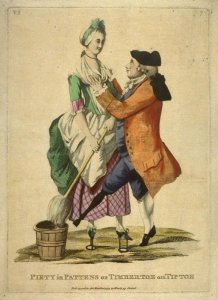
  3. Women’s wooden clog, or patten, with velvet strap and pointed toe.  “Willard” written on bottom.  c. 1700-1780.  COS-SH46.  Susan Barker Willard Bequest.
  4. Brown leather man’s shoe, c. 1750, well worn, found behind the chimney at 25 Ship St., which was built in 1753 by Jonathan Churchill.

Pattens-1

The pattens on the right side in the last picture deserve brief additional mention.  In days when streets were unpaved and a woman’s dress fell all the way to the ground, these wood or metal platforms lifted her feet and clothing above the muck.

Schooner Lizzie C. Lane

Schooner Lizzie C. Lane

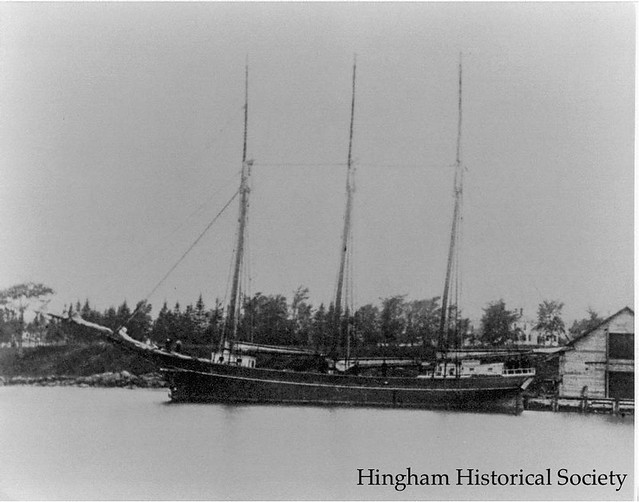
Howard Leavitt Horton (1904-1983) extensively annotated the back of this photograph of a three-masted schooner tied up at Hingham Harbor over one hundred years ago, melding an image, a business transaction, and a cherished childhood memory.

Schooner Lizzie C. Lane . . . Built at Searsport, Maine 1874. Burned at West Dublin Bay, Nova Scotia, June 3, 1921. 231 gross tons.  115.8’ x 29.8  x 9.2.  Crew of 5.

Called at Hingham – Geo Kimball Lumber Co. about 1914 or 15 as arranged by James Wiley Gilroy, lumber merchant and nephew of my grandmother Annie Eaton Horton of Elm Street (Mrs. Geo. W. Horton), my grandfather’s second wife, who was like a mother to me after my mother’s death in 1911.  I sat in Geo. Kimball’s office at the Harbor while Mr. Kimball and Mr. Gilroy made the business deal for a load of lumber shipped from Lunenberg, N.S.  I saw the schooner come into Hingham a couple of months later and dock at Kimball’s Wharf and went aboard. Mr. Hough, uncle of Karl Hough, was an employee of Kimball Lumber Co. at this time.

[Signed] Howard Leavitt Horton, Sr.

P.S. This was before World War I or before U.S.A. was involved.  I was in Lincoln School, 6th grade, so it was around 1914.

“The Old Tory”

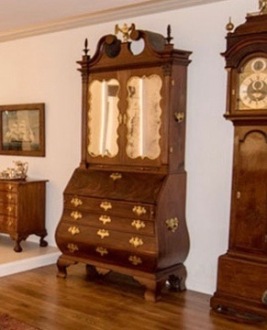
thumb.php (1).jpg            This beautiful drop-front desk and bookcase, newly installed in the Kelly Gallery at the Hingham Heritage Museum at Old Derby Academy, was built for Martin Gay (1726-1807) and Ruth Atkins Gay (1736-1810) upon their marriage in 1765 by cabinetmaker Gibbs Atkins of Boston, Ruth’s brother.

Called “the Old Tory” in acknowledgement of Martin Gay’s political leanings, the desk travelled to Nova Scotia with Martin upon the evacuation of Boston in 1776.  Many Loyalists were unable to bring larger pieces of furniture when fleeing, but Martin Gay owned a ship which made it possible for him to move the piece such a distance. Because Martin was a deacon of the West Church in Boston, he was charged with protecting the church’s valuables during the British occupation. Martin filled the drawers and shelves of his secretary desk with linen and silver communion service for safe keeping while exiled in Nova Scotia.

In 1788, Martin made a trip to England with hopes of procuring an indemnity for his losses as a Loyalist. Once again, “Old Tory” made the trip with Martin as he stayed in England for two years. Upon his return to Boston in 1792, Martin brought “Old Tory” back with him, filled with the linens and silver communion service to be returned to the West Church.

When Martin died in 1807, Ruth moved to the Gay family home on North Street in Hingham and lived there until her death in 1810. The desk descended in the Gay family until Ebenezer and Diana Gay donated it to a grateful Hingham Historical Society in 2014.

How Artist Joan Brancale Designed the Exhibit Mural for “Boxes, Buckets, and Toys: the Craftsmen of Hingham”

M1 Joan Brancale Hingham 1630 v2The birds’-eye view of Hingham Harbor, circa 1680, envisions Hingham as its earliest settlers found it, a heavily forested coastal village with a safe harbor and large tidal inlet called “Mill Pond.” The mural’s design concept, developed with Suzanne Buchanan, was to give context regarding the importance of the harbor for trade, the vast resource of timber that later helped drive the woodenware industry, and to depict how the early development of the village stemmed from the harbor front.

Working with exhibit designers Ed Malouf and Carol Lieb of Content Design Collaborative through a series of rough idea sketches, the following design evolved: M1 Joan Brancale Hingham 1630 NorthThe focus is on early North Street, later the route by which woodenware from village workshops of Hingham Centre and Hersey Street made their way down the harbor where ships awaited to carry them worldwide. The twilight setting was inspired by exhibit writer Carrie Brown’s description of candlelit homes in a world fueled and maintained by wood.

We see the village at twilight–simple homes, windows aglow—along “Town Road,” now North Street, where the first settlers were granted lots along an Indian path that followed Town Brook to what is now Beal Street. In the distance, I faintly M1 Joan Brancale Hingham 1630 Old Shipsuggested the steeple of Old Ship Church (not yet built) to help locate the site of an earlier meetinghouse on Main Street. At the harbor a single wharf, likely located at the mouth of Mill Pond, suggests the beginning of Hingham’s commercial harbor.  In later years, Hingham harbor’s many wharves were key to the success transporting goods produced by local tradesmen to Boston and beyond.

M1 Joan Brancale Hingham 1630 Mill PondThe viewer may be surprised at the prominence of Mill Pond—how it extends in the distance to what is now Home Meadows. This once broad expanse of water carried early settler Peter Hobart and company to their landing point at the foot of Ship Street at North Street. Mill Pond, flushed by tidal waters and fed by the Town Brook, is, alas, no longer.  In the late 1940s it was “paved over for a parking lot” along Station Street and the historic brook sent underground. The vestige of Mill Pond’s shoreline still remains, along the rear of old buildings lining the south side of North Street.

M1 Joan Brancale Hingham 1630 harbor detailResearch was important to surmise how Hingham Harbor may have first appeared to arriving settlers. I found no local 17th century drawings or paintings on which to base the design. Instead I used a variety of sources to help me understand what might be a plausible view. My research included:

  • Maps and harbor views of New Amsterdam and Boston and research done by the committee working on the development of Hingham Harbor’s Master Plan.
  • The 1893 History of Hingham, which provided information about the abundant hardwoods early settlers would have seen along the coast and drumlins of Hingham;
  • Not All is Changed, Russ and Lorena Hart’s aptly-titled history of Hingham, which includes early maps, including the first 12 lots granted along North Street, and vintage harborfront maps, which helped approximate the location of the first commercial wharf and buildings. These likely extended along Mill Pond near the grist mill, whose ancient foundation supports the old timbers of what is today called Liberty Grille.

Origins of the Quacum Sisters: Founding Mothers of Wilberforce Colony, Ontario

Marshfield, MA sisters Vilana, Rosana, and Salome Quacum, with their husbands, were founding members of the Wilberforce Colony, established near London, Ontario, in 1829 by and for free African Americans. This fascinating blog post from “Of Graveyards and Things,” reviews history and genealogy–including their Hingham connections James Tuttle and Lucretia Leonard.  Follow the link to read more.

mblauss's avatar

Sisters Vilana, Rosanna, and Salome Quacum were born at the turn of the 19th century on the south shore of Massachusetts, the daughters of a multiracial family with African, Mattakeeset (Massachuset) Indian, and Herring Pond (Wampanoag) Indian heritage. Although they had lived as free New England women, they each married husbands in the 1820s who were fugitive slaves. After spending several years in their hometown of Marshfield, Plymouth County, Massachusetts and Boston, Suffolk County, Massachusetts, each of the married sisters made the decision to leave their extended family behind and become founding members of the Wilberforce Colony in Ontario, on land which was owned and governed by African Americans, and thus offered security to the Quacum sisters’ husbands from American slave catchers, as well as the possibility of living in a more welcoming community with black governance.

The Origins of the Quacum Sisters

Their father Thomas Quacum was a resident…

View original post 2,986 more words