Hingham’s Unbuilt Highways, Part 1

For nearly the last 100 years, residents of Hingham have had to deal with traffic congestion in its downtown, the harbor area, and along Main Street. The recent effort by the town to survey residents about possible improvements to Route 3A and Summer Street is only the latest attempt to try to solve the town’s traffic problems. Documents from the John Richardson Collection and other materials in our archives confirm that the search for a solution to traffic problems has a long history.

Starting in the 1920’s the town asked the state to fund a project to take beach and through traffic away from Hingham Square. The state took the easiest solution and expanded Broad Cove Road and Otis Street to four lanes so that 3A could be re-routed away from the eastern end of Lincoln Street and North Street in 1932. Though successful, this action reduced the ability for non-automobile traffic to easily access the waterfront from that date forward. Around the same time, to further speed Nantasket and other traffic east of the Harbor, the state also built Chief Justice Cushing Highway, with the now infamous Harbor Rotary, and constructed George Washington Blvd. to Hull.

Looking North towards the Harbor Rotary in 1941:

Hingham Rotary and Harbor (1941)With the 1950s came the start of the freeway era in the country and Massachusetts. By 1959, the state had completed the 128 Beltway, the Central Artery, and the Southeast Expressway as far as Derby Street (later to be Route 3). Hingham officials saw the new expressway as an opportunity to attract tax-producing industrial and commercial development to South Hingham but also worried about what a potential residential population boom would do to the town. With these thoughts in mind, the Hingham Planning Board produced a report called the ‘1959 Town Plan Summary’ which projected Hingham’s population as 25,000 by 1980 and made a series of recommendations to best accommodate this growth while preserving the town’s character.

Cover of 1959 Planning Board Report:

1959 Hingham Town Plan Summary

The report made two recommendations to help increase recreational use of the Harbor. The first was to fill parts of it to connect the Harbor islands to the mainland and build a marina where the Yacht Club is now, as seen in the map below.

Hingham Harbor Plan (1959)

Second to ease waterfront access to town citizens, and to help solve many of the town’s traffic problems, the Board recommended building a pair of parkways (which, depending on costs, would be built as limited access expressways right away, or upgraded to them in the future) to take Nantasket and other through traffic away from the Harbor area and from Main Street (see Location A in the map below). The north-south parkway would take through traffic from Route 3A at the Back River Bridge southward parallel to Beal Street (by the Ammunition Depot, slated to close and holding out the opportunity for industrial development) and then further south along the western side of town to Route 3. The east-west parkway would then take southbound and Nantasket traffic east, following a route through the center of Town, north of High and Free Streets, and then across 3A to George Washington Blvd.

1959 Hingham Highway Plan

Neither of these plans got off the drawing board: they appear to have largely been an alternative to the state’s known plans for the Hingham area, which included, as can be seen referenced on the top left side map, the Shawmut Trail. The Shawmut Trail was a proposed expressway that would have run from Route 3 near today’s Braintree Split eastward across the Fore River (over a new bridge) to Route 3A in Weymouth just west of the Back River Bridge. It would then have continued into Hingham mostly along the path of Route 3A to end at the proposed Route 128 (later 228) Expressway near Turkey Hill (shown on Map C). As can be seen on the Location B and C Maps above, a portion of the Shawmut Trail route would have run directly from the Broad Cove Rd/Otis Street intersection to the Rotary. This would, as the report notes, involve running Route 3A “on a dike across the southern shallows of the Harbor cutting off the ponded areas from further recreational or boating use.” In other words, this plan would have prevented most of the current activities in the southern end of the harbor.

View of the southern end of Hingham Harbor from the Bathing Beach in 2014, a scene that would not be possible if the Shawmut Trail had been built:
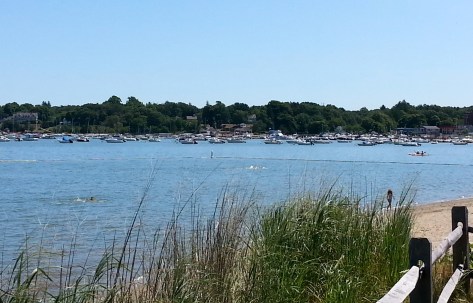
View of the southern end of Hingham Harbor from Bathing Beach, 8/9/14
Photo by Robert H. Malme, 8/9/14

Needless to say, this plan did not impress Hingham’s citizens or town officials. By the end of 1968 the state relented and ended the proposed Shawmut Trail in Weymouth. In the early 1970s the state officially abandoned the plan. Though none of these proposal came to be, a plan to build a relocated 228 expressway came much closer to fruition. More about that in Part 2.
 

Clubs and Societies in 19th c. Hingham

“It would be impossible,” Francis H. Lincoln remarked in the 1893 History of Hingham, Massachusetts, “to give a complete list of all the social organizations which have existed in Hingham.”

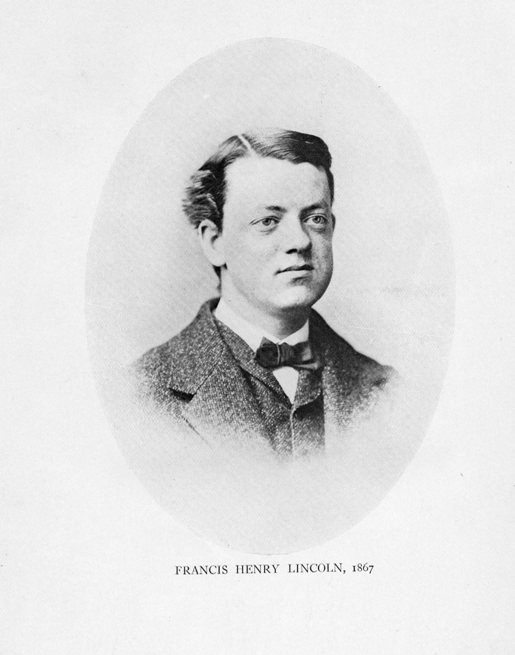
Francis H. Lincoln (

Francis H. Lincoln

Lincoln knew whereof he spoke: he was known for his active engagement in his community’s civic, religious, and charitable organizations. Three of the nine paragraphs in his eulogy were devoted exclusively to his membership in various societies and organizations, of which 21 are expressly named. This does not include his service on Hingham’s School Committee for nine years starting in 1879 and as treasurer of the American Unitarian Association.

Although certainly more engaged than most, Francis Lincoln was not the only one in town to show such a diversity of involvement. Each of the two 19th-century histories of Hingham devotes an entire chapter to the discussion of Hingham’s various “Lodges and Societies,” patriotic and political associations, charitable organizations, and recreational clubs. At one point, just in the arena of music, Hingham boasted both a brass and a cornet band, two choral societies (in addition to the church choirs), and a Philharmonic (formerly the more humbly named Amateur) Orchestra. Two social libraries were formed early on, in 1771 and 1773, and lasted until Hingham’s public library was founded close to a hundred years later. Early in the 20th century, the Hingham Historical Society was formed by townspeople interested in Hingham’s venerable history.

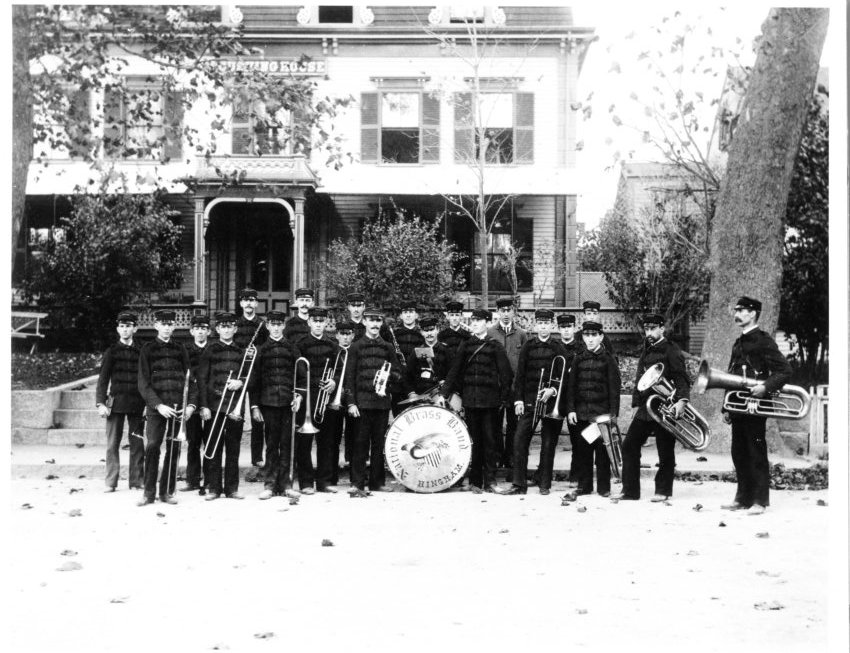
The Hingham National Brass Band

The Hingham National Brass Band

Each generation reorganized the societies to its liking: the Jefferson Debating Society of the early 19th century gave way in the 1840’s to the competition-based Hingham Debating Society, which in turn morphed thirty years later into the Monday Night Club, a more informal discussion group. (Despite this “informality,” when it was Francis Lincoln’s turn to address the club on the topic of “The Systems of Taxation In Massachusetts” in April 1878, he went armed with 26 pages of notes—preserved in our archives.) One organization, founded midcentury as the “G. I. A. of Scribes and Pharisees,” hosted socials, parades, fancy-dress balls and other diversions for decades, but changed its name and officers so often that it reportedly became known as the “Phoenix Club” for its constant re-emergences.

Political societies became popular with several abolition societies in the mid-19th century. After the Civil War, they switched their focus to temperance (with differing approaches, from religious to scientific) and then women’s rights. The Hingham Women’s Alliance boasted men as well as women amongst its members, and the local branch of the Massachusetts Women’s Suffrage Association met at Loring Hall, receiving support from Hingham resident and then-governor of Massachusetts John Davis Long.

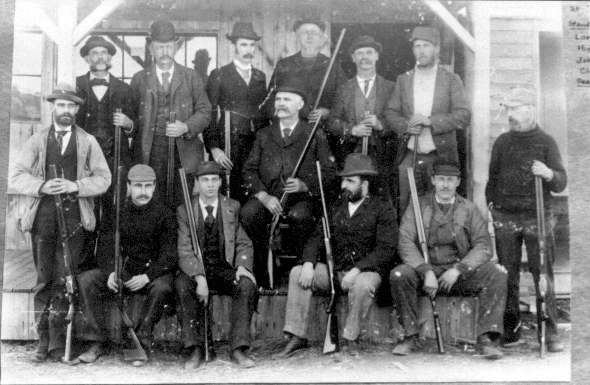
The Hingham Gun Club

The Hingham Gun Club

The community sustaining these myriad organizations was thus also sustained by them. In the early 1800s, facing a growth in population density that made both fire and thieves more common, townspeople founded the Society of Mutual Aid for Detecting Thieves and the Hingham Mutual Fire Society, both of which lasted through the century, promising to lend a hand when their neighbors’ belongings went missing or their buildings burst into flame.

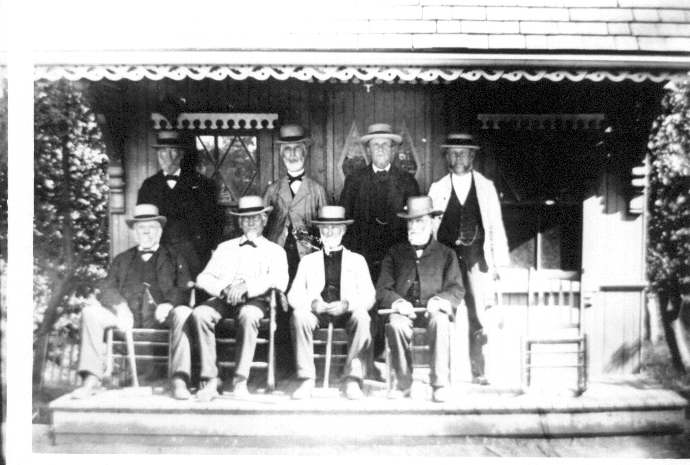
The Hingham Croquet Club

The Hingham Croquet Club

The social engagement and civic responsibility displayed in the Town’s profusion of associations and causes runs through its history, but the 19th century surely marked a high point in the number and strength of Hingham’s social organizations. Hingham was nothing less than a working example of what Alexis de Tocqueville saw as an explanation for the success of American democracy: our social engagement and investment in community created the interdependence that allowed our political processes (the process of voting and representation and compromise) to work. Or, as Francis Lincoln, club member extraordinaire, remarked in an essay written as a 15-year old student: “all the institutions of the land . . . are nurseries of learning, truth, and freedom.”

Visiting the Misses Barker

When she was young, Eliza Robbins of Milton enjoyed visiting the Barker sisters of Hingham. As an adult, she wrote a fond memoir of her visits to “The Misses Barker,” which she addressed to her younger sister, Sarah. Her essay, a typescript of which was placed in our archives by early society benefactress Susan Barker Willard, consists mainly of fond character sketches of the three maiden sisters who lived together on North Street in Hingham during the late 18th and early 19th centuries but also provides interesting glimpses of the Town of Hingham during that era.  According to Miss Robbins,

Deborah, Sarah and Bethiah Barker were daughters of Captain Joshua Barker of Hingham, Plymouth County, Massachusetts. Captain Barker belonged to a good family, when all the families were good—descendants of those primitive and pious colonists who first settled New England. He was a man of high honour, great benevolence and most amiable manner. . . . Mrs. Barker was the cousin of her husband and was the second of three sisters; the eldest died the widow of General Winslow and the youngest, Elizabeth, died single in the house of her nieces. The three sisters, especially the subject of this brief memo, never married.

Miss Robbins’ grandmother, Elizabeth Murray Inman, had owned a millinery business in Boston with the Barker sisters’ “Aunt Betsy” during the mid-1700s and, she explained, “between [the Murrays] and the Barkers an intimacy then commenced that was hereditary to the descendants of both the parties.”

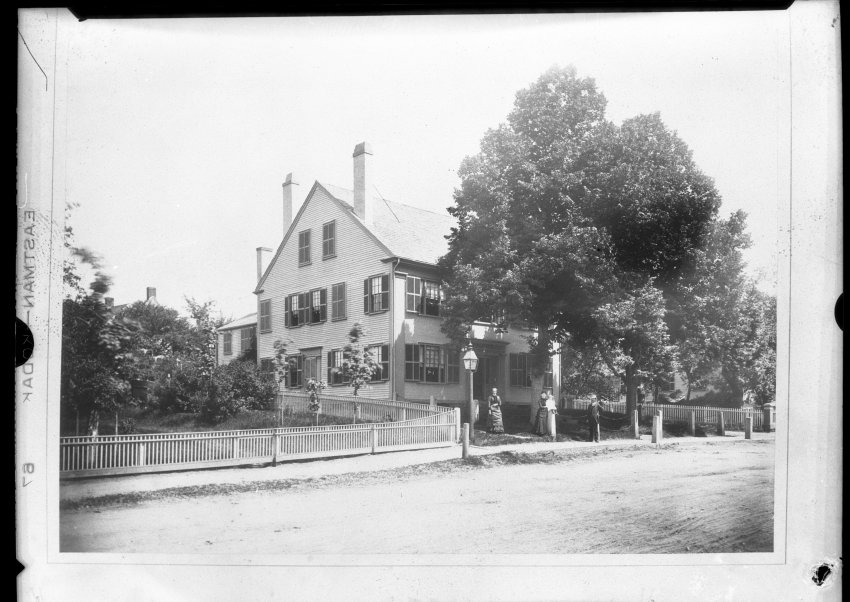
19th century photo of North Street Bank, 115 North Street, formerly the Joshua Barker home

19th century photo of North Street Bank, 115 North Street, formerly the Joshua Barker home

Remembering her visits to the Barker home, which was located on North Street in Hingham Square (next to the present-day Post Office), Miss Robbins wrote:

That parlour was a delightful south room. The fervent heat of the summer sun was broken by the thick shade of a wide spreading plane tree that stood near the house and the glossy tresses of a dangling woodbine hanging over the windows softened the light that entered it, leaving spaces sufficient to look through upon the street to which the ground before the house covered with short velvet grass descended in a gentle slope. On the further side of the street lay the vegetable garden of the neighbor, along the borders of a little brook that ran through them toward the sea, which though out of sight was not far off. Beyond the gardens lay another street—behind that stood a hill on the top of which the villagers bury their dead. On the right hand—onward to the limit of vision, along the path way ran houses, those of traffic and mechanic art—the Academy and the spire of an old Church. None of these objects were picturesque but they had a character, they represented life and death, learning and religion, industry and competency, security and contentment. . . .

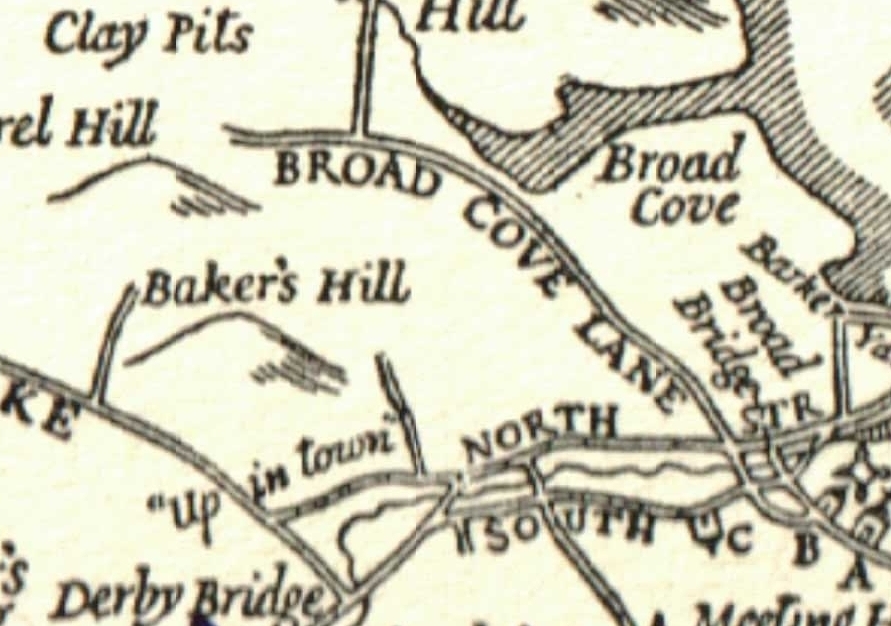
Detail from a map of historical names and places in Hingham.  ("Barker Shipyard" belonged to the sisters' uncle, Francis Barker.)

Detail from a map of historical names and places in Hingham. (“Barker Shipyard” belonged to the sisters’ uncle, Francis Barker.)

The basic layout that Miss Robbins describes is remarkably unchanged:  the house faces North Street, the bed of the former “Town Brook” (now the capped Greenbush train tunnel), and then South Street.  On the far side of South Street, Hingham Cemetery, Old Derby Academy, and Old Ship Church run south along Main Street ahead.

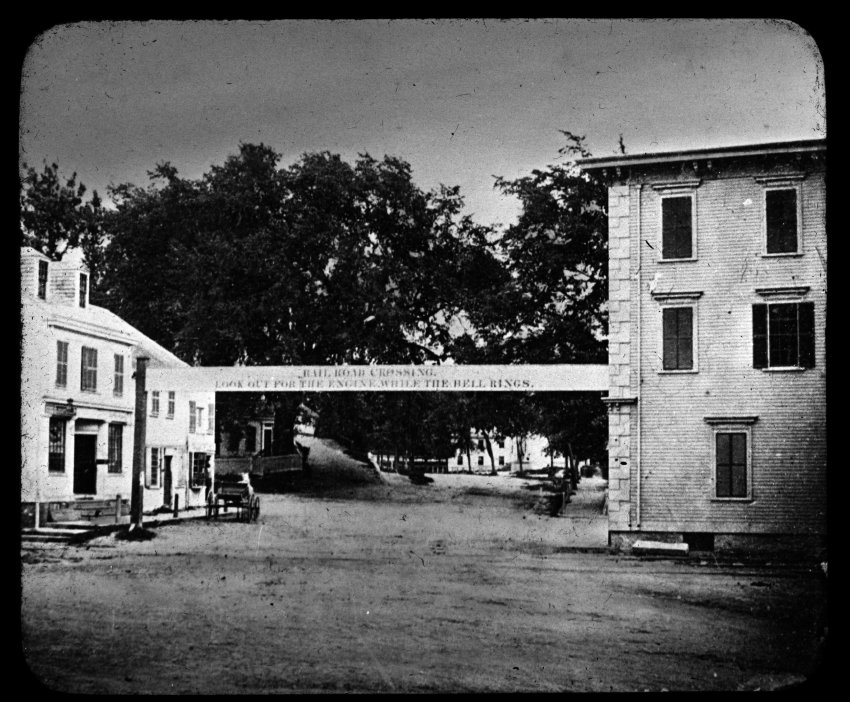
Hingham Square, looking south on Main Street, 1861.

Hingham Square, looking south on Main Street, 1861.


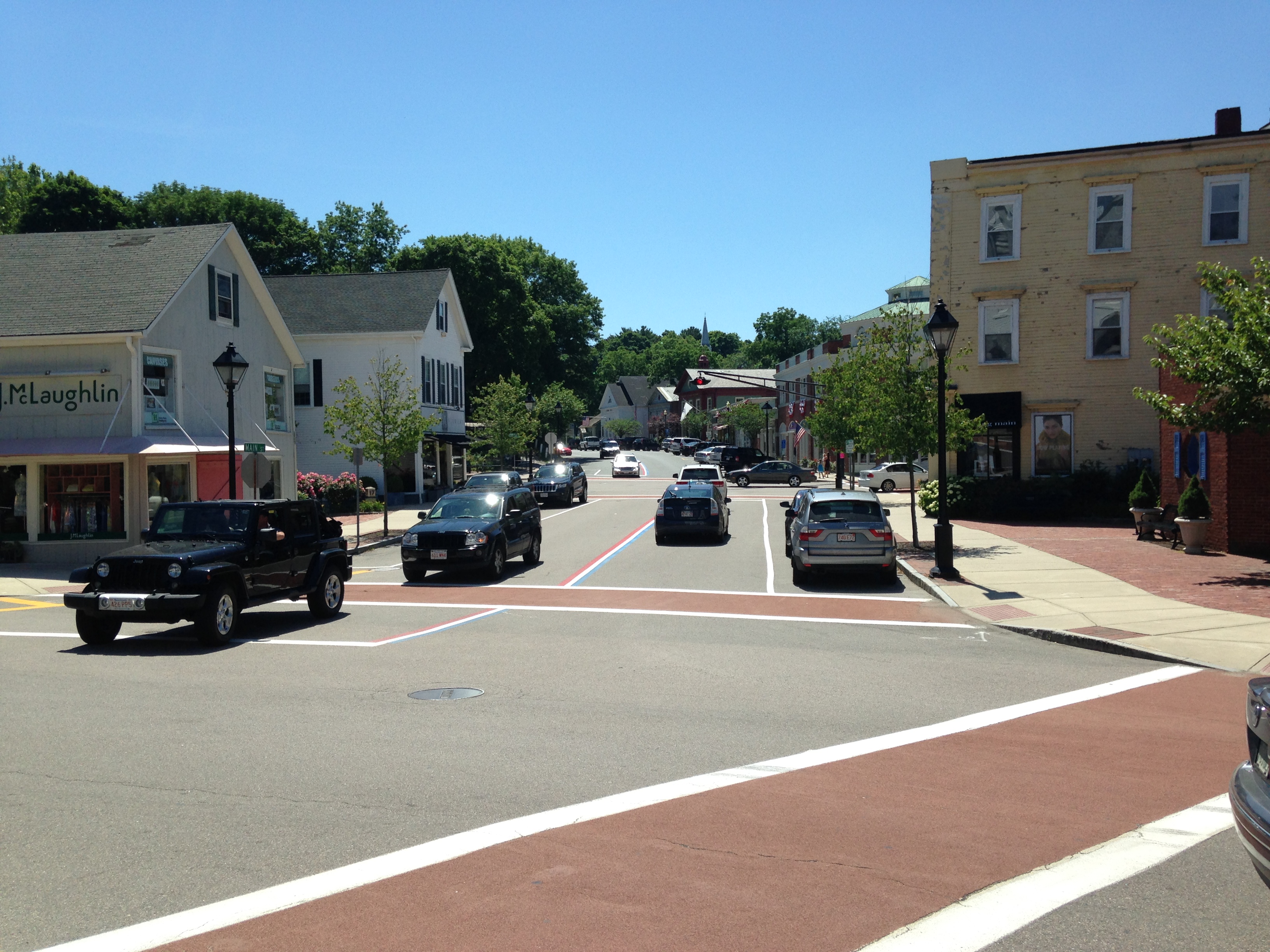
Hingham Square looking south on Main Street, today

Hingham Square looking south on Main Street, today

Battling “that Old Deluder, Satan” with a School

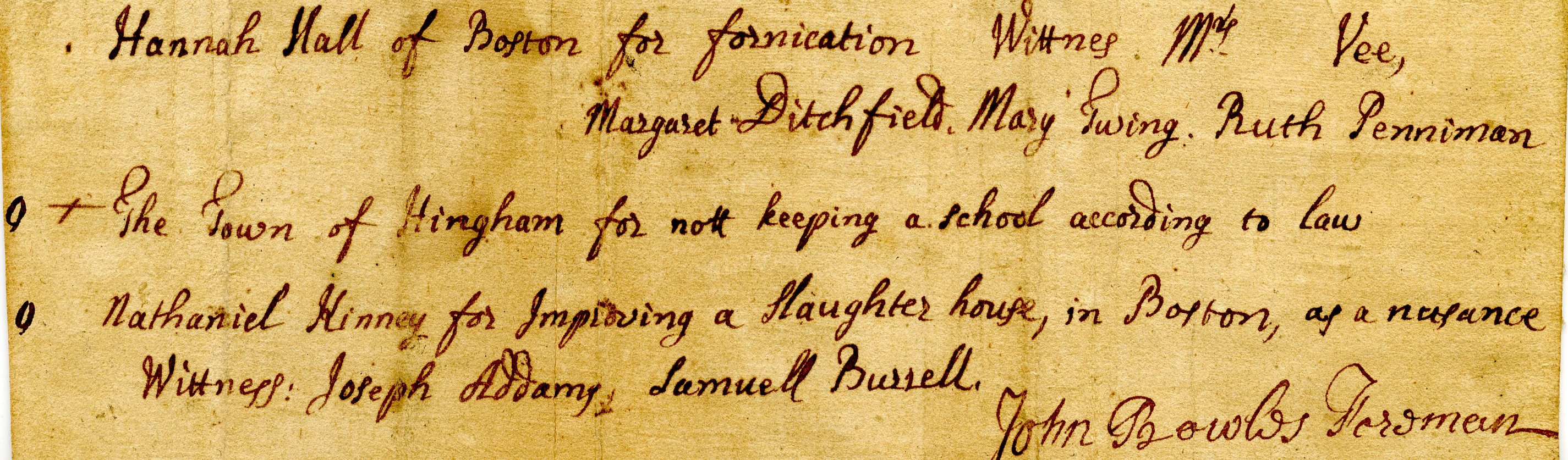
On April 6, 1714, a grand jury in Boston presented a series of charges against a number of individuals and entities.  Many of the offenses were exactly what we would expect from a group of 17th century Puritans:  “Richard Hancock of Boston for Selling Drink without license sundry times since last Session,” “Seth Smith of Boston for allowing unlawfull gaming,” “Nathaniel Ford of Weymouth for nott attending the publick worship of God,” and—a hat tip to Nathaniel Hawthorne—“Hannah Hall of Boston for fornication.”

MLD001One of the charges explains why this single-page manuscript came to Hingham, to be preserved in our archives:  “the Town of Hingham for not keeping a school according to law.”  This offense, as it turns out, is as characteristic of the Massachusetts Bay Puritans as the others charged on that day.

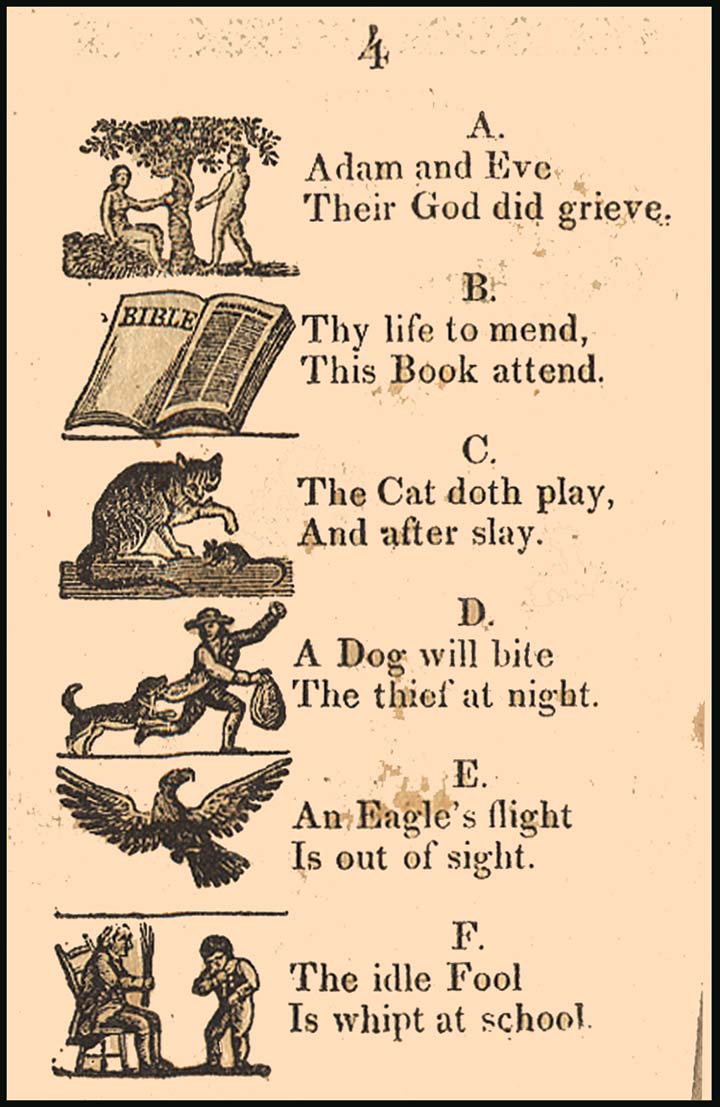
33447_2Education was very important to the founders of the Massachusetts Bay Colony.  The first public school in this country, Boston Latin School, was established in Boston in 1635, and the nation’s first university, Harvard College, was founded in Cambridge the next year.  In 1642, Massachusetts passed a law requiring parents to ensure that their children could read English or face a fine.

This concern with education grew from the very roots of Protestant theology:  the belief that Christian laity had the right–and a duty–to read the Bible in the vernacular and participate directly in the affairs of the church.  These fundamental goals are explained explicitly in the preamble to Massachusetts’ 1647 statute, sometimes called “The Old Deluder Satan Act,” that shifted the responsibility of education onto the growing towns:

It being one chief project of that old deluder, Satan, to keep men from the knowledge of the Scriptures, as in former times keeping them in an unknown tongue, so in these later times by perswading from the use of tongues, that so at least the true sense and meaning of the Originall might be clowded by false glosses of Saint-seeming deceivers; and that Learning may not be buried in the graves of our fore-fathers in Church and Commonwealth, the Lord assisting our indeavors: it is therefore ordered by this Court and Authoritie therof;

That every Township in this Jurisdiction, after the Lord hath increased them to the number of fifty Housholders, shall then forthwith appoint one within their town to teach all such children as shall resort to him to write and read, whose wages shall be paid either by the Parents or Masters of such children, or by the Inhabitants in general, by way of supply, as the major part of those that order the prudentials of the Town shall appoint. . . .

And it is further ordered, that where any town shall increase to the number of one hundred Families or Housholders, they shall set up a Grammar-School, the Masters thereof being able to instruct youth so far as they may be fitted for the Universitie. . . .

Hingham town records reference schoolteachers and a school building as early as the mid-1600s.  According to Francis Lincoln’s chapter on education in the 1893 History of the Town of Hingham, the increasing size of the town led to disagreements as early as 1708 and 1709 over where the school should be held.  Second Precinct—later Cohasset—wanted a rotation, so that school would sometimes meet in its area, as did “Great Plain”—South Hingham.  But there is no suggestion that HIngham’s school was ever closed.  Indeed, in a comprehensive list of the schoolmasters in Hingham from 1670 on, Lincoln reports that Jonathan Cushing was the schoolmaster from 1712-1713, after which the 1712 Harvard College graduate became the minister in Dover, New Hampshire.  Twenty-year old Job Cushing, Harvard College Class of 1714 succeeded him, remaining four year before becoming the first minister of the Shrewsbury church.

Bottom of documentPerhaps there was a lapse while the Town waited for Job Cushing to graduate.  There may have been complaints.  17th century grand juries could “present” charges based on their own knowledge and did not, as today, have to wait to be asked to hand down an indictment.  Was a disgruntled Hingham parent on that grand jury?  Perhaps we will learn more as we continue to dig through the archives.

The Rev. Phebe Hanaford

March is Women’s History Month and a perfect time to talk about the Rev. Phebe Hanaford, a fascinating woman whose connection with Hingham is not widely known.

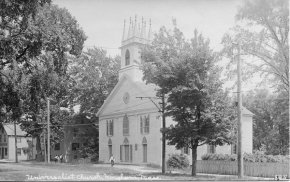
First Universalist Church and Society, Hingham. 

This photograph from our archives is of the Meeting House of the First Universalist Society in Hingham.  The building remains standing as a private home on North Street—albeit without the wonderful “crown.”  It was built in 1829 by a group of Hingham adherents of Universalism, a liberal Protestant Christian faith which, like Unitarianism, gained adherents in New England as a reaction to the strict Puritanism of the area’s early settlers.  Universalists believed in universal salvation:  that all human souls—not just the Elect—achieve salvation through Christ.  Their liberal theology was matched with liberal social views, and in the mid-19th century, the Universalists were one of the few Protestant denominations to ordain women to the ministry.

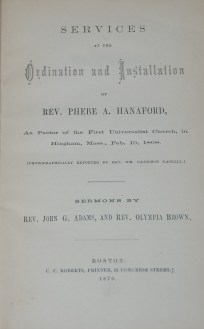
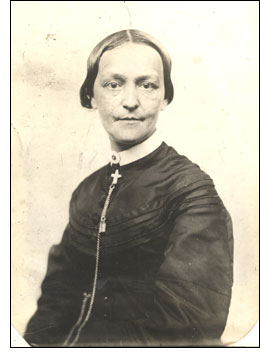
Phebe Hanaford, born Phebe Ann Coffin on Nantucket, was the first woman ordained to the ministry of any Christian denomination in Massachusetts–and only the third in the United States. That signal event occurred on February 19, 1868 at the Universalist Meeting House pictured above in Hingham, after Hanaford had served as that church’s pastor for around 18 months.  Sermons were preached by the Rev. Olympia Brown, the first woman minister in the United States and at that time pastor of the Universalist church in Weymouth, and the Rev. John Greenleaf Adams who preached on the text, “There is neither Jew nor Greek, there is neither bound nor free, there is neither male or female, but we are all one in Christ Jesus.”

Hanaford was popular as the part-time pastor in Hingham.  The Star in the West, a monthly Universalist publication, wrote at the time of her ordination:

Educated in the good old fashioned way, she had the bible from Genesis to Revelation at her tongue’s end; having common sense and a good heart she understood our faith. And when the question about pastoral labor was put [in the examination for ordination], the chairman of the committee of the Hingham society, where she has been preaching for a year, stated she had done it more effectually than any man they had had for the last twenty years!

She stayed in Hingham (while also preaching at the Universalist Church in Waltham) until 1870, commuting by horse and buggy from the Reading home she shared with her husband and two children.  In 1870, she accepted a call to the First Universalist Church and Society at New Haven, taking her children with her but leaving her husband behind.  From then on, in parishes in New Haven and Jersey City, New Jersey, she shared her home with a woman named Ellen Miles.

hanaford

Phebe Hanaford

Hanaford had been active in the abolition movement in the 1860s and after the Civil War became an increasingly well-know activist in the women’s suffrage movement.  She lost her pulpit in Jersey City in a controversy that stemmed partially from her outspoken involvement in the suffrage movement but also partially from her then-unorthodox domestic arrangements (contemporary newspaper articles referred to Miles as “the minister’s wife”).  She did not have a parish of her own again, but she wrote and spoke and remained active in the women’s suffrage and temperance movements.  In the public sphere, she presided at the funerals of both Elizabeth Cady Stanton and Susan B. Anthony.  Closer to home, she had the opportunity, unprecedented for a woman of her time, to give the blessing at her son’s ordination to the Congregational ministry and to perform her daughter’s marriage.

The Hingham Ice Harvest

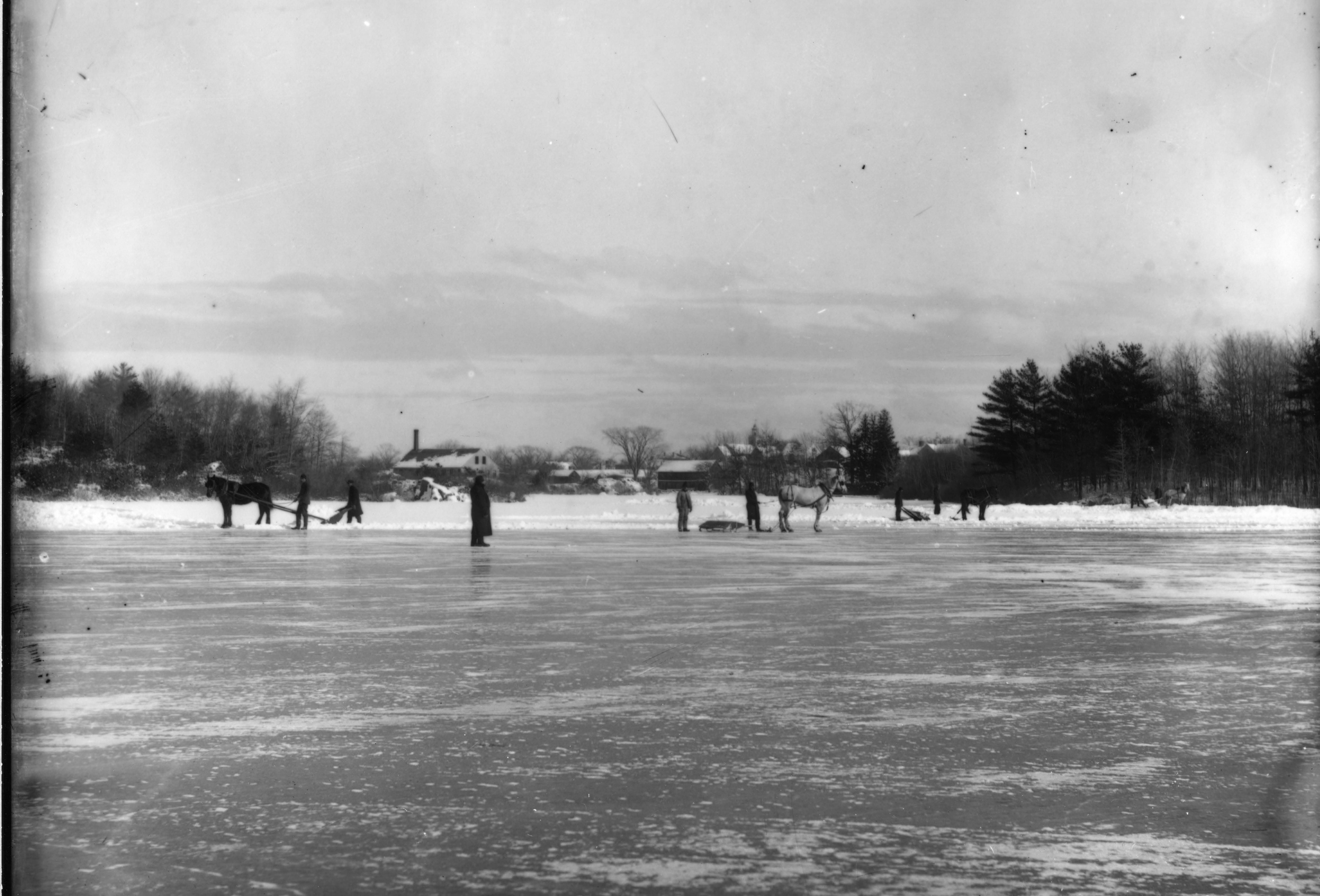
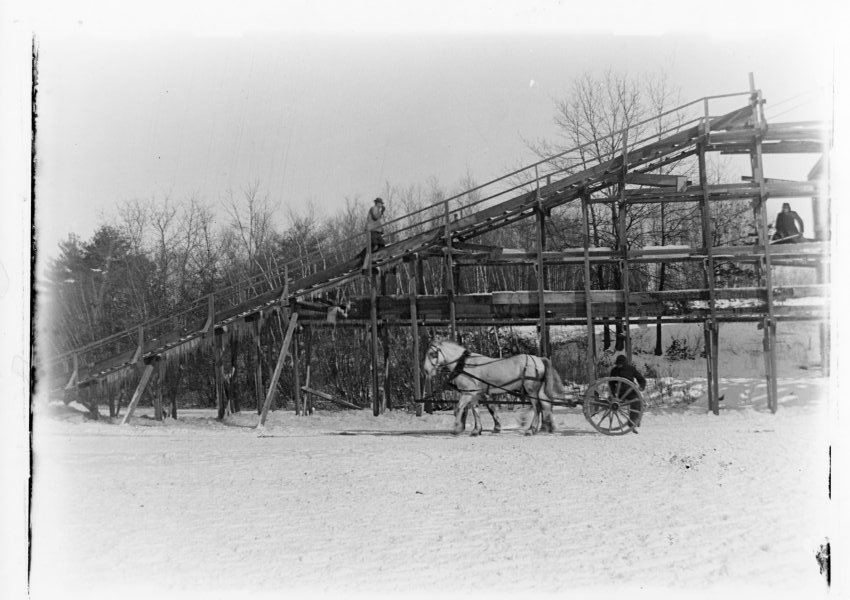
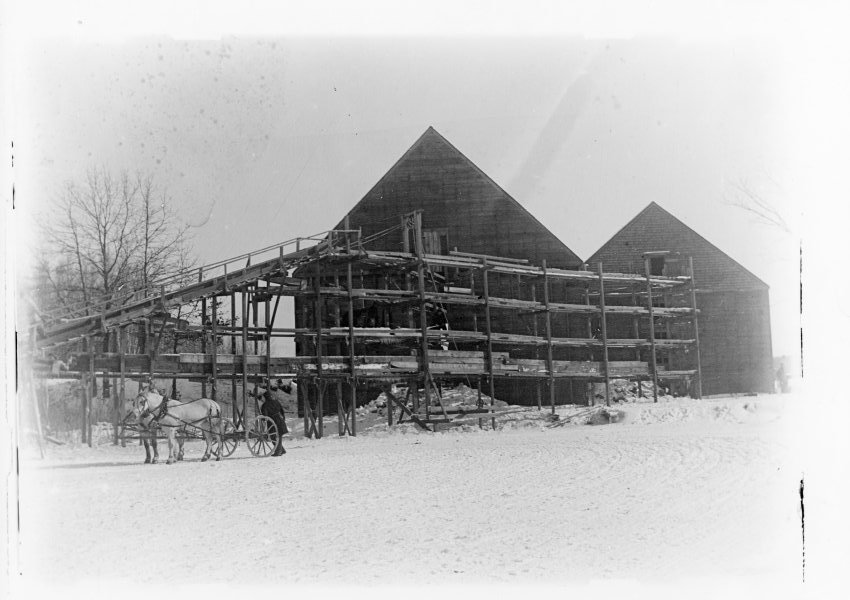
Ice joined the arsenal of food preservation tools in the 19th century, and local business devoted to producing and distributing ice to homes and business grew up.  (An earlier food preservative, salt, was the subject of an earlier post, “The Old Salt Works.”)  Local businesses harvested ice from Hingham’s many ponds, stored it, and sold it during the warmer months.  These photographs from our archives document Charles T. Leavitt’s ice operations on Cushing Pond in South Hingham:

Cutting ice at Cushing Pond

Men with horses and sleds cut ice at Cushing Pond

Ramp to Leavitt's Ice House, January 31, 1898

Ramp to Leavitt’s Ice House, January 31, 1898

Charles Leavitt's Ice House, January 31, 1898

Charles Leavitt’s Ice House, January 31, 1898

Each ice block was hand cut and weighed up to 400 pounds.  Blocks were sledded to shore, carried to the icehouse, and loaded in, so that the ice completely covered the floor space and then was layered until it reached the roof.  Properly piled and insulated, ice would remain frozen throughout the summer and into the following fall.  In Walden, Henry David Thoreau provided a description of the ice storage process:

They divided it into cakes by methods too well known to require description, and these, being sledded to the shore, were rapidly hauled off on to an ice platform, and raised by grappling irons and block and tackle, worked by horses, on to a stack, as surely as so many barrels of flour, and there placed evenly side by side, and row upon row, as if they formed the solid base of an obelisk designed to pierce the clouds. . . .  At first it looked like a vast blue fort or Valhalla; but when they began to tuck the coarse meadow hay into the crevices, and this became covered with rime and icicles, it looked like a venerable moss-grown and hoary ruin, built of azure-tinted marble, the abode of Winter . . . .

They told me that they had some in the ice-houses at Fresh Pond five years old which was as good as ever. Why is it that a bucket of water soon becomes putrid, but frozen remains sweet forever? It is commonly said that this is the difference between the affections and the intellect.

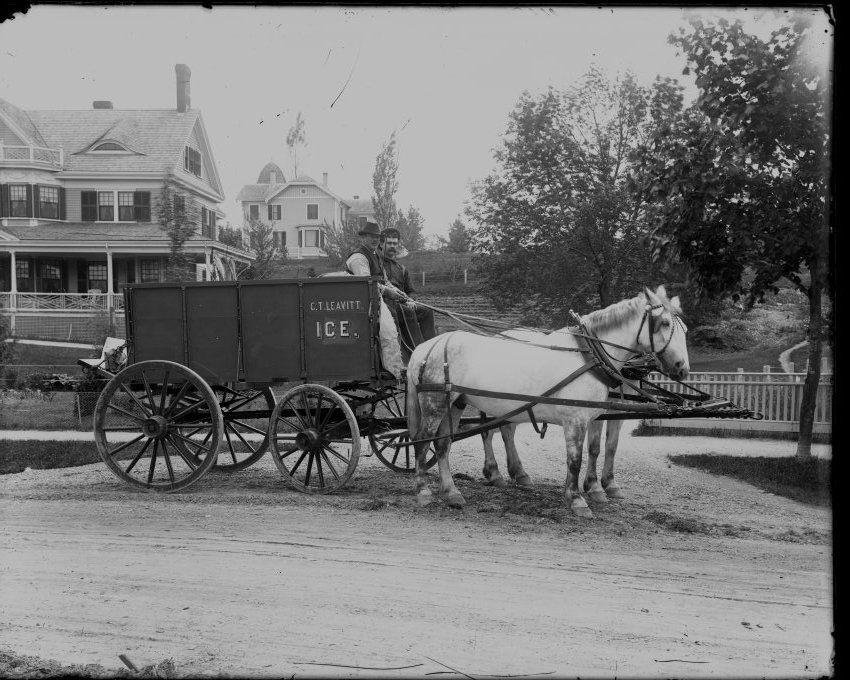
Charles T. Leavitt distributed ice in Hingham and around the South Shore until 1902, when he sold out to George C. Hayward, who continued to sell ice for another twenty or so years.  In January 1914, the Hingham Journal reported :

Mr. George C. Hayward, Hingham’s popular iceman, began Monday morning on cutting his ice for the season of 1914 at Cushing’s Pond, South Hingham. He has good clear ice of ten inch thickness.

By the second World War, however, most people in this area had electric refrigerators, and the days of the icebox and ice delivery were over.

"C.T. Leavitt Ice" Delivery Truck on South Street, Hingham

“C.T. Leavitt Ice” Delivery Truck on South Street, Hingham

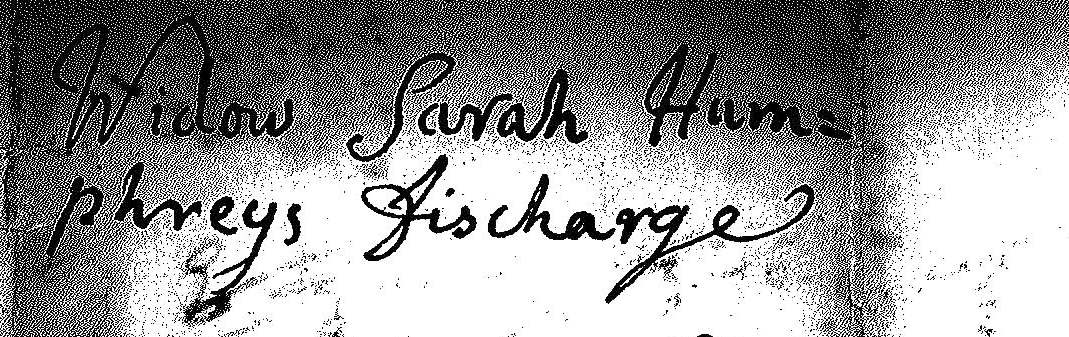
Widow Sarah Humphrey’s Discharge

A sad, tattered scrap of paper in our archives lets us see the effect on families of the colonial era’s high mortality rate–here the untimely passing first of a father and then of a child.

Title Widow Sarah Humphrey's DischargeSarah Humphrey was 32 years old and the mother of six living children (aged 11, 10, 8, 5, 2, and 4 months) when her husband Ebenezer died in 1745 at age 41.  Ebenezer Humphrey had been a weaver and a descendent of Hingham’s first settlers.  The family lived on High Street and appears to have been fairly well off (the inventory of his estate listed real and personal property worth £494).

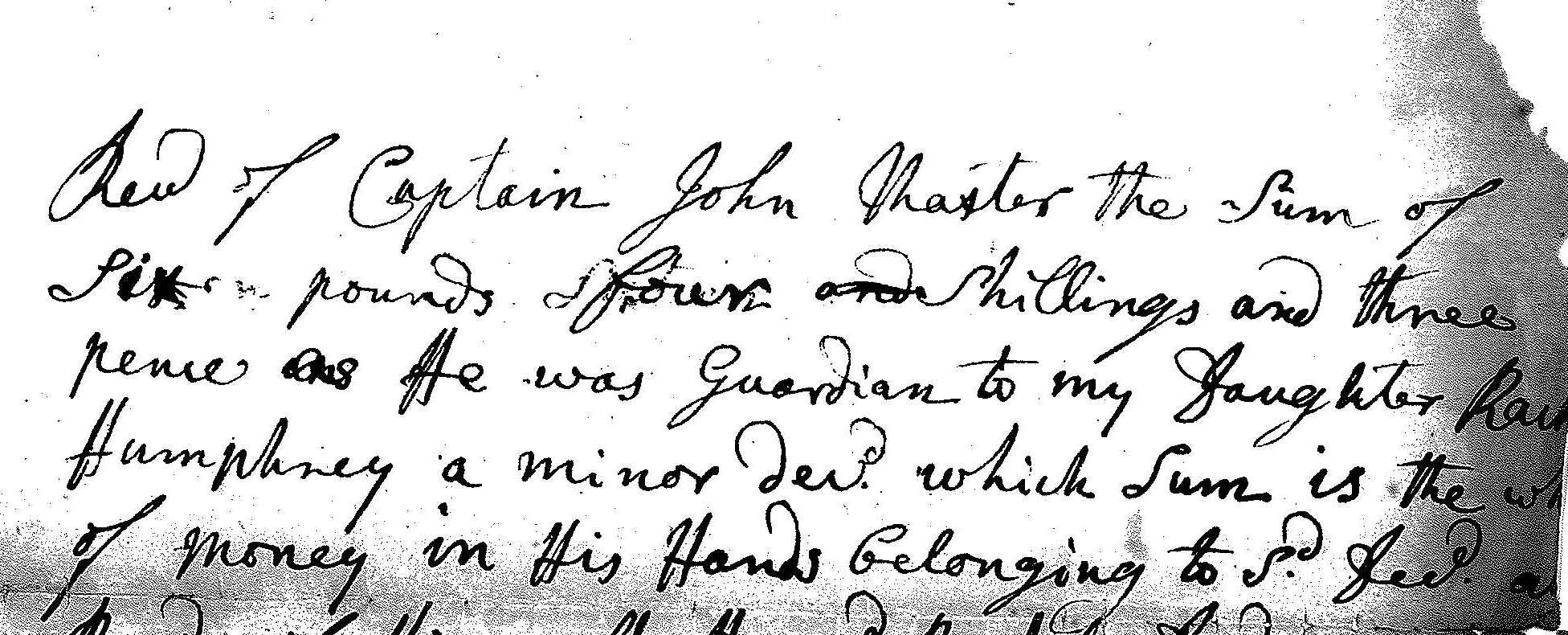
Cropped top of Discharge The document is Sarah’s sworn statement discharging John Thaxter from any further obligations as the court-appointed guardian of her daughter Rachel.  Rachel had died at the age of 17 and John Thaxter had returned to Sarah the property which he had held on Rachel’s behalf.  Sarah provided Thaxter a receipt acknowledging his full performance of his obligations:

 Rec’d of Captain John Thaxter the sum of six pounds four shillings and three pence.  He was guardian to my daughter Rachel Humphrey a minor dec’d which sum is the whole of the money in His Hands belonging to s’d dec’d minor.  Rec’d of him all s’d Rachel dec’d wearing appearell and what of Household Stuff or Goods that were in his possession and I do hereby for my self my Heirs acquit and discharge Him the s’d John his Heirs from s’d dec’d Estate having rec’d the whole of s’d dec’d Estate that was committed to his trust & care.  In testimony whereof I have sett my Hand & Seal this twenty second day of June A.D. 1758.

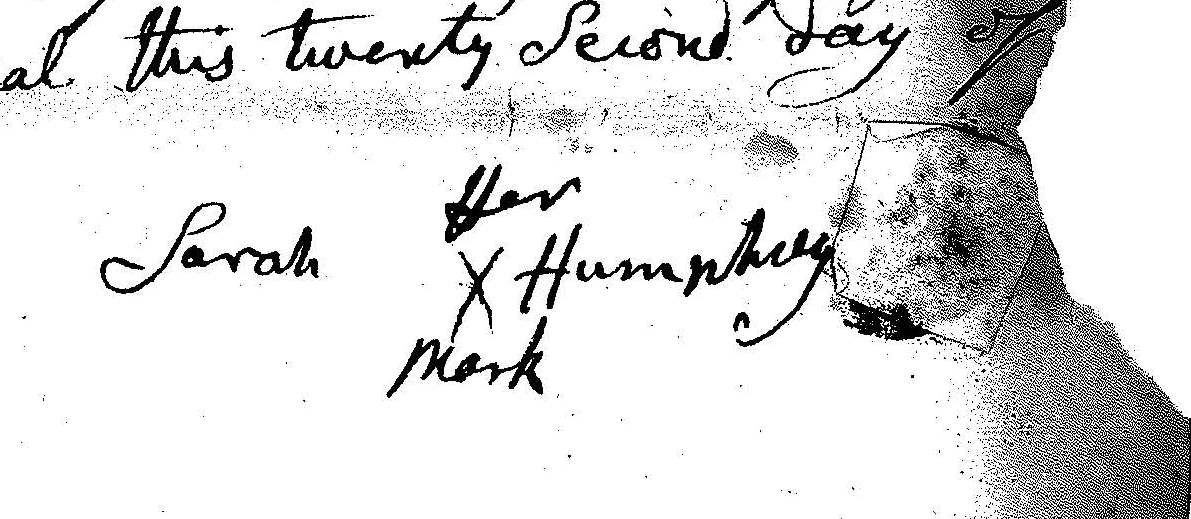
£6:4:3.                         Sarah Humphrey  (Her Mark)

Signed sealed in presence of

/s/ Welcome Lincoln

/s/ Hannah Barker

Sarah Humphrey Her MarkWhy was Thaxter named Rachel’s guardian (and the guardian of her younger siblings Mary and Ebenezer)?  The answer lies in colonial laws of property and inheritance that are very different than those with which we are familiar today.  Although Ebenezer Humphrey’s estate was relatively large, he did not leave a will.  Under Massachusetts law at that time, Ebenezer’s six children—not his wife—were his heirs.  Sarah was afforded a “dower share,” that is, the right to the use of one-third of her husband’s estate during her widowhood, but she did not own any of it.  It was very common, then, to appoint a guardian to take charge of the childrens’ inheritance during the years of their minority.

As administratrix of Ebenezer’s estate, Sarah accounted to the Probate Court in 1746 for amounts she had paid out of the estate, including the payment of Ebenezer’s debts, the “many implements of household allowed the widow,” and the expense of “maintaining and cloathing of three children . . . one of them 5 years, one 2 years, and one 4 months” for a year after her husband’s death.  Why just the younger three?  Perhaps her older children had been “put out” to work or learn a trade.  Perhaps they lived with relatives.  Probate records confirm that John Thaxter was appointed guardian of the three younger children in 1757, 12 years after Ebenezer’s death, for the express purpose of safeguarding what each of them had inherited from their father.  Why such a delay?  Had money started to run short?  The eldest child, Benjamin, had turned 21 the year before and Rachel’s big sisters, Hannah and Susanna, had just married.  Perhaps Benjamin, who was entitled to his share of the estate upon his majority, or Hannah’s or Susanna’s new husbands had raised questions about Sarah’s stewardship of her childrens’ inheritance.

We do not have any written discharge of John Thaxter as guardian of Rachel’s younger siblings, but his role as guardian was almost complete.  Ebenezer died in 1762 and Mary married in 1764.  Sarah Humphrey never remarried.  Having survived three of her seven children, she died, aged 70, in 1784.

The Old Salt Works

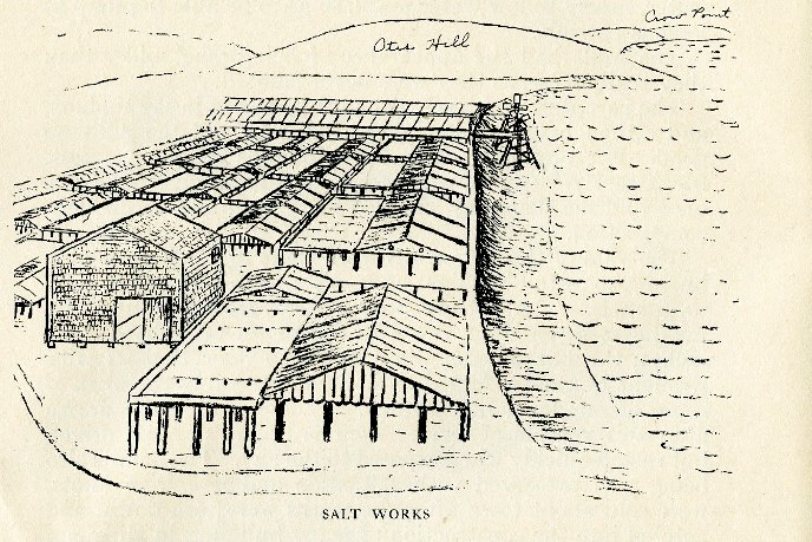
Illustration from "The Old Salt Works," Hingham Historical Society Publication No. 1 (1916)

Illustration from “The Old Salt Works,” Hingham Historical Society Publication No. 1 (1916)

The manufacture of salt in Hingham commenced at Broad Cove around 1812.  Buoyed by the rapid growth of Hingham’s fishing industry in the early years of the 19th century, several salt works were built, both at the easterly end of the harbor, near the steamboat landing, and on the salt meadows at Broad Cove.  Salt manufacture, “one of the old industries of Hingham,” was the subject of a paper presented to the Hingham Historical Society at its January 24, 1916 meeting, by Orin Brewster Sears, “a son of the proprietor of the [salt] works.”   The salt works owned and operated by Orin Brewster Sears’ father, also named Orin Sears, were built in the salt meadow along Otis Street, accessed by Fearing Road.  They were the last salt works to operate in Hingham.

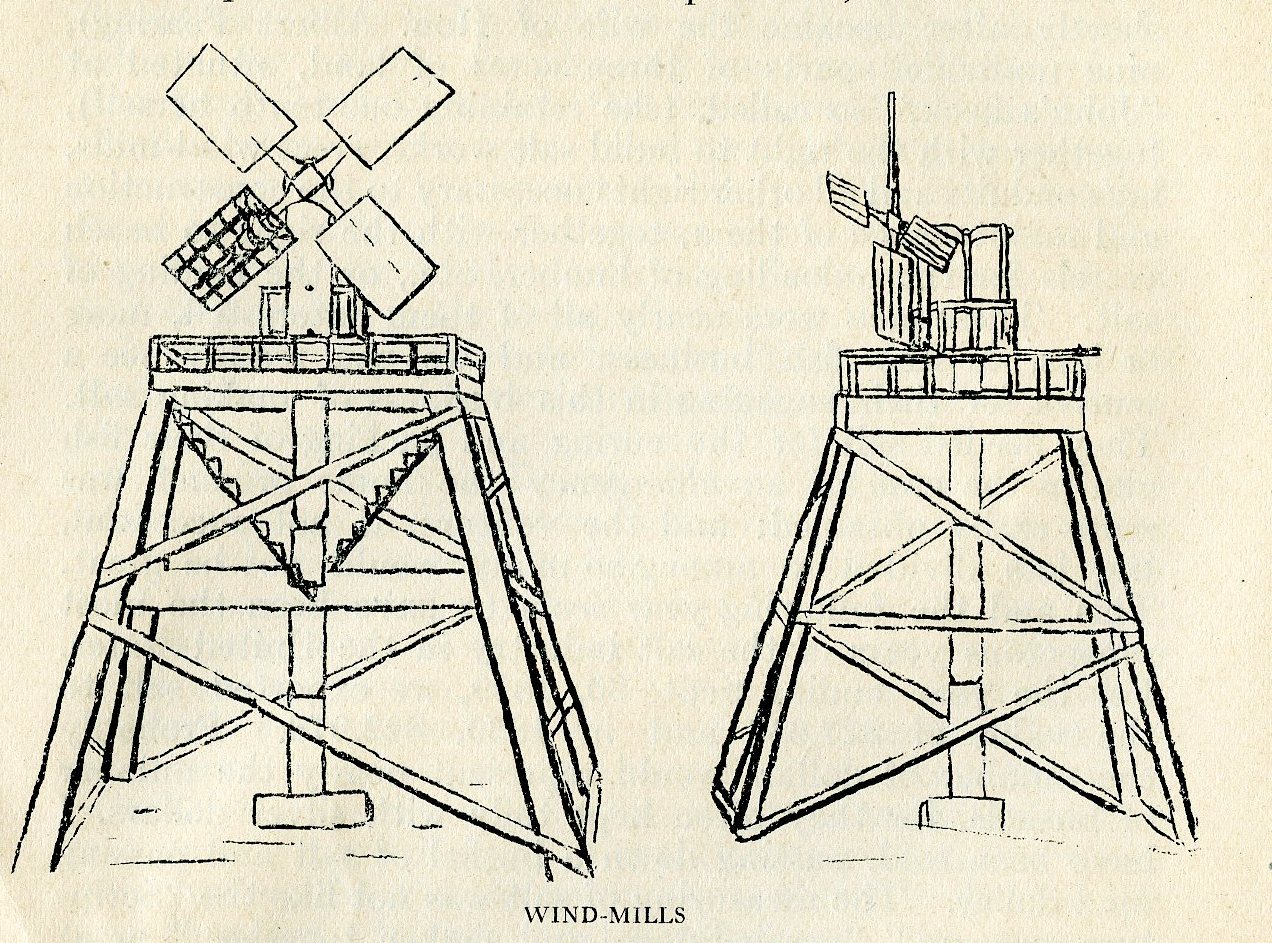
In his paper, “The Old Salt Works,” published in 1916 as “Hingham Historical Society Publication No. 1,” Sears described the method of extracting sea salt by solar evaporation.  Salt water was pumped from the harbor into two long rows of vats around 200 feet long, called the “water rooms,” which ran up from the harbor at the westerly end of the salt meadow.  The pumps used to fill the water rooms were powered by a pair of windmills.  The water sat in the vats, evaporating, until it began to deposit lime, at which point it was drawn, through a system of hollow logs, to the “pickle rooms.”  There, as evaporation continued, lime and other unwanted constituents of sea brine were separated from the salt and water and salt crystals began to form.  The liquid would then be drawn, again through hollow logs, to another set of vats in the “salt rooms.”   Here, as the salt crystals increased in size, they dropped to the bottom of the vats and were raked together, drained, and carried to the “salt house” to dry.  The entire process took around three weeks.

Illustration from "The Old Salt Works," Hingham Historical Society Publication No. 1

Illustration from “The Old Salt Works,” Hingham Historical Society Publication No. 1

The Sears family was instrumental in the development of New England’s salt industry.  Pre-revolutionary colonists imported salt from England.  The war-time embargo created a crisis on Cape Cod, where salted fish was a staple food and primary export.  Captain John Sears of Dennis is credited with having invented the method of sea salt extraction by solar extraction described above.  Well suited to New England’s climate, it was adopted across the Cape as our domestic salt industry grew, aided by tariffs imposed by the young United States government.  It was also the system used in Hingham.  Orin Sears moved to Hingham from Dennis in 1846, motivated by “the desire to keep his boys from going to sea,” then “the only lucrative business on the Cape.”  He purchased the salt works described in the Historical Society paper, although the heyday of the local salt industry had already passed.  Between the mid-1830s and the mid-1850s, as the result of the decline of its fisheries and the development of alternate domestic sources of salt, Hingham’s salt production declined from over 20,000 bushels a year to fewer than 2,000.

The Historical Society’s early interest in Hingham’s “old industries” went hand in hand with the early 20th century belief in progress.  Sears waxed philosophical in his talk about the disappearance of the old ways:

It may seem strange to some of us in this day of development, with mines of rock salt, salt lakes, and salt springs almost everywhere, that our fathers should have been obliged to procure their supply from the ocean; no less so that with our country filled to overflowing with petroleum, they should have been obliged to brave the dangers of the whale fishery, for oil for illuminating purposes.  Those of us who have lived to watch the transition from tallow candle to the electric light, from the lumbering stage coach over rough roads to the automobile on the modern oiled stone boulevards or swifter steam express trains, from the messenger to the wireless telegraph, have reason to thank God that we live in the twentieth century.

A Resolution Reached At Town Meeting

ayrshireThe great thing about poking around in an archive as rich as ours at the Hingham Historical Society is that connections are there to be made.  Half the story might be in one document—and then the other half pops up.  A prior post on this blog (“An Appeal to Town Meeting”) was about the address of an unnamed 18th century farmer to Hingham’s Town Meeting.  The farmer had complained that he was unable to drive his livestock to pasture at the Great Lots, or bring off any produce, because  another Hingham farmer, Thomas Hersey, had built a stone wall across a public way.  The farmer had came to Town Meeting armed with evidence that, he claimed, proved that one hundred years previously the Town had authorized the laying out of a road to ensure the access to the very same Great Lots now blocked by Mr. Hersey.  And there the story ended.  The documents we were looking at were from the Hersey Family papers, and they left the identity of the petitioner and the outcome of the dispute unknown.

Detail from D.A. Dwiggins' map of Hingham, "The Old Place Names," 1935

Detail from “Historic Map of Hingham, Mass.,” Hingham Public Library Local History & Special Collections

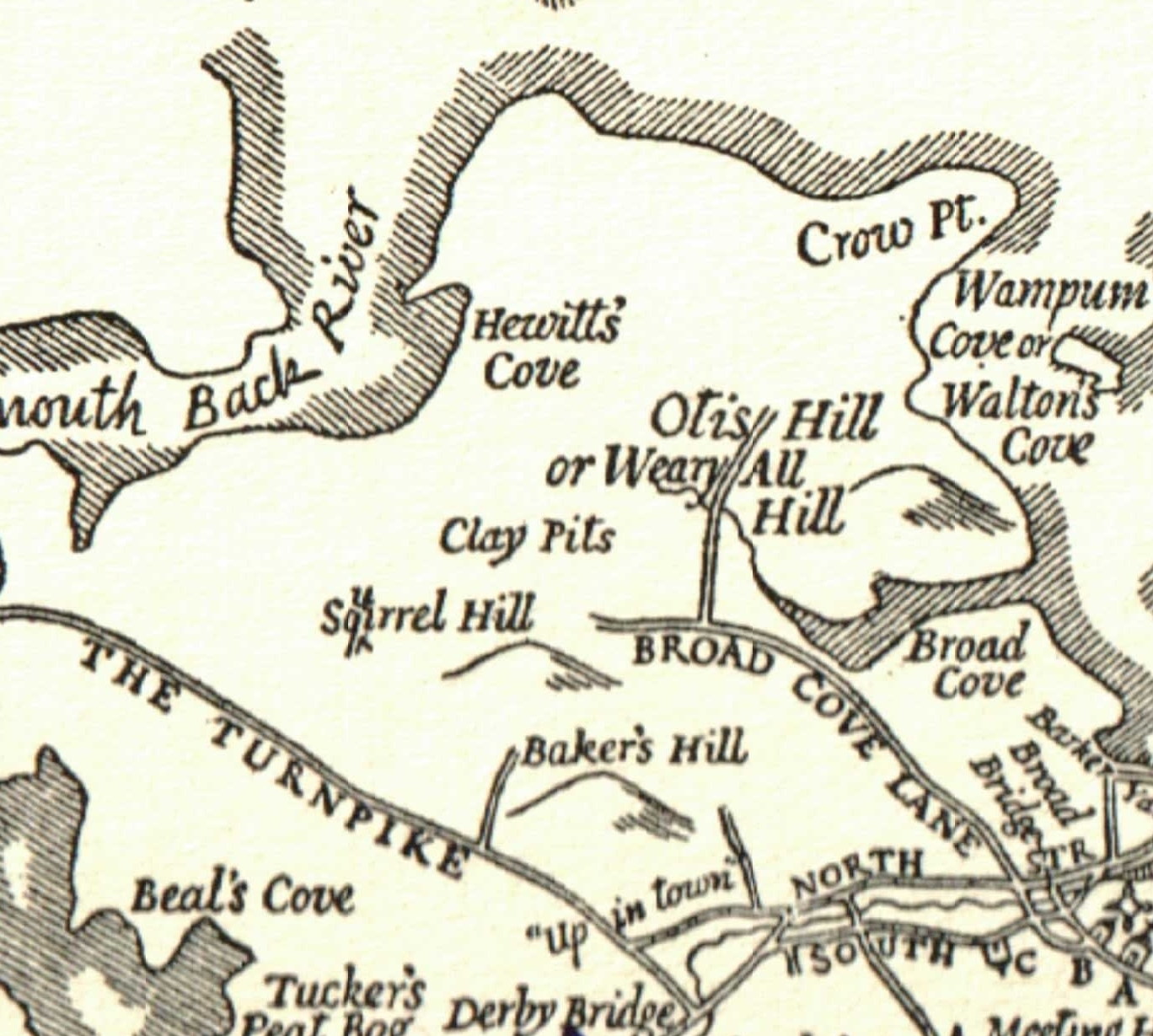
But it turned out that the rest of the story was nearby, in our Thaxter Family papers, because the unhappy petitioner was John Thaxter, Sr., who left a memorandum describing the resolution reached at Town Meeting, together with the “true copy” of the 17th century Town Meeting vote upon which he relied.  John Thaxter presented the dispute to Town Meeting on December 17, 1794.  He presented evidence that in June 1694, almost exactly 100 years previously, Josiah Loring had complained to the Town Meeting that he could not access his own pasture at the Great Lots.  The solution he had proposed, which was accepted by the Town, was the laying out of a public way between Broad Cove Lane and Goles Lane (the “Turnpike”) adjacent to the Great Lots and the Squirrel Hill Lots.  According to Thaxter’s memorandum, written the next day, here is what happened:

At a Legal town meeting in Hingham June ye 19th 1794.  The within votes of the Town [i.e., the 1694 record] were presented to the Town by John Thaxter as a memorial that the high way from Goles Lane to Broad Cove Street which has been passed & repassed on time immemorial is now stopped up by Thomas Hearsy erecting a stone wall across the same whereby said Thaxter is deprived from going to his pasture at great Lotts in a great measure.  As the meeting was thin the town thought there was a probability of said Thaxter & Hearsy settling the difficulty subsisting between them and they labored for an accommodation.  Said Thaxter then made said Hearsy a proposal.  As both of them had said they would not remove the wall, that if said Hearsy would send a hand he would another to remove the wall, which said Hearsy agreed to.  Then said Thaxter withdrew the memorial and nothing further was acted by the Town.  The wall was removed the next day.

So, with some encouragement (or pressure) from their neighbors, John Thaxter and Thomas Hersey settled their dispute, agreeing to share the job of removing the stone wall which Thaxter had proved was an obstruction on a public way.

Thaxter and Hersey were contemporaries, born two years apart in the early 1730s.  Hersey lived on Lincoln Street, Thaxter on South Street; both spent their entire lives in Hingham, except for military service and Thaxter’s years at Harvard College.  They must have known each other very well.  We don’t know what their personal relationship was or how this incident fit into it.  They have, however, provided us a glimpse into how local land use disputes were handled in a long-ago era.

Enjoying the “Cool Sea Breezes” at Hingham’s Old Colony House

The advent of mass transportation in the mid-19th century helped create the summer tourism industry that has been so important to our regional economy.  When New England and the Sea, an historical survey of our maritime heritage, addresses the rise of seaside resorts, it tips its hat to Hingham:  “. . . one had to have a summer house at the shore, or go to the White Mountains, or stay at one of the fashionable hotels—say, the Old Colony House at the head of the harbor in Hingham . . . .”

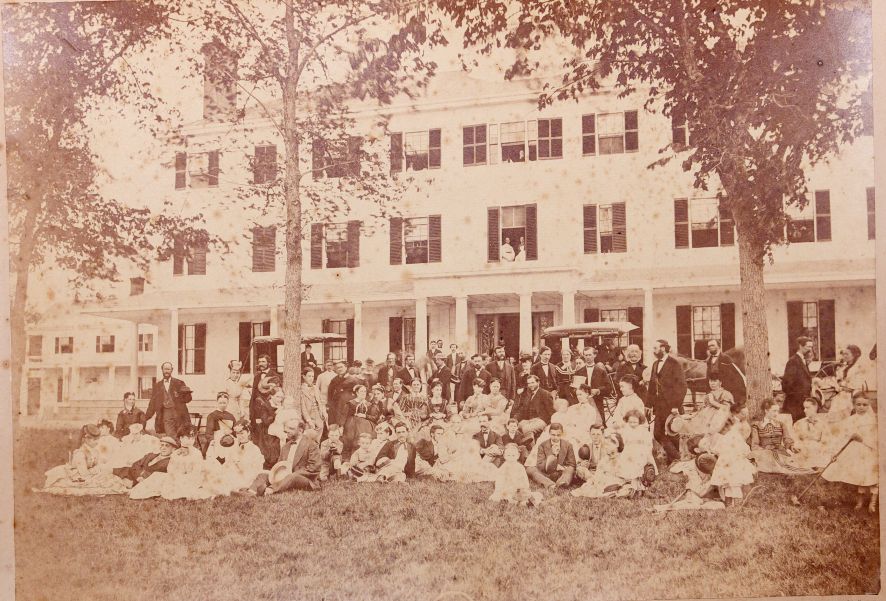
A gathering in front of the Old Colony House. Photograph from the archives at the Hingham Historical Society.

Built in 1832 by the Boston & Hingham Steamship Company, the Old Colony House was an early example of the symbiotic relationship between the infant transportation and recreation industries.  The steamboat General Lincoln made the trip from Boston to Hingham swift (around 75 minutes) and pleasant, while the Old Colony House, erected on Summer Street near Martin’s Lane, created a destination, increasing passenger traffic on the vessel.  The railroad came through Hingham in 1849, and one of the stops on the new South Shore Railroad, called “Old Colony House,” was close by the hotel, providing easy access from Boston—and soon thereafter, the opportunity to change trains for Nantasket.  (The station’s descendent is today’s Nantasket Junction stop on the MBTA Greenbush Line.)  After the Civil War, the great Nantasket hotels drew business away from the Old Colony House, which was in decline when it burned in 1872.

The Historical Society’s archives include a collection of the business papers of Alfred C. Hersey.  Among Hersey’s many business interests (largely in the shipping and transportation industries) was the Old Colony House, which the steamship company sold in the late 1830’s.  Hersey’s 21-page handwritten inventory of the hotel’s furnishings, made in May 1860, provides important detail about what a New England resort hotel of the 1860’s was really like.

The inventory faithfully describes the furnishings of each room of the hotel, including dining room, parlors, billiard room, bowling alley, and office, specifying quantities, materials, and state of repair.  In the “East Parlor,” for instance, guests could sit on their choice of 6 damask covered sofas (4 “slightly stained”), 1 stuffed arm chair, 13 black walnut stuff bottom chairs, a stuffed rocking chair, and 10 black arm chairs (which had among them, however, only 8 cushions).

A typical guest room was furnished with a bedstead, mattresses, bolster and pillow, bureau, washstand, looking glass, mosquito netting, chamber pot and cover, soap cup, mug, and curtains.  A servant’s room in the attic, by contrast, had a bedstead, mattress, bolster and pillow (“stained”), wooden chair, toilet table (“defaced”), “small” looking glass, basin and ewer, and soap cup.  (Servants’ rooms in the scullery appear to have had significantly fewer furnishings.)

The inventories of the kitchen and laundry provide detailed lists of equipment.  To launder the hotel linens and guests’ clothes required water casks, grease casks, basins, wash boards, starch pans, a mangle, clothes horses, brushes, 11 flat irons, iron racks, and an iron heater.

The contents of the kitchen and “pastry room” tell us about the hotel’s fare.  There were large and small frying pans, copper and iron sauce pans, a meat saw, large and small steamers, tin and copper baking and cake pans, iron cake molds, tin jelly molds, a gridiron, waffle irons, coffee pots, a tea chest, ice cream freezers, an ice cream chest, and an ice cream scoop.  The “pastry room” was furnished with a bed—the pastry cook must have needed to rise early.

In a series of travel letters published as A Trip to Boston in 1838, Enoch Cobb Wines wrote warmly of the

splendid and well-kept Old Colony Hotel, the refined social pleasures it affords, the noble view enjoyed from the observatory on its roof, and the cool sea breezes that almost enable you to put summer at defiance. . . . [It]t presented a gay and happy appearance.  The broad piazza which surrounds three sides of the house was thronged with smiling groups, in which a due intermixture of the gentler sex was not wanting . . . .

. . . There was an excellent band from Boston there, and we had the poetry of music, the poetry of motion, and the poetry of social happiness, all in high perfection; and afterwards the poetry of sound sleep in the cool air, for which the proprietor of the Old Colony seems to have made a perpetual contract.