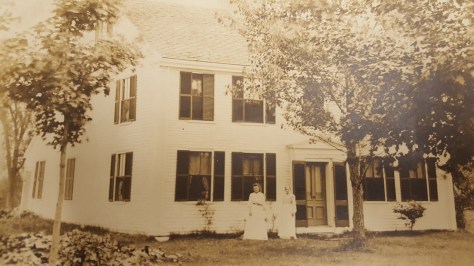
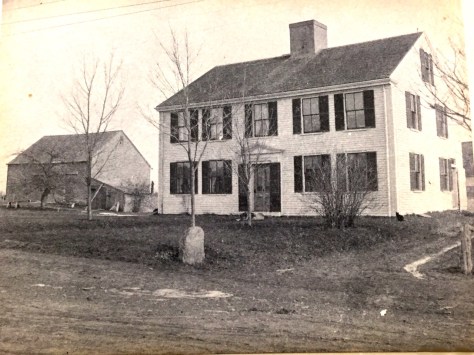
Over 350 years, the Benjamin Lincoln House was owned and used by 11 successive generations of the same extended family. In the late 19th and early 20th centuries it was occupied by the family of Roger Livingston and Ethel Bryant Scaife. Roger (1875-1951) was from Boston and a Harvard graduate from the class of 1897. Beginning in 1898 he worked for Houghton Mifflin Company, a Boston-based publisher, first as a contributor to The Atlantic Monthly and then later as an editor and director at the publishing house itself.


“Reception for Ethel Bryant and Roger Scaife,” 1906.
Roger married Ethel Bryant Scaife in 1906. Ethel (1876-1959) was what we would now call a socialite: she came from an upper middle class family, did not have a career, and spent much of her time engaged in clubs and homemaking responsibilities. She was a member of the Chilton Club, the Colonial Dames, and the English Speaking Union and was active in Trinity Church in Boston. Their union bridged the two’s colonial ancestry; Ethel was a descendant of General Benjamin Lincoln while Roger was a member of Society of Mayflower Descendants and the Society of Colonial Wars. After their wedding the two settled in Milton, Massachusetts, and maintained a home on Beacon Hill in Boston, where Roger stayed during the work week.

Portraits of Lauriston (top left), Elizabeth (top right), and Roger M. (bottom) Scaife, 1920’s.
Roger and Ethel had three children: Lauriston L. Scaife (1907-1970), Elizabeth (“Skiffy”) Scaife Beveridge (1910-1998), and Roger M. Scaife (1916-2001). Elizabeth was the one to later live in the house with her children, win it recognition as a National Historic Landmark, and inscribe the many objects, photographs, and documents throughout the house with the original owner’s name or the place it was from. Much of our knowledge of the Scaife family, as well as other generations of the Lincoln family before them, is due to her diligence and dedication to preserving their history.
Although the Scaifes spent the majority of their time at their other two homes, they still had occasional stays at “the family home” in Hingham, what we now refer to as the Benjamin Lincoln House. During many of these stays Roger would write poems about the house that speak to his reverence for the Lincolns. One of the earliest was “The Song of the Corner Cupboard,” written in 1907. In the second stanza he writes:
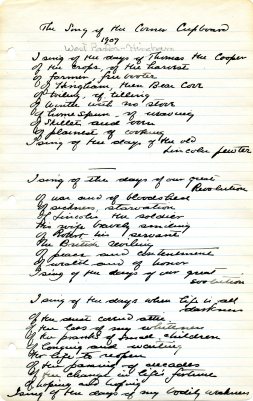
“The Song of the Corner Cupboard” from Roger L. Scaife’s Scrapbook (1907).
I sing of the days of our great Revolution
Of war and of bloodshed
Of sickness, starvation
Of Lincoln the soldier
His wife bravely smiling . . . .
In a later poem, written during a Christmas trip in 1948, Roger included the Scaifes in this lineage:
Eleven generations have enjoyed it’s shelter
Amid all the worlds bleak welter
The house has stood firm as a rock
With always a welcome for those who knock
The House has been a refuge true
In hard times and in good days too
The Lincolns, Crosbys, Bryants, Scaifes
May not be rich, but play it safe
They have always stood for what is right . . . .
Although the Scaifes spent less time in the house compared to other generations, their presence can still be seen throughout. This is primarily through the books. While prior generations wrote their names or other inscriptions inside, Roger and Ethel had bookplates inside of theirs.
A bookplate is a decorative label pasted into a book, usually on one of the front endpapers, indicating ownership of the book. In addition to the owner’s name the Latin phrase “ex libris,” translated as “from the library,” is often included on the label. As for the designs, they were either a design related to the book owner such as crest, coat of arms, or motto, or one commissioned by an artist. Bookplates were popular in the late 19th and early 20th century amongst those of Roger and Ethel’s class.
In the case of Roger and Ethel’s bookplate, they had commissioned Bruce Rogers. There is lacking documentation about the specifics of the bookplate commission. It is unclear when it was completed, what Roger and Ethel asked for initially, and to what extent each one’s input was honored.
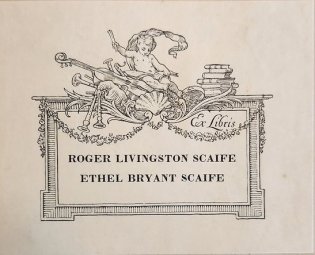
Printed bookplate found inside “Cape Coddities” by Roger Livingston Scaife.
What is left is only the bookplate itself, which consists of a small naked child reading a book laid across their lap and holding something, possibly rolled paper, in their right hand. The child is flanked by musical instruments on their right and books on their left. It is possible that these objects were meant to symbolize Ethel (the instruments) and Roger (the books). Ethel was known well enough for her musical talent that it was mentioned in the two’s wedding announcement shown earlier in this post. Books would only be natural for Roger as he was not only a writer and editor but an avid reader as well. The ivy strewn below the instruments and the frame enclosing their names were consistent with other design motifs by Bruce from this time period.
Bruce Rogers is best known as a typographer, but got his start as a book designer. His first notable position was at The Riverside Press in Cambridge, MA. The Riverside Press was owned by Henry Oscar Houghton, who would partner to create Houghton Mifflin Company in 1880 (now Houghton Mifflin Harcourt). In the 1900s and 1910s Roger oversaw the publishing of limited edition prints of literary classics with book cover designs by Bruce. It is likely during these years when the two were working together that Roger commissioned the bookplate, since there is currently no other time known that these two worked together professionally.
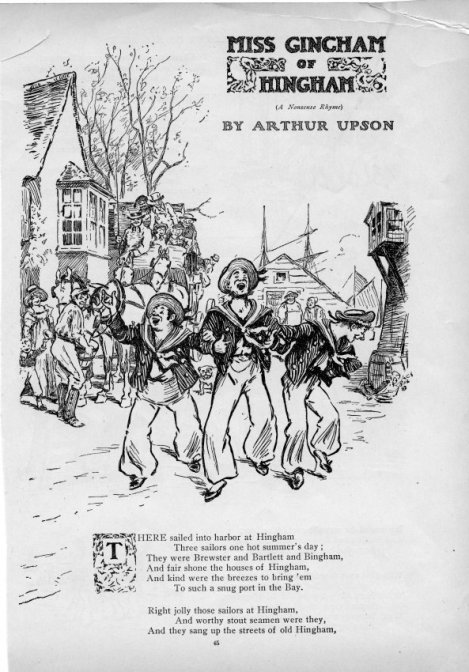
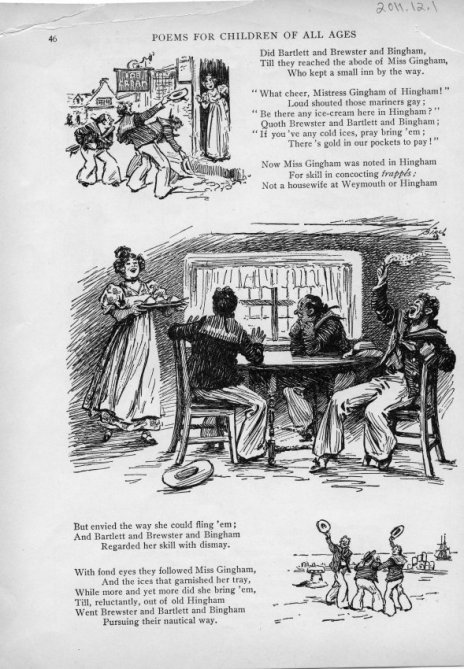
In addition to his nonfiction writing and work as an editor and director at Houghton Mifflin Company, Roger also wrote six books. They were published between 1913 and 1922: Confessions of a Debutante (1913); What daddies do: old-fashioned rhymes for new fangled kiddies (1916); Muvver and Me: old-fashioned rhymes for new fangled kiddies (1917); The Land of the Great Out-of-Doors (1920); Cape Coddities (1920); and The Reflections of a T.B.M. (1922). Most of them are light-hearted in nature, whether that be the nursery rhymes found in Muvver and Me and What Daddies Do, or the satirical tone found in The Life of a T.B.M. (Tired Business Man).
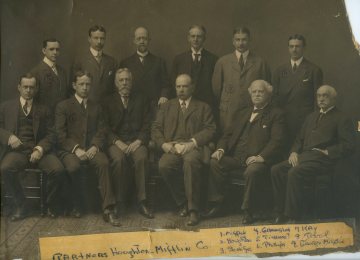
Houghton Mifflin partners, c. 1910 (R. L. Scaife, second row, on the far left). Annotation by Elizabeth Scaife Beveridge.
All were published through Houghton Mifflin Company under pseudonyms. There once again is no documentation of the reason for this choice. Roger had nonfiction pieces in newspapers and magazines published under his legal name, so he wasn’t opposed to being recognized for some of his writing. It’s not clear if this is something Roger wanted or if there were higher ups at Houghton Mifflin Company who made this decision. Cape Coddities marked the end of Roger’s attempts to be a published author . However, he continued to write for pleasure. The Christmas poem from 1948 is just one from a whole notebook of poems now in the archives of the Hingham Historical Society.
After 36 years at Houghton Mifflin Company Roger got a job as a vice president, director, and editorial advisor at Little, Brown and Company in 1934. He worked there until his retirement in 1948. From 1944 to 1948 he also worked as an interim director at Harvard University Press, which was considering closing due to losses in the 1930s. Roger was specifically contracted because of his successful track record at other publishing giants. During his short tenure at Harvard University Press, it was able to double its output and save itself from bankruptcy.
Roger chose to retire in 1948 due to increasing health problems. Up until his death he remained engaged with civic commitments in Milton, such as the Board of Trustees at the Library, as well as with Class leadership obligations for his Harvard class. Roger passed away in 1951 and was survived by Ethel and his children. Ethel lived until 1959, spending the last four years of her life in Hingham living with her daughter Elizabeth and her grandchildren in the “family home.”
Endnotes:
1. Harvard University’s Houghton Library has a collection of Bruce Rogers’ sketches from the late 19th and early 20th century, including one sketch and one mockup print of Roger and Ethel’s bookplate, where these motifs are shown in other bookplate designs as well as drawings and sketches. [Rogers, Bruce. Bruce Rogers papers and designs. Houghton Library, Harvard University.]
2. All images are of materials generously donated to the Hingham Historical Society by Rose Woodard and Franklin Beveridge–the last of the 11th generations of Lincoln descendants to own the Benjamin Lincoln House.
3. This post was written by Aurora Daniel who was the Hingham Historial Society’s 2023 Sally Hess Intern.
 Out of the Archives