Nature vs. Nurture: Consider the Spragues, Part 3

In this final part of my blog about the Sprague family, I’ll highlight descendants of Ralph Sprague, the oldest of the three brothers who came to the Massachusetts Bay Colony in 1628.

In the books written about Ralph Sprague and his family, Ralph is most highly regarded for his service to the Massachusetts Bay Colony.

In The Founding of Charlestown by the Spragues, A Glimpse of the Beginning of the Massachusetts Bay Settlement (1910), written by Henry H. Sprague, the author quotes the earlier historian Richard Frothingham, Jr., who wrote of Ralph Sprague in The History of Charlestown (1845):

He was a prominent and valuable citizen – active in promoting the colony.

The Spragues of Malden, Massachusetts (Hingham Historical Society archives)

And in The Spragues of Malden, Massachusetts, by George Walter Chamberlain, this is written about Ralph’s contributions:

Ralph Sprague served as a Deputy to the General Court from Charlestown, then including Everett, Malden, Melrose, Stoneham and Somerville, etc., in at least sixteen sessions and served on important committees many times. The fact that Mr. Sprague served with the most distinguished men of the Massachusetts Bay Colony so long indicates that he was a man of sound judgment and remarkable ability. His influence in the Colony was great.

While Ralph first built a home for his family in Charlestown, he was later given more land:

In 1638 the Town of Charlestown made a record of twelve lots of land which were granted to him. Five of these lots were on Mystic Side, out of which the town of Malden was formed in 1649.

Within a decade, Ralph Sprague was helping to establish the Town of Malden.

On 1 Jan. 1648/9, Lt. Ralph Sprague and nine other freemen . . .  petitioned the General Court of Massachusetts Bay Colony, for a separation from Charlestown, and Misticke side became a distinct town of the name Maulden, 11 May 1649.

This post is intended to focus on historically prominent descendants of Ralph Sprague of Charlestown and Malden who were 19th and 20th century scientists, inventors, and industrialists. But permit me a diversion first to highlight some of Ralph’s descendants who made their mark during their time, though they are less remembered now:

Dr. John C. Sprague (1754-1803) of Malden, a descendant of Ralph’s son John Sprague, did military service as a surgeon, was twice captured by the British, and was imprisoned for a time in Ireland. After the War for Independence, he became a schoolteacher and also was involved in Malden Town government, serving on a wide range of Committees. At a special Town Meeting in 1797, Dr. Sprague was elected both to a committee on education and to a committee to raise money for the encouragement of singing. In noting this specific service, the author of The Spragues of Malden adds: “Thus was Dr. Sprague identified with the best things of his native town in the reconstructive period following the Revolutionary War.”
Phineas Sprague (1777-1869) of Malden—the 5th in a line of men named Phineas descended from Ralph’s son John, was a delegate to the Constitutional Convention of Massachusetts in 1820, at which he spoke on the Declaration of Rights, saying: “It is tyranny in the highest degree to compel a man to worship in a manner contrary to the dictates of his conscience. Religion is an affair between God and our own souls.”

Phineas’ liberal views regarding religion, like those we in Hingham associate with the minister at First Parish, Ebenezer Gay (1696-1787) in the early days of what was first known as the Arminian movement, eventually led Phineas to withdraw from First Parish of Malden. Phineas later would be involved in establishing a Universalist church in Malden.

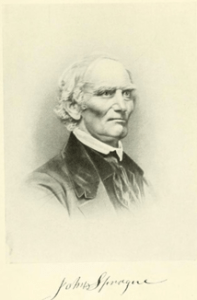
Dr. John’s son, John Sprague (1781-1852) of Malden, like his cousin Phineas, espoused liberal views of religion at a time when religious congregations in New England were dividing due to differing theological views during what would be known in Protestantism as the Great Awakening, and then due to differing political views: Federalism vs. States Rights. (In Hingham, these political divisions led to the founding of New North Church by a group of Federalist-leaning residents including Major General Benjamin Lincoln.)
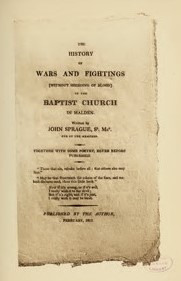
John was an original member of the First Baptist Church of Malden but later found himself unwelcome in the church due to his Arminian views vs. the Calvinist doctrines of the minister at the time. In 1812, John Sprague wrote and self-published a pamphlet that caused quite a stir: The History of Wars and Fightings (Without Shedding of Blood) in the Baptist Church in Malden. A subtitle reads “Together with Some Poetry, Never Before Published.”

On April 12, 1812, the members of the Baptist church based his exclusion from the congregation on the publication of this book. While John Sprague was a shoemaker by trade, he enjoyed writing poetry—and a few of his humorous poems are included in the The Spragues of Malden. 

John was selected by the town of Malden for many committees, among them: the Bunker Hill Monument Association formed to raise money for the monument’s construction, and the committee formed by the town in 1844 to choose the best path through Malden for what was then called the Maine Railroad.  I think many of those who serve on Town Committees in Hingham today would have enjoyed the company of shoemaker John Sprague of Malden.

Horatio Sprague Sr. (1784-1848), a descendant of Ralph’s son John, was born in Boston, but most associated with Gibraltar, where he permanently resided from 1815 until his death. Horatio was a merchant and ship owner in Gibraltar, a British territory on the tip of the Iberian Peninsula, when he was chosen to be U.S. Consul there in 1832.  His duties, largely tied to facilitating commerce, were not onerous, but his health declined.

His son, Horatio Jones Sprague Jr. (1823-1901), who was born in Gibraltar and spoke several languages, was appointed after his father’s death as U.S. Consul in Gibraltar and served in that post for 53 years. His consular workload was greater than his father’s due to the opening of the Suez Canal in 1870, and two wars that had an impact during his tenure: the Civil War in the U.S. (1861-65) and the Spanish-American War (1898.) Horatio Sprague Jr. also broadened the business portfolio he’d developed with his father when he became an importer of tobacco to Gibraltar. Horatio died in 1901, and would be succeeded as U.S. Consul by his son, Richard Sprague (1871-1934.) 

Details about this now-unusual Sprague diplomacy dynasty is on this website, serving fans of James Joyce. Why would such a James Joyce website include information about the Spragues of Gibraltar? I was surprised to learn that James Joyce’s famous work Ulysses (first serialized beginning in 1918, then published as a book in 1922) has a Horatio Sprague Jr. reference, as “old Sprague the consul”:

. . . when general Ulysses Grant whoever he was or did supposed to be some great fellow landed off the ship and old Sprague the consul that was there from before the flood dressed up poor man and he in mourning for the son.

While James Joyce’s Ulysses is a work of fiction, this reference to Ulysses Grant visiting Gibraltar is based on historic fact. The then former president, Ulysses Grant visited Gibraltar as part of a world tour in 1878, when the U.S. Consul there was Horatio Jones Sprague, Jr.

Now, on to those descendants of Ralph Sprague who made lasting contributions to science, innovation, and industry in the 19th and 20th centuries.

Charles H. Sprague (1827-1904) of Malden descended from Ralph’s son Phineas (1637-1690), who was among the Malden men who fought in King Philip’s War.
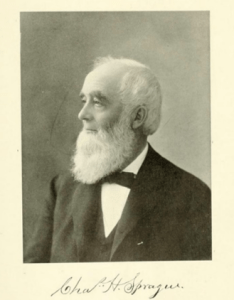
Charles served his local community as a member of the Malden City Council, following in the public service tradition of many Spragues over the centuries. And like other notable Spragues, Charles was a scientist as well as a prominent business leader.

In 1849, Charles Sprague was appointed by the United States Government to the editorial staff of the American Ephemeris and Nautical Almanac, where he reported on astronomical observations. He held this position for fifteen years. American Ephemeris and Nautical Almanac was published, under the authority of the Secretary of the Navy, from 1855 to 1980, containing information necessary for astronomers, surveyors, and navigators.  The Preface tothe 1855 edition reports “the preparation of this work was begun in the latter part of the year 1849, in accordance with an act of Congress, approved on the 3d of March of that year.” The publication continues now as The Nautical Almanac.

Charles went on, in 1870, to establish the Charles H. Sprague Company, a privately-held power company focused on the market for coal during the early part of the industrial age. During World War I, the company became the major supplier of coal to America’s European allies. To facilitate the shipment of coal across the Atlantic, he also founded the Sprague Steamship Company which operated a large fleet of vessels serving many company-owned terminals.
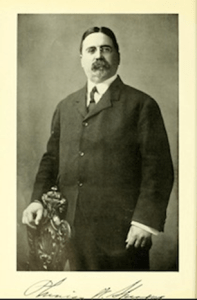
Charles’ son and Malden native Phineas Warren Sprague (1860-1943) had been a partner of what had become C.H. Sprague & Son, and after his father’s death he assumed full control of the business. The company would later expand into oil and be renamed Sprague Energy. In 1942, the U.S. Government selected Sprague Energy to manage its wartime coal shipment program.
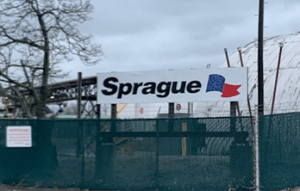
Sprague Energy, Quincy, Mass.

Charles’ grandson, Phineas Sprague Jr. (1901-1977) joined company management after World War II service in the Navy, from which he retired as a Lieutenant Commander. While the family sold its remaining interests in the company in 1970, the Sprague Energy brand is still in use, and has expanded into natural gas—including here on the South Shore, where the Sprague Energy brand is emblazoned at an oil terminal on Southern Artery along the Town River in Quincy, MA.

Frank Julian Sprague (1857-1934), another descendant from Ralph’s son John, was born in Milford, CT., was raised in North Adams, MA by an aunt and other relatives after his mother’s death when he was 9 years old. As a boy, Sprague became fascinated by the textile mills and related manufacturing operations in North Adams. He did quite well in school and went on to Annapolis where he studied electrical engineering. He worked briefly with Thomas Edison, but his major contributions came after he began working on his own inventions, for the electric motor, electric railways and electric elevators. His patented inventions made the electric streetcar a reliable means of transit for emerging “streetcar suburbs.” I enjoyed reading the biography: Frank Julian Sprague, by William D. Middleton, MD., published by Indiana University Press in 2009 (cover shown here), which chronicles his life as well as his many inventions.
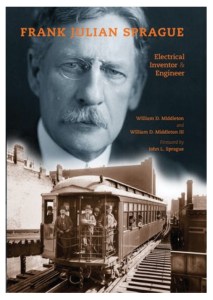
Frank lived with his family in New York City for much of his life. As a graduate of the Naval Academy and former Naval Officer, Frank was buried at Arlington National Cemetery.

Robert (1900-1991) and Julian (1903-1960) Sprague, sons of Frank Julian Sprague, became the co-founders, in 1926, of one of the largest electric components companies of its time. The Sprague Specialties Company, founded by the brothers in Quincy, MA, moved to North Adams, MA in 1930.  They chose North Adams due to their father’s fondness for his boyhood there. In 1942 the company changed its name to the Sprague Electric Company.

The company expanded in 1942—buying the factory buildings that previously housed the Arnold Print Works textile firm. The 16 acres of grounds on the Hoosic River in North Adams, Massachusetts, encompass a vast complex of 19th-century mill buildings and occupy nearly one-third of the city’s downtown business district. This was the home of Sprague Electric Company until 1985. At its peak, Sprague Electric was one of the largest electronic component manufacturers in the world.

John Louis Sprague, Sr. (1930-2021), Robert’s son, would be the last Sprague to head the Sprague Electric Company.  John Sprague was a chemist who joined the company soon after completing his PhD at Stanford in the late 1950s. He would spend 11 years as president of Sprague Electric. John’s son, John Sprague Jr., wrote a blog, available at www.spraguelegacy.com about his dad’s role with the company. The website also chronicles the history of the Sprague Electric Company.

The Sprague Electric Company was sold in 1976. John Sprague was still president (under the new ownership) in 1984 and 1985 when company owner Penn Central moved the company’s international headquarters from the Berkshires to Lexington and eliminated 700 Sprague jobs in North Adams.  That move, the Berkshire Eagle later reported, “left a legacy of bitterness in the city,” even though Sprague didn’t completely leave North Adams until the early 1990s.

Innovation and the Arts
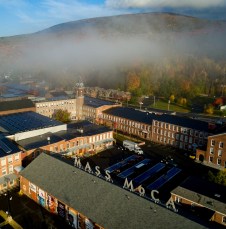
(Photo courtesy of MassMoCA.org)

Given the history of this family in both the arts and sciences, it seems so appropriate that what was the Sprague factory complex in North Adams has become Mass MOCA—an art museum, known for its embrace of innovation across the visual arts and, in more recent history, performing arts as well.

After years of planning, fund-raising and some additional construction on the former factory site, MASS MoCA celebrated its opening in 1999, as the center’s website says: “marking the site’s launch into its third century of production, and the continuation of a long history of innovation and experimentation.”

That “long history of innovation and experimentation” certainly applies to the contributions over generations of the creative Sprague family as well. Perhaps both nature and nurture played a role. An impressive legacy.

SOURCES not otherwise referenced:

Portraits of John, Charles H., and Phineas W. Sprague from Historic Homes and Places and Genealogical and Personal Memoirs Relation to the Families of Middlesex County, Massachusetts, vol. III (Cutter, ed., 1908)

Obituaries of Charles H. Sprague published in the Boston Daily Globe, July 1, 1904; and the Springfield Republican (Massachusetts) June 30, 1904.

The History of Malden, Massachusetts 1633-1785

Malden Past and Present: 1649-1899, pub. May, 1899.

The website www.spragueenergy.com

Special thanks to my friend Paula Bagger who provided many of the images of items from the Hingham Historical Society archives–for part 2 of this blog in particular.

                                                                                                           ################

Books as Heritage: Inside the Scaife Family Collection

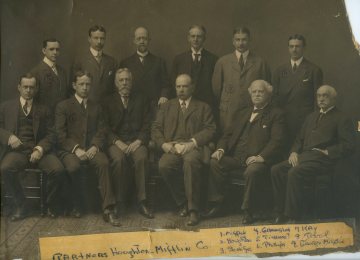
Over 350 years, the Benjamin Lincoln House was owned and used by 11 successive generations of the same extended family. In the late 19th and early 20th centuries it was occupied by the family of Roger Livingston and Ethel Bryant Scaife.  Roger (1875-1951) was from Boston and a Harvard graduate from the class of 1897. Beginning in 1898 he worked for Houghton Mifflin Company, a Boston-based publisher, first as a contributor to The Atlantic Monthly and then later as an editor and director at the publishing house itself.

“Reception for Ethel Bryant and Roger Scaife,” 1906.

Roger married Ethel Bryant Scaife in 1906. Ethel (1876-1959) was what we would now call a socialite: she came from an upper middle class family, did not have a career, and spent much of her time engaged in clubs and homemaking responsibilities. She was a member of the Chilton Club, the Colonial Dames, and the English Speaking Union and was active in Trinity Church in Boston. Their union bridged the two’s colonial ancestry; Ethel was a descendant of General Benjamin Lincoln while Roger was a member of Society of Mayflower Descendants and the Society of Colonial Wars. After their wedding the two settled in Milton, Massachusetts, and maintained a home on Beacon Hill in Boston, where Roger stayed during the work week.

Portraits of Lauriston (top left), Elizabeth (top right), and Roger M. (bottom) Scaife, 1920’s.

Roger and Ethel had three children: Lauriston L. Scaife (1907-1970), Elizabeth (“Skiffy”) Scaife Beveridge (1910-1998), and Roger M. Scaife (1916-2001). Elizabeth was the one to later live in the house with her children, win it recognition as a National Historic Landmark, and inscribe the many objects, photographs, and documents throughout the house with the original owner’s name or the place it was from. Much of our knowledge of the Scaife family, as well as other generations of the Lincoln family before them, is due to her diligence and dedication to preserving their history.

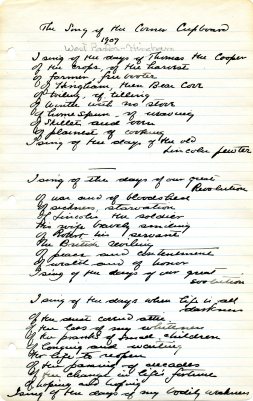
Although the Scaifes spent the majority of their time at their other two homes, they still had occasional stays at “the family home” in Hingham, what we now refer to as the Benjamin Lincoln House. During many of these stays Roger would write poems about the house that speak to his reverence for the Lincolns. One of the earliest was “The Song of the Corner Cupboard,” written in 1907. In the second stanza he writes:

“The Song of the Corner Cupboard” from Roger L. Scaife’s Scrapbook (1907).

I sing of the days of our great Revolution
Of war and of bloodshed
Of sickness, starvation
Of Lincoln the soldier
His wife bravely smiling . . . .

In a later poem, written during a Christmas trip in 1948, Roger included the Scaifes in this lineage:

Eleven generations have enjoyed it’s shelter
Amid all the worlds bleak welter
The house has stood firm as a rock
With always a welcome for those who knock
The House has been a refuge true
In hard times and in good days too
The Lincolns, Crosbys, Bryants, Scaifes
May not be rich, but play it safe
They have always stood for what is right . . . .

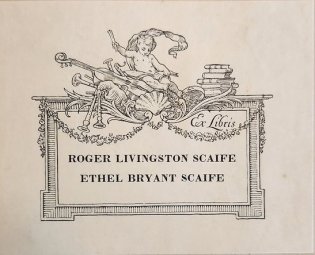
Although the Scaifes spent less time in the house compared to other generations, their presence can still be seen throughout. This is primarily through the books. While prior generations wrote their names or other inscriptions inside, Roger and Ethel had bookplates inside of theirs.

A bookplate is a decorative label pasted into a book, usually on one of the front endpapers, indicating ownership of the book. In addition to the owner’s name the Latin phrase “ex libris,” translated as “from the library,” is often included on the label. As for the designs, they were either a design related to the book owner such as crest, coat of arms, or motto, or one commissioned by an artist. Bookplates were popular in the late 19th and early 20th century amongst those of Roger and Ethel’s class.

In the case of Roger and Ethel’s bookplate, they had commissioned Bruce Rogers. There is lacking documentation about the specifics of the bookplate commission. It is unclear when it was completed, what Roger and Ethel asked for initially, and to what extent each one’s input was honored.

Printed bookplate found inside “Cape Coddities” by Roger Livingston Scaife.

What is left is only the bookplate itself, which consists of a small naked child reading a book laid across their lap and holding something, possibly rolled paper, in their right hand. The child is flanked by musical instruments on their right and books on their left. It is possible that these objects were meant to symbolize Ethel (the instruments) and Roger (the books). Ethel was known well enough for her musical talent that it was mentioned in the two’s wedding announcement shown earlier in this post. Books would only be natural for Roger as he was not only a writer and editor but an avid reader as well. The ivy strewn below the instruments and the frame enclosing their names were consistent with other design motifs by Bruce from this time period.

Bruce Rogers is best known as a typographer, but got his start as a book designer. His first notable position was at The Riverside Press in Cambridge, MA. The Riverside Press was owned by Henry Oscar Houghton, who would partner to create Houghton Mifflin Company in 1880 (now Houghton Mifflin Harcourt). In the 1900s and 1910s Roger oversaw the publishing of limited edition prints of literary classics with book cover designs by Bruce. It is likely during these years when the two were working together that Roger commissioned the bookplate, since there is currently no other time known that these two worked together professionally.

In addition to his nonfiction writing and work as an editor and director at Houghton Mifflin Company, Roger also wrote six books. They were published between 1913 and 1922: Confessions of a Debutante (1913); What daddies do: old-fashioned rhymes for new fangled kiddies (1916); Muvver and Me: old-fashioned rhymes for new fangled kiddies (1917); The Land of the Great Out-of-Doors (1920); Cape Coddities (1920); and The Reflections of a T.B.M. (1922).  Most of them are light-hearted in nature, whether that be the nursery rhymes found in Muvver and Me and What Daddies Do, or the satirical tone found in The Life of a T.B.M. (Tired Business Man).

Houghton Mifflin partners, c. 1910 (R. L. Scaife, second row, on the far left). Annotation by Elizabeth Scaife Beveridge.

All were published through Houghton Mifflin Company under pseudonyms. There once again is no documentation of the reason for this choice. Roger had nonfiction pieces in newspapers and magazines published under his legal name, so he wasn’t opposed to being recognized for some of his writing. It’s not clear if this is something Roger wanted or if there were higher ups at Houghton Mifflin Company who made this decision.  Cape Coddities marked the end of Roger’s attempts to be a published author . However, he continued to write for pleasure. The Christmas poem from 1948 is just one from a whole notebook of poems now in the archives of the Hingham Historical Society.

After 36 years at Houghton Mifflin Company Roger got a job as a vice president, director, and editorial advisor at Little, Brown and Company in 1934. He worked there until his retirement in 1948. From 1944 to 1948 he also worked as an interim director at Harvard University Press, which was considering closing due to losses in the 1930s. Roger was specifically contracted because of his successful track record at other publishing giants. During his short tenure at Harvard University Press, it was able to double its output and save itself from bankruptcy.

Roger chose to retire in 1948 due to increasing health problems. Up until his death he remained engaged with civic commitments in Milton, such as the Board of Trustees at the Library, as well as with Class leadership obligations for his Harvard class. Roger passed away in 1951 and was survived by Ethel and his children. Ethel lived until 1959, spending the last four years of her life in Hingham living with her daughter Elizabeth and her grandchildren in the “family home.”

Endnotes:

1. Harvard University’s Houghton Library has a collection of Bruce Rogers’ sketches from the late 19th and early 20th century, including one sketch and one mockup print of Roger and Ethel’s bookplate, where these motifs are shown in other bookplate designs as well as drawings and sketches.  [Rogers, Bruce. Bruce Rogers papers and designs. Houghton Library, Harvard University.]

2. All images are of materials generously donated to the Hingham Historical Society by Rose Woodard and Franklin Beveridge–the last of the 11th generations of Lincoln descendants to own the Benjamin Lincoln House.

3.  This post was written by Aurora Daniel who was the Hingham Historial Society’s 2023 Sally Hess Intern.

Christmas Greetings from the Pacific Theater

Meg Ferris Kenagy, author and chronicler in this space of her family’s history in Hingham and beyond, recently donated three Christmas cards sent home to Hingham by her father and two of her uncles during their service in the U.S. military during World War II.  Each young man was stationed in the Pacific Theater–far from home–and each remained away for several years, with his only contact with loved ones coming via cards and letters.  These three holiday cards, therefore, are more than novelty items that look so different from cards we are sending each other right now. Rather, they are also a tangible reminder during the holiday season of how fortunate most of us are to be able to celebrate with those nearest to us.

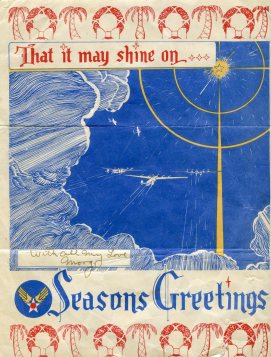
Hingham native Oliver L. (“Morg”) Ferris (1918-1985) served in the Army Air Corps as an airplane mechanic stationed in Hawaii and Guam, achieving the rank of Sergeant.  He was a married man when he entered the service; while he was abroad, his wife, Margaret (“Rita”) Ferris, lived with her parents, the Scanlans, in Dorchester. For Christmas 1944, Morg sent Rita and her parents an Army Air Corps Christmas card which he signed on the front: “With all my love, Morg.”  The card, postmarked December 9, 1944, shows aircraft in formation flying out of clouds towards what looks like a Christmas star.  Between border decorations of palm trees and holiday wreaths at the top and bottom, it includes an inspirational, mission-driven message: “That It Might Shine On.”
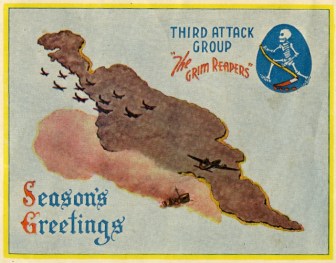
Morg’s younger brother Richard Ferris (1921-2016) was also serving in the Pacific with the Army Air Corps, but his choice of Christmas card could not have been more different! Richard served in the National Guard from 1939 to 1940 and, from 1941 to 1945, with the Army Air Corps as a member of the 3rd Bomber Group, which took the nickname “The Grim Reapers.”

Richard’s card features the outline of the island of New Guinea drawn with an overlay of a burning ship and attacking airplanes.  The emblem of the “Grim Reapers”–a skeleton carrying a bloody scythe–is printed in the upper right, while “Season’s Greetings” is printed in red and blue at the bottom left.  The printed message on the inside is perhaps a bit jarring for a greeting card:

This is our busy season / We hope you’ll excuse us, please

The Grim Reapers have to harvest / Those sons of the Nipponese.

We can only pause a moment / To wish you Christmas Cheer;

But this we guarantee you: / Peace during the Coming Year. 

The card is signed in pencil, “Richard.”

While the card is undated and bears no postmark, the context suggests it may have been sent for Christmas 1943, when the Third Bomber Group was indeed very “busy” with aerial bombing of New Guinea, as the allies fought a lengthy campaign to win New Guinea, which had been invaded by the Japanese in 1942. (Shown here: the 3rd  Bomber Group attacks Japanese ships in Simpson Harbor, New Guinea, Nov. 2, 1943.  Photo courtesy of the U.S. Naval Historical Center.) 
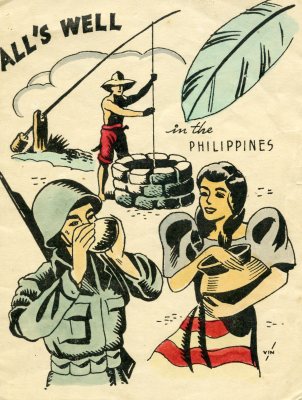
Dorchester native Edward Scanlan (1920-1965) was Rita Ferris’ brother. and Morg and Richard’s brother-in-law.  He served in the Navy as a marine engineer and was stationed in the Philippines.  His undated card, sent to Morg and Rita, riffs on exotic travel posters of the day, featuring a four-color picture of a G.I. drinking from a coconut shell or wooden bowl offered by a native woman, while a native man operates a well nearby.  “All’s Well in the Philippines,” the card reassures the recipient (albeit with a very bad pun).  Inside, Ed has carefully handwritten the names of various cities in the Philippines in a style suggestive of steamer trunk labels and wrote:
Greetings Rita and Morg, We may leave the P.I.’s today or tomorrow for Finchauen, New Guinea; we aren’t sure yet. That is, I haven’t decided.  I’d like to send Morg’s family a card but I don’t know the address so please give them my regards.  See you in the funny papers.  Keep smiling, Big Brother Ed.

On the back of the card, Ed added a wistful postscript:  You’re on the right side of the ocean; when you’re in the good old U.S.A.

Happily, all three young men returned home.

Morg returned home to Rita, and they had seven daughters, including Meg Kenagy, the donor of these cards.  Richard married Muriel Richards and served in the Hingham Fire Department from 1947 to 1967, achieving the rank of Lieutenant.  When Ed returned, he married Pauline Russell and also became a firefighter, for the Boston Fire Department.

The Farm Hills Civic Society

Individually we are ineffective, united we achieve results.

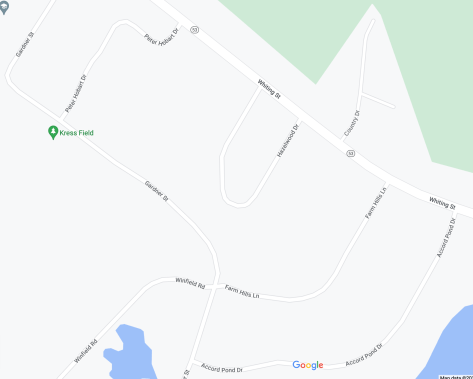
While researching my neighborhood around Peter Hobart Drive, I noticed that information about its history was limited in comparison to other parts of town. The road connects to upper Gardner Street, an area whose history extends to the early days of Hingham’s establishment. Various smaller streets branch off and create an entanglement of roads that forms our neighborhood community. My street was named after the Reverend Peter Hobart, one of the original settlers of Hingham and a pastor of the Town’s first church. However, the life of this neighborhood only stretches back to the early twentieth century, far later than the time period when Hobart lived.

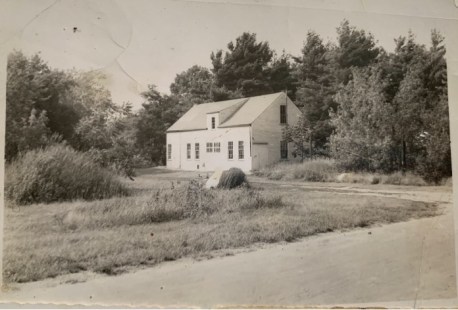
The chicken barn that started the neighborhood c. 1963

Development began in 1938 with a chicken barn hiding behind an old bucket factory, and the rest of the houses were constructed throughout the fifties and sixties. To my dismay, much of Hingham’s historical research does not extend beyond World War II but rather focuses on the original era of English settlement. Although newly developed areas of town were not involved in Hingham’s establishment, they illustrate the pathway of change taken throughout Hingham’s existence.

The neighborhoods of upper Gardner Street have contributed greatly to the town’s politics and communal activities for the past few decades. The concern that initially brought the Farm Hills Civic Society together involved a proposal to extend Route 3 into the upper Gardner area. Residents worried that adding a busy highway in the middle of the neighborhood would  negatively affect the area’s character and interfere with the neighborhood’s tranquil and hospitable personality. In collective agreement that this proposal would create a great disturbance, residents collaborated to prevent the extension from being constructed.

Writing articles and calling meetings to present their views to others, the group achieved success in preventing the extension. This communal organization endures, still presenting their collective ideas for improvements to the neighborhood while fighting against town proposals that would threaten the area’s character.

Throughout the organization’s life, it has accomplished a variety of goals, both small and large. Creating a sense of community has been a principal goal of the Farm Hills Civic Society since it first began. One manner of accomplishing this has been hosting social events, such as annual Easter egg hunts and block parties. Involving neighbors in enjoyable communal activities enhanced the feeling of togetherness necessary for the FHCS to continue working for the benefit of the community as a whole. These events often catered to child residents, indicating the group’s desire to create a positive environment for families to raise their children.

According to an early resident of Peter Hobart Drive, Mary Thomas, many families moved from the Boston area to suburban towns, considered the “countryside” in the fifties, to enjoy the improved school systems, and today the neighborhood remains home to many families with young children. Consequently, many of the FHCS’s smaller goals centered on maintaining a safe and welcoming environment for children to grow up in. In the late seventies, the association prevented Pilgrim Arena from gaining a liquor license. This popular ice rink is often frequented by children for its exceptional activities and sports practices, and allowing such an establishment to sell liquor seemed inappropriate to the FHCS. The group also advocated for the preservation of safety in areas within the neighborhood where children often played. The same year as the ice rink victory, the society prevented an access road from being constructed through Kress Field. This plot was donated to the town to allow for a children’s playground to be built, and today it is a beloved part of the neighborhood’s child-friendly environment. In the early 2000s, they petitioned for the installation of a four-way stop at the intersection of Gardner Street, Winfield Lane, and Farm Hills Lane in order to preserve safety for families living near this area.

A 1969 newspaper article by Debra K. Piot in which the Thomas’s explain that they bought their home “looking for family roots in Hingham”

Just a few years after the FHCS was first incorporated, it faced a significant concern presented by the town government. The town provided the Selectman with permission to determine the relocation process of Route 228 with state officials. The six-lane highway would have cut through the Gardner Street neighborhoods, polluting the water supply with oil and salts while removing up to eighty-five homes around Farms Hills. To avoid the devastation this relocation would have caused, the FHCS united to defeat the proposal, which had been presented two separate times.

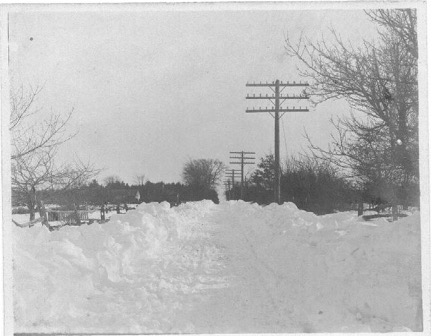
Gardner Street in a snow storm c. 1898

One of the Farm Hills Civic Society’s most notable accomplishments occurred between the years 1999 and 2000. A real estate company known as Mills Corporation of VA proposed a plan to construct a mega-mall where the South Weymouth Naval Air Station was once located. The development would have needed a connector road to be structured through the neighborhood, causing endless traffic on the surrounding streets. When the residents of the Farm Hills Area learned of this proposal, local town and state officials were already finalizing negotiations, explaining to the FHCS that the project was a “done deal.” However, neighbors rallied together, publishing newspaper articles to educate fellow townspeople about the issues this connector road would cause. With the tide turning in their favor, the FHCS called a town meeting, demonstrating the community support that their efforts had garnered and disrupting the supposedly “already decided” project.

The FHCS has seen incredibly dedicated presidents and members over the years. Notably, Stephen Kelsch served as president during the eighties, and members of his community remember and admire his efforts. He focused much of his attention on the effects of development in the South Hingham area, and current residents appreciate the enduring accomplishments he allowed the FHCS to achieve. Kelsch, sadly, passed in 2013, but his impact on the town’s politics remains apparent. Alongside the FHCS, he involved himself in multiple town committees and historical associations, including the Hingham Historical Society.

Current resident of Farm Hills Lane, Judy Kelley, has been an active member of the FHCS for many years. Her efforts in vocalizing the ideas and opinions of the FHCS have tremendously aided the accomplishment of many of the neighborhood’s goals. One significant issue that she helped the neighborhood overcome was the impending development of a substantial apartment complex near the upper Gardner area. Between the years 2011 and 2013, a development company known as AvalonBay planned to replace 18.5 acres of wooded area on Recreation Park Drive with an apartment complex comprised of sixteen buildings and one hundred seventy-seven individual apartments. This location was chosen to avoid specific town zoning regulations that inhibit crowded population densities. The construction of these apartments would have also required an access road leading into the neighborhood from Deerfield Road. This development would have resulted in multiple four-story housing complexes squeezing uncomfortably into the small streets of upper Gardner, inevitably increasing congestion on nearby roads and highways. Judy Kelley explained in an interview with Jeff Keating from WGBH News that the development would not have been accepted if the size of the land and the community were taken into greater consideration. Ultimately, with the help of the FHCS, the town selectmen passed a proposal to utilize the land for further development of the South Shore Industrial Park.

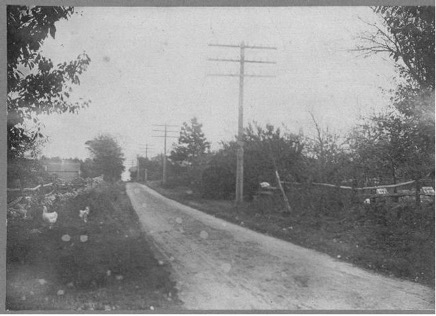
Gardner Street (with stone walls and chickens), c. 1900

Documents describing the accomplishments of the FHCS express: “Individually we are ineffective, united we achieve results.” This statement perfectly depicts the organization’s dedication to creating a supportive community and advocating for the best interests of the entire neighborhood. The community still remains politically active, with residents involved in various aspects of the town’s government, and the Farm Hills Civic Society continues to advocate for the good of the neighborhood under the current president, Ted Healy, who has served since 2014. Former residents believe that the group is more dynamic now than ever before due to dedicated leadership over the years.

The author, Ella Kennedy, is a member of the Hingham High School Class of 2022.  She participate in the Hingham Historical Society’s high school intern program during the fall term 2021.    

Marion Teague, Hingham History Maker

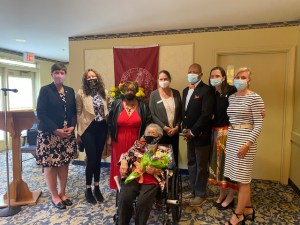
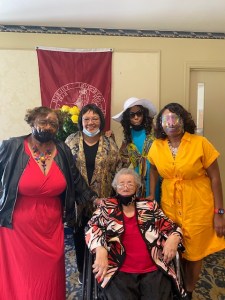
Hingham History Makers Awards Ceremony, May 14, 2021. Photo courtesy of Veronica Hodges

Marion L. Teague, Hingham History Maker

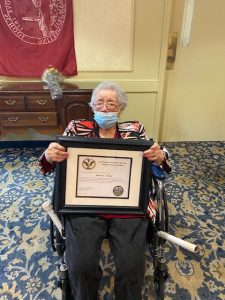
On Friday, May 14, 2021, the Hingham Historical Society awarded Marion Teague the designation “Hingham History Maker,” to honor her pioneering role in researching and preserving the history of Black and Indigenous people in Hingham.  At a necessarily small (owing to COVID restrictions) ceremony at Harbor House in Hingham, State Rep. Joan Meschino presented a citation from the Massachusetts House and Senate to 98-year old Marion and congratulated her on a “life well-lived” in the Town of Hingham.  Paula Bagger, President of the Society, spoke about Marion’s eventful life and work and presented a framed “History Maker” award.  Paula’s remarks may be read here.  Additional tributes to Marion were offered by Elizabeth Dings, on behalf of the Hingham Historical Commission; Joseph Collymore, of Harbor Media and also a longtime family friend; the Rev. Geoffrey Dana Hicks of Hingham’s First Baptist Church; and Marian’s daughter, Joyce Barber.  Katie Sutton attended as a representative of the Hingham Unity Council and Marian’s family and friends filled out the highly appreciative audience.

Tuttleville — detail from 19th c. Plymouth County Atlas

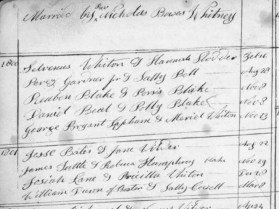
Marion is being celebrated for the pioneering role she has played in helping to preserve the history of Tuttleville, a two hundred year old Black neighborhood around Ward and High Streets in Hingham, and its families, some of whom have lived in Tuttleville throughout those two centuries. The eponymous James Tuttle (1780-1834), was the first Tuttle in Hingham, and he settled in the Ward Street/High Street area around the turn of the 19th century.  He was preceded as a landowner in the area, however, by members of a Black family named Humphrey; on November 29, 1801, James Tuttle and Rebecca Humphrey (1797-1843), a daughter of that family, were married by the Rev. Nicholas B. Whitney at Hingham’s Second Parish.

Marriage Record, James Tuttle and Rebecca Humphrey

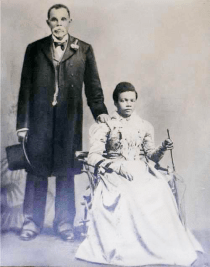
Believed to be John Tuttle and his half-sister Betsy. Photo in collection of Hingham Historical Society

James and Rebecca’s son, John Tuttle (1810-1886), described in the federal census as a farmer, was an important member of this growing Black community, as was his half-brother, James King Tuttle (1834-1906), whose mother was James Tuttle’s second wife, Margaret Quacum Leonard (1796-1806).  James King Tuttle was a shoemaker; many of the Tuttles worked in the shoe factories then operating in Weymouth.  John and James King Tuttle were instrumental in the founding of a village church, the Free Christian Mission, in 1876.

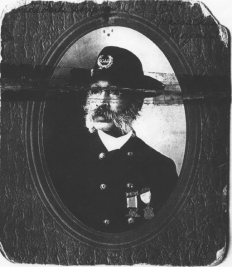
Lewis Legare Simpson as a member of the GAR

James King Tuttle married Henrietta Simpson (1840-1921) on November 13, 1856, thus joining the Tuttle family to the large (Henrietta had 15 siblings!) Simpson family, whose heritage was Black and Native American (the Chappaquiddick tribe). Henrietta’s brother, Lewis Legare Simpson (1843-1918), enlisted in the Massachusetts 54th volunteer infantry, the first Black fighting regiment in the Civil War.

Marion’s grandfather, Walter Thomas Tuttle (1859-1931), was a son of James King Tuttle and Henrietta Simpson.  Also employed in shoe manufacturing, he married Laura Vickers (1869-1931), from Worcester County.  Laura’s heritage was also Indigenous; she was a member of the Nipmuc nation.  Their daughter Mabel, who married Herbert Lindsay, was Marion’s mother.


So, once again, thank you, Marion Laura Lindsay Teague, and we look forward to continuing to discuss Hingham history with you for a long time!

Generations of Tuttle-Simpson women. Photo courtesy of Veronica Hodges

Charlotte Gardner Briggs: an Ordinary Life in Extraordinary Times

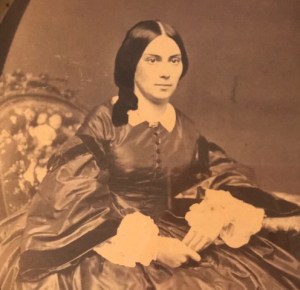
Charlotte Briggs, c. 1871

When Charlotte Briggs died in 1940 in her 99th year, she was “reported to be Hingham’s oldest resident.”  According to her descendants she had another claim to fame: when she was young, she shook hands with Abraham Lincoln. She left no written account of this, or of any other matter, but it is the story she told her children, grandchildren and great-grandchildren.

Charlotte, my great-great grandmother, was born 179 years ago, in May 1842, to Hiram and Lucinda Bailey Gardner. Hiram was a widower with four children when he married Lucinda. They proceeded to have nine more. From their farm in Hanson, Hiram supplied timbers and masts to shipbuilders on the North River. For some years, the farm was on the Boston to Plymouth stagecoach road and when the stage pulled in to change horses in Hiram’s barnyard, it was met with great excitement by Charlotte and her siblings.

The oldest of her mother’s nine children, Charlotte spent her days taking care of children, baking, gardening, and providing community service. She and her mother attended meetings at the Quaker Meeting House in Pembroke as Lucinda was drawn to the Quaker religion of her Bailey grandfather and uncles, who were preachers and abolitionists.

As a girl, Charlotte was a student at Hanover Academy, and stayed to teach for a while after she completed her education. During the Civil War, she lived at home with her parents and worked as a shoemaker. In 1871, at age 28, she married William Briggs, who was 16 years her senior, and moved to his nearby farm in Norwell.

Marriage and Motherhood

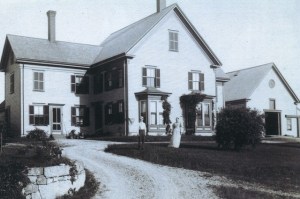
Charlotte and William Briggs in front of their house.

So began Charlotte’s busy life as a wife and soon-to-be mother of a girl and two boys. The large farm was a family business; in addition to growing crops, William cut ice from their pond and stored it in an ice house on the property until summer when they would sell it. The boys worked with their father, and daughter Frances helped her mother cook, clean and care for the gardens.

Charlotte’s child-raising years passed unrecorded, as did most women’s at a time when their work revolved around the home, family, farm and church. But Charlotte’s children grew, and married and two of them had children of their own.  It is here that we get a glimpse of Charlotte’s life and the farm her grandchildren remember so fondly, because her granddaughter, my great-aunt Ruth, did record her memories.

Ruth details “the garden lands, hayfields, pasturelands, and orchards … The upland pasture had grown into delicious high-bushed blueberries. In back of all this was acres of woodland. The barn housed four horses, two cows and pigs. Around the house to the side and back were pear trees, sour apple trees, grapevines, blue and raspberry currant and gooseberry bushes … In the fall, the cellar was full of vegetables, barrels of apples, and a closet full of preserves.”

These descriptions leave little doubt as to what Charlotte did with her days. Ruth also remembers “going to the Quaker Meeting House with my grandmother Charlotte.”

Thirty years in Hingham

4. William Briggs, Charlotte’s husband, with granddaughters Ruth and Amy Litchfield. 1897.

Hard work did nothing to shorten the lives of the Briggses. William lived to be 83, and Charlotte lived into her 99th year. When William died in 1910, Charlotte was only 68. Her children were married and had homes of their own. The farm was too big and too much work for her alone, so she sold it, living first with her son and then moving permanently to her daughter Frances’s house in Hingham.

To understand the Hingham household Charlotte moved into is to understand the shattered lives of widows, young and old, aging without a safety net, and the challenges facing women who lost their income with their husbands, because the family had been devasted by death.

At home were matriarch Sarah Trowbridge Litchfield, 75, who was mourning the deaths of her only two sons who died within two years of each other, her widowed daughters-in-law, Martha and Frances, as well as Frances’s daughters, Amy and Ruth, 18 and 16. It was a house of loss—the sons, the husbands, the father. It was a house of mourning. It was a house of women.

But, this house of women would provide the support they each needed. In the winter of 1916, they buried homeowner Sarah Litchfield, 80. The matriarch gone, the house stayed in the family, and the women supported themselves through dressmaking, real estate sales, and savings. They sent Amy to Skidmore School of Arts and Ruth to nursing school.

Charlotte was there for all these years and more. Her granddaughter Amy married in 1917, and her new husband Oliver Ferris moved into the house of women. They had three children, but not before a pandemic stuck and a world war was fought. Four generations were at home now. Granddaughter Ruth married and moved to the house next door and the corner of School and Pleasant streets became a family enclave.

In the ’20s, the introduction of radio made baseball fans of the whole family, and throughout the Great Depression of the ’30s, Charlotte’s gardening and farming skills helped keep the family fed. She was often seen crossing the lawn between her granddaughters’ houses, checking on this and that, stopping to pull a weed or talk to a child. She saw her grandchildren grow to be young adults.

Charlotte Gardner Briggs, 95; her granddaughter, Amy Litchfield Ferris, 42; her daughter, Frances Briggs Litchfield, 66. 1937. School St., Hingham.

In her 90s, she grew frail and her daughter and granddaughters cared for her at home until she died of old age “after a week’s illness.” Funeral services were held at her home on School Street, a minister of the Old Ship Church officiated, and she was buried with her husband in the Hanover Center Cemetery

Charlotte and Lincoln

Did Charlotte shake hands with Abraham Lincoln? He was in the Boston area in 1848; Charlotte was only six years old and would have been with her mother or relatives. Would the tall congressman have bent down to shake hands with a child? Maybe. He was in New England again in 1860; Charlotte was 18. Did she see him then, or did she travel out of state to hear him speak? Maybe. But I am quite sure that, at some time, Charlotte Gardner Briggs did shake hands with the man. She was not a woman who would have made up a story.

Notes

“[R]eported to be Hingham’s oldest resident,” “after a week’s illness.”:” Obituary, Hingham Journal, Dec. 12, 1940.

William S. Briggs married Charlotte S. Gardner on Feb. 15, 1871. Three children: (1) Frances m. Wilbur Litchfield, had two children. (2) Joseph married Maude Whiting. (3) Walter S. m. Charlotte Osborne, had two children.

The Hingham Historical Society thanks Meg Kenagy not only for this post but for permission to share family photos.

A Revolutionary Epidemic

Boston Aug 2 1776 / Rec’d of General Lincoln four pounds in full for / Inoculating him & son for the Small Pox / Jos. Gardner [Document from Hingham Historical Society archives]

Smallpox was a dreaded disease in the 18th century.  It was endemic in Great Britain and, while overall less common in North America, the period of the American Revolution coincided with a very serious smallpox epidemic that started in the cities of the northeast in 1775 and spread across the continent.  The soldiers of the northeastern militias and the newly formed Continental Army were at great risk, not only because life in an army camp resulted in the easy spread of such a viral infection but also because Americans were generally less likely to have developed immunity to smallpox than their British counterparts.  

Inoculation against smallpox was known but was not the same as vaccination as we know it. As practiced in 1776, live smallpox virus was “inoculated” under the patient’s skin to induce a mild viral infection.  People inoculated against smallpox got sick, were contagious, and sometimes died.  One typically isolated oneself for some period of time when receiving a smallpox inoculation.  (It was only in 1798 that a British doctor, Edward Jenner, discovered that cowpox, a harmless relative of smallpox, offered protection against smallpox without creating an actual smallpox infection, thus developing the first vaccine.)  

It was at first General Washington’s policy not to inoculate soldiers because (1) they could infect each other and (2) they actually got sick, leading to concern that the enemy might know when a company was undergoing inoculation.  Smallpox had hindered the Continental Army’s attack on Quebec during the winter of 1775-1776, and Washington changed his policy and started inoculating the Continental troops the following winter at Morristown, New Jersey.  

It is not surprising, against this backdrop, that Benjamin Lincoln, at the time Major General of the Massachusetts militia, received a smallpox inoculation in August 1776, as evidenced by a receipt in our archives. He was preparing to leave Massachusetts the following month to lead two regiments of the Massachusetts militia to join Washington’s army in the defense of New York.  The following February, he was commissioned a Major General of the Continental Army, initially at Bound Brook, New Jersey.  His son, Benjamin Lincoln V, who inoculated with him, was a 21 year old law student at the time, serving under his father in the Massachusetts militia.

Joseph Gardner, the doctor who inoculated Lincoln, was in the summer of 1776 the Surgeon of Col. Thomas Crafts’ Artillery Regiment in the Massachusetts militia.  Like General Lincoln, Dr. Gardner joined the Continental Army in early 1777; he is recorded as having been one of the physicians with Washington and his forces at Valley Forge in the winter of 1777-78.  

The Construction of the New Meetinghouse: Old Ship Church

By Rosamund Conroy

Early New England meetinghouses were the hearts of towns, serving not only as places of worship but also municipal buildings and even forts or garrisons. These basic structures hosted a variety of activities—from town meetings and trials to baptisms—and the original settlers were generally prohibited from building their homes more than a half a mile away from their town’s meetinghouse.

Hingham’s first meetinghouse was constructed shortly after the incorporation of the town, on the site where the Hingham Heritage Museum and Visitor Center now stands. It had a palisade fence, a bell and was probably a rough-hewn, unheated timber structure, similar to many others of that time. 

In January 1679, perhaps in a nod to its growing population and increasing wealth, the town voted to replace the old meetinghouse and build a new one “with all convenient speed.” They established a small committee to visit other towns for ideas and by May 1680 (the new year being in March under the Julian calendar), the town voted to build the new meetinghouse—the structure we now know as Old Ship Church— “where the old one doth stand.”

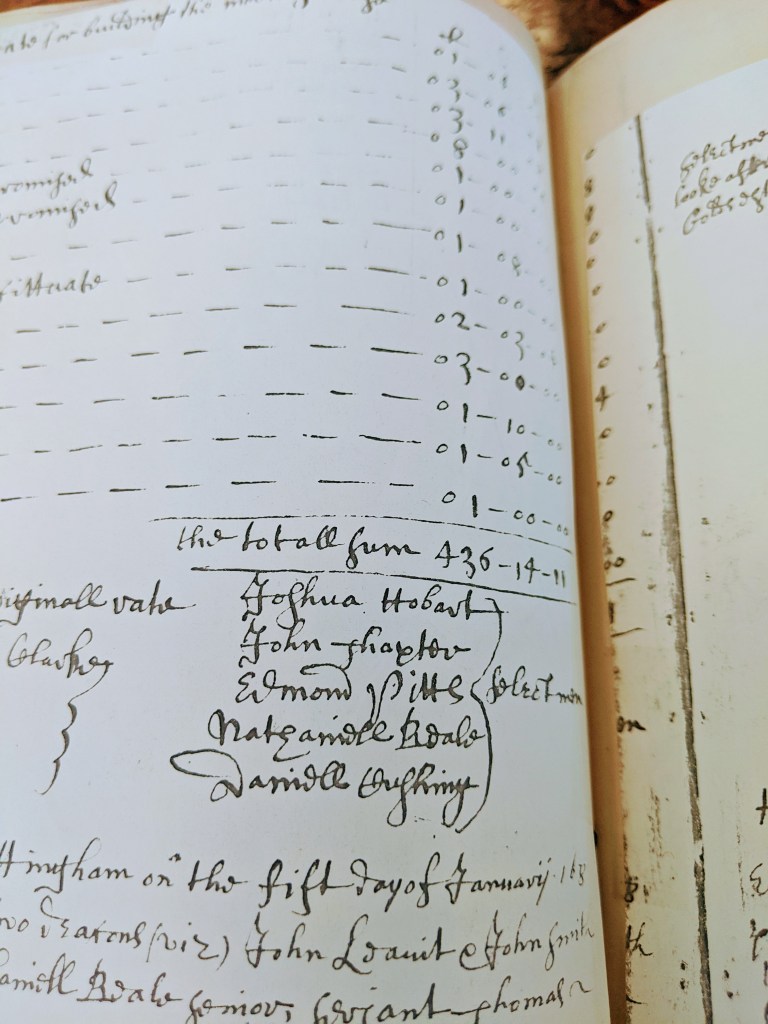
The vote was split though and the location proved controversial, with several powerful freemen preferring a different site. Despite the discord, other aspects of the project proceeded and in August 1680, the town agreed the building’s dimensions. In October 1680, they established the rates (the contribution per man, proportional to their assessed wealth) for a project total of about £437—an enormous sum of money in those days. At nearly £16, the highest rate payer was Daniel Cushing Snr. Esq., while many of the younger or poorer men “promised” a £1 contribution, vowing to pay it at a future date.

An excerpt from the Daniel Cushing Manuscript (1680’s) showing the total rate collected for the meetinghouse. The selectmen listed above held opposing views as to where the meetinghouse should be situated. Only photocopies survive from this part of the manuscript.
(Hingham Historical Society archives/Photo: R. Conroy)

The next spring arrived yet the location continued to be a thorny issue. In May 1681, the General Court got involved and sent two members, William Stoughton and Joseph Dudley, to view both sites. (Interestingly, Dudley would later be widely reviled throughout the colony for his role in the short-lived government of Sir Edmund Andros.) The men found both locations unsuitable and disallowed the construction of the new meetinghouse in “either the old place or in the plaine.” Governor Simon Bradstreet and the magistrates ordered another town meeting to resolve the issue and directed the selectmen to give them a “speedy returne” about the outcome. 

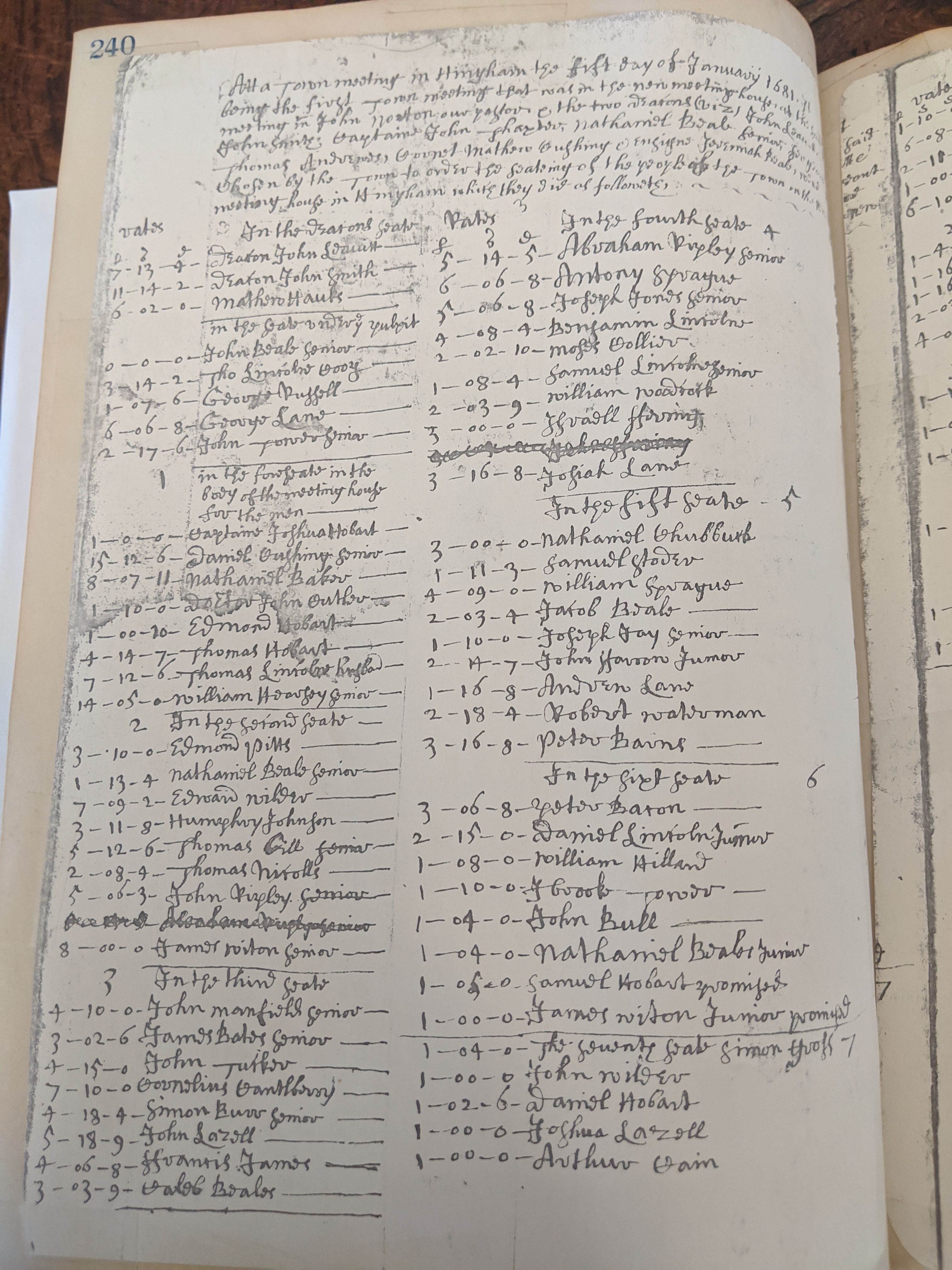
A compromise was reached when Captain Joshua Hobart donated a parcel of land for the meetinghouse. It was near to the old site but presumably more agreeable to all parties and an affirmative vote was duly passed at the subsequent town meeting. The meetinghouse frame was raised over three days in July and its first use was civic, for a town meeting on January 5, 1681. At that meeting, a committee was established to agree upon the seating arrangements in the new meetinghouse—a complicated task that involved segregation by sex and ordering by social hierarchy. 

A few days later, on January 8, 1681, the new meetinghouse—now known as the Old Ship Church—held its first Sabbath service, a tradition that continues to this day.


An excerpt from the Daniel Cushing manuscript (1680’s) showing the rate that each man paid, plus their seat in the meetinghouse. Hinghamites sat on seats (benches), not pews and the order presumably applied to all occasions, civil or religious. Only photocopies survive from this part of the manuscript.
(Hingham Historical Society archives/Photo: R. Conroy)

Would you like to know more? For a general overview of life in seventeenth-century New England, Albion’s Seed, by David Hackett Fischer provides an interesting social history of the English folkways that shaped America’s colonies. Food buffs will enjoy reading America’s Founding Food by Stavely and Fitzgerald, whereas Good Wives by Laurel Thatcher Ulrich provides a glimpse into the hidden world of Puritan women.

Primary source materials can be as engrossing as edited works and they often bring a particular historical period to life in unexpected ways. A wealth of seventeenth-century primary sources can be found locally (try the Hingham Historical Society, the Hingham Public Library or the Massachusetts Historical Society) as well as online (for example, in the digital records at the Massachusetts State Archives).


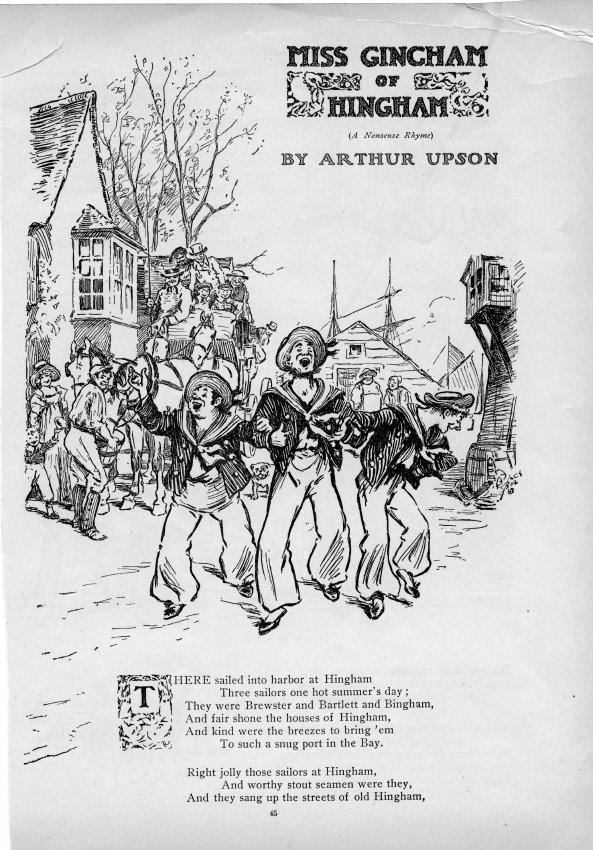
Miss Gingham of Hingham


From The  Bookshelf for Boys and Girls, Children’s Book of Fact and Fancy, New York: University Society (1912).

2011121

There sailed into harbor at Hingham
Three sailors one hot summer’s day;
They were Brewster and Bartlett and Bingham,
And fair shone the houses of Hingham,
And kind were the breezes to bring ‘em
To such a snug port in the Bay.

Right jolly those sailors at Hingham,
And worthy stout seamen were they,
And they san up the streets of old Hingham,
Did Bartlett Brewster and Bingham,
Till they reached the abode of Miss Gingham,
Who kept a small inn by the way.

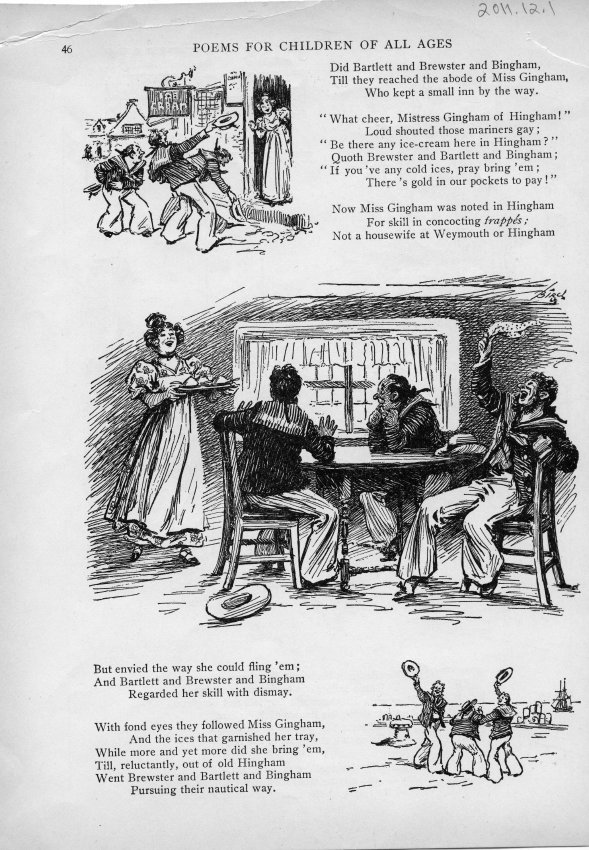
“What cheer, Mistress Gingham of Hingham!”
Loud shouted those mariners gay;
“Be there any ice-cream here in Hingham?”
Quoth Brewster and Bartlett and Bingham;
“If you’ve any cold ices, pray bring’em;
There’s gold in our pockets to pay!”

2011121-2

Now Miss Gingham was noted in Hingham
For skill in concocting frappes;
Not a housewife at Weymouth or Hingham
But envied the way she could fling ‘em;
And Bartlett and Brewster and Bingham
Regarded her skill with dismay.

With fond eyes they followed Miss Gingham,
And the ices that garnished her tray,
While more and yet ore did she bring ‘em,
Till, reluctantly, out of old Hingham
Went Brewster and Bartlett and Bingham
Pursuing their nautical way.

By Arthur Upson.

A Book for Governor Andrew

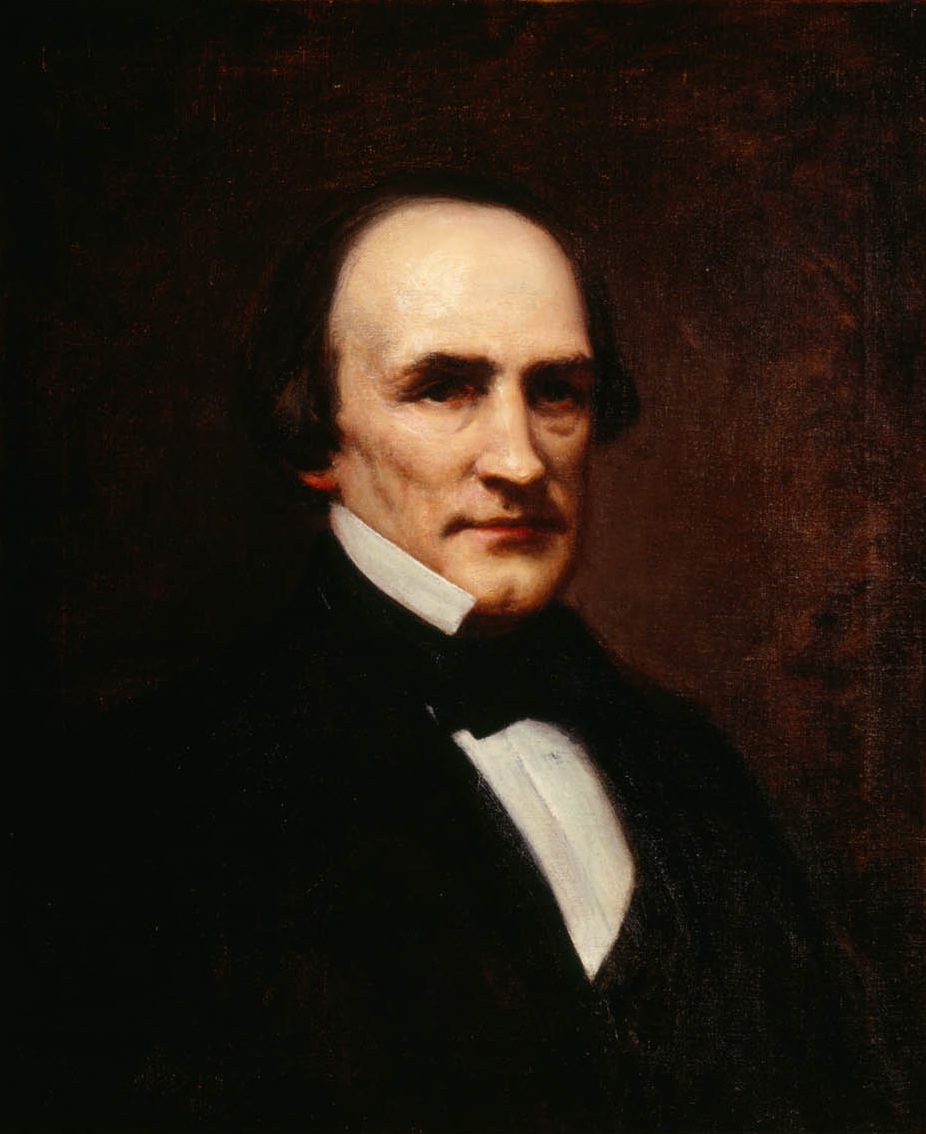
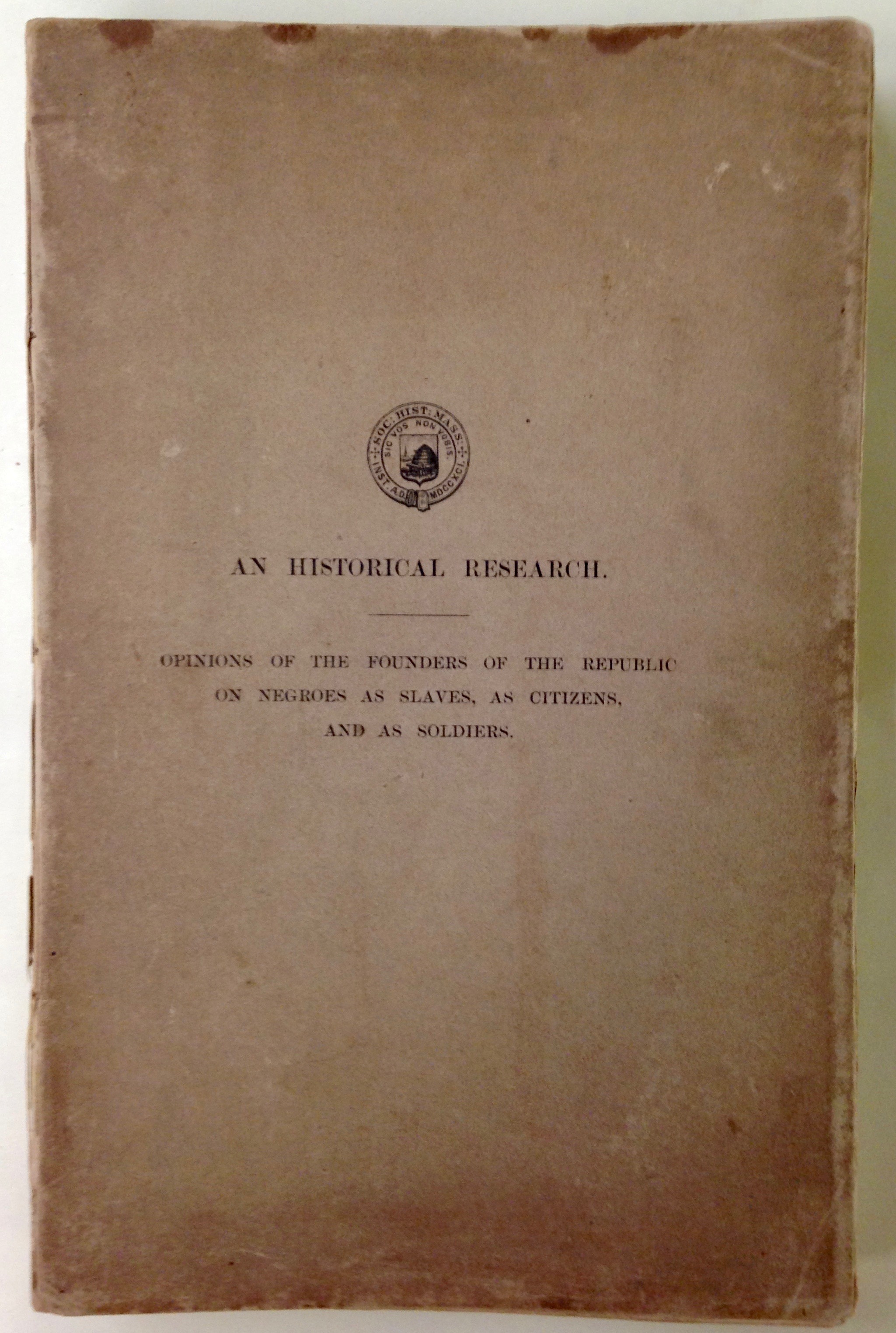
george_livermore_1904_portraitOn August 14, 1862, George Livermore, an historian, rare book collector and abolitionist from Cambridge, gave a lecture at the Massachusetts Historical Society titled “An Historical Research Regarding the Opinions of the Founders of the Republic on Negroes as Slaves, as Citizens and as Soldiers.”  In his lecture, also published that year, Mr. Livermore argued that the Founding Fathers considered black men capable of bearing arms and fighting for independence and therefore they should also be allowed to fight for the Union cause in the Civil War then underway. img_2433

Massachusetts Senator Charles Sumner gave President Lincoln a copy of Livermore’s lecture, and it is said that Livermore’s arguments influenced Lincoln when he was drafting the Emancipation Proclamation in the fall of 1862.  A few month’s later, through Sumner’s offices, the pen with which President Lincoln signed the Emancipation Proclamation was given to George Livermore.  (It is currently on display at the Massachusetts Historical Society).

john-albion-andrewAlthough Lincoln disappointed Sumner by moving deliberately toward introducing uniformed black soldiers into the Union Army, his administration responded positively when, in January 1863, Massachusetts’ abolitionist war Governor, Hingham’s own John Albion Andrew, lobbied for leave to raise a black regiment.  The Massachusetts 54th Infantry Regiment was the first to be comprised of black volunteers, from Massachusetts and other states.
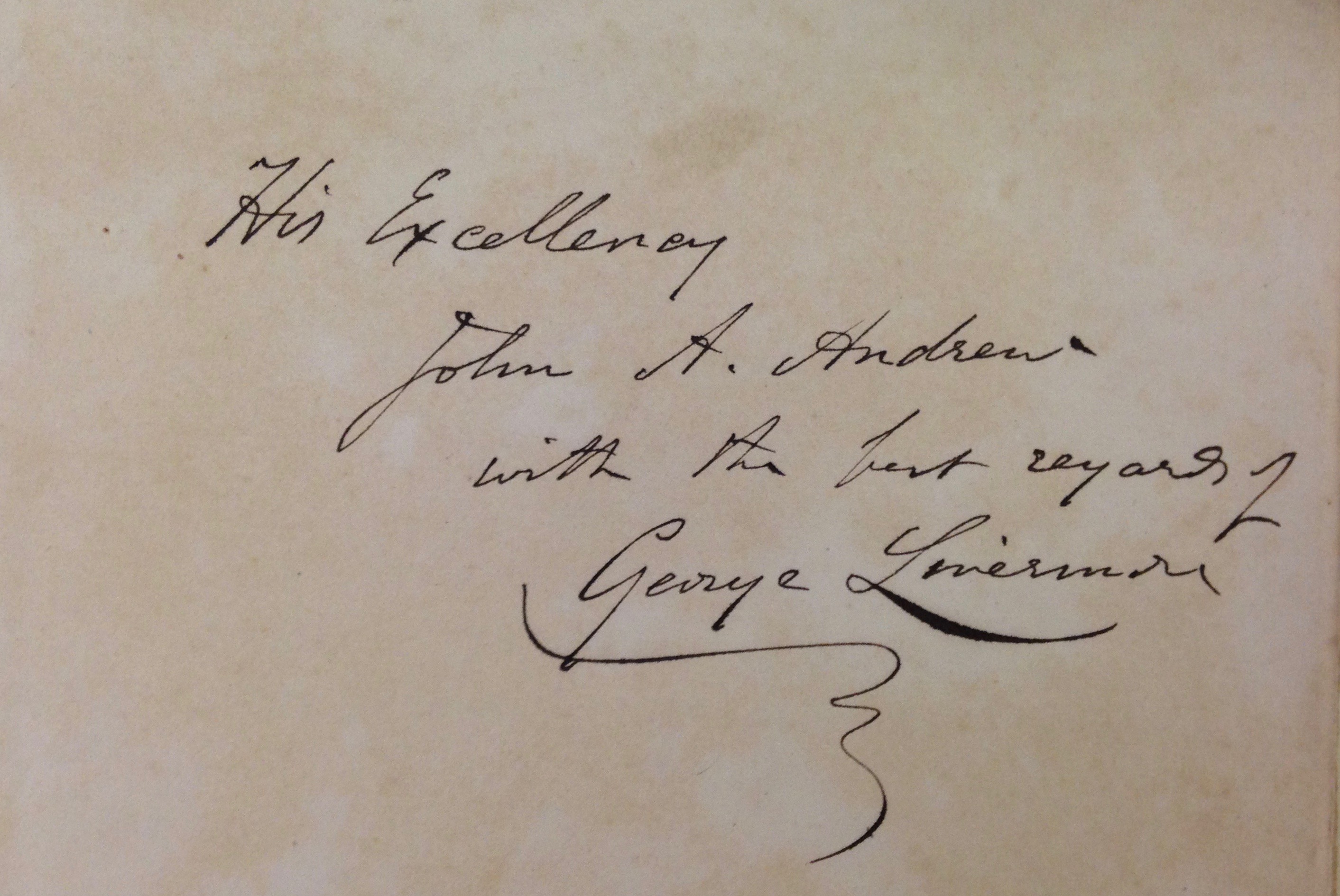
Was Governor Andrew at the Massachusetts Historical Society when Mr. Livermore gave his lecture?  Did Sumner or Livermore send Andrew a copy? Either way, it is fitting that one of the books in our collection from Governor Andrews’ library is his copy of “An Historical Research,” making the case for black soldiers and citizens, inscribed for him by the author.

img_2435