A Silver Wedding Anniversary: 600 Guests, Gifts and Gaiety

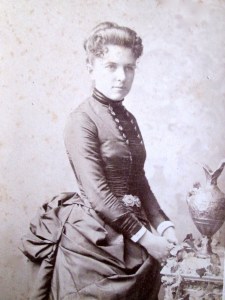
On May 28, 1909, Martha and Rozy Litchfield of Hingham Centre placed an announcement in the Hingham Journal.

Mr. and Mrs. Roswell Lincoln Litchfield will receive their friends in honor of the twenty-fifth anniversary of their marriage on the evening of Tuesday June the eighth from eight to ten o’clock at Grand Army Memorial hall. This invitation is general. No cards will be issued.

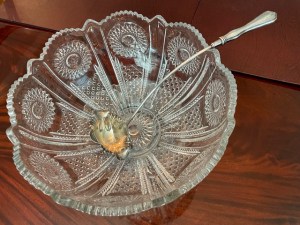
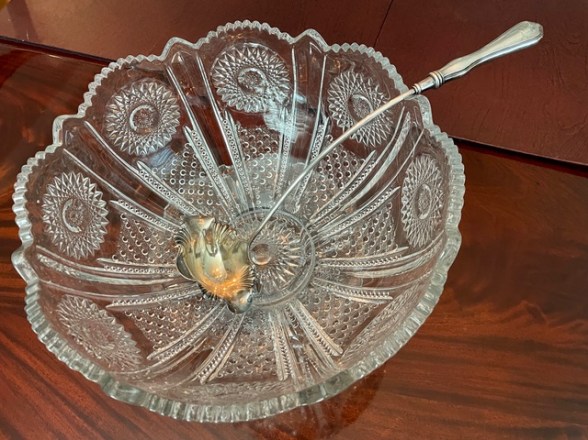
Six hundred friends showed up. There was a dinner and music and dancing.  On June 9, 1909, in an article titled, “Twenty-fifth Anniversary,” the Journal reported that there were an “unusual number of wedding remembrances, including silver and glassware, painted china, gold and silver coin and “greenbacks”, bric-a-brac, also many useful and fancy articles.”1    Among the many gifts was a punchbowl with a silver ladle inscribed with the letter L, which have been passed down through the Litchfield family.

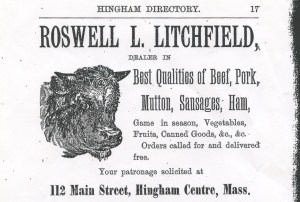
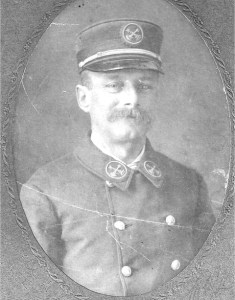
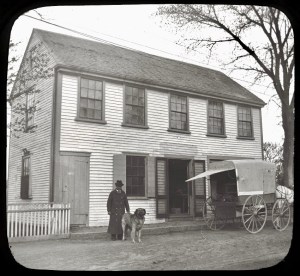
Martha and Rozy’s popularity was rooted in their love of community and volunteer work. Rozy had a successful meat market on Main Street in Hingham Centre. He was also an officer in Centre fire department, which he joined at age 18, fighting fires, keeping the records, and representing the department in parades and at conferences. Martha was “at home” as many women were—housekeeping being all consuming in the late nineteenth century. She was active in many organizations and raised money for a number of charities. She sang soprano in the First Parish choir and was an active members of the Women’s Relief Corps.

Ad for the Litchfield Meat Market, Hingham Directory (1885)

Look back 25 years, to June 1884, when Martha Sprague married Rozy Litchfield at her family’s home on Main Street, in Liberty Plain. Following the wedding, she moved to his family’s home at the corner of School and Pleasant streets to live with his widowed mother, Sarah Litchfield, and younger brother.  Martha and Rozy did not have children.

The timing of the 25th anniversary party and the show of respect and affection to the couple was serendipitous, because less than four months later, Rozy was dead at age 50 of heart disease. His obituary as printed in the Hingham Journal on October 8, 1909 is compelling.

OLD CHIEF MOURNED.

Dist. Engineer Litchfield Buried at Hingham.

HINGHAM CENTER, In the old Colonial Litchfield home on School St. where he was born, always lived and where he died, the funeral of District Engineer Roswell Lincoln Litchfield was held this afternoon at 2 o’clock. The service was conducted by Rev Louis C. Cornish of the First Unitarian church. . . .

The Odd Fellows’ burial service was read at Hingham Center cemetery by Fred H. Miller, acting noble grand, and Arthur W. Hersey, chaplain. Prior to the funeral service the entire membership of the Hingham fire department gathered in the assembly hall at the central fire station and held a service “in memoriam,” conducted by Chief Cushing, who in an eulogy said that the town had lost an upright citizen, the department a capable and faithful officer, and he himself and every member of the fire department, a genuine friend.

During the hour of the funeral, places of business throughout the town were closed, flags were at half-staff on all the fire houses in town and on many public buildings and private residences. While the funeral cortege was passing the bell in the tower of the central fire station struck 50 blows, the dead chief’s age.

Martha, who was also 50 at time of her husband’s death, stayed on School Street with her sister-in-law, the widow Frances Litchfield, and her daughters. Together, they maintained the house and started a dressmaking business. In 1919, ten years after Rozy’s death, Martha married an old friend, Eugene Skinner, and moved to his home on Leavitt Street.  When she moved, she left the punch bowl and ladle in the family home on School Street. It was passed down to Rozy and Martha’s niece, Ruth Litchfield Marsh, who gave it to our mother, Margaret Rita Scanlan Ferris, wife of Oliver Litchfield Ferris.

Society’s note:  By “our,” the author means herself and her sister, Mary Ferris Gens.  Meg and Mary donated the punchbowl and ladle to the Hingham Historical Society this summer.  We are grateful for the objects and the wonderful story.

1796: It’s Triplets for the Litchfields

The Litchfield triplets—Lincoln, Polly, and Hubbard—were born on August 11, 1796 in Scituate to Abner and Mary (Lincoln) Litchfield. Surely this was big news in that small town; triplets were rare. While they were born in Scituate, the triplets had many connections to Hingham; several of their siblings and children married Hingham residents and, in turn, their children were born in Hingham.

The Litchfield Triplets — Lincoln, Polly, and Hubbard. (Photo courtesy of Meg Ferris Kenagy.)

When the triplets were born, their parents, Abner and Mary (Lincoln) Litchfield, were in their late 30s and had been married for 16 years. They already had six children (Jacob, Celle, Rachel, Hearsey, Samuel and Abner, Jr).  Abner was a landowner, farmer and Revolutionary War veteran descended from Laurence, the progenitor of the New England Litchfields. Mary was descended from the Lincolns of Hingham.

The triplets were given family names and not only did they all survive at a time when infant and child mortality was high, they all lived long lives. Hubbard and Polly lived to 78 and Lincoln to 80.  This was so unusual that when, in 1889, the Burlington Weekly Free Press ran an article titled “Long-lived Triplets,” which featured three sets of New England triplets, the Litchfields were included.

There is a family photo of the trio taken in their later years. It came to the author from her great aunt, Ruth Litchfield Marsh of Hingham, great-granddaughter of Lincoln Litchfield. The photo is undated, but here are the triplets: Lincoln, Polly and Hubbard.

Lincoln Litchfield, first of three

Lincoln was a farmer like his father and grandfathers before him. He also worked as a shipwright. In April 1830, he married Isabella Merritt in the First Parish Church in Scituate. He was 33 and Isabella, the daughter of Paul and Deborah Merritt, was 24.The couple had three children: Joseph in 1831, Mary in 1833, and Jairus in 1841. Jairus died of consumption as a child but Joseph and Mary grew up in Scituate and married Hingham residents. Mary married Hingham blacksmith Henry Merritt in 1853 and moved to Leavitt Street. Three years later, Joseph married Sarah Trowbridge and moved to School Street. Their mother, Isabella, lived to see them both settled in their new homes, but did not live to see her grandchildren. She died in December 1857 of consumption and was buried in the Merritt Cemetery in Scituate. She was 52.

A year later, Lincoln remarried. His bride, Adeline Hatch of Cohasset, was 43; he was 62. Lincoln lived a long

The Merritt Cemetery on Clapp Road in Scituate. (Photo courtesy of findagrave.com.)

time, dying on May 7, 1877, age 80 years and 8 months. He was buried with this first wife Isabelle in the Merritt Cemetery. Second wife, Adeline, was buried there 16 years later.

The “Litchfield Litchfields”

Lincoln’s triplet siblings, Polly and Hubbard, first appear in the public record with their marriages. Interestingly, both of them married Litchfields–making Polly “Polly Litchfield Litchfield” and Hubbard’s wife, Eliza “Eliza Litchfield Litchfield.”

Hubbard Litchfield, second of three

Hubbard was 28 when he married Eliza Litchfield in 1824.  They had four children: William, Jane, Thomas, and Caroline. In 1839, when Caroline was three years old, Eliza died at age 33.  She was buried in the Merritt Cemetery. A year later, Hubbard remarried Scituate resident Martha Brown.

Hubbard was a farmer and shipwright who lived close to his brother Lincoln throughout his life. He died March 29, 1875 at age 78 and is also buried in the Merritt Cemetery. His sister Polly died two days later; their names are inscribed on the same page in the Scituate town death records.

Polly Litchfield Litchfield, third of three

Gravestone of Mary Lincoln (“Polly”) Litchfield Litchfield. (Photo courtesy of findagrave.com.)

At birth, the third triplet was named Mary Lincoln Litchfield, for her mother, but as her mother was called “Polly,” she would also be called Polly.  Polly married Perez Litchfield, a Scituate farmer, in about 1820. According to town records she had eight children: Charles, 1821; Perez L., 1823; Solon, 1825; Mary L., 1826; Augusta, 1830; Angeline, 1832; Abner, 1835; and Perez, 1837. Polly’s husband Perez died of heart disease in 1860 at age 68. She died at 78 in 1875 and was buried in the Union Cemetery in Scituate. Her gravestone is inscribed:

“Mary L. / Wife of Perez Litchfield /Died March 31, 1875 / Aged 78 years 7 months 19 days /Into thy hand o father I commit my spirit.”

Polly died the same day her brother Hubbard was buried.

Descendants

Bella Merritt Fearing (1869-1937). (Photo courtesy of Meg Ferris Kenagy.)

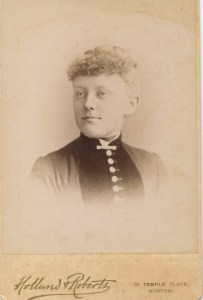
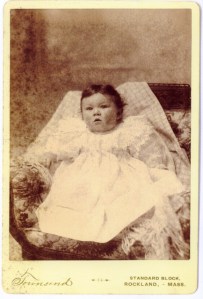
The Litchfield triplets left many relatives, and residents of Hingham, Scituate and neighboring South Shore towns residents will find familiar names among them including Merritt, Studley, Marsh, Lincoln, Trowbridge, Briggs, Fearing, and Young.  The large intermarried Merritt and Litchfield clans followed family naming conventions, challenging historians and genealogists. This photo printed on a cabinet card is Lincoln’s granddaughter Bella Merritt Fearing (1869-1937). Her parents are Mary (Litchfield) and Henry Merritt of Leavitt Street. Her paternal grandmother was Isabella Litchfield Merritt, and her maternal grandmother was Isabelle Merritt Litchfield. 


Notes

  1. In 1856, Joseph Henry Litchfield married Sarah  Trowbridge, daughter  of  Roswell  Trowbridge and  Sarah    (Jones) Trowbridge, in Hingham.  Two of their children were born in Hingham: Roswell Lincoln Litchfield (b. 1859 m. Martha Sprague) and Wilbur Trowbridge Litchfield ( b.1869, m. Frances Briggs).  Source:  Hingham Town Records.
  2. In 1853, Mary Brooks Litchfield married Henry Merritt, son of Henry Merritt and Isabella (Litchfield), in Hingham. Their children born in Hingham: Henry Lincoln Merritt, July 20, ___; Mary Isabel Merritt, Sept.  24, 1869; Anna Whitney Merritt, Apr. 7, 1879. Source:  Hingham Town Records.
  3. Children of Polly and Perez Litchfield: Charles, b. 1821; Perez L., b. 1823; Solon, b. 1825; Mary L., b. 1826; Augusta, b. 1830; Angeline, b. 1832; Abner, b. 1835; and Perez, b. 1837. Source:  Scituate Town Records.
  4. The private Merritt Cemetery in Scituate was established about 1775 and last used about 1938.
  5. For more about the Litchfields and other Hingham families, see: The House on School Street, Eight Generations, Two hundred and four years. One family.

Irish in Hingham: Hannah and her Brothers

From the 1880s through about 1920, Irish immigration to America was led by women. Fleeing poverty and lack of opportunity in their native land, they came alone or with a friend or cousin. They took jobs as domestic servants or mill workers, managing to send a bit of money home, which enabled other family members to follow. In Hingham, we see this unique immigration pattern played out in the life of Hannah Ferris. Whether or not she paid her brothers’ passage, she and her husband, Henry Trowbridge took them in when they came.

Hannah Ferris Trowbridge (1856-1934)

Hannah (Ferris) Trowbridge and Henry Trowbridge, circa 1885

She came, Hannah Ferris, a young woman, out of the impoverished west of Ireland early in the 1880s. She came, first, to the industrial town in central Massachusetts where she found work as a servant. In the summer of 1884, she came to Hingham, the bride of Henry Trowbridge, farmer, butcher, shop owner, and Civil War vet. He was more than a dozen years her senior, a recent widower, with no children.

How Henry and Hannah met is unknown. There were a number of Irish families in town. Henry’s cousin had a live-in Irish servant as did his several of his neighbors. Did one of them introduce the couple? Someone had to because she lived in Worcester, he lived in Hingham, and because more than miles separated them. She was a domestic servant; he was a business owner. She was Catholic; he held a pew in the Old Ship.

Raymond Trowbridge (1896-1962), son of Henry and Hannah, as a child. Raymond was a WWI and WWII Navy vet. His father was a Civil War Naval Vet.

They married in the Catholic church in Worcester in July 1884 and returned to Hingham where she moved into his house on the corner of Union and Pleasant streets. They had five children. Three of them died young. Their first born, Isabel, died of croup at “2 years, 2 months, 2 days.” Frances died of meningitis at 15 months, and they lost Henry Jr. to tuberculosis at 14. The Catholic cemetery was still new when they buried their young ones.

Henry was more than busy with work, farming, and family, but in 1982, he undertook a new project. He built three new houses on his Pleasant/Union Street property:  a new one for his family and two others that came in handy when his relatives needed them and when Hannah’s brothers started coming to town.

* * * *

Hannah Ferris was the second of twelve children born in a small cottage in rural Killarney. Eight of her siblings immigrated into Massachusetts. Her younger sister Kate went to Worcester where she married, died and was buried in an unmarked grave with her six-month old son. Her seven brothers started their new lives in Boston or Worcester and have stories of their own, several marred by tragedy. The brothers were all in Hingham at some time, and many of their names are inked into St. Paul’s Church records as Godfather to one of Hannah’s children. Of the seven brothers, Morgan, Robert and Daniel lived in Hingham.

Morgan Ferris, my great-grandfather (1859-1938)

The Morgan Ferris family, School Street, 1921. Front, from left: Morgan Ferris, Oliver Tower, Oliver Ferris, Annie Tower, Annie (Tower) Ferris. Back, from left: Kathryn Ferris, Marjorie Ferris, Oliver Ferris, Amy (Litchfield) Ferris, Richard Ferris, Gordon Ferris.

Morgan Ferris came to Boston in about 1884 when he was in his twenties and soon followed Hannah to Hingham. He was a skilled carpenter and set up a business. Over the years, he built many houses on the South Shore. In 1892, he married Annie Tower, daughter of Oliver and Anne Tower of School Street. A minister of the First Baptist Church performed the ceremony in her family home; the record shows she was 19 and he was 29. (He was actually 33.)  They bought a house on School Street at the intersection of Spring Street and had three children, Oliver, Kathyrn, and Gordon. All three children attended Hingham schools, married, and stayed in town. Oliver married Amy Litchfield, Katheryn, Bob McKenzie, and Gordon, Evelyn Staples. They, in turn, had children; many of them made Hingham their home.

Morgan died in 1938 at age 78. There are a few stories that came down the years; most are about his story-telling prowess and his big belly laugh. One is about his love of sports, another says that when he died, the rosary beads he brought with him from Ireland were found in his bureau drawer.

Robert Ferris (1868-1957)

In November 1892, twenty-three-year-old Robert Ferris married Irish-born Margaret McCarthy, a laundress, in Boston. At the time, he was living in Hingham with Henry and Hannah and, more than likely, working on building their new houses. He was a carpenter like several of the brothers, but he wanted something else and became a Boston police officer. He and his family moved closer to the city, and he returned the Union Street house to Hannah in a legal transaction. He began his career patrolling the South Boston waterfront. The only picture I have of him accompanies an article in The Boston Globe in 1901 which recognizes him for saving a nine-year old boy from drowning.  He and Margaret had three children and lived relatively long lives.

Daniel Ferris (b. 1874)

Daniel and Gertrude Ferris’ children, Frances and John, c. 1902.

In 1898, Daniel was a U.S. Marine stationed in Boston, but his home was with Henry and Hannah. In 1899, he married their next-door neighbor, Gertrude Stephenson, daughter of Ezra and Clara of Pleasant Street. Daniel was 23 and she was 20. According to the Hingham Journal, the marriage “took place at St. Paul’s parsonage” on a Wednesday night. After their marriage, the couple lived with her family. Their daughter Francis was born in 1900 and son John in 1901.  Things did not go well, however. Daniel was arrested for theft, court martialed and discharged from the service. Soon after, he left Hingham. Gertrude took a job as shoemaker and lived with her parents before eventually moving to Bank Street.

Daniel disappeared from the record until  September 12, 1918, when he completed a WWI draft registration card. On that day, he was a logger living in a camp in Washington state. In addition to the birthdate, we know he is “our” Daniel Ferris, because he reported his nearest relative to be Robert Ferris, Police Headquarters, Boston, Mass.

Daniel’s problems and subsequent move may have hit Hannah hard – he was her youngest. brother When she was 18, she had walked to a civil registration office in Ireland to report his birth: “Informant, Hannah Ferris, present at birth.”

* * * *

Hannah’s life was full and her door, it seems, was always open. She kept in touch with her brothers and their children. She was Godmother to many and responded when they needed help. When her brother Eugene’s wife died of a fall at their home in Malden, her body was brought to Hingham and buried in Hannah and Henry’s plot in St. Paul’s cemetery.

Henry died in 1930 at 87, “one of the oldest GAR men in the state.”  When Hannah died four years later at 78, she left a detailed will. To her son Raymond she left $1,000, to her daughter Mabel went her house worth $4,100, and to St. Vincent DePaul, a Catholic charity committed to serving the poor and suffering, her entire savings of $3,269.93.

Hannah, Henry and four of their five children are buried in St. Paul’s Cemetery. Morgan and his family are buried in the Hingham Centre Cemetery.

The Trowbridge Ferris graves. Four of Henry and Hannah’s five children and Hannah’s sister-in-law, Emma, are buried here. Henry and Hannah’s names are on the other side.


Notes

  1. There are a number of good sources on the subject of Irish female immigration. “The Irish BridgetIrish Immigrant Women in Domestic Service in America, 1840-1930 written by Margaret Lynch-Brennan, is a good one. N.Y.: Syracuse University Press, 2009.
  2. The National Women’s History Museum website says: “Strong female networks sustained the immigration flow of Irish women, even during times of economic depression … Irish women were the only immigrant group to establish immigration chains … Whereas other ethnic groups sent their sons to America, Ireland sent its daughters.” Raising a glass to Irish women, March14, 2017,
  3. On dates, names and ages: Hannah and Morgan consistently shaved four or five years off their ages on official documents. Their other siblings were only marginally more accurate. Daniel alternately used Donald as his first name.
  4. On quotations in this post: “2 years, 2 months, 2 days”: Isabel Trowbridge death notice, Hingham Journal, Nov. 13, 1887; “took place at St. Paul’s parsonage”: Hingham Journal, June 1899; “one of the oldest GAR men in the state”: Henry Trowbridge obituary, Daily Boston Globe, May 7, 1930.
  5. Eugene’s wife, Emma Ferris, 64, died in a fall from the second-story piazza of her Malden home. “She was cleaning rugs when the railing broke.” The Boston Globe, Sept. 1, 1923.
 

Charlotte Gardner Briggs: an Ordinary Life in Extraordinary Times

Charlotte Briggs, c. 1871

When Charlotte Briggs died in 1940 in her 99th year, she was “reported to be Hingham’s oldest resident.”  According to her descendants she had another claim to fame: when she was young, she shook hands with Abraham Lincoln. She left no written account of this, or of any other matter, but it is the story she told her children, grandchildren and great-grandchildren.

Charlotte, my great-great grandmother, was born 179 years ago, in May 1842, to Hiram and Lucinda Bailey Gardner. Hiram was a widower with four children when he married Lucinda. They proceeded to have nine more. From their farm in Hanson, Hiram supplied timbers and masts to shipbuilders on the North River. For some years, the farm was on the Boston to Plymouth stagecoach road and when the stage pulled in to change horses in Hiram’s barnyard, it was met with great excitement by Charlotte and her siblings.

The oldest of her mother’s nine children, Charlotte spent her days taking care of children, baking, gardening, and providing community service. She and her mother attended meetings at the Quaker Meeting House in Pembroke as Lucinda was drawn to the Quaker religion of her Bailey grandfather and uncles, who were preachers and abolitionists.

As a girl, Charlotte was a student at Hanover Academy, and stayed to teach for a while after she completed her education. During the Civil War, she lived at home with her parents and worked as a shoemaker. In 1871, at age 28, she married William Briggs, who was 16 years her senior, and moved to his nearby farm in Norwell.

Marriage and Motherhood

Charlotte and William Briggs in front of their house.

So began Charlotte’s busy life as a wife and soon-to-be mother of a girl and two boys. The large farm was a family business; in addition to growing crops, William cut ice from their pond and stored it in an ice house on the property until summer when they would sell it. The boys worked with their father, and daughter Frances helped her mother cook, clean and care for the gardens.

Charlotte’s child-raising years passed unrecorded, as did most women’s at a time when their work revolved around the home, family, farm and church. But Charlotte’s children grew, and married and two of them had children of their own.  It is here that we get a glimpse of Charlotte’s life and the farm her grandchildren remember so fondly, because her granddaughter, my great-aunt Ruth, did record her memories.

Ruth details “the garden lands, hayfields, pasturelands, and orchards … The upland pasture had grown into delicious high-bushed blueberries. In back of all this was acres of woodland. The barn housed four horses, two cows and pigs. Around the house to the side and back were pear trees, sour apple trees, grapevines, blue and raspberry currant and gooseberry bushes … In the fall, the cellar was full of vegetables, barrels of apples, and a closet full of preserves.”

These descriptions leave little doubt as to what Charlotte did with her days. Ruth also remembers “going to the Quaker Meeting House with my grandmother Charlotte.”

Thirty years in Hingham

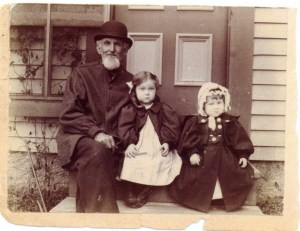
4. William Briggs, Charlotte’s husband, with granddaughters Ruth and Amy Litchfield. 1897.

Hard work did nothing to shorten the lives of the Briggses. William lived to be 83, and Charlotte lived into her 99th year. When William died in 1910, Charlotte was only 68. Her children were married and had homes of their own. The farm was too big and too much work for her alone, so she sold it, living first with her son and then moving permanently to her daughter Frances’s house in Hingham.

To understand the Hingham household Charlotte moved into is to understand the shattered lives of widows, young and old, aging without a safety net, and the challenges facing women who lost their income with their husbands, because the family had been devasted by death.

At home were matriarch Sarah Trowbridge Litchfield, 75, who was mourning the deaths of her only two sons who died within two years of each other, her widowed daughters-in-law, Martha and Frances, as well as Frances’s daughters, Amy and Ruth, 18 and 16. It was a house of loss—the sons, the husbands, the father. It was a house of mourning. It was a house of women.

But, this house of women would provide the support they each needed. In the winter of 1916, they buried homeowner Sarah Litchfield, 80. The matriarch gone, the house stayed in the family, and the women supported themselves through dressmaking, real estate sales, and savings. They sent Amy to Skidmore School of Arts and Ruth to nursing school.

Charlotte was there for all these years and more. Her granddaughter Amy married in 1917, and her new husband Oliver Ferris moved into the house of women. They had three children, but not before a pandemic stuck and a world war was fought. Four generations were at home now. Granddaughter Ruth married and moved to the house next door and the corner of School and Pleasant streets became a family enclave.

In the ’20s, the introduction of radio made baseball fans of the whole family, and throughout the Great Depression of the ’30s, Charlotte’s gardening and farming skills helped keep the family fed. She was often seen crossing the lawn between her granddaughters’ houses, checking on this and that, stopping to pull a weed or talk to a child. She saw her grandchildren grow to be young adults.

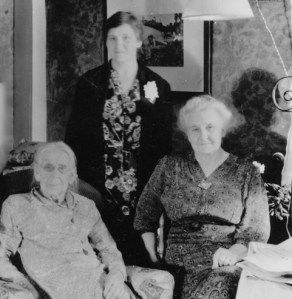
Charlotte Gardner Briggs, 95; her granddaughter, Amy Litchfield Ferris, 42; her daughter, Frances Briggs Litchfield, 66. 1937. School St., Hingham.

In her 90s, she grew frail and her daughter and granddaughters cared for her at home until she died of old age “after a week’s illness.” Funeral services were held at her home on School Street, a minister of the Old Ship Church officiated, and she was buried with her husband in the Hanover Center Cemetery

Charlotte and Lincoln

Did Charlotte shake hands with Abraham Lincoln? He was in the Boston area in 1848; Charlotte was only six years old and would have been with her mother or relatives. Would the tall congressman have bent down to shake hands with a child? Maybe. He was in New England again in 1860; Charlotte was 18. Did she see him then, or did she travel out of state to hear him speak? Maybe. But I am quite sure that, at some time, Charlotte Gardner Briggs did shake hands with the man. She was not a woman who would have made up a story.

Notes

“[R]eported to be Hingham’s oldest resident,” “after a week’s illness.”:” Obituary, Hingham Journal, Dec. 12, 1940.

William S. Briggs married Charlotte S. Gardner on Feb. 15, 1871. Three children: (1) Frances m. Wilbur Litchfield, had two children. (2) Joseph married Maude Whiting. (3) Walter S. m. Charlotte Osborne, had two children.

The Hingham Historical Society thanks Meg Kenagy not only for this post but for permission to share family photos.

Hingham Sailors in the Civil War: Where the Wild Winds Swept Them

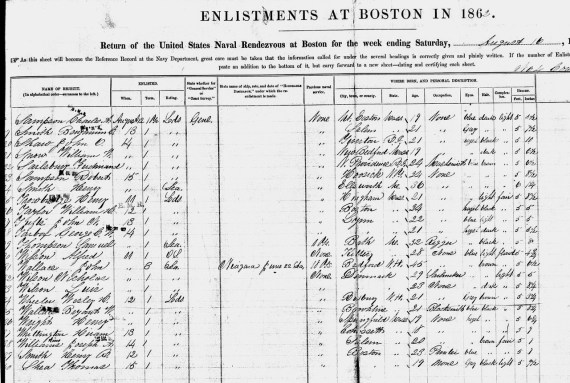
In August 1862, three young Hingham men enlisted in the U.S. Navy. At the Charlestown Navy Yard, they were issued uniforms and entered into the record: Benjamin Jones, twenty-nine, hazel eyes, dark hair; George Merritt, twenty-one, blue eyes, brown hair; Henry Trowbridge, twenty-one, blue eyes, light hair. Ranked as landsmen, they will earn $13 a month.1

Trowbridge Henry NavalRec 1862 copy

U.S. Navy, Enlistments at Boston in 1862.  Henry Trowbridge of Hingham.

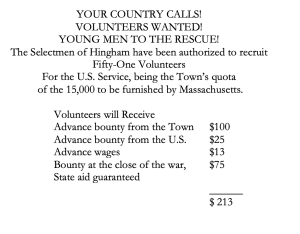
The war was in its second year. The month before President Lincoln had put out an urgent call for additional troops, and the town had rallied to meet its quota. On July 25, 1862, the Hingham Journal printed a powerful appeal that included increased bounties:

Within days of the newspaper notice, our three Hingham Centre boys enlisted, and the village must have been a hive of activity as family and friends gathered to wish the young men well. Benjamin and Henry were first cousins and related to George through the old Massachusetts families.

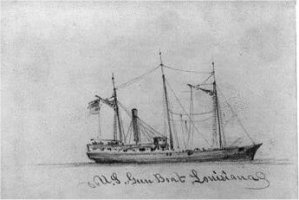
098665501After several months of training in the north, the three young men left for the sounds of North Carolina aboard the USS Hetzel, a side-wheel steamer, chartered to maintain blockades on southern ports. In North Carolina, they transferred to the gunboat USS Louisiana, “five guns,”2 whose mission was to intercept blockade runners and support ground troops. The ship was crowded and damp, the weather humid and, in addition to the enemy, sailors fought the plethora of diseases that haunted ships. At some time that winter, George Merritt got sick. Suffering from intense fevers and chills, he was moved to a hospital in North Carolina. On February 7, 1863, he died of “swamp fever” and was buried “from the hospital.”2
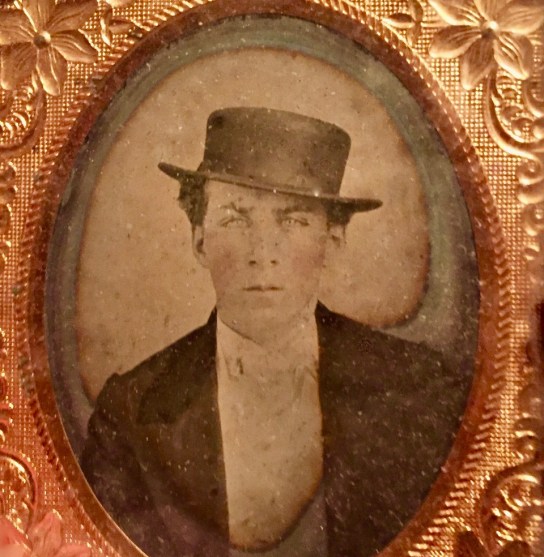
George Merritt II

Hingham Civil War Monument, Hingham Cemetery

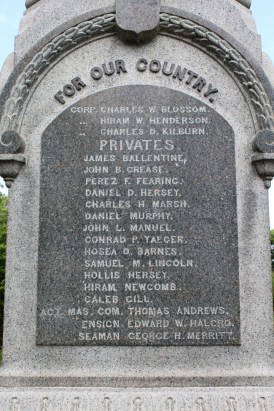
A letter or telegram carried the news north. Adding to his parents’ grief was the fact their son was buried so far from home. They would eventually place a memorial headstone in the First Parish Cemetery in Norwell,and George’s name would be inscribed on the Civil War Monument erected by the town after the war. The publication produced for the monument’s dedication, details his service and asks: “Is his sleep less sweet in the land where the wild wind swept him, than if soothed to rest at home, and kin and friends had wept him?”2

Benjamin and Henry remained aboard the USS Louisiana through the winter, and in April 1863, they took part in the sea and land battle at Washington, North Carolina. In August, their service complete, they were discharged and “granted passage home.”2 It must have been a subdued homecoming—of the three young sailors who had left the year before, only two came home. And Henry was ill. The Hingham Journal reports the homecoming:

September 4.

Henry Trowbridge has been confined to his father’s residence with fever, is getting better. Benjamin Jones has enjoyed good health since his return from the U.S. gunboat Louisiana, which were blockading Washington, N.C. The young and noble Merritt was one of the three from here in their company; his bones now rest on Southern soil, but his soul is in heaven.

At war’s end, Henry went to work with his father in a meat market in Hingham Centre. He married, moved out of his parent’s house on School Street, and built a house at the corner of Pleasant and Union streets. After the untimely death of his wife, Mary Ordway Trowbridge, he married Hannah Ferris, an Irish immigrant, and had five children. In addition to rebuilding the house at 51 Pleasant Street after it burned to the ground, he built two houses on Union Street, the one at 11 Union survives. Throughout his long life, he lived to be 87 years old, he was involved in the work of US Grand Army of the Republic post, which Civil War veterans started after the war.  When he died in 1930, he was remembered as “one of the oldest GAR men in the State.”4

Henry Trowbridge age 21

Henry Trowbridge, age 21. Hand-tinted dagurreotype from family collection.

Footnotes

  1. “United States Naval Enlistment Rendezvous, 1855–1891,” NARA microfilm publication M1953. Washington D.C.: National Archives and Records Administration. Henry Trowbridge, Benjamin L. Jones, George H. Merritt, Aug 1862. FamilySearch. Web. Author note: Henry and George were actually both 20, not 21 as indicated in the records.
  2. Burr, Fearing, George Lincoln, The Town of Hingham in the Late Civil War. Includes biographical information Benjamin Jones, pp. 312–313; Henry Trowbridge, p. 313; George Merritt pp. 388–389.
  3. See photo of memorial headstone, George H. Merritt, First Parish Cemetery, Norwell, Plymouth County. Find a Grave website, findagrave.com
  4. Henry Trowbridge obituary: Daily Boston Globe, May 7, 1930.

About the author

Meg Ferris Kenagy is a freelance writer who grew up in Hingham, Massachusetts. She is the author of The House on School Street, Eight generations. Two hundred and four years. One family.

Ruth Litchfield Marsh (1893-1991), Hingham Visiting Nurse

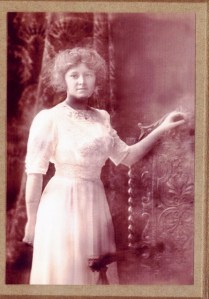
Ruth Briggs Litchfield, 19 years old, 1912. Photo courtesy of Meg Kenagy

At the end of August 1918, the worldwide influenza pandemic hit the Boston area. Doctors and hospitals were overwhelmed. Red Cross volunteers and nurses stepped in to help. In Hingham, Ruth Litchfield Marsh, two years out of nursing school, worked throughout the crisis. She was 25 years old. It was through this experience that she became committed to public health, working over her long life with the Hingham Visiting Nurses Association and as a volunteer for South Shore Hospital.


Ruth, the elder of S. Frances and Wilbur Litchfield’s two daughters. Photo courtesy of Meg Kenagy.

Ruth was born in April 1893 at 11 Union Street, Hingham, the first of two daughters of Sarah Frances Briggs and Wilbur Trowbridge Litchfield. She lived most of her life on School Street. She married George Marsh in May 1919, had four children and many grandchildren. Her house and gardens were always beautifully kept and she always had time to bake a casserole for a neighbor, talk to a child, and teach sewing. When she died at 97 years old, she was remembered for her many contributions to the town:  Girl Scout leader, nurse, volunteer, member of the Women’s Alliance of the Old Ship Church.  She was my grand-aunt and I, as well as many others, remember her compassion and gentle sense of humor.  For more about the life of Ruth Litchfield Marsh, you can read: The House on School Street, Eight Generations, Two hundred and four years. One family.


A Letter from Home: Easterly Winds and Death

Old letters open a window to the past. There isn’t a genealogist or historian who doesn’t yearn for them. And for good reason: letters carry the voices of our ancestors, they tell us a story. They illuminate our history.

One such letter, written on May 1, 1830 by Hingham resident Benjamin Thomas, Jr., to his uncle Martin Cushing in Maine, contains “sorrowful” news. It relates the death of Martin’s older brother Adna, who died the day before. The story it tells is of working conditions, medical knowledge, and a community caring for its own.

By way of background, Martin and Adna, sons of Isaac and Mary Cushing, were born in Hingham in 1788 and 1785, respectively. Descended from Matthew, the first Cushing to settle in town, they grew up in Hingham Centre, working on the family farm and in the sawmill. As adults, they entered the trades: Adna became a stonemason, Martin a bricklayer. In 1810, Adna married Sarah Leavitt and built a house at what is now 63 Pleasant Street; within a decade, he had moved his family to Leominster. Martin married Susan Thomas and moved to Maine.

In the letter, Benjamin recounts the facts of Adna’s death. He does not indulge in emotion or offer sympathy. From it, we learn that, in the winter of 1830, Adna worked indoors as a stone mason and that “the dust gave him a bad cough.” We learn that spring brought bad weather: there were “3 weeks of easterly winds and mist, by which [Adna] took a bad cold.” We learn that at the tail end of April, while working on a job in Charlestown, Adna fell violently ill and died. We learn he “labored” within days of his death.

When he died, his body “was brought to Hingham by a sail boat,” and “he was buried from M. & F. Burrs house” on the day of his death.

What the letter doesn’t tell us is that Adna was only 44 years old when he died. It doesn’t say how his wife and children learned of his death. Knowing he was buried the day he died, we understand that he was in the ground before most people knew he was dead. We see that immediately following his death a group of friends or co-workers carried his body from Charlestown to Hingham by sailboat. We know the news was rushed to Hingham Centre, and that the Fearing Burrs opened their home for an unexpected funeral. We realize that, in a matter of hours, a coffin was acquired, a gravedigger found, and a minister fetched. We are left to imagine the ripples of grief that spread across the villages and towns as friends and family heard the news.

Martin died seven years after his brother and is buried in Maine. How the letter survived is not clear as his widow is believed to have remarried and moved west, but it was handed down through the Cushing family. Thanks to the letter, we have a better idea of what it was like to live in Hingham in 1830.

Endnotes

Benjamin Thomas Jr. (1799-1854) was a nephew of Susan (Thomas) Cushing, Martin Cushing’s wife. He was the son of her brother, a gunsmith who lived in Hingham Centre. Lincoln, George et al., History of the Town of Hingham, Massachusetts, Vol. III (Genealogical), 1893. Pub. by the Town.

A copy of the letter from Benjamin Thomas Jr. to Martin Cushing was shared with me by researcher Margie von Marenholtz.

Adna Cushing (1785-1830) and Martin Cushing (1788-1837) were two of Deacon Isaac and Mary (Jones) Cushing’s seven children.

The Capt. Adna Cushing house at 63 Pleasant Street was built in 1811, according to the Hingham Historical Commission, Inventory of Historic, Architectural and Archaeological Assets. On Adna’s move to Leomister, see Cushing, James Stevenson. The genealogy of the Cushing family, an account of the ancestors and descendants of Matthew Cushing, who came to America in 1638.1905. Montreal, The Perrault Printing Co.

On M. & F. Burr’s house: Fearing Burr Sr. (1778-1866) had a store and home in Hingham Centre. Lincoln, George et al., History of the Town of Hingham, Massachusetts, Vol. III. Ibid. Adna is buried with his parents and his wife in Hingham Centre Cemetery. Note: His gravestone says he was 45 years old when he died; he was 44, in his 45th year.

Martin Cushing died 20 May 1837. “Maine Deaths and Burials, 1841-1910,” database, FamilySearch, Feb. 2018.