The Daly Family of Hingham

Historian John Richardson (1934-2011) was an avid collector of all things Hingham– its places, its buildings, its people. Among his collection in the Historical Society’s archives are 64 binders of material, gathered from families, purchased at estate sales, or sometimes rescued from homes or buildings facing demolition, that chronicle the lives of a disparate group of Hingham individuals and families.

Two binders are devoted to Daniel Daly (1825-1911), one of the town’s earliest Irish immigrants, and his descendants. They tell a story that takes the family from newcomers just prior to the Civil War to well respected members of the Hingham community by century’s end.
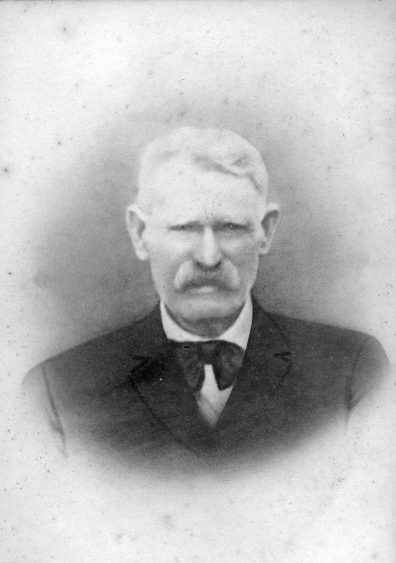
Portrait of John Daly, early 1900s(?), John P. Richardson Collection, Hingham Historical Commission / Hingham Historical Society

Daniel Daly was born in County Armagh, Ireland and arrived in Hingham in 1855, soon after marrying Nancy Crowe (1835-1905) from the County of Tipperary. Daniel began as a gardener, hiring himself out to local families. After serving in the Civil War he started working as a gardener and florist with prominent Hingham families, such as Charles B. Barnes.
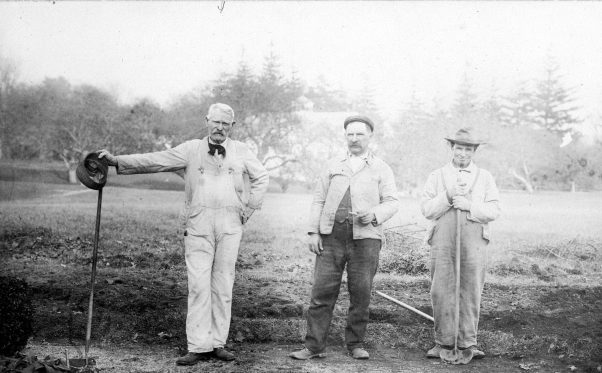
Photo of Daniel Daly and 2 others on Estate of Charles B. Barnes, early 1900s, John P. Richardson Collection, Hingham Historical Commission / Hingham Historical Society

With the money he earned, he bought a house at 19 Green Street where he and Nancy raised their family. The Dalys had two children who survived to adulthood and who both attended Hingham schools: Daniel (1857-1900), who later moved to St. Louis and became a police officer, and Edmund (1866-1930), who started out working in retail stores in Boston and later became a businessman ins own right as a partner in the Hingham Bicycle Company and later as the sole owner of Edmund Daly & Co., Hatters and Furnishers, which had a store in West Hingham.
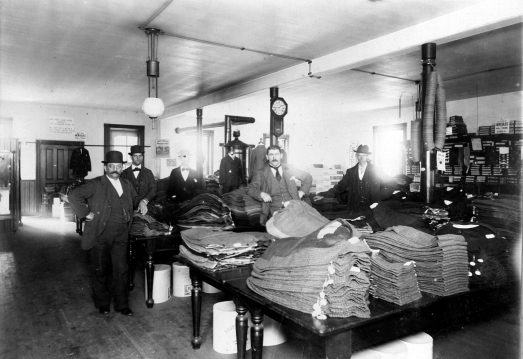
The interior of Edmund Daly and Co. store in West Hingham, 1910s(?), Edmund Daly (center), others unidentified. John P. Richardson Collection, Hingham Historical Commission / Hingham Historical Society

The Daly Family materials include this floor  sample from Daly & Co.:
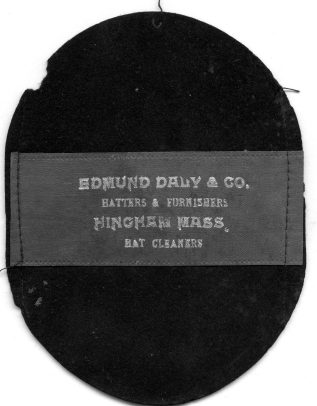
Sample hat(?) floor sample from Edmund Daly & Co. c. 1910 from John P. Richardson Collection, Hingham Historical Commission / Hingham Historical Society

Because he was a well respected businessman, members of the local community urged him to run for public office, including for a seat in the state legislature in the early 1900s.
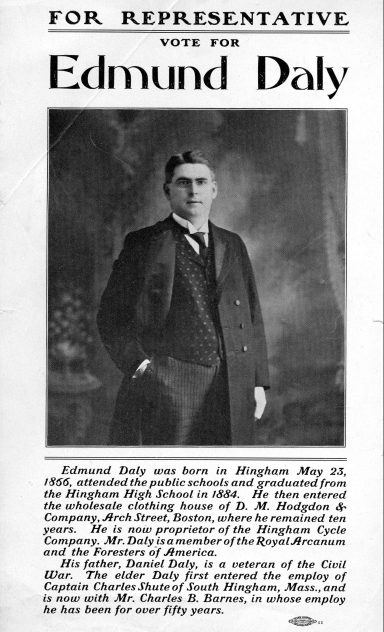
Political Poster supporting Edmund Daly for State Representative, Unknown, prior to 1910, John P. Richardson Collection, Hingham Historical Commission / Hingham Historical Society

Though he did not win this election for state office, Edmund served on many town boards, including the Playground Commission. Meanwhile, he inherited the family house on Green Street after his father’s death in 1911.
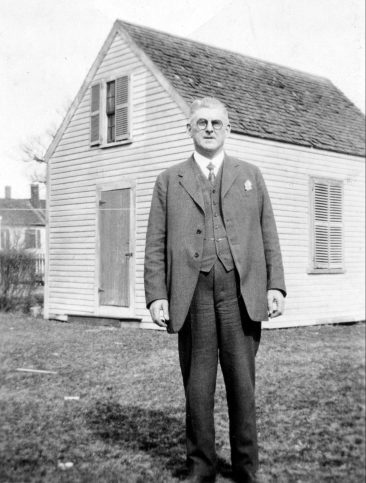
Edmund Daly standing in the backyard of his home at 19 Green Street, 1920s? John P. Richardson Collection, Hingham Historical Commission / Hingham Historical Society

His community standing and political connections allowed him to be appointed as Hingham Postmaster by President Wilson in 1917, a job he held until 1930 when he suffered a fatal heart attack walking to work from his home. The town was shocked and saddened in hearing the news.

Edmund Daly married Margaret E. Daly (1864-1952). They had one daughter, Annabel Daly (1900-1993) who also attended the Hingham schools. The Richardson Daly binders even include one of her primary school class photos.
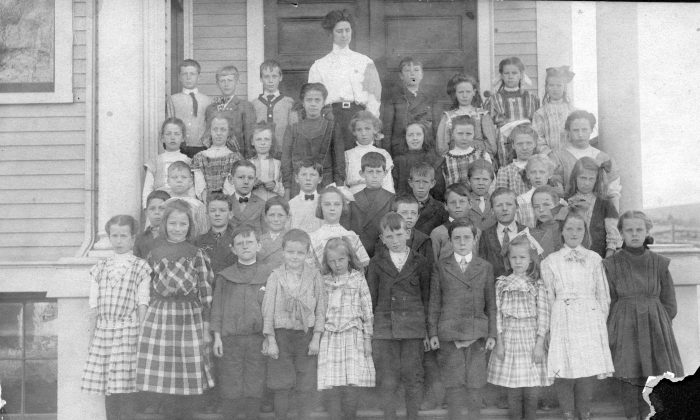
Class photo in front of Primary School Building in Hingham, unknown date (circa 1912), Annabel Daly second from left in first row. John Richardson Collection, Hingham Historical Society

She then attended Hingham High School where she graduated in 1918. In her adult life, she kept a scrapbook of her early years and her father’s career, through which most of her family’s history was saved.
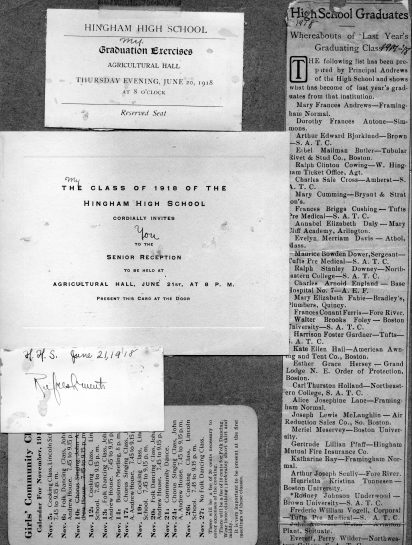
Page from Annabel Daly’s Scrapbook, June 1918. John P. Richardson Collection, Hingham Historical Commission / Hingham Historical Society

She not only kept items of a personal nature but chronicled important events in town as well. Among her materials is media coverage of the destruction of the original Hingham High School by fire in 1927.
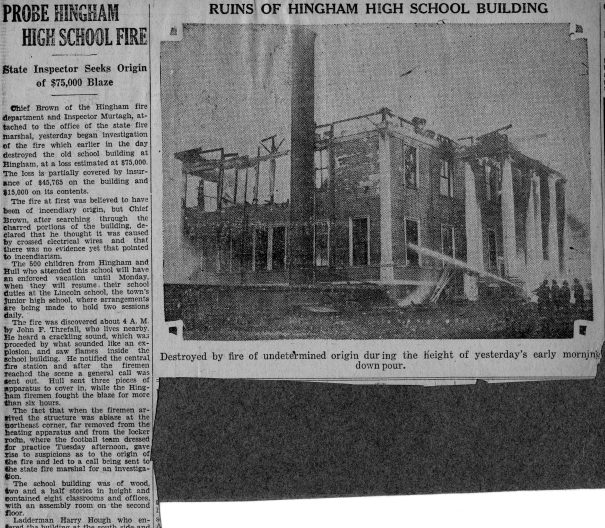
Page from scrapbook of Annabel Daly, Oct. 1927. John P. Richardson Collection, Hingham Historical Commission / Hingham Historical Society

Annabelle Daly continued to live in the Green Street house until her death at age 92. She did not marry and had no children. She was buried in the family plot at the St. Paul’s Cemetery. Her collection was obtained by John Richardson, who organized the Daly family materials into binders. These Daly binders and other family materials collected by John Richardson will soon be greatly more accessible at the new Hingham Heritage Museum.
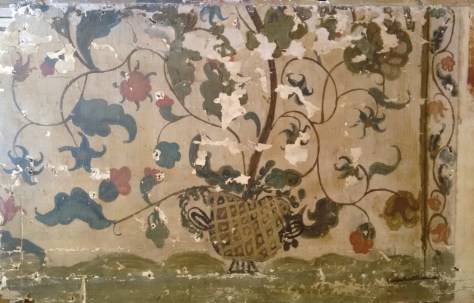
Signs of “nature’s god” at the Ebenezer Gay house

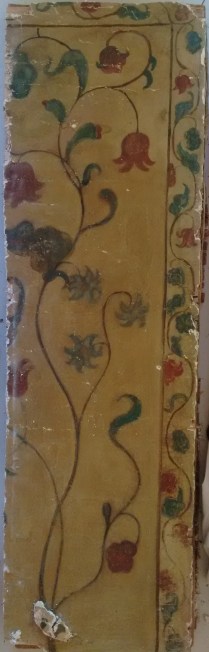
When a local developer purchased the Rev. Ebenezer Gay (1696-1787) house at 89 North Street, local historian John P. Richardson participated in some pre-construction historical investigations.  These painted panels from the Gay house, later installed in the 1690 Old Fort House which Mr. Richardson owned and occupied, are now part of the John P. Richardson Collection at the Hingham Historical Society.

2012302001

Wall Fragment from the Ebenezer Gay House.   John P. Richardson Collection, Hingham Historical Society.

The first wall fragment is made of a plaster and lath surface attached to heavy vertical boards, which are in turn attached to two more modern boards horizontally laid.  The decorative side is painted a dirty off-white base with a meandering vine ad flower motif that originates out of a basket or planter decorated in a cross hatch pattern with dots in each diamond of the crosshatch.  The basket rests on a hilly green stylized landscape. The vine bears large, stylized acanthus-type leaves and flowers of varying shapes in red and blue. Five hand-cut nails protrude from the wall—two at the far left, one at the top center, one at the upper right, one at mid-right.

2012302000

Wall Fragment from the Ebenezer Gay House. John P. Richardson Collection, Hingham Historical Society.

The second decoratively painted wall fragment consists of two layers of plaster and lath encasing two heavy vertical boards. The plaster side is painted with at least 2 layers of paint, the topmost having been added by a 20th century Gay family member seeking to restore the design.  The original background was green, while the background of the current surface layer is a dirty tan color.

A meandering vine motif climbs the panel, with the vine bearing red tulip-shaped blue lily-shaped flowers.  At right is a narrow border set off by a dark brown line.  Within the border the flower and vine motif repeats in a narrower scale. To the right of the border is an unfinished area of white plaster with two maroon colored squares of paint laid out in a windowpane pattern.

In his book, The Benevolent Deity: Ebenezer Gay and the Rise of Rational Religion in New England, author Robert J. Wilson III described the Gay house at it looked during the years that Ebenezer lived there with his wife, Jerusha (Bradford) Gay and their ten children:

The house was a 2-1/2 story, rectangular, pitched-roof affair, somewhat large for the period, but not ostentatiously so.  Though it was painted a rather austere blue-gray on the outside, the interior was lively and colorful.  Someone (Jerusha?) adorned the cream colored walls of the family sitting room with a free hand vine design, very like eighteenth-century crewelwork.  The woodwork, fireplace wall, and the wainscott (added later) were all painted a light green.  The whole effect suggested that nature’s god in all his vibrancy was very much alive in the Gay house.


My Sally Hess Internship

How has the 2016 Sally Hess internship affected me? Truthfully, it’s hard to describe all the minute ways in which I have grown while working with the Hingham Historical Society this summer. The opportunity to serve as the 2016 Sally Hess Intern has aided me in a good deal of self-discovery and helped launch my development as a museum professional.

Here’s a little background about myself— I went to college with an inkling of an idea for what I might have wanted to study as a major: a high school teacher had assigned an art history paper in which we had to describe work of a Renaissance painter. This sparked curiosity for a subject that I had never before encountered. My high school didn’t offer any art history courses so I gave it a shot my freshman year of college. It just so happened that I had stumbled across the subject that kindled an intense yearning to know more—a craving which I hope everyone feels at some point in their lives.

So, after four determined years of study I graduated college in May 2016 with my Bachelor’s degree. Coming back to one’s hometown after such a momentous occasion doesn’t always feel so glorious; however, I took this anticlimactic feeling to propel my next steps, which included reaching out to the Hingham Historical Society in hopes that they might have some niche for me to work with them. While I waited for them to respond to my inquiry, my mind kept returning to the typical questions a newly graduated individual deliberates: what do I want to do with my degree? Where should I look for work? What work is there for someone with my focus? Needless to say, I was feeling restless, nervous, and a little dire.

image-of-eve-fairbanks-working-as-intern-1

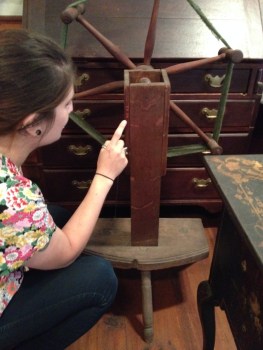
Eve Fairbanks working with a wool winder at the Old Ordinary, our 1688 house museum

Then, in a rather timely fashion, the Historical Society responded, interviewed me, and decided to award me their Sally Hess Internship for the summer of 2016. Thus I found myself with a paid internship with a great organization. Over the months I’ve been working with them, I have been exposed to many facets of the museum world that had never even seemed an option for me. For example, I consider myself a “public-speaking-aphobe.” The Sally Hess Internship required me to act as a docent at the Historical Society’s 1688 house museum, known as the Old Ordinary. This opportunity took me out of my comfort zone but I soon overcame some of that initial nervousness I have with presenting myself. I learned the rooms inside and out by watching other tour guides and reading the material the Hingham Historical Society provided for me. By the fifth tour I gave on my own, visitors to the Old Ordinary were not only commenting on the extraordinariness of the building but also on the quality of my tours. I also experienced the collections work done at a museum: cataloguing 17th– 20th century artifacts, entering new files into our collections database, and researching the history and significance of objects in our collection. I have fallen even more deeply in love with the museum world and have confronted many of those haunting post-graduation thoughts I previously mentioned.

image-of-eve-fairbanks-working-as-intern-2

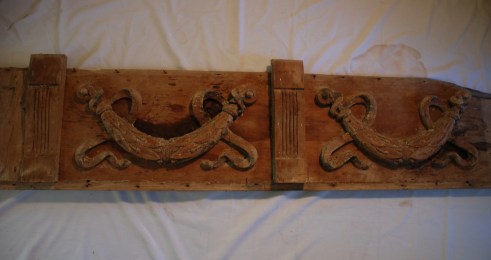
Sally Hess intern Eve Fairbanks catalogued the numerous  architectural elements from local buildings in the John P. Richardson Collection at the Hingham Historical Society. 

I now feel as though I have a direction I want to head in. I’ve confirmed with myself that I might enjoy museum work as a career. I plan to seek out other opportunities working with documentation of artifacts, helping organize behind the scenes at a museum, or (who knows) maybe even giving more tours. The notion of going back to school for a Master’s degree doesn’t seem so far-fetched; now, that I feel a new verve for this business. I am so grateful that the Hingham Historical Society gave me a chance to work with them. I will never forget this experience and can’t wait to see where it leads me.

Thanks infinitely,
Eve