Dr. Robert Thaxter–Dedicated Physician and Champion of the Poor

Dr. Robert Thaxter was born in Hingham on October 21, 1776, only months after the 13 American colonies declared their independence from Great Britain. This was of course a year symbolic of strength, resilience and change, and the same can be said of Dr. Thaxter, who possessed this type of fortitude and a commitment to helping others that one day would claim his life.
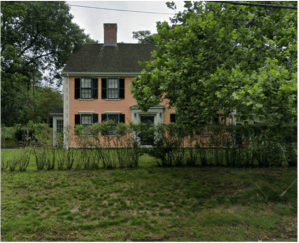
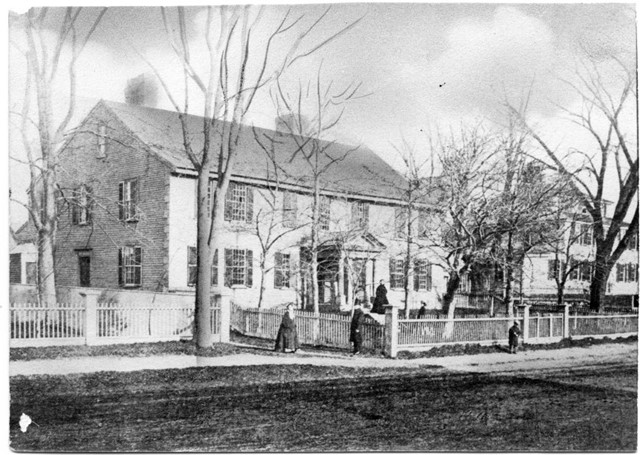
Tranquility Lodge, 137 Main Street, Hingham

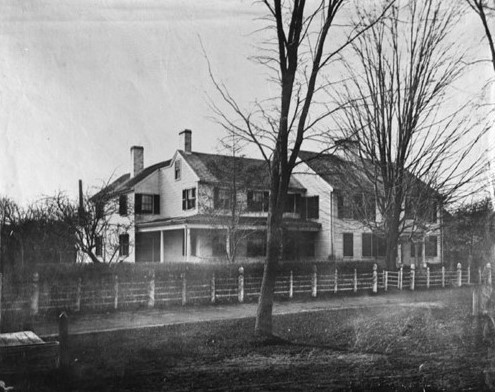
Likely born in his grandparents’ house at 21 Lincoln Street (now known as the Hingham Historical Society’s Old Ordinary), Robert Thaxter grew up at 137 Main Street in Hingham, a lovely home once called “Tranquility Lodge,” sitting just down aways on Main Street from Hingham’s 1681 Old Ship Church Meeting House.  

He graduated from Harvard College in 1798 and attended the highly selective private cadaver lectures in Anatomy and Surgery offered by the famous surgeon Dr. John Warren (1753-1815), who would go on to be a founder of Harvard Medical School. Dr. Robert Thaxter’s original admission ticket to Dr. Warren’s class is seen below.  Robert soon joined the Massachusetts Medical Society and in 1824 delivered that body’s annual oration, titled A Dissertation on the Excessive Use of Ardent Spirits.
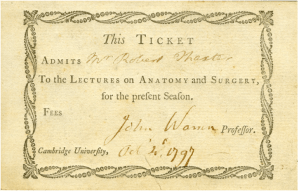
Robert continued a family tradition as a highly respected medical doctor. He was mentored by and practiced with his father, Dr. Thomas Thaxter, in the study of medicine and surgery in Hingham. Dr. Thomas Thaxter was of deep Hingham roots, as “the family of Thaxters were among the early settlers of that town.” (The Boston Medical and Surgical Journal, Vol, XLVI., Wednesday, May 19, 1852. No.16 pg. 309)

Dr. Robert Thaxter kept detailed records of his patients. His medical diary is a treasure that the Hingham Historical Society holds in its archives. He had a unique writing style and in one journal entry describes the travels of a critically ill man who journeyed from northern Maine for medical care.
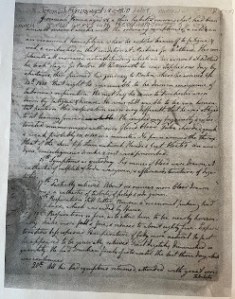
This was a demanding trip in the 19th century even for a healthy person let alone one with a critical illness. But Dr. Thaxter was a physician of both the rich and the poor and a healer with an extensive reputation as a doctor both near and far. The doctor’s notes reflect his high level of compassion for this distressed patient. His concise description of the patient’s clinical findings also shows a modernist sensibility in terms of his ability to describe clinical findings with a degree of precision. At that time, treating patients was limited by the lack of today’s medicines such as antibiotics which may have cured this patient. Dr. Thaxter did a remarkable job taking care of patients with the limited pharmacopoeia available at that time. Dr. Thaxter’s 1810 entry regarding his examination of this sick patient is as follows.

Jeremiah Ferino: Jeremiah, 28, a thin habit, (and) narrow chest, had been unwell several weeks with the ordinary symptoms of a cold an occasional haemophysis, when he exhaled himself to fatigue (and) … (and) embarked in that condition at Machias for Portland.

His complaints all increased notwithstanding which on his arrival at Portland he took stage for Boston. At Portsmouth he was stopped one day by epistaxis then … his journey to Boston, where he arrived April 14th, 1810.

That night he was unable to lie down in consequence of laborious respiration. The next day he came to Dorchester worn down by fatigue (and) disease. He was still unable to lie in a horizontal position. His respiration was so very difficult that he was obliged to sit leaning forward. He coughed very frequently (and) expectorated mucous mixed with very (fluid) blood.

To have medicines on hand as a doctor, his father, Dr. Thomas Thaxter was also proprietor of a pharmacy in Hingham, which Robert’s maiden aunt, Abigail Thaxter, ran.  (History of the Town of Hingham, 1893; Vol II, page 323; “Native and Resident Physicians” by George Lincoln.)  The Thaxter pharmacy would have had a wealth of compounds, elixirs, herbs, and other medicinal items that the young Robert Thaxter could access to treat and cure ailments of that time. Dr. Robert Thaxter’s beautiful wooden medicine chest is also in the collection of the Hingham Historical Society. His medicine chest contains thirteen mold blown glass bottles, many of them with original paper labels. The bottles are labeled with interesting ingredients such as maraschino, strawberry syrup, ginger, parfait amour, rose water, spirit of camphor, orange, oil of cinnamon, oil of cloves, and aromatic elixir. Today, most of these items would be found in our kitchen spice rack rather than our medicine cabinet.

Once trained, Robert Thaxter stayed in Hingham side by side with his father and continued the medical practice. They were both driven and ambitious men but by 1809, Dr. Robert Thaxter needed his independence. He moved his medical practice to Dorchester. Not surprisingly, he was “immediately received into popular confidence which he retained until his death.” (The Boston Medical and Surgical Journal, Vol, XLVI., Wednesday, May 19, 1852. No.16 pg.309). Dr. Thaxter was married to his love of medicine and never took a wife. Once settled in Dorchester, he posted the following advertisement in the July 22, 1809 Columbian Centinel Newspaper:

NOTICE: Doctor Robert Thaxter informs the Inhabitants of Dorchester that he has taken lodgings at the residence of Mr. William Richards, where he will be ready at all times to attend to his profession. He will inoculate with kine Pox, free of expense, all persons who feel themselves unable to pay.

(History of the Town of Hingham, 1893; Vol II, page 324. “Native and Resident Physicians” by George Lincoln.)

At that time, Boston was a homogeneous and in many ways provincial society, with a deeply rooted regard for its protestant English past.  Irish immigrants now flooded into Boston hoping for a second chance in life. These Catholic newcomers, though, were seen as a threat to the norms of Boston society. Dr. Thaxter’s decision to relocate his practice to Dorchester was a bold move. He might have damaged his reputation as a doctor by leaving, but he didn’t and still returned to the area to perform surgeries (The Boston Medical and Surgical Journal, Vol, XLVI., Wednesday, May 19, 1852. No.16 pg.309).

Once settled in Dorchester his reputation took off. Dr. Thaxter’s diligence, careful medical observation, and never-ending dedication to the sick expanded his medical practice to neighboring areas. As time went on, he also was drawn to the Irish poor now arriving in Dorchester. “The Irish population gathered more thickly about him . . . .  By night and by day, he was at their beck,” (The Boston Medical and Surgical Journal, Vol, XLVI., Wednesday, May 19, 1852. No.16 pg.312)

Dr. Thaxter’s commitment as a doctor to serving the needy, poor, and especially, those from Ireland fleeing the potato famine is commendable—then and now. Those emigrating by what were later called “coffin ships” from Ireland carried poor passengers in steerage where there was a lack of food, plenty of filth and diseases running rampant such as typhus. (As described in a Hingham Historical Society lecture, “The Irish Riviera and Hingham’s Irish 1850-1950,” available for viewing here, typhus and other infectious diseases were killers without our present-day antibiotics.

Dr. Thaxter met his end doing what he believed in. “He fell a martyr to the ship fever (typhus fever), caught in attending an Irish family, just from on board ship.” (Obituary, Boston Daily Evening Transcript 11 Feb 1852).  It was said that “Dr. Thaxter never stopped helping the Irish.” (Ibid.) He had a charitably rich and spiritual life to the end. Dr. Thaxter died February 9th, 1852. He was 75 years old. (History of the Town of Hingham, 1893; Vol II, page 324; “Native and Resident Physicians” by George Lincoln.)

To learn more about the Thaxter family and its place in local and American history, please see our post One if By Land, Two If By Sea on this blog.  You might also look at the recent publication, Revolutionary War Patriots of Hingham, by Ellen Miller and Susan Wetzel, Dec 26, 2023, which details the town’s Patriots, including quite a few from the Thaxter family who left their mark in history.
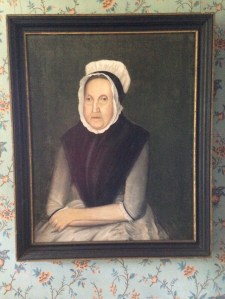
Abigail (Smith) Thaxter

If you are in Hingham, you also may want to visit Dr. Thaxter’s likely birthplace, the Old Ordinary. There you can see a portrait of Dr. Robert Thaxter’s grandmother, Abigail Smith Thaxter, hanging in the parlor.

Dr. Robert Thaxter’s spirit carries on today in public service and health. This tradition of outreach and assistance to those most disadvantaged continues in the Boston area such as the work of the late Dr. Paul Farmer and the continuing work of Partners in Health, and Dr. Jim O’Connell and Boston Health Care for the Homeless, as well as numerous others dedicating their lives to helping those in need.
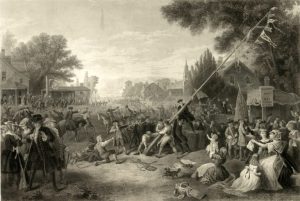
October 1774: Hingham Raises a Liberty Pole

“Raising the liberty pole,” 1776 / painted by F.A. Chapman ; engraved by John C. McRae, N.Y. (Library of Congress)

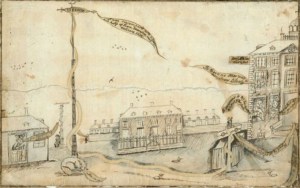
1774 was a big year for young Samuel Gardner of South Hingham.  Over the course of that year, he made five short notations in what had once been his father’s diary:  that he was married on January 6; that he commenced “keeping house” on April 27; that his father, Samuel Gardner, Sr., died on November 5; and that his first child, also named Samuel, was born the following day, November 6.  The fifth entry, made on October 16, 1774, was, “Liberty pool [sic] raised.”  To have merited an entry along with the other four milestones means this, too, was an important event in Samuel’s life. 

It has long been reported that a liberty pole was raised in South Hingham.  The hill running up Main Street from Glad Tidings Plan to the vicinity of what is now South School was called Liberty Pole Hill in the 19th century, and the name was adopted for a residential subdivision, bounded by Main Street, Cushing Street, and Old County Road, that was constructed in the 1950s and 1960s.  But until we located a transcription of Samuel Gardner’s diary in the papers of local historical Julian Loring, we had no written confirmation of or information about Hingham’s liberty pole.   

Liberty Pole in the Fields (New York). 1770 cartoon engraved by P. E. du Simitiere. (Library Company of Philadelphia)

What is a liberty pole anyway?  Liberty poles erected in colonial towns in the years running up to the American Revolution were symbols of dissent from Great Britain.  They were typically tall wooden masts or poles with a red flag or cap on top and often served as the sites of meetings or demonstrations.  The reference was classical, recalling stories of a pole topped with a freedman’s cap erected after Julius Caesar’s assassination as a symbol of the Romans’ freedom tyranny.  (Boston initially had a Liberty Tree, where in 1765 the Sons of Liberty hanged Andrew Oliver in effigy to protest the Stamp Act, though after British soldiers chopped it down during their occupation of Boston, it was replaced with a liberty pole.) 

Liberty poles were raised across New England in the 1760s and 1770s, sometimes in protest (for instance, of the Stamp Act or the Boston Port Act) and sometimes in celebration (for instance, the Stamp Act’s repeal  or the opening of the First Continental Congress). 

The timing of Hingham’s liberty pole–raised on October 16, 1774–is no surprise.  In May 1774, Parliament enacted the Boston Port Act, closing Boston Harbor, and other of the so-called Intolerable Acts as retribution for the Boston Tea Party.  Boston’s Town Meeting issued a call for a trade embargo against Great Britain and by mid-summer 1774, Hingham’s Town Meeting had formed a committee to draft a non-importation covenant, or agreement in solidarity with Boston to boycott goods from Great Britain and the West Indies.  On August 17, Town Meeting approved the draft covenant but stayed its execution pending action by the First Continental Congress, which had convened on September 5.  (By late October, Town Meeting had received and adopted the articles of the Continental Association, a non-importation, non-exportation, and non-consumption agreement against British merchants and goods, in the hopes that economic pressure might encourage Parliament to address colonial grievances.) 

On September 21, 1774, the Town heard a report of the Suffolk County Committees of Correspondence and voted its agreement with that body’s resolves, later called the “Suffolk Resolves.”  These included boycotting British goods, defying the Intolerable Acts, refusing to pay taxes, and urging the towns to raise and train militias of their own people.  Consistent with those resolves, at the same meeting, Hingham voted to recommend “to the officers of the Militia to assemble their men once in the week and Instruct them in the art of War and the Men be provided with Arms and Ammunition According to Law.” 

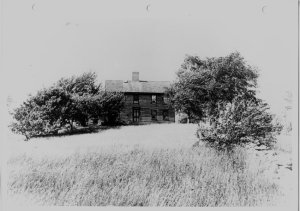
Enoch Whiton House, 1083 Main Street (Hingham Historical Society)

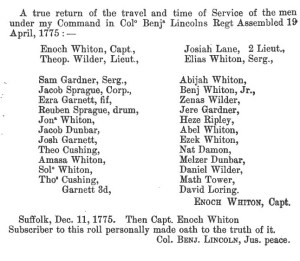
Hingham had several militia companies, roughly organized by geography.  Samuel Gardner belonged to the company under the command of Captain Enoch Whiton, a neighbor of his on Liberty Plain. (Captain Whiton’s house still stands at 1083 Main Street; as do those of Samuel Gardner, Sr., and Jr., at 1035 and 1006 Main Street, respectively.  It is remembered that Captain Whiton’s company trained in the vicinity of what is now the Marchesiani Farmlands at 1030 Main Street–right across the road from the home of Samuel Gardner, Sr. 

The militia men were undoubtedly instrumental in the raising of a liberty pole not far north of their training grounds on October 16, 1774.  Their revolutionary activity was only beginning; Captain Whiton’s company mustered and marched on April 19, 1775, when word of Lexington arrived in Hingham.  

History of the Town of Hingham, vol. I, pt. 2 (1893)

One If By Land; Two If By Sea: the Hingham Connection

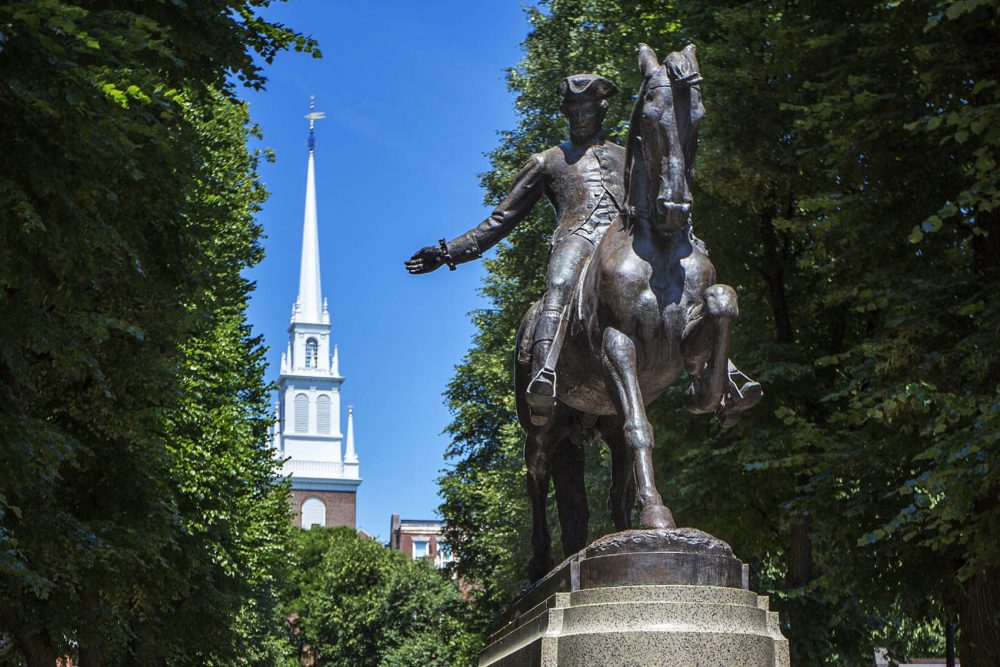
Most people are aware of Paul Revere’s midnight ride in April 1775 due to the poem by Henry Wadsworth Longfellow and the hanging of two lanterns in the Old North Church steeple preceding his journey.  We at the Hingham Historical Society were delighted to learn that this event has a Hingham connection.

Thaxter Mansion, North Street, Hingham

One of the men responsible for hanging the two lanterns was John Pulling, Jr. a vestryman of Old North and a friend of Paul Revere. John was born in 1737 in Boston and was a trader by occupation. He married his first wife, Annis Lee, in Manchester in 1768. They had two children, a daughter and son both named for their parents.

Abigail (Smith) Thaxter

John’s wife Annis died in 1771. This is where the Hingham connection comes in. John married his second wife, Sarah Thaxter McBean (17461843) in January 1773. She was the daughter of Major Samuel Thaxter (1723-1771) of Hingham, a trader and veteran of the French and Indian War, and Abigail Smith (1722-1807), daughter of Samuel and Bethia (Chipman) Smith of Sandwich. Sarah grew up in the Thaxter mansion on North Street, the site of today’s St. Paul’s Church. A portrait of Sarah’s mother, Abigail Smith hangs in our Old Ordinary museum.

Pulling Tablet, Old North Church

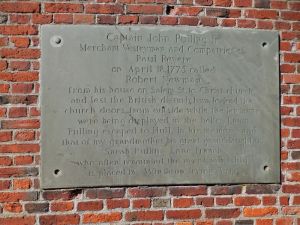
This was Sarah’s second marriage as well. She was the widow of Duncan McBean, a West Indies planter from a family of Scottish traders. The McBeans had no surviving children. Records show that Sarah and John Pulling had three known children: Sarah (1773), Martha (ca 1780) and Richard (bef. 1782). During the Revolutionary War John served as a Captain and Commander of Ordinance Stores. On April 19 when he heard he was wanted by the British for questioning in his role aiding Revere, he, Sarah and their children fled Boston in a fishing boat, making their way to Hull. This event is memorialized on a tablet on the Old North Church. When they returned to the North End of Boston after the British evacuated in March 1776, they found their house ransacked and all their property gone. 

121-123 Main Street, Hingham

After John’s death in 1787 Sarah and her family (including the two children from John’s first marriage) returned to Hingham, where they lived until Sarah married for the third time to Thomas Reed of Abington in 1793. It is unknown where in Hingham Sarah and the children lived during that five-year period as Sarah’s childhood home, the Thaxter Mansion had been sold to Elisha Leavitt, Jr. in 1770. Perhaps Sarah and the children lived with

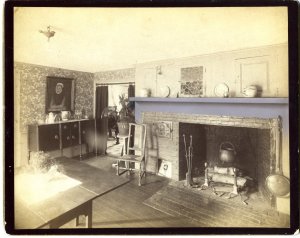
Parlor at 137 Main Street, Hingham

one of her younger brothers who remained in Hingham? Dr. Thomas Thaxter lived at 121 Main Street and Henry Thaxter lived at 137 Main Street. Both houses still stand today. After marrying Thomas Reed, Sarah resided in Abington until her death in 1843 at age 97.

Joshua Winslow “Out of The Frying Pan and Into the Fire”

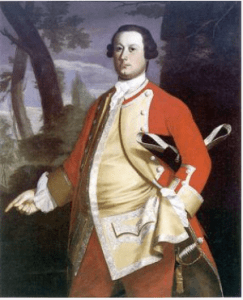
Portrait of Joshua Winslow (1755) by John Singleton Copley

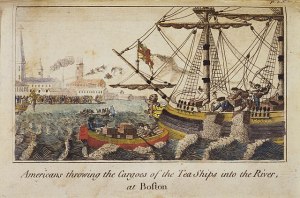
A letter in our archives, written almost exactly 250 years ago today, provides a personal account of events leading up to the famous Boston Tea Party,  whose semiquincentennial will be widely celebrated next month.  The letter is from Joshua Winslow, a merchant and member of an ancient Plymouth County family, to Jotham Gay, son of Hingham, Massachusetts, pastor Ebenezer Gay, and himself a merchant.  In his November 18, 1773, letter to Gay, Winslow describes his appointment as one of six “consignees” authorized to receive (and pay the duty on) East India Company tea to be brought into the colonies under the newly enacted Tea Act of 1773; Boston’s resistance to the importation of that tea; and his growing sense that he might be heading “out of the frying pan and into the fire.”  Winslow and Gay were in business together and good friends, their families linked by several marriages.  When he wrote to Gay, Winslow had just returned to Massachusetts after a number of years in Cumberland, Nova Scotia.  This is only one letter in a long-standing correspondence between Winslow and Gay, but it is both evocative and timely.

Winslow first provides a clear explanation of the economic and political factors at play as a result of the Tea Act:

[M]y time has been much engaged of late in a New Affair, which, whether it has reached you or not I can’t tell, but I have said just now something of my going out of the frying pan into the fire.  This was meant to allude to a New Measure of the East India Company for introducing their teas into the several Governments in America at a lower Rate than ordinary, in order to prevent the vast Importation of Dutch Teas, which, as they do not pay the duty, are sold at a lower rate than that from England, by which means the India Company’s Teas have been accumulating upon their hands & the great door for vending the same into the Colonies in a manner Shut up.  By the Interest of my Friends I was appointed one of the Companies Agents in Boston, & if the thing is Effected, it will afford a handsome commission.  But the Country seems to be all up in arms again, & as great a Commotion at last is made about it, as there was about the Stamp Act–nay, they seem to carry opposition much higher than they did then.  All the provinces seem determined that it shall never be landed in America . . . .

Even if being sold directly from the East India Company, the tea remained subject to taxation under the Townshend duties, and thus the Americans supporting the Patriot cause did not want this lower-priced tea landing in the colonies.  The six consignees–Governor Thomas Hutchinson and two of his sons, Benjamin Faneuil, Richard Clarke, and Winslow–would be responsible for paying the duties before selling the tea on to New Englanders.

Winslow’s letter then turned to a description of some alarming events of November 3, 1773–what may be thought of as the opening chapter in the Tea Party story:

[T]o so great a height had [opposition to the East India Company tea] got in Boston, the beginning of this month, that I had an Express from my associate Mr. Faneuil on the evening of the 2nd Inst. to be in Town next day by 11 o Clock.  I set out at Midnight and rode till 9 o Clock Next Morning.  When I got to town I found the Flag up at Liberty Tree, & the inhabitants had been notified by hand bills Stuck up the day before to appear at the Tree at 12 o Clock that day to hear the Consignees resign their Commissions, & swear that they would return the Tea by the ships which brought it out.  We met at Mr. Clark’s Store, who with the Governor’s Two Sons are the other Consignees & determined that we would not go. Whereupon a Committee of the whole house came down from the Tree thro: King Street (at about 1 o Clock) to Mr. Clark’s store, where Mollineux at the head of a number demanded of us to Resign our Commissions & swear that we would Return the Tea — &c &c.  He was told we had no answer to make thereto, whereupon we were declared Enemies to the Country, & notified that we were to expect the Resentment of the People.  Accordingly soon after he left the Store, an Attack began by breaking the Doors, Pelting Stones, Dirt, &c, upon those within and attempted to break in upon us, but having a number of resolute Friends we sustained the attack & after about one hour’s siege they marched off , the chief of them at least, & we being Reinforced by a number of Friends, quitted the Store . . . .

 “Next day was pretty quiet,” Winslow continued,

but a Town Meeting was ordered for the day following — Which met accordingly but it being 5th Nov: and no small intimations of another attack that night under the sanction of its being Pope’s Night, I not being desirous of another Amusement of that Nature ordered my Chaise & left Town — nor have I been there since.

(Pope Night, a New England descendant of England’s Guy Fawkes Day, was a raucous and sometimes violent celebration; a consignee of English tea might reasonably be concerned about additional trouble.)

Back in Marshfield, Winslow expanded on his frustration:

There have been other Meetings since for the same purpose & one attack upon Mr. Clark’s House, but as the Tea is not yet arrived and until it is we are in Manner Ignorant of the Nature of the Instructions which may accompany it.  We cannot resign in Honor or Conscience; for this we are abused and stigmatized as Enemies of the Country & what not — but I need not enlarge as you will see the proceedings in the Publick Prints.

He closed on a somewhat hopeful note:

How the matter will end must be left to time.  Meanwhile, I don’t intend to go to Town again until [the tea] arrives, when perhaps there may be such Instructions therewith as may make our own way Clear, either to Resign or to Accommodate matters in such a manner as may prove Satisfactory to the People. 

We can’t be accused of a spoiler if we suggest that Winslow’s optimism was misplaced.  In his next letter to Gay, dated January 3, 1774 (also in our archives), he recounts what has become one of the most familiar stories of the Revolution:

Whether you have received my former letter or not, it is most probable you have heard by the way of Halifax of the violent lengths to which they have proceeded in Boston, with the Tea ship’t by the India Company to that port.  That when it arrived in that Harbour the people Seized upon it, & put a guard on board the Several Ships to prevent it being landed, with a determination that it should be returned from whence it came.  That the Agents, apprehensive of further ill treatment from the People, retired to the Castle for the safety of their persons sometime about the beginning of December, where they yet remain.  That the People finding the measure of returning the Tea impracticable to be accomplished had destroyed all that came in these vessels, to the amount of 342 chests, by cutting them to pieces and turning the whole of it into the Dock. whereby a Loss of about L16,000 must fall upon some body or other. 

Escaping to Hingham

When we think of tourism in Massachusetts, examples such as Hull’s Nantasket Beach, Cape Cod’s Provincetown, or Martha’s Vineyard’s Edgartown immediately come to mind. Perhaps surprising to some, Hingham held a role as a tourist destination, possessing three resort hotels throughout the 19th century.

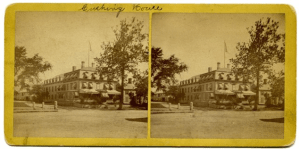
First built in 1770, the Union Hotel was constructed where the Hingham Post Office stands today. In the early 19thcentury, it was renamed the Drew Hotel and then later the Cushing House and underwent various renovations before it was torn down in 1949.

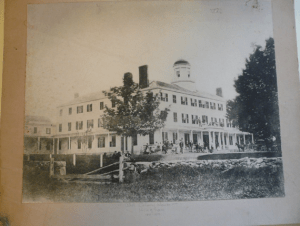
Next, the Old Colony House was built in 1832 on top of Old Colony Hill, close to what is now Summer Street, with grounds extending to Martin’s Well. Founded by the Boston and Hingham Steamship Company, it burned down in October of 1872.

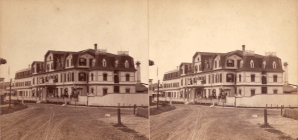
Thirdly, in 1871 the Rose Standish House was constructed in what is now Crow Point. The hotel was part of Samuel Downer’s Victorian-era amusement park, Melville Garden, until the park was dismantled in 1896.

What were some of the factors contributing to Hingham’s rise in tourism?

While Hingham could be accessed by horse drawn carriage, the development of steamships and railroads during the 1800s was important to connecting small, rural towns like Hingham to Boston’s wealthy citizens, and later the general public, in order to grant quick access to the pleasures they had to offer.

Furthermore, with the increase in urbanization due to the Industrial Revolution, towns such as Hingham became places of escape from the city’s hustle and bustle. As cities grew, doctors and scholars began to associate the city with not only various physical diseases but also mental maladies. While sea bathing and the sea air were thought to possess healing properties, it was also considered salubrious to take a respite from the city itself. An excerpt from the research magazine Scientific American, published in 1871, discussed the medical benefits of a seaside visit for people suffering from a variety of ailments: from anxious businessmen, to people living in crowded towns, or to people recovering from illness or injury. The author stated

To these people it is not the sea air alone, nor yet change of air; but it is change of scene and habit, with freedom from the anxieties and cares of study or business, the giddy rounds of pleasure, the monotony of every-day life, or the sick room and convalescent chamber, which produce such extraordinary beneficial effects . . . .

With the development of a middle class during this time, more people could afford the time and money to engage in leisure activities and embark on day trips to Boston’s surrounding towns. From the naturalistic scenery of World’s End surrounding the Old Colony House to the dancing and boating at the Rose Standish House and Melville Garden, the escapist nature of Hingham’s seaside resorts provided urbanites a sojourn away from the city.


A Schoolboy Fan of the “Boston Game”


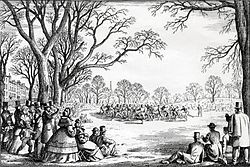
Artist's rendering of the Oneida Football Club in match play on Boston Common

Artist’s rendering of the Oneida Football Club in match play on Boston Common

Those interested in the history of American football know that the Oneida Football Club of Boston is often given significant credit for the development of the modern game. That team was formed by Gerrit S. Miller, one of a number of Boston schoolboys who played what was sometimes called the “Boston game” on Boston Common during the early 1860s. The game involved both running and kicking plays and developed a more consistent set of rules than prior versions of American football.

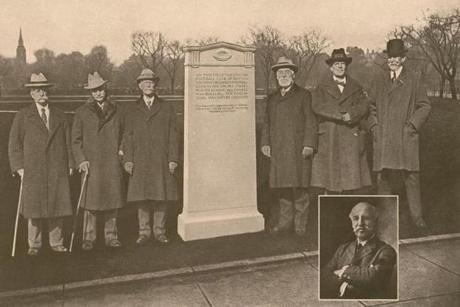
In 1925, a marker was erected on Boston Common to commemorate the Oneida Football Club.  It reads, “On this field the Oneida Football Club of Boston, the first organized football club in the United States, played against all comers from 1862 to 1865. The Oneida goal was never crossed.”

Oneida Football Club members at the dedication of the monument on Boston Common.  Lincoln's classmate, Gerrit S. Miller is immediately to the right of the monument.

Oneida Football Club members at the dedication of the monument on Boston Common. Lincoln’s classmate, Gerrit S. Miller, stands  immediately to the right of the monument. (Photo from W. Scudder, An Historical Sketch of the Oneida Football Club of Boston: 1862-1865)

Miller and other early players attended Epes Sargent Dixwell’s Latin School, a Boston preparatory school.  Francis Lincoln of Hingham was a classmate of theirs at Mr. Dixwell’s School and, if not a football player, certainly a fan. His high school diary, which is preserved in our archives, reports on football at Mr. Dixwell’s School. Here, on October 18, 1862, he reports on some intramural play:

The first class were challenged by the second for a match game of football. The first class were assisted by Thies and the second by G. S. Miller.
Two games out of three.
The second class beat. The first game was very hard and long—1 h. 6 m. with considerable lurking by Frank Peabody.

Louis Thies, like Gerritt Miller, was a member of the Oneida Football Club.   Both student coaches’ names appear on the Boston Common marker. (“Lurking,” of which Frank Peabody was guilty, was an early word for “offsides.”)

Lincoln also reports on a June 1862 football match between Mr. Dixwell’s School and the Boston Latin School. This was clearly considered an important event by more than young Lincoln, who pasted into his diary the results reported in four different newspapers:

The Boston Evening Traveller, June 6th:

MATCH GAME OF FOOTBALL.—A match game of football came off yesterday afternoon, on the Common, between the Latin and Mr. Dixwell’s school. The Latin school boys won three games in five, and were the challenged party. The best feeling prevailed on both sides. Each game was a specimen of splendid playing, and the last was prolonged to the unusual time of forty-two minutes—resulting in the victory of the Latin school.

The Boston Herald, June 6th:

FOOTBALL MATCH. A football match between seventeen boys of the Public Latin School and the same number from Mr. Dixwell’s school took place yesterday afternoon on the parade ground. The Latin school boys won three games in five and were therefore victorious.

The Boston Daily Advertiser, June 7th:

FOOTBALL MATCH.–A football match between seventeen boys of the Public Latin School and the same number from Mr. Dixwell’s school took place on Thursday afternoon on the parade ground. The Latin school boys won three games in five and were therefore victorious.

The Boston Journal, June 6th:

MATCH GAME OF FOOTBALL.–Seventeen boys of the Public Latin school, and a like number from Mr. Dixwell’s school, played on the parade ground on Thursday afternoon a match game of football, which resulted in the Latin school boys winning three games in five. Each game was a specimen of splendid playing, and the last was prolonged to the unusual time of forty-two minutes—resulting in the victory of the Latin school.

Francis Lincoln also gave an eyewitness report of this match in his diary. He can be forgiven if he has a slightly different take than the Boston newspapers on the disappointing result for his classmates in his entry for Thursday, June 5, 1862:

Seventeen fellows from our School challenged the same number of the Latin School to kick a match game of football. Our fellows beat the first game; Latin school, second; Our fellows, third; Latin School, fourth & fifth.
Some foul play on side of Latin School.

Battling “that Old Deluder, Satan” with a School

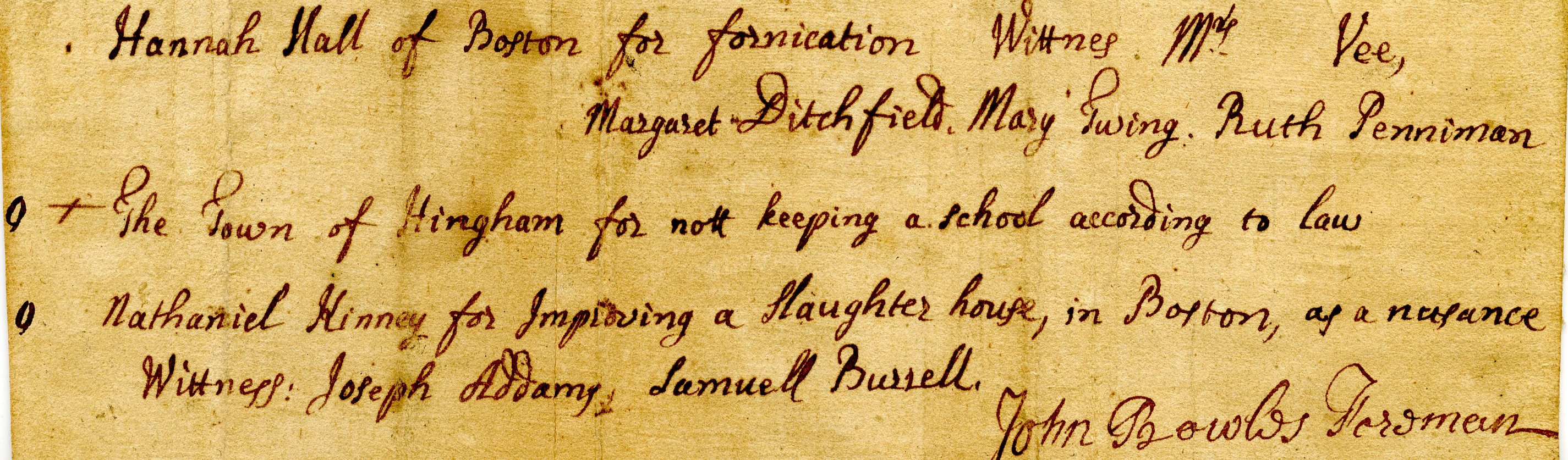
On April 6, 1714, a grand jury in Boston presented a series of charges against a number of individuals and entities.  Many of the offenses were exactly what we would expect from a group of 17th century Puritans:  “Richard Hancock of Boston for Selling Drink without license sundry times since last Session,” “Seth Smith of Boston for allowing unlawfull gaming,” “Nathaniel Ford of Weymouth for nott attending the publick worship of God,” and—a hat tip to Nathaniel Hawthorne—“Hannah Hall of Boston for fornication.”

MLD001One of the charges explains why this single-page manuscript came to Hingham, to be preserved in our archives:  “the Town of Hingham for not keeping a school according to law.”  This offense, as it turns out, is as characteristic of the Massachusetts Bay Puritans as the others charged on that day.

33447_2Education was very important to the founders of the Massachusetts Bay Colony.  The first public school in this country, Boston Latin School, was established in Boston in 1635, and the nation’s first university, Harvard College, was founded in Cambridge the next year.  In 1642, Massachusetts passed a law requiring parents to ensure that their children could read English or face a fine.

This concern with education grew from the very roots of Protestant theology:  the belief that Christian laity had the right–and a duty–to read the Bible in the vernacular and participate directly in the affairs of the church.  These fundamental goals are explained explicitly in the preamble to Massachusetts’ 1647 statute, sometimes called “The Old Deluder Satan Act,” that shifted the responsibility of education onto the growing towns:

It being one chief project of that old deluder, Satan, to keep men from the knowledge of the Scriptures, as in former times keeping them in an unknown tongue, so in these later times by perswading from the use of tongues, that so at least the true sense and meaning of the Originall might be clowded by false glosses of Saint-seeming deceivers; and that Learning may not be buried in the graves of our fore-fathers in Church and Commonwealth, the Lord assisting our indeavors: it is therefore ordered by this Court and Authoritie therof;

That every Township in this Jurisdiction, after the Lord hath increased them to the number of fifty Housholders, shall then forthwith appoint one within their town to teach all such children as shall resort to him to write and read, whose wages shall be paid either by the Parents or Masters of such children, or by the Inhabitants in general, by way of supply, as the major part of those that order the prudentials of the Town shall appoint. . . .

And it is further ordered, that where any town shall increase to the number of one hundred Families or Housholders, they shall set up a Grammar-School, the Masters thereof being able to instruct youth so far as they may be fitted for the Universitie. . . .

Hingham town records reference schoolteachers and a school building as early as the mid-1600s.  According to Francis Lincoln’s chapter on education in the 1893 History of the Town of Hingham, the increasing size of the town led to disagreements as early as 1708 and 1709 over where the school should be held.  Second Precinct—later Cohasset—wanted a rotation, so that school would sometimes meet in its area, as did “Great Plain”—South Hingham.  But there is no suggestion that HIngham’s school was ever closed.  Indeed, in a comprehensive list of the schoolmasters in Hingham from 1670 on, Lincoln reports that Jonathan Cushing was the schoolmaster from 1712-1713, after which the 1712 Harvard College graduate became the minister in Dover, New Hampshire.  Twenty-year old Job Cushing, Harvard College Class of 1714 succeeded him, remaining four year before becoming the first minister of the Shrewsbury church.

Bottom of documentPerhaps there was a lapse while the Town waited for Job Cushing to graduate.  There may have been complaints.  17th century grand juries could “present” charges based on their own knowledge and did not, as today, have to wait to be asked to hand down an indictment.  Was a disgruntled Hingham parent on that grand jury?  Perhaps we will learn more as we continue to dig through the archives.

A Letter From Daphney

Among the Deborah Barker letters to Christian Barnes in our archives (see post of October 28) is a well-worn manuscript dated May 13, 1787.  It is signed “Daphney,” and was originally indexed as authored by “Daphne Barker.”  Indeed, Deborah Barker’s frequent references to Daphne in her own letters call up the image of an elderly aunt who visits her Hingham relations from time to time.

But there is no Daphne in the Barker family tree.  We started looking at the Barnes family and, before long, realized that Daphne was the Barnes’ former slave, left behind when Loyalists Henry and Christian Barnes fled to England in 1775.

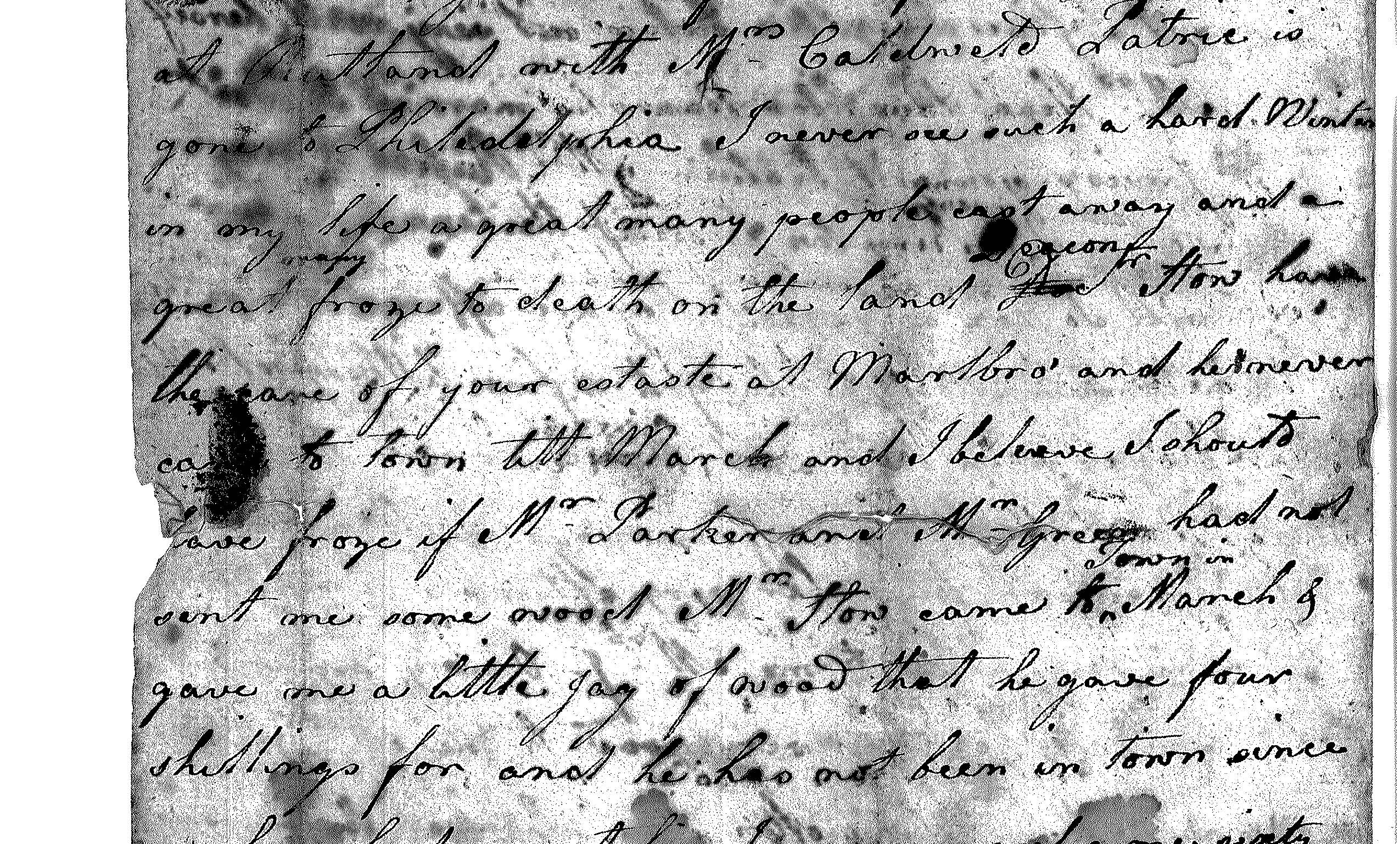
The letter is in Deborah Barker’s handwriting, but the voice is unmistakably Daphne’s.  She updates her former mistress on local news and describes a general economic malaise: “Everybody is very poor.  The streets are full of beggars and the people steal so that the jails are full.”  She fills Mrs. Barnes in on her Boston friends—and she is not afraid to dish the dirt.  “Mrs. Howe,” she writes, “was at Boston this winter.  She came in a shay.  She is grown as big as a great ox.”  When she saw Mrs. Howe, Daphne writes, she “enquired after Dolly Gate and Mrs. How told she had gone up to near Rutland and had another child by a married man.”   “John Parker’s sister Polly,” she reports, “went up to see him and came home with a child but no husband.”

Daphne is vocal in her complaints about the support she is receiving from the General Court, which became responsible for her after it confiscated the Barnes’ Marlborough estate.  Simon Stow, a Marlborough lawyer, “has the care of your estate in Marlbro’ and he never came to town till March and I believe I should have froze if Mr. Parker and Mr. Green had not sent me some wood.  Mr. Stow came to town in March & gave me a little fag of wood that he gave four shillings for and he has not been in town since.”

Daphney's letter to Christian Barnes, May 13, 1787 (Hingham Historical Society archives)

Daphney’s letter to Christian Barnes, May 13, 1787 (Hingham Historical Society archives)

When Daphne wrote this letter, she was living on Rowe’s Lane in Boston (near today’s Bedford Street), renting from a black woman named Venus, according to legislative records at the Massachusetts Archives.  Deborah Barker did not approve:  she wrote that the money the General Court set aside for Daphne “would be a very comfortable support . . . could she be prevailed upon to live anywhere but in a negro house . . . .”

Daphne appears to have come to Hingham in the summer, as reflected in repeated references in Deborah Barkers’ letters:   “[Daphne] continues her annual visits to Hingham and we are fond of seeing her” (Aug. 5, 1783); “I expect [Daphne] every day as I promised to write for her as soon as I returned from my journey” (June 1788); “she spent a month with us the summer past but grew impatient to go home” (Nov. 12, 1790).  The letter in our archives was undoubtedly written on one of Daphne’s visits to Hingham.

Further research is needed to discover what Daphne’s ties were to Hingham.  Was she related to one of the Barkers’ slaves?  Was she raised on the South Shore?  Even without full context, her letter allows us to hear the voice of an individual which might otherwise have been lost and to ponder relationships we have trouble understanding.

Boston Greets the “King of America”

General Benjamin Lincoln may have stood in for General George Washington at Yorktown, accepting Lord Cornwallis’ sword, but not all of his Hingham neighbors and friends were on his side in the Revolutionary War.  A letter in our archives from Deborah Barker of Hingham describes the reception the newly inaugurated President Washington received when he visited Boston in October 1789–and leaves no question about what she thought of the new republic and its chief executive.

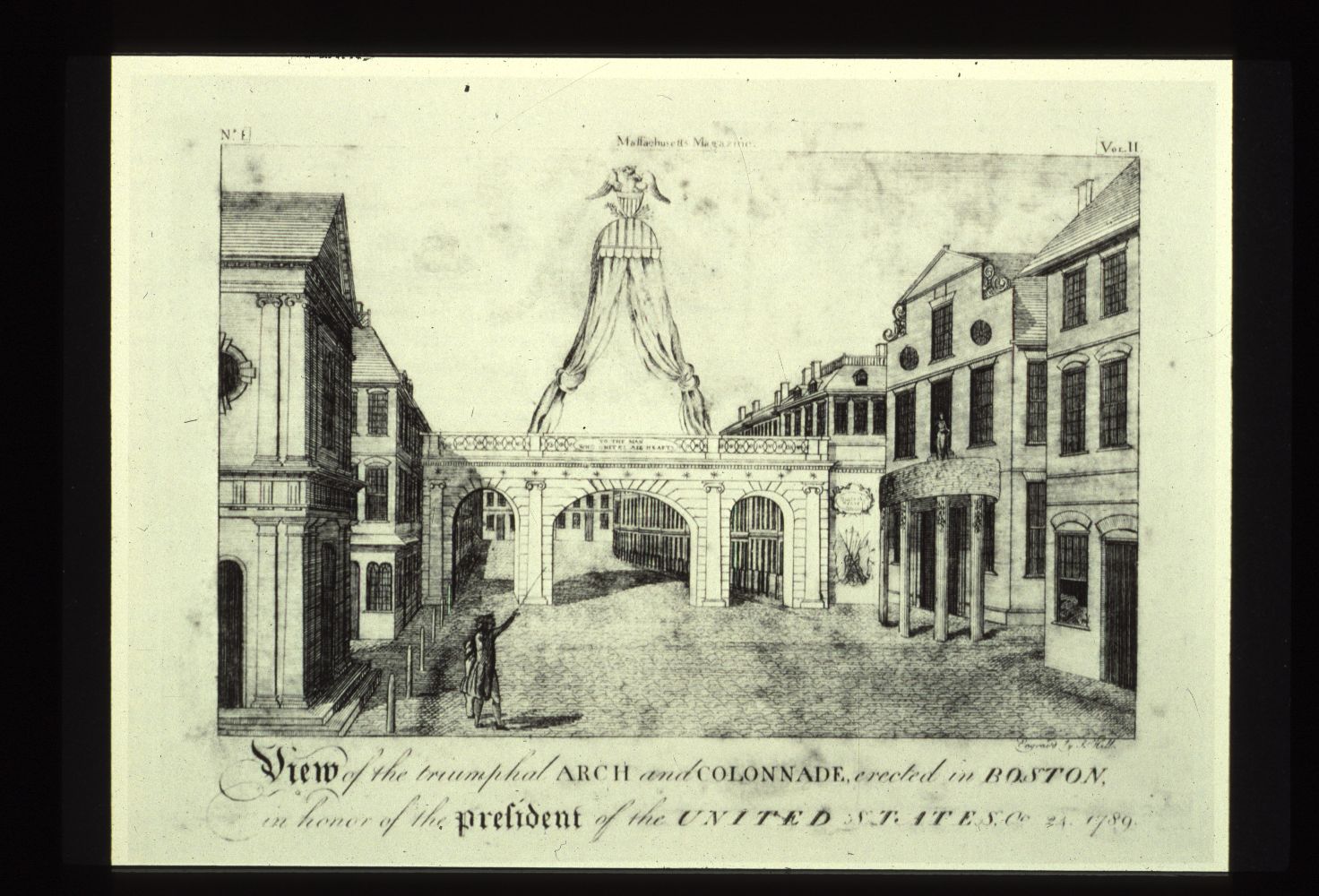
Washington  toured the New England states in the fall of 1789, arriving in Boston on October 24 to an elaborate public celebration.  As pictured below, a triumphal arch, designed by Charles Bulfinch, was constructed in Washington’s honor at the west end of the Old State House, over what was later renamed Washington Street.

1789_TriumphalArch_Boston_MassachusettsMagazine Larger

Engraving published in Massachusetts Magazine in 1789. Caption on the picture reads, “View of the triumphal Arch and Colonnade, erected in Boston in honor of the President of the United States, Oct. 24, 1789.”

Deborah Barker, one of three daughters of loyalist Joshua Barker, who fought for the Crown in the French and Indian War, was not among those impressed. She had been in Boston when Washington arrived and reported to Christian Barnes of Bristol, England, her mother’s cousin, that “[t]he General as President of the United States (or in other words as the King of America) thought proper to visit the northern part of his territories.”  She continued in the same sarcastic vein:

. . . Such a movement could not be performed secretly. It was no sooner announced that he intended visiting Boston than every breast beat with rapture, joy, and exultation. The mechanicks were employed, some in erecting triumphal arches, some in painting flags expressive of their several branches of business, which the most respectable of the order were to carry forth . . . . All of the superior orders were busy in forming addresses expressive of his transcendent merit, and their great love and respect for him. The poets in writing odes and other poems asserted their abilities. . . . The military were all in motion and made a superb appearance. Thus after a week’s preparation and expectation the great the important day (in honor of which everything that an infant world could do was to be done for the Man that many of them fancyed themselves under the greatest obligation to) arrived. The people met in the Mall, formed themselves into a regular processing, each man following the flag bearing a device expressive of his employment, first the merchants, then the clergy, doctors, lawyers, & sea captains, the mechanics alphabetically, thus proceeded by the select men (they you know must always be first) they marched down prison lane and up the main street . . . .

Barker knew she had an appreciative audience for her colorful description. Christian Barnes and her husband, Henry, had been forced to flee Massachusetts in 1775 because of Henry’s British trading activities and had forfeited their substantial estate.  Banished by an Act of the General Court, they had settled in Bristol. Portraits of Christian and Henry Barnes hang in the parlor of our Old Ordinary House Museum. Christian’s has two slashes across it and Henry’s a hole in the middle of the chest; tradition claims that these inflicted by the Marlborough patriots who seized the Barnes estate. It is through Deborah Barker that these paintings came to rest in Hingham.