Powerful Words in the Name of Freedom

Every day Hingham residents drive or walk past the entrance to a small park lying between Central and Hersey Streets. Now known as Burns Memorial Park, it was once home to Tranquility Grove, an outdoor space used for meeting and rallies—including in particular abolitionist rallies.

Hingham was home to an active group of abolitionists. Led in large part by local women who were considered extremists by many, Hingham’s abolitionists worked for freedom through petitions, speeches, meetings, and protests. High-profile abolitionists visited Hingham regularly during this period, including Frederick Douglass (who came more than once), William Lloyd Garrison, an aging John Quincy Adams, and the Grimke sisters.

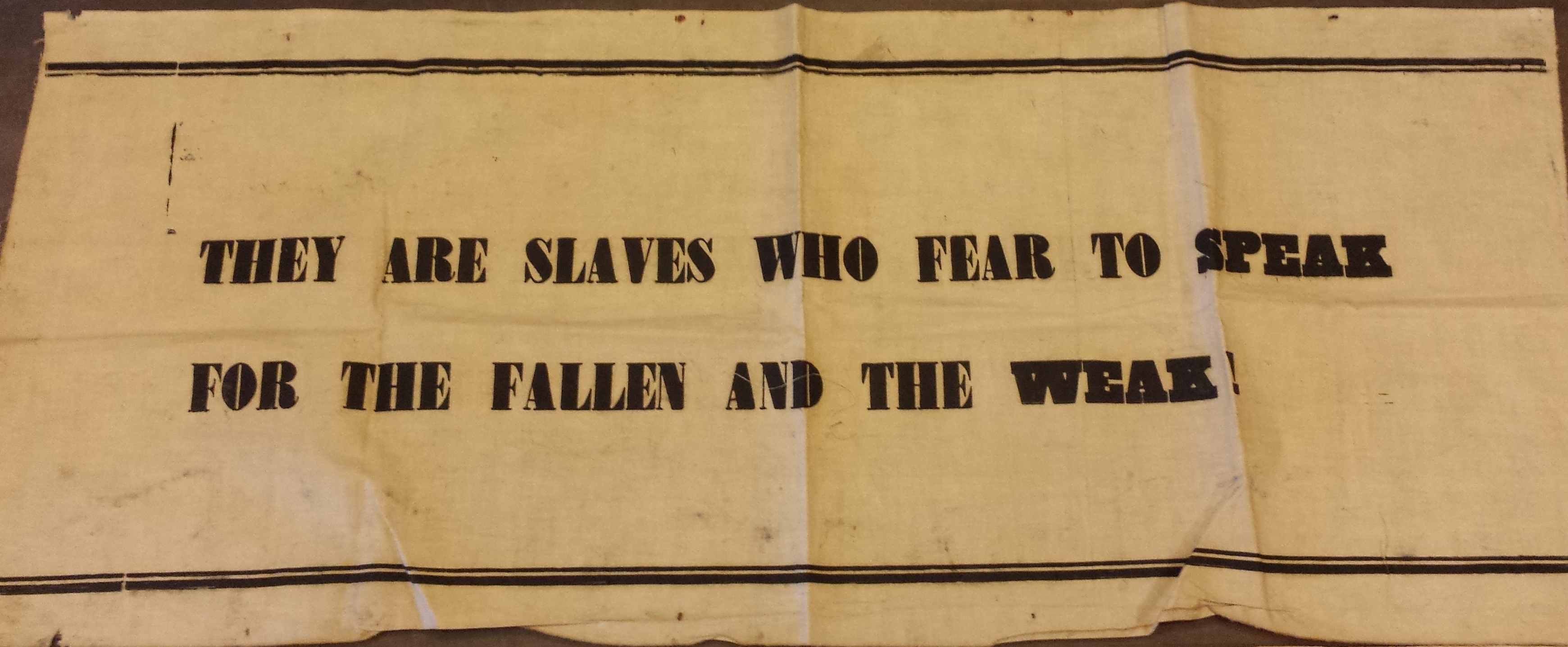
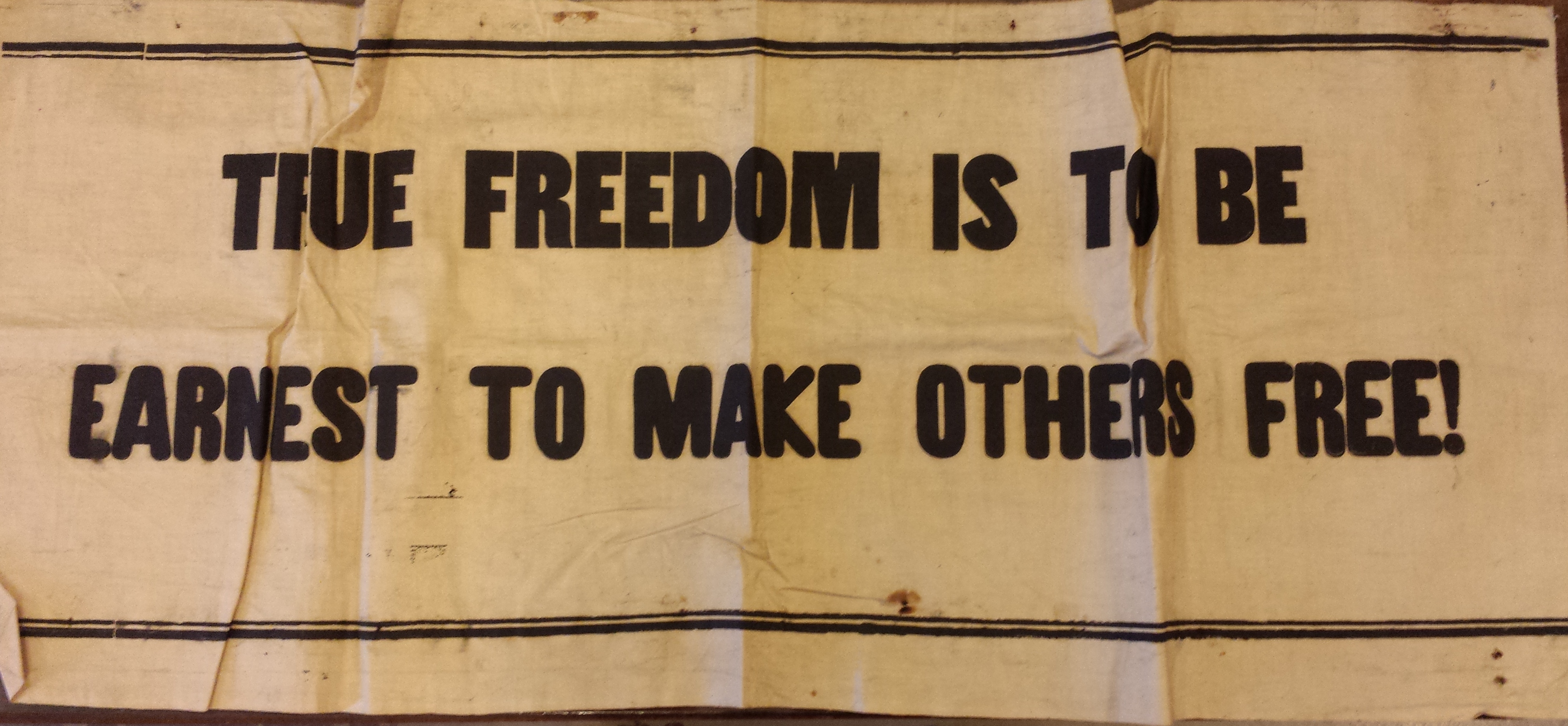
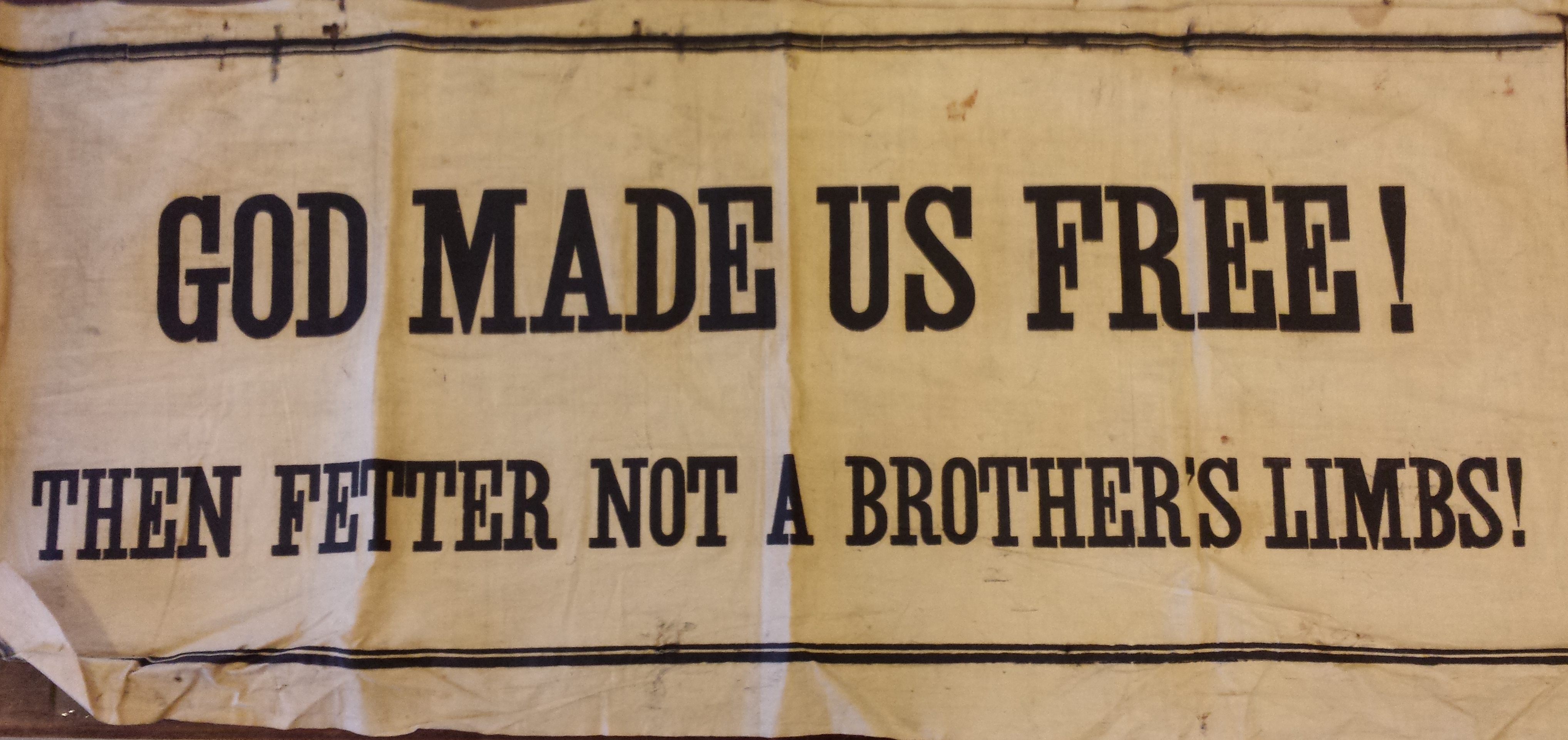
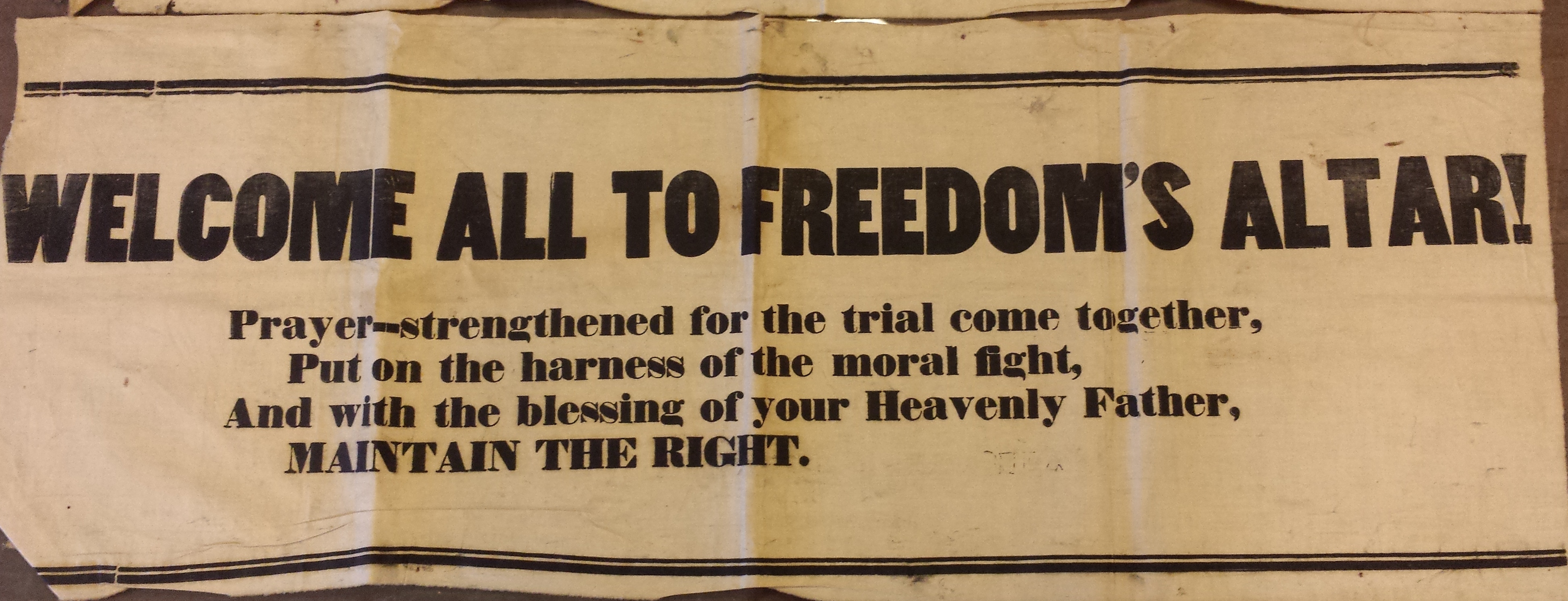
On August 1, 1844, the Hingham Anti-Slavery Society hosted a large regional rally to mark the tenth anniversary of the abolition of slavery in the British West Indies. The rally featured a speech by Frederick Douglass at the First Baptist Church and a procession down Hingham’s Elm Street to Tranquility Grove. As the abolitionists entered the Grove, they were greeted by large white banners hung from the surrounding fir trees. In bold black letters, the banners spelled out anti-slavery slogans:

20141011_110642They are slaves that fail to speak/ for the fallen and the weak

20141011_110456True freedom is to be earnest to make OTHERS free

20141011_110507God made us free! Then fetter not a brother’s limbs!

20141011_110636Welcome All to Freedom’s Altar!

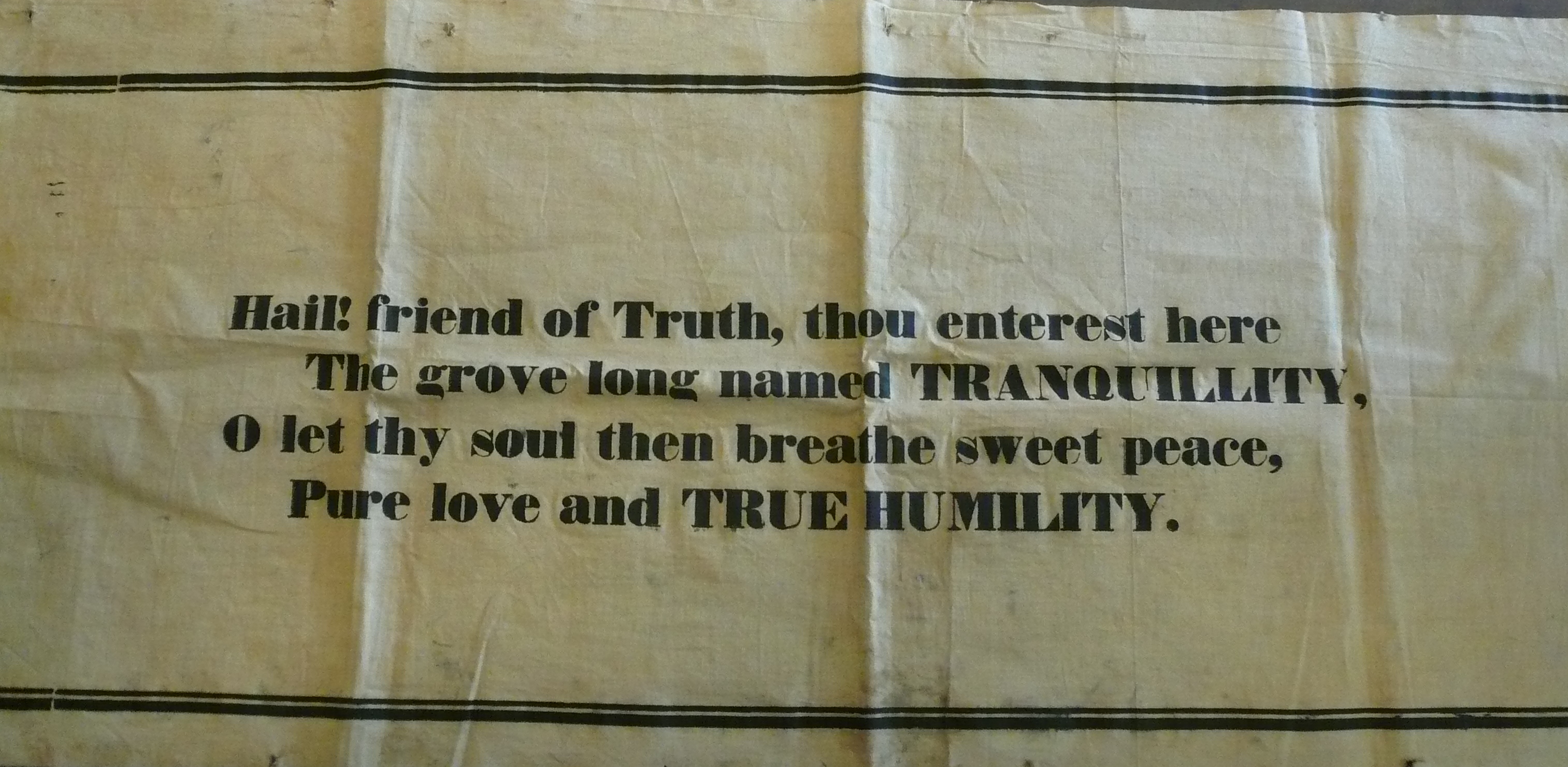
Fragile and creased with age, the banners from the 1844 Tranquility Grove meeting are preserved in our archives. One of them makes direct reference to Tranquility Grove, greeting supporters entering the rally with a verse:

Hail! Friend of Truth, thou enterest here
The grove long named TRANQUILITY.
O let thy soul then breathe sweet peace,
Pure love and TRUE HUMILITY.

P1060107The efforts of the Hingham abolitionists contributed to the larger national abolition movement which would continue to gain traction across the country until the Emancipation Proclamation brought their hard work to fruition. The banners remain an evocative reminder of Hingham’s participation in that important work, and their powerful statements still right true to this day.

Clubs and Societies in 19th c. Hingham

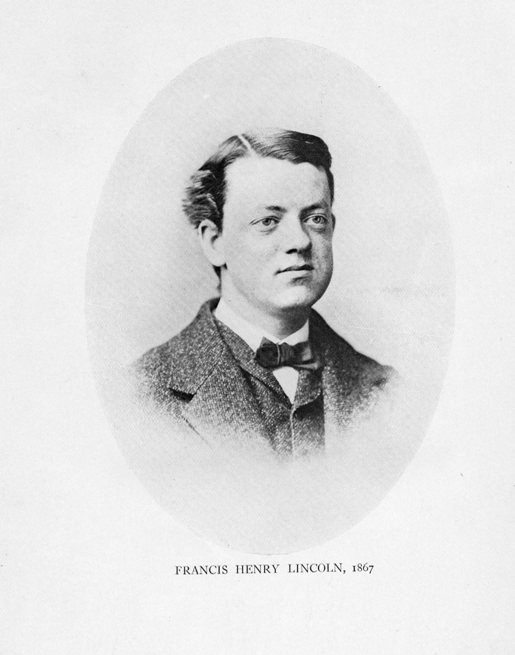
“It would be impossible,” Francis H. Lincoln remarked in the 1893 History of Hingham, Massachusetts, “to give a complete list of all the social organizations which have existed in Hingham.”

Francis H. Lincoln (

Francis H. Lincoln

Lincoln knew whereof he spoke: he was known for his active engagement in his community’s civic, religious, and charitable organizations. Three of the nine paragraphs in his eulogy were devoted exclusively to his membership in various societies and organizations, of which 21 are expressly named. This does not include his service on Hingham’s School Committee for nine years starting in 1879 and as treasurer of the American Unitarian Association.

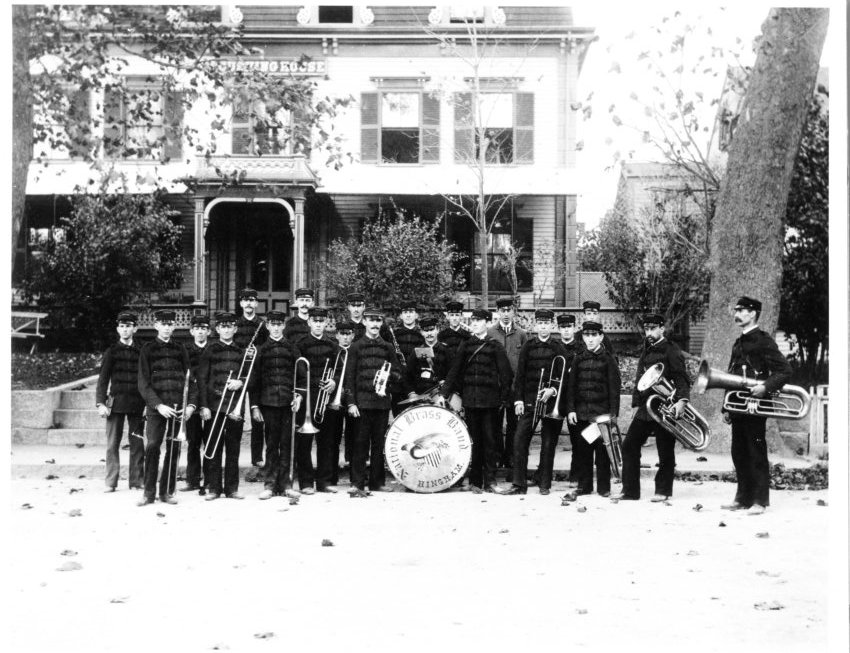
Although certainly more engaged than most, Francis Lincoln was not the only one in town to show such a diversity of involvement. Each of the two 19th-century histories of Hingham devotes an entire chapter to the discussion of Hingham’s various “Lodges and Societies,” patriotic and political associations, charitable organizations, and recreational clubs. At one point, just in the arena of music, Hingham boasted both a brass and a cornet band, two choral societies (in addition to the church choirs), and a Philharmonic (formerly the more humbly named Amateur) Orchestra. Two social libraries were formed early on, in 1771 and 1773, and lasted until Hingham’s public library was founded close to a hundred years later. Early in the 20th century, the Hingham Historical Society was formed by townspeople interested in Hingham’s venerable history.

The Hingham National Brass Band

The Hingham National Brass Band

Each generation reorganized the societies to its liking: the Jefferson Debating Society of the early 19th century gave way in the 1840’s to the competition-based Hingham Debating Society, which in turn morphed thirty years later into the Monday Night Club, a more informal discussion group. (Despite this “informality,” when it was Francis Lincoln’s turn to address the club on the topic of “The Systems of Taxation In Massachusetts” in April 1878, he went armed with 26 pages of notes—preserved in our archives.) One organization, founded midcentury as the “G. I. A. of Scribes and Pharisees,” hosted socials, parades, fancy-dress balls and other diversions for decades, but changed its name and officers so often that it reportedly became known as the “Phoenix Club” for its constant re-emergences.

Political societies became popular with several abolition societies in the mid-19th century. After the Civil War, they switched their focus to temperance (with differing approaches, from religious to scientific) and then women’s rights. The Hingham Women’s Alliance boasted men as well as women amongst its members, and the local branch of the Massachusetts Women’s Suffrage Association met at Loring Hall, receiving support from Hingham resident and then-governor of Massachusetts John Davis Long.

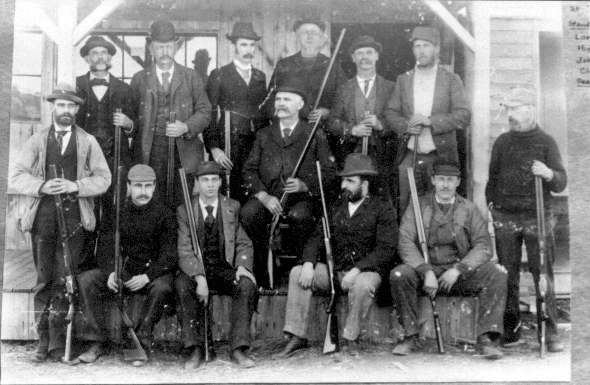
The Hingham Gun Club

The Hingham Gun Club

The community sustaining these myriad organizations was thus also sustained by them. In the early 1800s, facing a growth in population density that made both fire and thieves more common, townspeople founded the Society of Mutual Aid for Detecting Thieves and the Hingham Mutual Fire Society, both of which lasted through the century, promising to lend a hand when their neighbors’ belongings went missing or their buildings burst into flame.

The Hingham Croquet Club

The Hingham Croquet Club

The social engagement and civic responsibility displayed in the Town’s profusion of associations and causes runs through its history, but the 19th century surely marked a high point in the number and strength of Hingham’s social organizations. Hingham was nothing less than a working example of what Alexis de Tocqueville saw as an explanation for the success of American democracy: our social engagement and investment in community created the interdependence that allowed our political processes (the process of voting and representation and compromise) to work. Or, as Francis Lincoln, club member extraordinaire, remarked in an essay written as a 15-year old student: “all the institutions of the land . . . are nurseries of learning, truth, and freedom.”

“Harrison Melodies” in Hingham

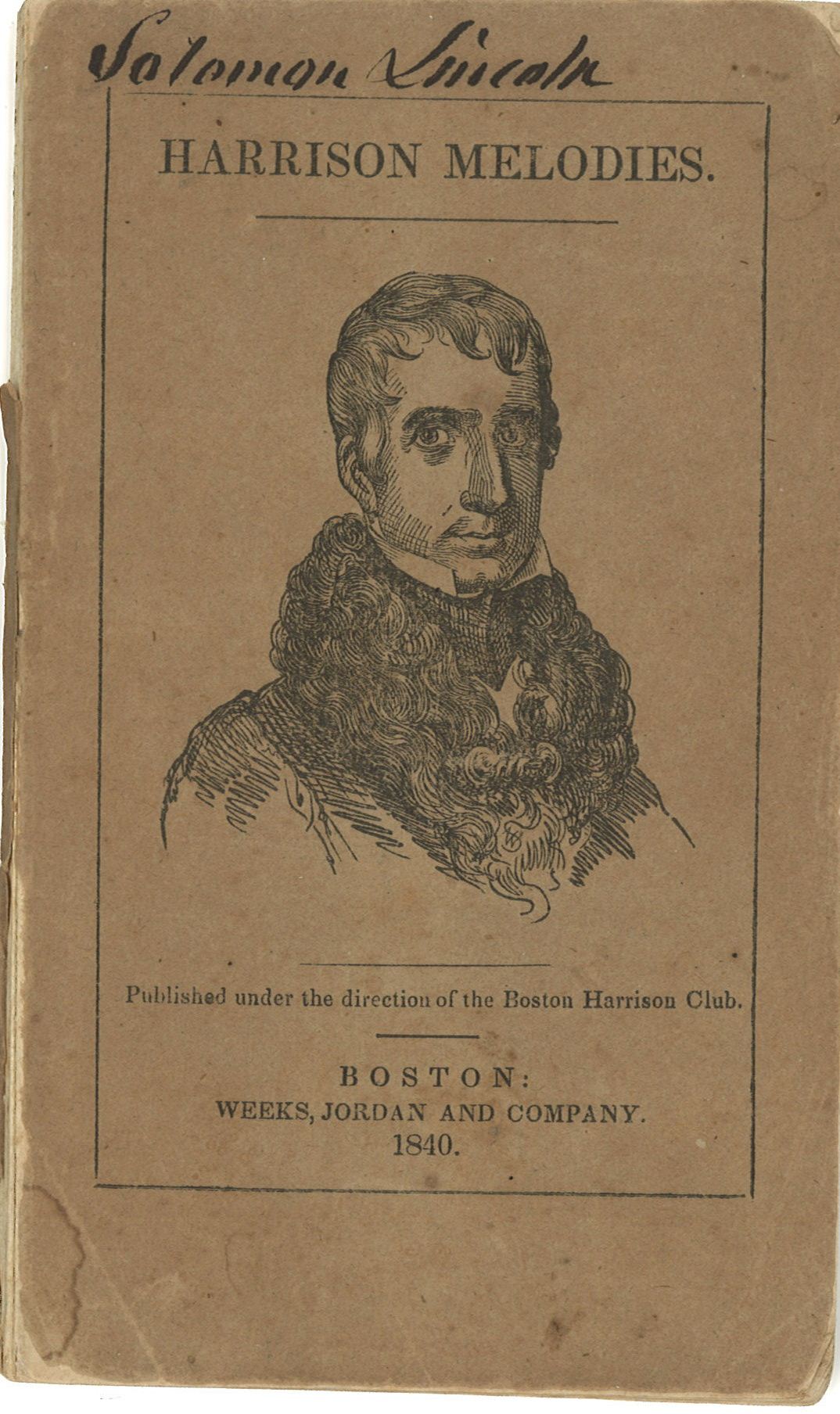
Harrison Melodies Cover

Solomon Lincoln’s copy of “Harrison Melodies.” Lincoln, a lawyer and banker, was active in Hingham politics.

We recently blogged about Jairus Lincoln’s 1843 “Anti-Slavery Melodies”—an anthology of songs to sing at abolition rallies (see The Songs of the Abolitionists). We were delighted to learn that the political singing did not end there, having recently discovered in our archives a second political songbook, only three years older, published by  local supporters of William Henry Harrison during the 1840 Presidential election campaign. This compilation of the lyrics of seventy pro-Harrison songs, the authors explained, filled a pressing need:  “The want of such a compilation has been for some time sensibly felt at . . . ‘Whig gatherings’” around Boston.

The Whig party was born out of opposition to Andrew Jackson’s Democratic party.  The ‘Age of Jackson” and “Jacksonian democracy” were built on increasingly broad white male suffrage as states eliminated poll taxes and property ownership requirements that once limited the vote to wealthier men.  Long before Abraham Lincoln, Andrew Jackson was famously born in a log cabin.  Jackson’s veto of a bill renewing the charter of the Second Bank of the United States divided Eastern mercantile interests and western farmers, debt-ridden in a tough economy.  Not surprisingly, Hingham was “Whig” country:  in their Hingham history Not All Is Lost, Russell and Lorena Hart report that Andrew Jackson won only 28 votes from Hingham during his first Presidential run and 32 votes as the incumbent four years later.

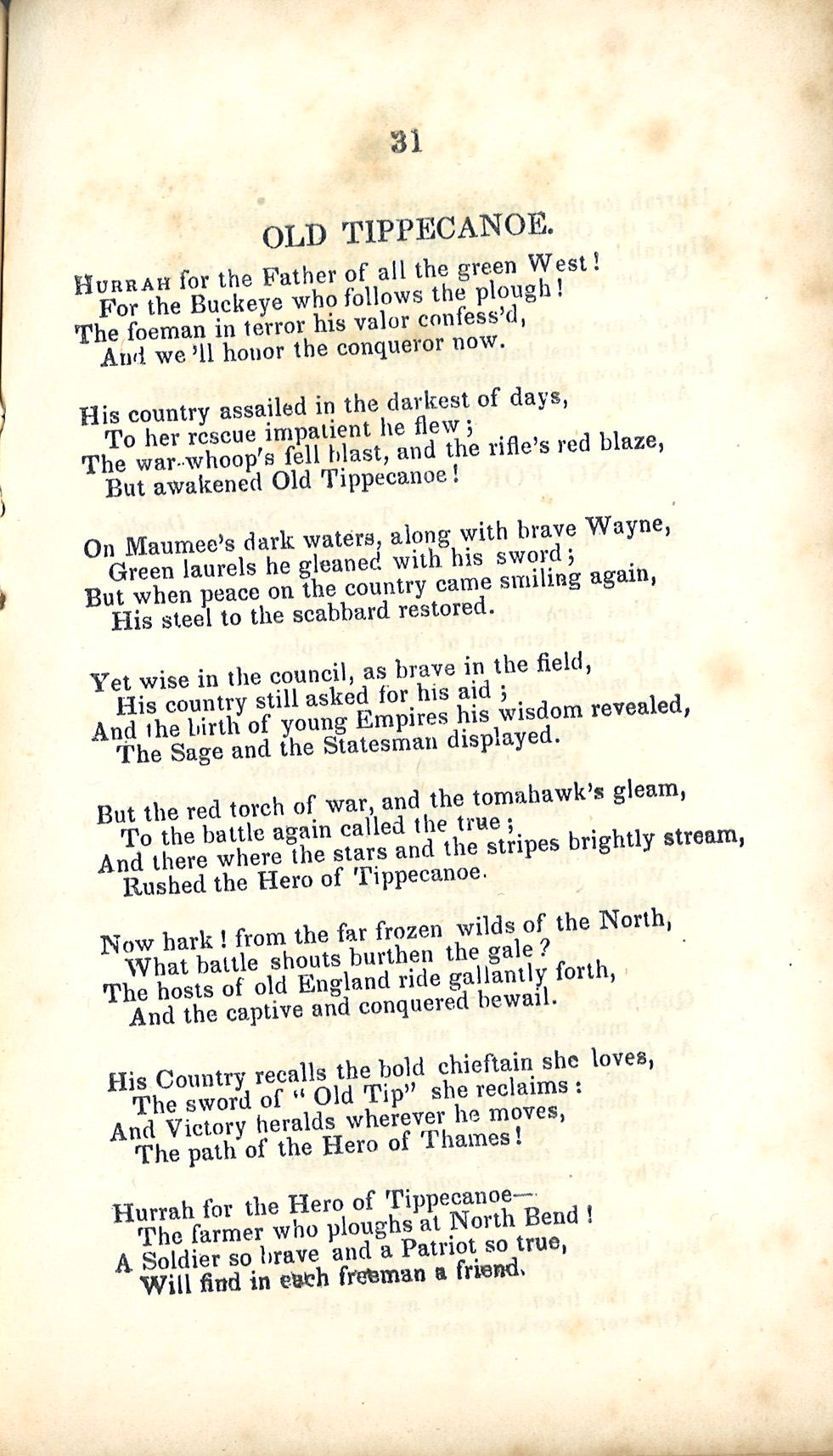
"Old Tippecanoe."  The campaign slogan "Tippecanoe and Tyler too" is still remembered.

“Old Tippecanoe.” The campaign slogan “Tippecanoe and Tyler too” is still remembered.

William Henry Harrison (1773-1841) was the Whig candidate for President in 1840. He had gained national fame defeating Native American forces at the 1811 Battle of Tippecanoe, served as the first territorial delegate to the U.S. Congress from the Northwest Territory, and was later elected congressman from the new State of Ohio. Taking a page from Andrew Jackson’s book (although he had been raised in a wealthy Virginia family), Harrison ran for President as a war hero and a man of the people. His supporters impugned his opponent, incumbent President and Democratic candidate Martin van Buren, as a New Yorker and wealthy elitist.  The Democrats in turn ridiculed Harrison as old and provincial, suggesting that he was most fit to sit in his log cabin, drinking hard cider. Harrison and as his vice-presidential candidate John Tyler seized upon these symbols, using images of log cabins and cider jugs in their campaign.

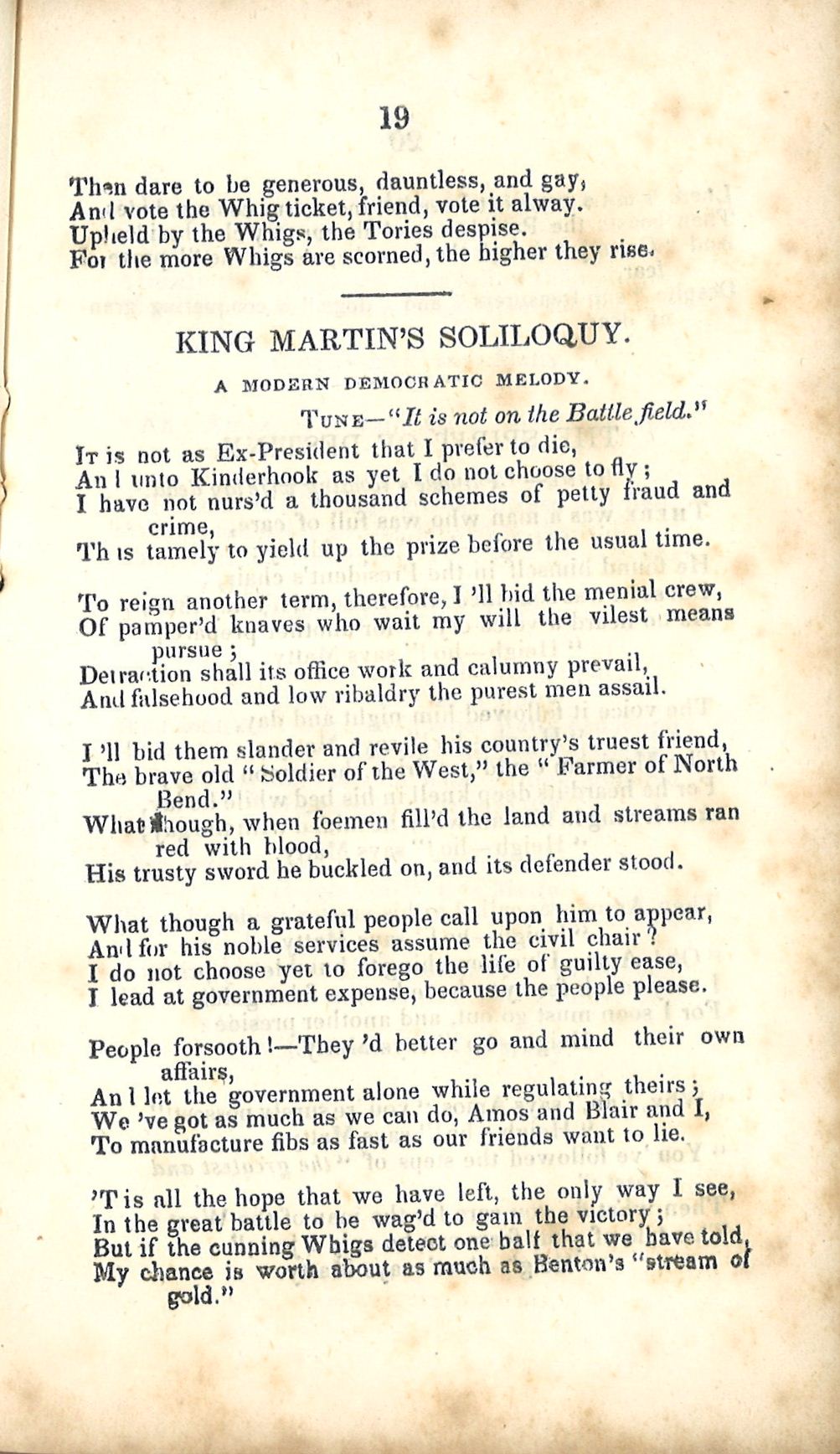
"King Martin's Soliloquy."  The Whigs chose the name of their party from that of the    18th century opponents of King George III.

“King Martin’s Soliloquy.” The Whigs chose the name of their party from that of the 18th century opponents of King George III.

The “Harrison Melodies” return repeatedly to the log cabin and hard cider theme, as well as Harrison’s Indian wars nickname, “Old Tippecanoe.”  Van Buren is referred to as “King Martin,” a reference to the Whig objection that Jacksonian Democrats wielded a dangerous amount of executive power.  (Jackson had killed the Second Bank of the United States not because he believed it unconstitutional but because he disagreed with it as a matter of policy.  This was a departure from prior Presidential vetoes.)

William Henry Harrison was elected President in 1840.  The Whigs’ joy was short-lived, however.  Harrison died after only a month in office.


The Songs of the Abolitionists

Jairus Lincoln of Hingham published his song book “Anti-Slavery Melodies: For the Friends of Freedom” for the Hingham Anti-Slavery Society in 1843.  Music was an important part of abolitionist meetings and rallies. In the foreword to his anthology, Lincoln noted the success that the temperance movement had enjoyed incorporating music into its message and urged the anti-slavery movement to follow the example: “[t]here are many who have not the gift of speech-making, but who can, by song-singing, make strong appeals, in behalf of the slave, to every community and every heart.”

Lincoln included the words and music to 57 anti-slavery songs, some original, some “standards” in the movement, and some taken from a previous anthology, “The Anti-Slavery Pick-nick.”  Many of the melodies are based on hymns that would have been very familiar to the audience, with lyrics based on anti-slavery poetry by John Pierpont, Elizabeth Margaret Chandler, John Greenleaf Whittier, and Henry Wadsworth Longfellow, among others. (To our 21st century sensibilities, the absence of any music influenced by the rich music–spirituals and field tunes–of the enslaved peoples themselves is striking.)

A few songs stand out.  Lincoln included a sharp parody of a familiar patriotic hymn:

My country! ’tis of thee,
Stronghold of slavery,
Of thee I sing:
Land where my fathers died,
Where men man’s rights deride,
From every mountainside,
Thy deeds shall ring.

My native country! thee,
Where all men are born free,
If white their skin:
I love thy hills and dales,
Thy mounts and pleasant vales,
But hate thy negro sales,
As foulest sin. . . .

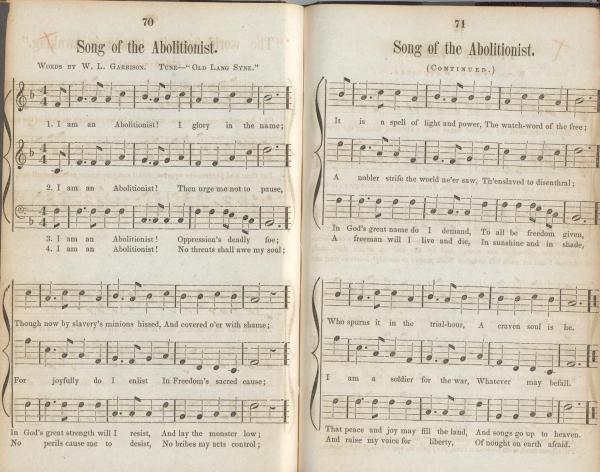
One well-known anti-slavery anthem, “The Song of the Abolitionist,” was written by William Lloyd Garrison, to be sung to the tune of “Auld Lang Syne”:

I am an Abolitionist! I glory in the name;
Though now by slavery’s minions hissed, And covered o’er with shame;
It is a spell of light and power, The watch-word of the free;
Who spurns it in the trial-hour, A craven soul is he.

I am an Abolitionist! Then urge me not to pause,
For joyfully do I enlist In Freedom’s sacred cause;
A nobler strife the world ne’er saw, Th’ enslaved to disenthral;
I am a soldier for the war, Whatever may befall. . . .

Words and music to "Song of the Abolitionist," from Lincoln's Anti-Slavery Songbook

Words and music to “Song of the Abolitionist,” from Lincoln’s Anti-Slavery Songbook

In From Abolition to Rights for All: The Making of a Reform Community in the Nineteenth Century, Professor John Cumbler writes that “[t]he social world of abolitionism also had its lighter side.”  The two examples with which he supports his assertion are close to home:  an 1844 meeting in Hingham, where New England abolitionists enjoyed a boat trip from Boston, the seaside, and the country air, and a “fishing party” to Cohasset during those same years. Perhaps after enjoying sunshine and a good meal, the abolitionists pulled out their copies of Lincoln’s “Anti-Slavery Melodies”–perhaps even the copy that is now in our archives.

A few years ago, a choral ensemble from Arizona State University recorded a number of the songs from Lincoln’s “Anti-Slavery Melodies.” Click here and scoll down the page to listen.


Lincoln on Lincoln (and the start of the Civil War)

When John Barker, subject of two prior posts on this blog (“A Soldier Writes Home” and “John Barker at Gaines Mill”), went off to war in 1861, 15-year old Francis H. Lincoln of Hingham was a student at Derby Academy.  In two bound volumes, preserved in our archives, he minutely described his primary and secondary education.  The Academy’s rules (memorialized in these books) provided that “the writing of compositions be required of the scholars as often as once a fortnight during each term.”  Lincoln recorded each of his efforts in these volumes.

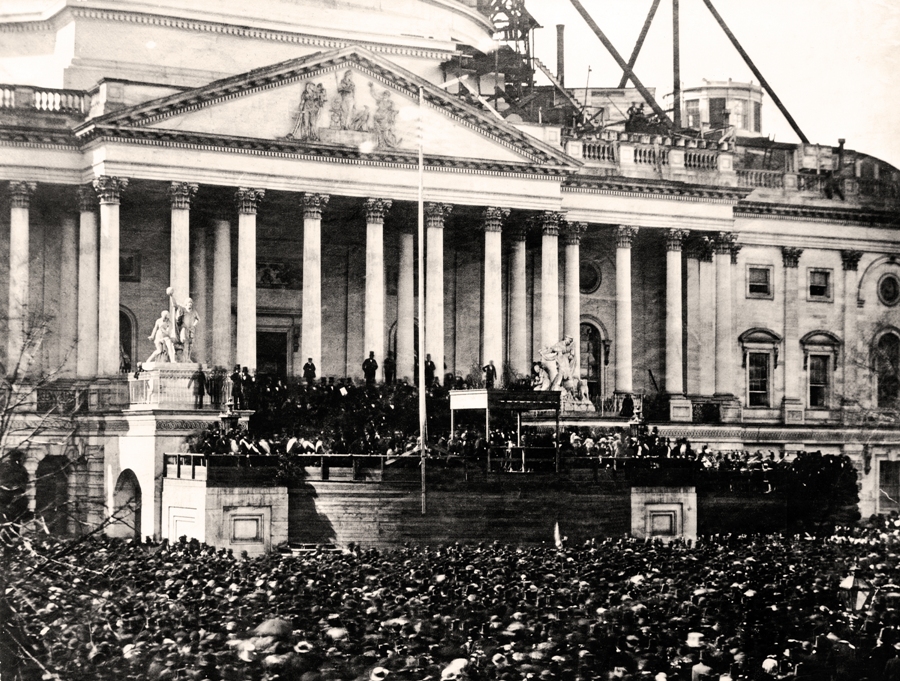
Two of Lincoln’s compositions written during his last year at Derby took current events as their subject–South Carolina’s secession from the Union, the election of a distant relation as President, and the coming of war.  In February 1861, two months after South Carolina seceded, he penned “A Fable on the Times”:

“Once upon a time” when the people of the United States elected their President, the South or Southern States, the inhabitants of which were mostly Democrats, generally outvoted the Republicans and other parties of the North; but in 1860 at the Democratic conventions, for nominating candidates for the Presidency they were unable to agree, and Republicans outvoted the other parties, and selected Abraham Lincoln of Illinois, President.

Mr. Lincoln being a man opposed to slavery, South Carolina, a miserable little State, tried to rebel against the Union, by seceding and making war, endeavoring to get some other small states to join her, and form what they intended to call the “Southern Confederacy.”

How this will turn out, nobody knows, but probably the Republicans will be masters of the Union.

“Haec fabula docet” that persons must not think that they can be masters of everything, that they must be sometimes willing to give way to others; and it is best to begin these habits in early life, for the child that is permitted to have its own way will grow up like South Carolina creating hatred, and perhaps war. Therefore, O parents, “lead up children in the way they should go;” therefore, O Republicans, do your best; correct South Carolina in her mad course, and “lead it up in the way it should go.”
Inauguration of Abraham Lincoln, March 5, 1861. Photo from Lincoln Collection, Library of Congress

The next months were eventful.  Lincoln’s June 1861 composition was titled, “Fort Sumter”:

 This fort, which is situated upon an island in the harbor of Charleston, South Carolina; was taken by Secessionists in the spring of 1861, shortly after the inauguration of Abraham Lincoln as President of the United States.

Although much might be said about Fort Sumter, I shall not confine myself to that in particular, but shall write concerning the present rebellion in general.

The Southern or slave-holding states, especially South Carolina, have probably desired to be separated from the Northern for more than twenty years; and until now have not had what they thought could be called a reasonable excuse. Once, I believe, during the administration of Andrew Jackson, they made an attempt at secession, but failed, as they must now.

They have now made the excuse, that Lincoln will interfere with their institutions, and do all in his power, to free their slaves; but this is nonsense; for Lincoln said in a speech before he was elected, “I shall not meddle with their institutions or slaves, but I shall certainly not permit them to extend slavery any farther than it has now gone.”

Persons who had sworn allegiance to the Government and Laws of the United States, have proved traitors, and have done all in their power to destroy the Union; and have done, also, to accomplish this object, the worst thing they could have done for themselves, that is, opened war upon us; and when Major Anderson (who was in command at Fort Sumter) and his handful of men, were nearly starved, opened fire upon him, and shame upon him, a Massachusetts man was the first to fire upon him.

The North should and will have revenge. “The Union must and shall be preserved.”  There are still at the South, many who would give all their property to preserve the Union, and such men should be delivered from the hands of those mean and cowardly scamps who are compelling them hither to die or fight for them.

But they will be freed, and their persecutors punished, and if the leaders, viz. Jefferson Davis & Gen. Beauregard and a few others escape with their lives they may congratulate themselves.

Boston Greets the “King of America”

General Benjamin Lincoln may have stood in for General George Washington at Yorktown, accepting Lord Cornwallis’ sword, but not all of his Hingham neighbors and friends were on his side in the Revolutionary War.  A letter in our archives from Deborah Barker of Hingham describes the reception the newly inaugurated President Washington received when he visited Boston in October 1789–and leaves no question about what she thought of the new republic and its chief executive.

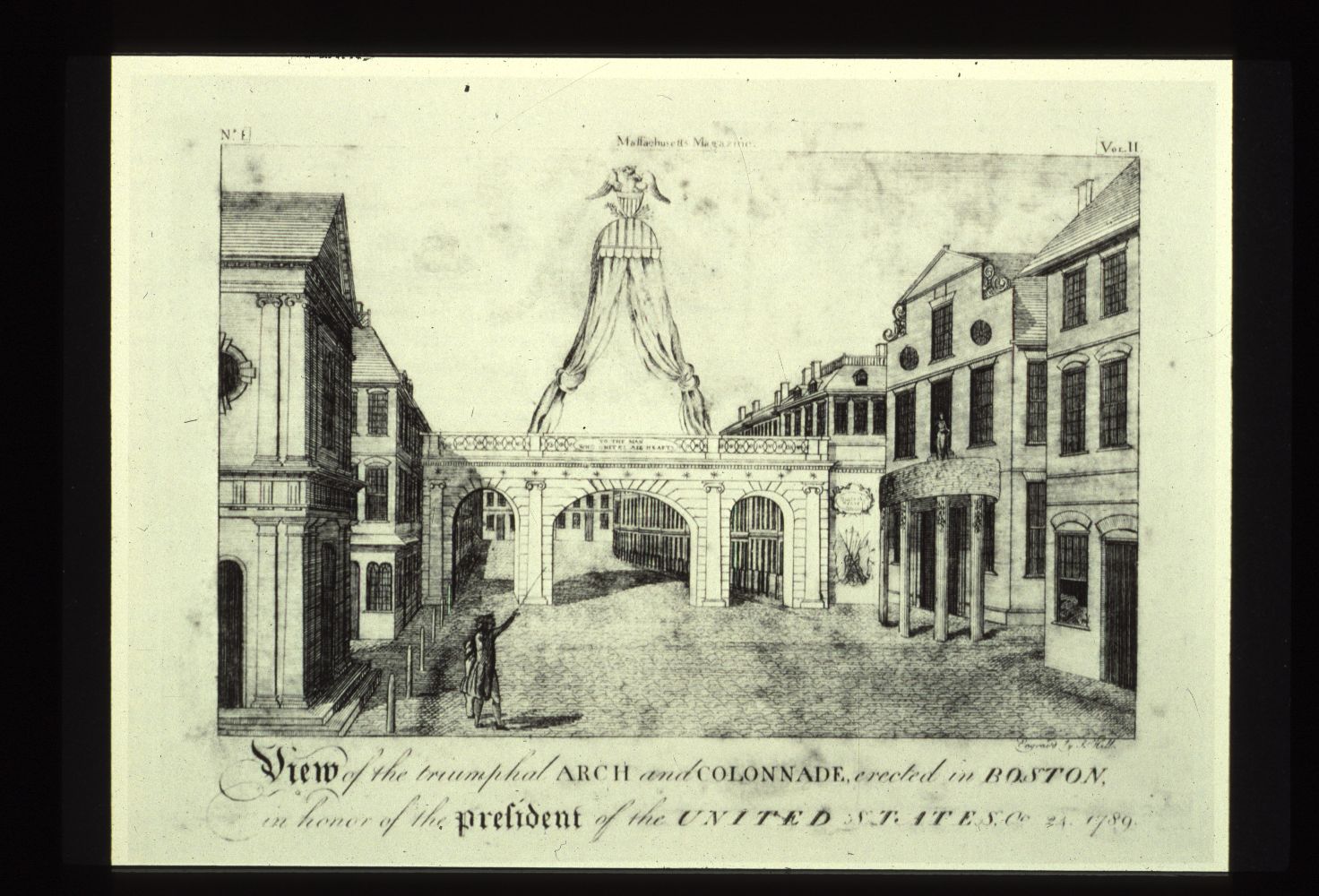
Washington  toured the New England states in the fall of 1789, arriving in Boston on October 24 to an elaborate public celebration.  As pictured below, a triumphal arch, designed by Charles Bulfinch, was constructed in Washington’s honor at the west end of the Old State House, over what was later renamed Washington Street.

1789_TriumphalArch_Boston_MassachusettsMagazine Larger

Engraving published in Massachusetts Magazine in 1789. Caption on the picture reads, “View of the triumphal Arch and Colonnade, erected in Boston in honor of the President of the United States, Oct. 24, 1789.”

Deborah Barker, one of three daughters of loyalist Joshua Barker, who fought for the Crown in the French and Indian War, was not among those impressed. She had been in Boston when Washington arrived and reported to Christian Barnes of Bristol, England, her mother’s cousin, that “[t]he General as President of the United States (or in other words as the King of America) thought proper to visit the northern part of his territories.”  She continued in the same sarcastic vein:

. . . Such a movement could not be performed secretly. It was no sooner announced that he intended visiting Boston than every breast beat with rapture, joy, and exultation. The mechanicks were employed, some in erecting triumphal arches, some in painting flags expressive of their several branches of business, which the most respectable of the order were to carry forth . . . . All of the superior orders were busy in forming addresses expressive of his transcendent merit, and their great love and respect for him. The poets in writing odes and other poems asserted their abilities. . . . The military were all in motion and made a superb appearance. Thus after a week’s preparation and expectation the great the important day (in honor of which everything that an infant world could do was to be done for the Man that many of them fancyed themselves under the greatest obligation to) arrived. The people met in the Mall, formed themselves into a regular processing, each man following the flag bearing a device expressive of his employment, first the merchants, then the clergy, doctors, lawyers, & sea captains, the mechanics alphabetically, thus proceeded by the select men (they you know must always be first) they marched down prison lane and up the main street . . . .

Barker knew she had an appreciative audience for her colorful description. Christian Barnes and her husband, Henry, had been forced to flee Massachusetts in 1775 because of Henry’s British trading activities and had forfeited their substantial estate.  Banished by an Act of the General Court, they had settled in Bristol. Portraits of Christian and Henry Barnes hang in the parlor of our Old Ordinary House Museum. Christian’s has two slashes across it and Henry’s a hole in the middle of the chest; tradition claims that these inflicted by the Marlborough patriots who seized the Barnes estate. It is through Deborah Barker that these paintings came to rest in Hingham.