Dr. Robert Thaxter–Dedicated Physician and Champion of the Poor

Dr. Robert Thaxter was born in Hingham on October 21, 1776, only months after the 13 American colonies declared their independence from Great Britain. This was of course a year symbolic of strength, resilience and change, and the same can be said of Dr. Thaxter, who possessed this type of fortitude and a commitment to helping others that one day would claim his life.
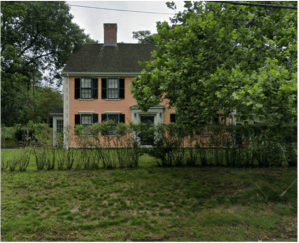
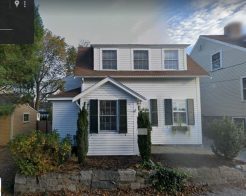
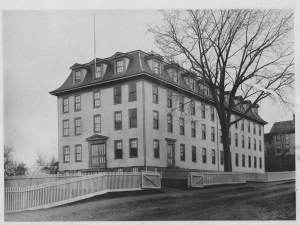
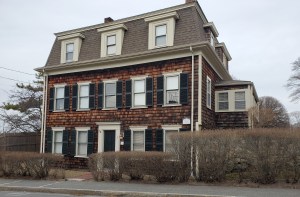
Tranquility Lodge, 137 Main Street, Hingham

Likely born in his grandparents’ house at 21 Lincoln Street (now known as the Hingham Historical Society’s Old Ordinary), Robert Thaxter grew up at 137 Main Street in Hingham, a lovely home once called “Tranquility Lodge,” sitting just down aways on Main Street from Hingham’s 1681 Old Ship Church Meeting House.  

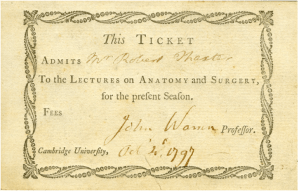
He graduated from Harvard College in 1798 and attended the highly selective private cadaver lectures in Anatomy and Surgery offered by the famous surgeon Dr. John Warren (1753-1815), who would go on to be a founder of Harvard Medical School. Dr. Robert Thaxter’s original admission ticket to Dr. Warren’s class is seen below.  Robert soon joined the Massachusetts Medical Society and in 1824 delivered that body’s annual oration, titled A Dissertation on the Excessive Use of Ardent Spirits.
Robert continued a family tradition as a highly respected medical doctor. He was mentored by and practiced with his father, Dr. Thomas Thaxter, in the study of medicine and surgery in Hingham. Dr. Thomas Thaxter was of deep Hingham roots, as “the family of Thaxters were among the early settlers of that town.” (The Boston Medical and Surgical Journal, Vol, XLVI., Wednesday, May 19, 1852. No.16 pg. 309)

Dr. Robert Thaxter kept detailed records of his patients. His medical diary is a treasure that the Hingham Historical Society holds in its archives. He had a unique writing style and in one journal entry describes the travels of a critically ill man who journeyed from northern Maine for medical care.
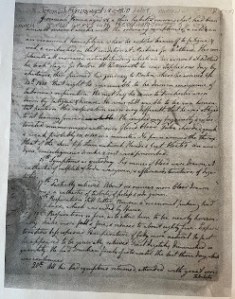
This was a demanding trip in the 19th century even for a healthy person let alone one with a critical illness. But Dr. Thaxter was a physician of both the rich and the poor and a healer with an extensive reputation as a doctor both near and far. The doctor’s notes reflect his high level of compassion for this distressed patient. His concise description of the patient’s clinical findings also shows a modernist sensibility in terms of his ability to describe clinical findings with a degree of precision. At that time, treating patients was limited by the lack of today’s medicines such as antibiotics which may have cured this patient. Dr. Thaxter did a remarkable job taking care of patients with the limited pharmacopoeia available at that time. Dr. Thaxter’s 1810 entry regarding his examination of this sick patient is as follows.

Jeremiah Ferino: Jeremiah, 28, a thin habit, (and) narrow chest, had been unwell several weeks with the ordinary symptoms of a cold an occasional haemophysis, when he exhaled himself to fatigue (and) … (and) embarked in that condition at Machias for Portland.

His complaints all increased notwithstanding which on his arrival at Portland he took stage for Boston. At Portsmouth he was stopped one day by epistaxis then … his journey to Boston, where he arrived April 14th, 1810.

That night he was unable to lie down in consequence of laborious respiration. The next day he came to Dorchester worn down by fatigue (and) disease. He was still unable to lie in a horizontal position. His respiration was so very difficult that he was obliged to sit leaning forward. He coughed very frequently (and) expectorated mucous mixed with very (fluid) blood.

To have medicines on hand as a doctor, his father, Dr. Thomas Thaxter was also proprietor of a pharmacy in Hingham, which Robert’s maiden aunt, Abigail Thaxter, ran.  (History of the Town of Hingham, 1893; Vol II, page 323; “Native and Resident Physicians” by George Lincoln.)  The Thaxter pharmacy would have had a wealth of compounds, elixirs, herbs, and other medicinal items that the young Robert Thaxter could access to treat and cure ailments of that time. Dr. Robert Thaxter’s beautiful wooden medicine chest is also in the collection of the Hingham Historical Society. His medicine chest contains thirteen mold blown glass bottles, many of them with original paper labels. The bottles are labeled with interesting ingredients such as maraschino, strawberry syrup, ginger, parfait amour, rose water, spirit of camphor, orange, oil of cinnamon, oil of cloves, and aromatic elixir. Today, most of these items would be found in our kitchen spice rack rather than our medicine cabinet.

Once trained, Robert Thaxter stayed in Hingham side by side with his father and continued the medical practice. They were both driven and ambitious men but by 1809, Dr. Robert Thaxter needed his independence. He moved his medical practice to Dorchester. Not surprisingly, he was “immediately received into popular confidence which he retained until his death.” (The Boston Medical and Surgical Journal, Vol, XLVI., Wednesday, May 19, 1852. No.16 pg.309). Dr. Thaxter was married to his love of medicine and never took a wife. Once settled in Dorchester, he posted the following advertisement in the July 22, 1809 Columbian Centinel Newspaper:

NOTICE: Doctor Robert Thaxter informs the Inhabitants of Dorchester that he has taken lodgings at the residence of Mr. William Richards, where he will be ready at all times to attend to his profession. He will inoculate with kine Pox, free of expense, all persons who feel themselves unable to pay.

(History of the Town of Hingham, 1893; Vol II, page 324. “Native and Resident Physicians” by George Lincoln.)

At that time, Boston was a homogeneous and in many ways provincial society, with a deeply rooted regard for its protestant English past.  Irish immigrants now flooded into Boston hoping for a second chance in life. These Catholic newcomers, though, were seen as a threat to the norms of Boston society. Dr. Thaxter’s decision to relocate his practice to Dorchester was a bold move. He might have damaged his reputation as a doctor by leaving, but he didn’t and still returned to the area to perform surgeries (The Boston Medical and Surgical Journal, Vol, XLVI., Wednesday, May 19, 1852. No.16 pg.309).

Once settled in Dorchester his reputation took off. Dr. Thaxter’s diligence, careful medical observation, and never-ending dedication to the sick expanded his medical practice to neighboring areas. As time went on, he also was drawn to the Irish poor now arriving in Dorchester. “The Irish population gathered more thickly about him . . . .  By night and by day, he was at their beck,” (The Boston Medical and Surgical Journal, Vol, XLVI., Wednesday, May 19, 1852. No.16 pg.312)

Dr. Thaxter’s commitment as a doctor to serving the needy, poor, and especially, those from Ireland fleeing the potato famine is commendable—then and now. Those emigrating by what were later called “coffin ships” from Ireland carried poor passengers in steerage where there was a lack of food, plenty of filth and diseases running rampant such as typhus. (As described in a Hingham Historical Society lecture, “The Irish Riviera and Hingham’s Irish 1850-1950,” available for viewing here, typhus and other infectious diseases were killers without our present-day antibiotics.

Dr. Thaxter met his end doing what he believed in. “He fell a martyr to the ship fever (typhus fever), caught in attending an Irish family, just from on board ship.” (Obituary, Boston Daily Evening Transcript 11 Feb 1852).  It was said that “Dr. Thaxter never stopped helping the Irish.” (Ibid.) He had a charitably rich and spiritual life to the end. Dr. Thaxter died February 9th, 1852. He was 75 years old. (History of the Town of Hingham, 1893; Vol II, page 324; “Native and Resident Physicians” by George Lincoln.)

To learn more about the Thaxter family and its place in local and American history, please see our post One if By Land, Two If By Sea on this blog.  You might also look at the recent publication, Revolutionary War Patriots of Hingham, by Ellen Miller and Susan Wetzel, Dec 26, 2023, which details the town’s Patriots, including quite a few from the Thaxter family who left their mark in history.
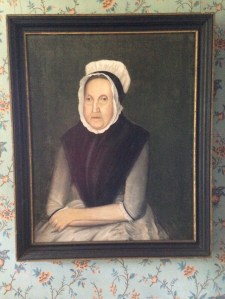
Abigail (Smith) Thaxter

If you are in Hingham, you also may want to visit Dr. Thaxter’s likely birthplace, the Old Ordinary. There you can see a portrait of Dr. Robert Thaxter’s grandmother, Abigail Smith Thaxter, hanging in the parlor.

Dr. Robert Thaxter’s spirit carries on today in public service and health. This tradition of outreach and assistance to those most disadvantaged continues in the Boston area such as the work of the late Dr. Paul Farmer and the continuing work of Partners in Health, and Dr. Jim O’Connell and Boston Health Care for the Homeless, as well as numerous others dedicating their lives to helping those in need.
A Very Green Street: Irish Families in Hingham in 1900

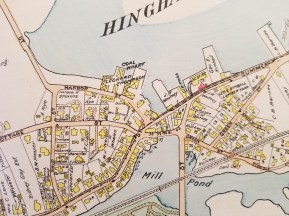
Detail from 1903 Hingham map

Green Street, which became a mapped street of Hingham in 1838, had existed as an informal road since early in Hingham’s history. In the late 1800s it was increasingly populated by Irish immigrants and their families, though the name Green Street does not appear to have a direct connection with its Irish community.  The immigrants here primarily came from counties in southern Ireland like Cork and Tipperary, although Dan Daly, one of the early Irish of Green Street, had arrived in 1855 from County Armagh, in Northern Ireland, where St. Patrick is said to have founded a Celtic Christian monastery.

19 Green Street, Hingham

In 1900, many in the neighborhood, like Dan Daly, at 19 Green Street –then 72 and still working – had livelihoods tied to nearby estates and the comings and goings at Hingham Harbor. The Gilded Age had increased wealth for some in Hingham while also creating jobs for many Irish immigrants fleeing poverty tied to the Irish potato famine which began in 1845.  In addition to Daly, Irish-born estate gardeners included

23 Green Street, Hingham

30-year-old John Connelly and 32-year-old James Donnell, both of whom settled on Green Street to raise families.  Also working as a gardener in 1900 was 78-year-old John Magner. He and his wife Bridget Hanley were empty nesters in 1900, after raising 5 children at 23 Green Street.  One son, John Magner, Jr., lived with his young family on Martins Lane, where he was head gardener for the Brewer Estate.  (The Magner clan would continue to grow in Hingham during the 20th century.)

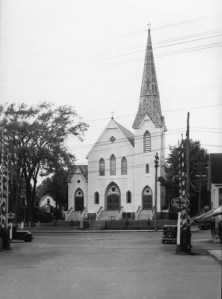
St. Paul’s Church, Hingham, c. 1930.

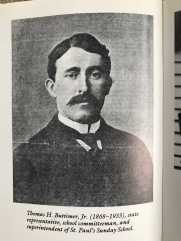
Another Green Street resident likely employed by a nearby estate was Judith (Barrett) Buttimer, 61, a widow who worked as a laundress. Judith’s husband, John Buttimer, a farm laborer, died young, at only 55, as did many hard-working immigrant laborers. John had emigrated in 1854 with a younger brother, Thomas Buttimer, who in 1900 was a farm foreman in Hingham. Thomas and his wife, Catherine Barrett, had married in 1858 in Randolph–before the building of St. Paul’s, Hingham’s first Catholic church (dedicated in July 1871).  One of their six children, Thomas H. Buttimer State Rep. Thomas H. ButtimerJr., who in 1900 had his own family home on Lincoln Street, was a prominent  attorney, and in 1902 would be elected as state representative from the 3rd district. Over on Green Street, Aunt Judith must have been quite proud, although in 1902, as a woman, she would not yet have had the right to vote.
Milk bottle cap, World’s End Farm

The 1900 census identifies some other Irish immigrants on Green Street as “farm hands” or “farm laborers,” including 37-year-old Dennis Long, married with two young children, and 48-year-old James Buckley, married with two teen-agers. Long and Buckley likely were working at one of the farms in north Hingham at the time, perhaps John Brewer’s “gentleman’s farm” – established in the 19th century at World’s End, or the Jordan Farm,  then one of the largest farms in Hingham, located on Union Street (now the location of Hingham High School.)

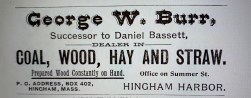
Hingham’s days as a Gilded Age seasonal tourist destination were, in 1900, mostly past. The steamship lines recently had ended their scheduled stops at Hingham Harbor after assessing the damage to the Hingham wharves caused by the 1898 Portland Gale.  Melville Garden, the amusement park at Crow Point, had been dismantled in 1896, and the Old Colony House, just up the hill on Summer Street, had burned down in 1872.  But Green Street’s location near the harbor gave its residents convenient access to work related to the coal and wood fuel-supply dealers, lumber wharves, and other harbor-related businesses. For many, this proximity to businesses needing carting and other hauling and loading services created jobs as teamsters, or as hostlers. Teamsters living on Green Street in 1900 included the recently married Cornelius Ryan, 31, and William Welch, 33 and married with young children.
Kimball Lumber yard at Hingham Harbor

6 Green Street, Hingham

William Welch was born here to Irish immigrants John Welch and wife Julia of 6 Green Street.  John Welch, 80 years old in 1900, was still working as a laborer according to the census record. He and Julia had eleven children, but only four were still living in 1900. Tuberculosis and pneumonia, along with scarlet fever, were frequent causes of death for children and young adults in the late 19th and early 20th century Irish immigrant community here.  Hostlers on Green Street included 27-year-old James Riley, living here with wife Bridget and two young children, along with mother-in-law Bridget Coughlan. James was a recent arrival, emigrating as a teenager in 1890. His 20-year-old wife had come earlier, as a young girl in 1877.

Also now working as a hostler was Thomas Morrissey Jr., 38, a former shoemaker, married for 17 years to Mary Crehan. For the Morrsisseys, 1900 was just seven years since the tragic loss of three of their young children to scarlet fever. The children’s young lives are memorialized on the family headstone at St. Paul’s Cemetery.  Both Thomas and Mary were born in Irish immigrant households in Hingham. Thomas grew up on Elm Street. Mary’s parents earlier had a home on Green Street but after her dad’s death, her mother Ellen Crehan lived with her youngest daughter Catherine’s family here.

Of course, the horses managed by both teamsters and hostlers needed the services of blacksmiths. There were several blacksmith shops in the downtown Hingham area then and one Irish immigrant blacksmith then living on Green Street, Michael Downes, may be one of those shown in this 1900 image of workers at the Huntley Blacksmith shop.

In 1900, Green Street residents also found work for the railroad. The Old Colony line’s South Shore branch through Hingham to Cohasset, built in 1849, created jobs including those held by 40-year-old Irish immigrant Jeremiah Collins, who was supporting his Irish-born wife Margaret and six children born here as a Section Foreman for the railroad, and 39-year-old Irish immigrant Michael Kelly, a track walker for the railroad, whose household included, in addition to wife Margaret and six children, an Irish-born boarder, Michael Wallace, also a railroad worker. Taking in boarders was a common practice in the Irish community here, both to assist newer immigrants and to provide added income for the household. The children in the Kelly household as of 1900 included four daughters and two sons, all under ten years old. Another daughter would be born in 1901. Three of the “Kelly girls” of Green Street would, years later, be among the first women in Hingham to register to vote after the 19th amendment passed in 1920.  By that time, their father had left railroad work behind and joined his neighbors working at nearby private estates.
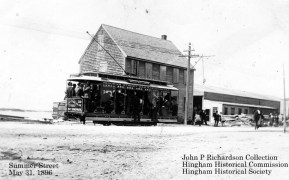
Hingham Street Railway Car on Summer Street in front of Walsh’s Paint Shop, May 31, 1896.

As the new century dawned, both sons and daughters of the Irish of Green Street often left school and began working as teenagers. Many then stayed in their parents’ household into adulthood, perhaps in part to contribute to the family income as their parents aged. These next-generation Green Street residents at work in 1900 included James Buckley, Jr., 19, then working for the Electric Street Railway.  (One such street car is show here traveling along Summer Street at the harbor, not far from Green Street.)

Burr, Brown Tassel Factory

Three adult daughters of John and Julia Welch were living with their parents in 1900 and working as: a dry-goods dealer (Mary, 39), a dressmaker (Hannah, 35); and a fringe-maker (Julia, 34).  As a fringe-maker, Julia Welch likely worked at the Burr Brown Tassel Factory, nearby on Fearing Road. Julia Buttimer’s daughter, Nellie, 33, worked as a clerk at a shoe and boot store. Dan Daly’s 34-year-old son, Edmund, who lived in his parents’ Green Street home with wife Margaret in 1900, was employed as a clothing dealer.

Detail from 1893 Hingham map showing Dower ropewalk on Hersey Street.

Before ending our visit to the Green Street of 1900, we’ll note some other residents who, like Thomas Morrissey, had ties to the close-by west Hingham area referred to as an “Irish village” in the 1993 Hingham history, Not All Is Changed, published by the Hingham Historic Commission.  James Dower Jr., 33, who in 1900 lived on Green Street with his wife Catherine, their newborn child, and his mother-in-law, Ellen Crehan, was born in Hingham, to Irish immigrants James Dower Sr. and Catherine Bowden, at 135 Hersey Street. This home is still there, near the entrance to St. Paul’s Cemetery, and, like other homes referenced in our visit today, is listed on the Town of Hingham’s Comprehensive Inventory of Historic Assets. In 1900, James Dower Jr. would have walked to work on Hersey Street, where he was  a ropemaker in his father, James Dower’s “rope walk,” then adjacent to the family home. (The rope-making mechanism from the Dower ropewalk is on public display at Hingham Town Hall, on loan from the Hingham Historical Society.)

21 Green Street, Hingham

Mary Casey, living on Green Street in 1900, was the widow of ropemaker Jonas Casey, who may have worked at the Dower ropewalk. The Casey home, at 21 Green Street is another vintage highlight of this charming neighborhood.  If you have enjoyed this brief visit to Hingham’s Green Street of 1900, consider booking a docent-led tour of Hingham’s Irish Immigrant Neighborhood sometime this spring or summer. The walking tour was created as part of the nine-town South Shore Irish Heritage Trail launched in 2022. Email info@hinghamhistorical.org to book.

From Plow Blades and Horseshoes to Automobiles: A Metal-working Skill Lived On

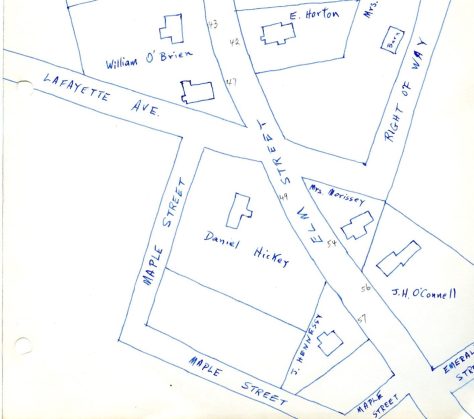
Earlier this year I was researching Hingham’s Irish immigrant neighborhood in preparation for the launch of a Hingham walking tour tied to the South Shore Irish Heritage Trail.   As described in Not All Is Changed: A Life History of Hingham (1993, Hingham Historical Commission), “by the 1870s, Crowe’s Lane, Hersey near Elm Street, upper Elm, Emerald Street, and Bates Court, were an Irish village . . . .”  I spent time reviewing pages about these streets in the Loring Notebooks in our Society archives. These “notebooks” actually are binders filled with historic details about Hingham streets and properties, assembled by local historian Julian Loring (1899-1978).  The description of a property at the corner of Lafayette and Elm Streets — in the heart of the “Irish village” intrigued me.  Daniel Hickey, a blacksmith, and his family, lived on this corner from late 1889 until around 1910. I did some additional digging and felt rewarded for the effort:  the multi-generational Hickey family story that emerged paints a vivid picture of life in Hingham, and America, in the late 19th and early 20th century.

Daniel Hickey was born in Hingham to Irish immigrant parents. And it was with his father John that a metal-working family tradition began.

Irish immigrant John Hickey, from Kilkenny, met Bridgett Hackett, of County Cork, on Prince Edward Island, Nova Scotia. They arrived in Boston in 1832 and married there that November.  They had settled in Hingham sometime before 1835 when their first daughter, Mary, was born. John described himself as a laborer on his 1845 naturalization form but would soon develop far more specialized skills.

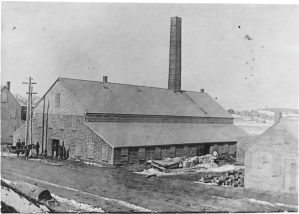
Howard Foundry at Hingham Harbor, 1896. Kimball Family Photo Collection, Hingham Historical Society.

The Hickey genealogy in the 1893 History of the Town of Hingham tells us that John and Bridgett found a place to live on North Street near the harbor. Successive federal and state census records tell us that by 1850, John was employed as an “iron melter,” a “furnace man,” then an “iron screener” and, by 1860, a “moulder.”  Although no surviving record could be found, almost certainly John was working at the Howard Foundry at Hingham Harbor.

John and Bridgett’s 9 children—5 daughters and 4 sons–were born in Hingham. (John died in 1866 and his wife Bridget in 1873.) Three of their four sons–James, born in Hingham in 1839; Thomas, born in 1841; and Daniel, born in 1851–followed their dad into hot metal work.

Their eldest son James became an iron screener and moulder as a teenager (likely joining his dad at the local foundry) and then took his trade into the Civil War, where he served in the 4th Regiment of the Massachusetts Cavalry—perhaps making cannon balls as well as horseshoes for his unit. After the war James married and moved to Canada.

Second son Thomas, described as a blacksmith when he joined the 1st Cavalry in 1861, later served in the 4thCavalry. His 4 plus years of service were eventful and admirable as related in The Town of Hingham the Late Civil War (1876, F. Burr and G. Lincoln.) He mustered out at the war’s end in 1865 as a second lieutenant. James and Thomas were among the 24 young men from Hingham who were in cavalry service during the Civil War.

Burr-Brown Tassel Factory, Fearing Road, Hingham, c. 1865. Hingham Historical Society

Thomas returned to the family’s Hingham home on North Street, where in 1865, he (aged 23) and 4 younger siblings were living with their parents. His 21-year-old sister Ellen worked at the nearby Burr, Brown Tassel Factory, a popular employer for young women from Irish immigrant families, and John Jr., 19, was a periodical dealer, perhaps selling reading material to commuters from the then-downtown train station. Thomas married in 1866. By 1879, records show that Thomas had a 2-man blacksmith business in Hingham. It is quite possible that the second blacksmith at Thomas’ shop was younger brother Daniel, who would have been in his 20’s by that time. By 1880, Thomas and his wife Mary Jane had a home on Cottage Street and three young sons. They moved to Quincy in 1883.

Daniel stayed in Hingham. In 1876, he married Margaret Hanley of East Weymouth, whose parents, John Hanley and Margaret Keane, were both Irish immigrants. John Hanley, a farmer, was born in Tipperary County. Perhaps Margaret met Daniel Hickey when he provided blacksmith services for her dad’s farm animals. After they married and started a family, the couple first lived on Ship Street. By 1892, Daniel and Margaret had 5 children — 3 sons and 2 daughters.

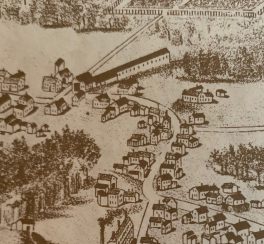
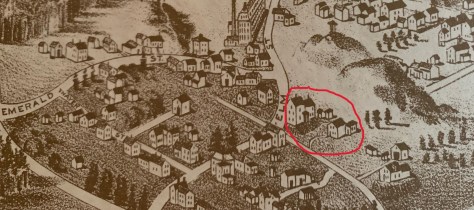
Detail from “A Bird’s Eye View of Hingham,” map published by A. F. Poole, Brockton, Mass. (1885). Hingham Historical Society

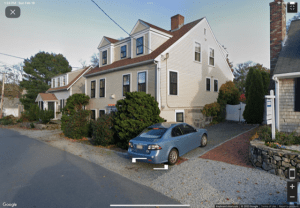
In November 1889, Daniel and his family moved to the corner of Elm and Lafayette, where the property included a barn suitable for horseshoeing. This excerpt from an 1885 illustrated map of Hingham shows the corner as it likely looked when Daniel bought the property in 1889, before the surrounding Maple Street neighborhood was developed, around 1900. Daniel also had a business location for his blacksmith business within walking distance, at 23 North Street. Daniel bought the corner property at 49 Elm Street from Alfred Howard, a carpenter and cabinetmaker, who may have built the home (c.1860) which still stands at this address. Alfred was the son of a blacksmith, Edmund Howard. Daniel had likely known the Howard family for years, as it was Alfred’s uncle, Charles Howard, inventor of the Howard Plow, who had started the Howard Foundry at Hingham Harbor.

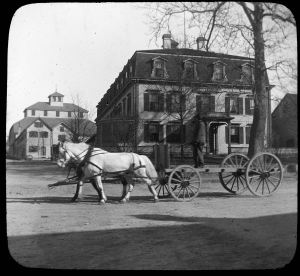
A horse-drawn open wagon passes the Cushing House on North Street c. 1896. Kimball Family Photo Collection, Hingham Historical Society

The late 19th century was a busy time for livery stables and the blacksmith trade as horse and buggy was a primary means of transportation.  In the 1860 census there were 14 blacksmiths doing business in town, as related in a fascinating program on the history of transportation in Hingham researched and presented by archivist Bob Malme (and now available to view on the Society’s YouTube channel.

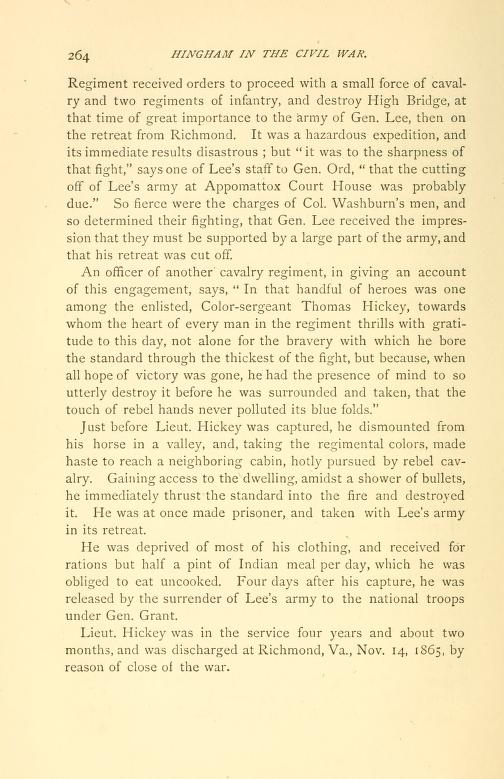
But times were about to change. The first automobile in Hingham, arriving in 1902 according to Not All Is Changed, was owned by Francis Willard Brewer (1846-1907), an affluent local “gentleman farmer.” By 1912 Hingham had acquired its first motor-powered fire engine, replacing one team of horses. That year, with their family now grown and local blacksmithing businesses gradually being replaced by auto repair shops, Daniel and Margaret downsized to a home at 37 Elm Street. But the family interest in horses, and in metal work, continued with their sons Daniel Jr. and Herbert.

Daniel Hickey, Jr., born in Hingham in 1883, and later living in Boston, was, at age 34, a riding instructor, according to his WWI draft registration.  He worked for a time at Boston’s Park Riding School, which was operated by a J. B. Ferry.  Daniel was also described as an “automobile driver”—which suggests he worked as a chauffeur in early automobiles, in addition to teaching students to ride horses.

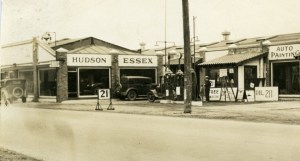
Hudson Motors dealership, Summer Street, Hingham, 1926. Kimball Family Photo Collection, Hingham Historical Society

Indicative of the changing times, Daniel’s oldest son Herbert, born in 1878, moved to Detroit sometime after 1910, and had a long career in the fast-growing auto industry. For a time, he was an inspector at the Hudson Motor Car Company, which had an early dealership on Summer Street at Hingham Harbor. Hudson Motor Company, founded in 1909, merged in 1954 to become American Motors Corporation.  It was fascinating to learn how the Hickey family’s livelihood evolved with changes in transportation, while the skills in metal work continued through the generations.

The Daly Family of Hingham

Historian John Richardson (1934-2011) was an avid collector of all things Hingham– its places, its buildings, its people. Among his collection in the Historical Society’s archives are 64 binders of material, gathered from families, purchased at estate sales, or sometimes rescued from homes or buildings facing demolition, that chronicle the lives of a disparate group of Hingham individuals and families.

Two binders are devoted to Daniel Daly (1825-1911), one of the town’s earliest Irish immigrants, and his descendants. They tell a story that takes the family from newcomers just prior to the Civil War to well respected members of the Hingham community by century’s end.

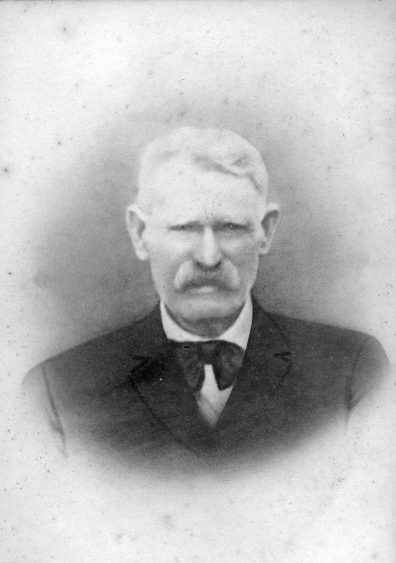
Portrait of John Daly, early 1900s(?), John P. Richardson Collection, Hingham Historical Commission / Hingham Historical Society

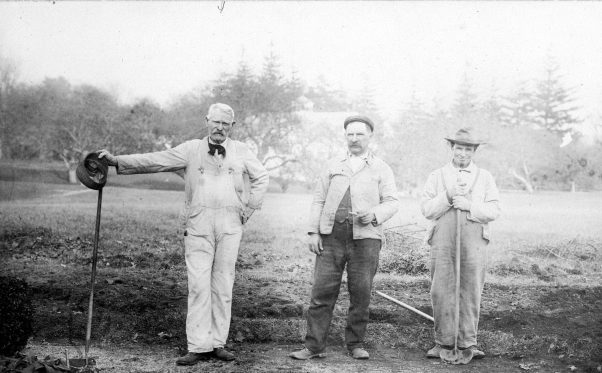
Daniel Daly was born in County Armagh, Ireland and arrived in Hingham in 1855, soon after marrying Nancy Crowe (1835-1905) from the County of Tipperary. Daniel began as a gardener, hiring himself out to local families. After serving in the Civil War he started working as a gardener and florist with prominent Hingham families, such as Charles B. Barnes.

Photo of Daniel Daly and 2 others on Estate of Charles B. Barnes, early 1900s, John P. Richardson Collection, Hingham Historical Commission / Hingham Historical Society

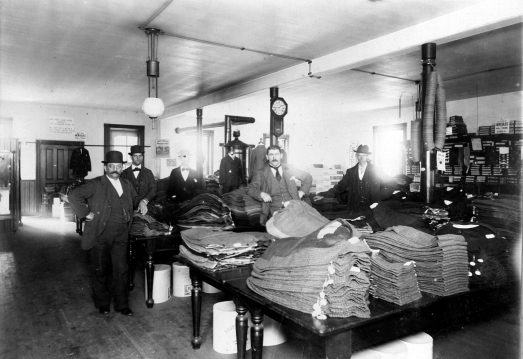
With the money he earned, he bought a house at 19 Green Street where he and Nancy raised their family. The Dalys had two children who survived to adulthood and who both attended Hingham schools: Daniel (1857-1900), who later moved to St. Louis and became a police officer, and Edmund (1866-1930), who started out working in retail stores in Boston and later became a businessman ins own right as a partner in the Hingham Bicycle Company and later as the sole owner of Edmund Daly & Co., Hatters and Furnishers, which had a store in West Hingham.

The interior of Edmund Daly and Co. store in West Hingham, 1910s(?), Edmund Daly (center), others unidentified. John P. Richardson Collection, Hingham Historical Commission / Hingham Historical Society

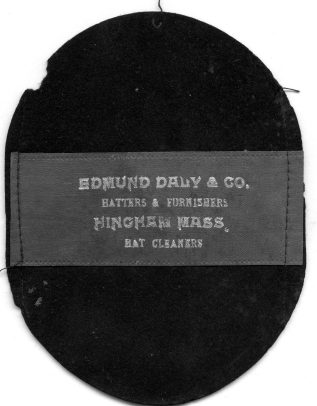
The Daly Family materials include this floor  sample from Daly & Co.:

Sample hat(?) floor sample from Edmund Daly & Co. c. 1910 from John P. Richardson Collection, Hingham Historical Commission / Hingham Historical Society

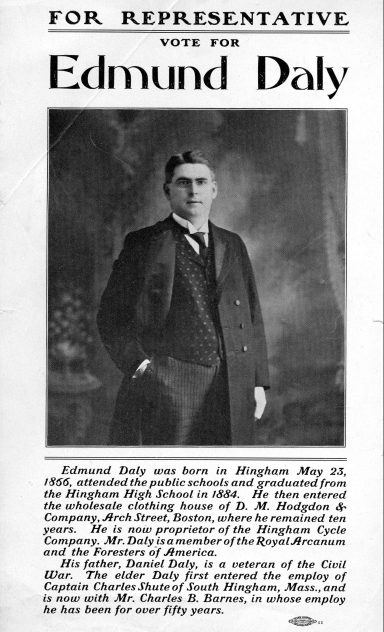
Because he was a well respected businessman, members of the local community urged him to run for public office, including for a seat in the state legislature in the early 1900s.

Political Poster supporting Edmund Daly for State Representative, Unknown, prior to 1910, John P. Richardson Collection, Hingham Historical Commission / Hingham Historical Society

Though he did not win this election for state office, Edmund served on many town boards, including the Playground Commission. Meanwhile, he inherited the family house on Green Street after his father’s death in 1911.

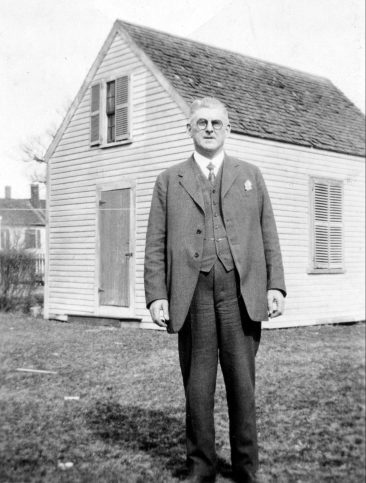
Edmund Daly standing in the backyard of his home at 19 Green Street, 1920s? John P. Richardson Collection, Hingham Historical Commission / Hingham Historical Society

His community standing and political connections allowed him to be appointed as Hingham Postmaster by President Wilson in 1917, a job he held until 1930 when he suffered a fatal heart attack walking to work from his home. The town was shocked and saddened in hearing the news.

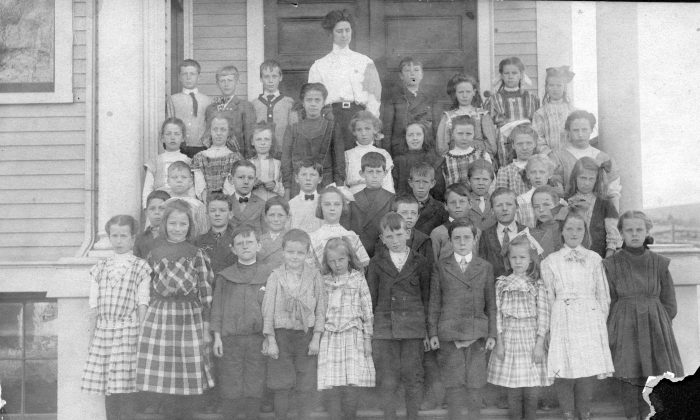
Edmund Daly married Margaret E. Daly (1864-1952). They had one daughter, Annabel Daly (1900-1993) who also attended the Hingham schools. The Richardson Daly binders even include one of her primary school class photos.

Class photo in front of Primary School Building in Hingham, unknown date (circa 1912), Annabel Daly second from left in first row. John Richardson Collection, Hingham Historical Society

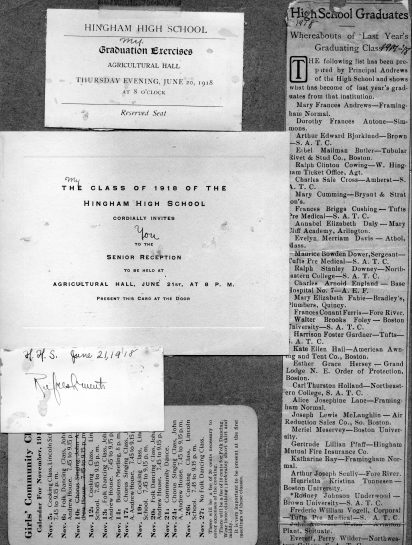
She then attended Hingham High School where she graduated in 1918. In her adult life, she kept a scrapbook of her early years and her father’s career, through which most of her family’s history was saved.

Page from Annabel Daly’s Scrapbook, June 1918. John P. Richardson Collection, Hingham Historical Commission / Hingham Historical Society

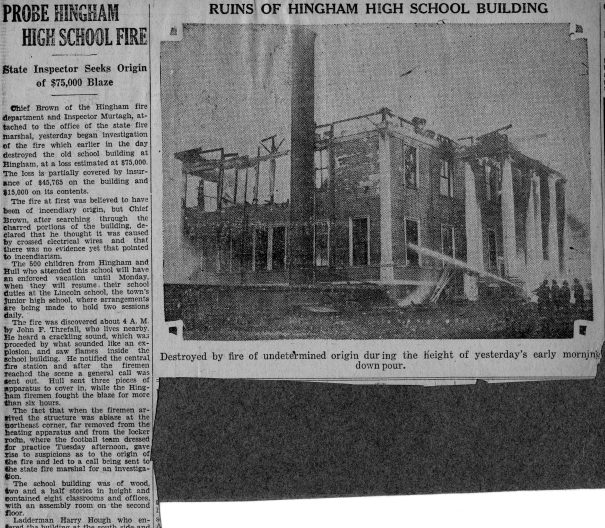
She not only kept items of a personal nature but chronicled important events in town as well. Among her materials is media coverage of the destruction of the original Hingham High School by fire in 1927.

Page from scrapbook of Annabel Daly, Oct. 1927. John P. Richardson Collection, Hingham Historical Commission / Hingham Historical Society

Annabelle Daly continued to live in the Green Street house until her death at age 92. She did not marry and had no children. She was buried in the family plot at the St. Paul’s Cemetery. Her collection was obtained by John Richardson, who organized the Daly family materials into binders. These Daly binders and other family materials collected by John Richardson will soon be greatly more accessible at the new Hingham Heritage Museum.