[The photos and text are from a 2011 exhibit put together by Mary Fitzmaurice and Suzanne Buchanan to showcase shoes, boots, and other footwear in our costume collection.]
After farming, shoemaking was the most common occupation listed in the 1893 Hingham Genealogy. Like aprons and stockings, the shoes that people wore every day rarely survived. They simply wore out. That explains why most of the shoes on display here are in pretty good condition. They probably were worn only on special occasions or by people who could afford more than one or two pairs of shoes.
The well-worn working man’s shoe in the center of the bottom picture is the one exception to that rule. It is one of thousands of shoes that were hidden in chimneys and walls by New England families when they built new homes in the 1700s and 1800s. The origins of this tradition are murky, but shoes dating back to the 15th century have been found in the walls of houses in England, so we know that it came over with the Colonists. Some scholars think it was a way to bless the house or bring good luck. If you live in a historic house, you may have an old shoe in your wall, too.
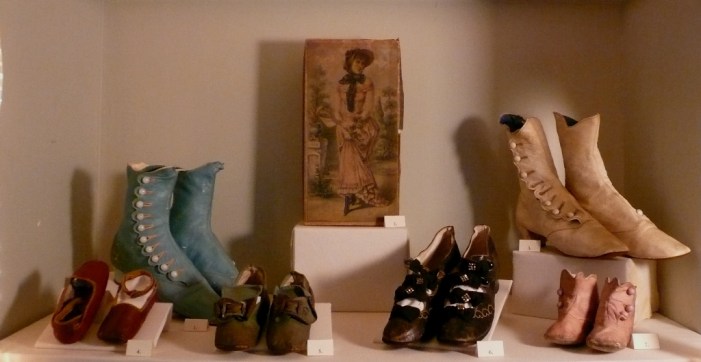
- Light blue kid high-button boots, ca.1890, with a 1” Louis heel, ten milk-glass buttons, and scalloped button hole edges. COS-SH8
- Shoe box from T.E. Moseley & Co. of Boston, printed by August Gast & Co. of NY in 1887. Gift of Mrs. Alfred Cushing.COS-SH23.
- Ivory kid high-button boots, ca. 1890.
- Red child’s shoe with ankle strap. Metal buttons center front. Made by Foster and Peabody of Boston, 1850-70.
- Green leather child’s shoe with metal buckles, 1890s
- Black leather girl’s shoe with 3 straps and bows, 1890-1910
- Child’s pink scalloped high-button shoes, c. 1900-20. COS-SH33. Gift of Wisconsin Historical Museum.
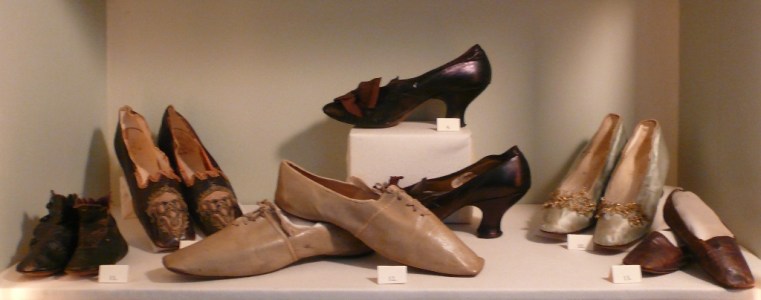
- Ladies’ black kid shoes with cut-out details and pink silk lining and gold chain stitching. Made in Paris, Viault-Este, and sold in London by Thierry & Sons. c. 1850-1875. Gift of Clara L. Barnes. COS-SH26.
- Ladies’ bronze kid leather evening shoes with brown tie bows and vamp heel and a pink satin insert on each toe. c. 1920-25. Made in Paris by Viault-Este. Gift of Mrs. J. Andrews. COS-SH29
- Ladies’ pale green satin slippers with gold and clear glass bead decoration over short, round vamps. Ivory kid and cotton innersoles and lining. Stamped on right innersole: Thayer McNeil & Hodgkins, 41 Temple Place, Boston. 1890-1910. Gift of Mrs. George F Bennett. COS-SH21.
- Child’s black high-buttoned shoes with red leather lining, c. 1900-20. COS-SH32
- Beige ladies’ leather tie shoes with silk ribbon ties, bound in silk grosgrain. c. 1810-1860. COS-SH25.
- Child’s flat brown leather slippers with square toes and vamps. From I.E. Moseley & Co.corner of Summer and Hawley Streets, Boston. Late 19th century. COS-SH17.
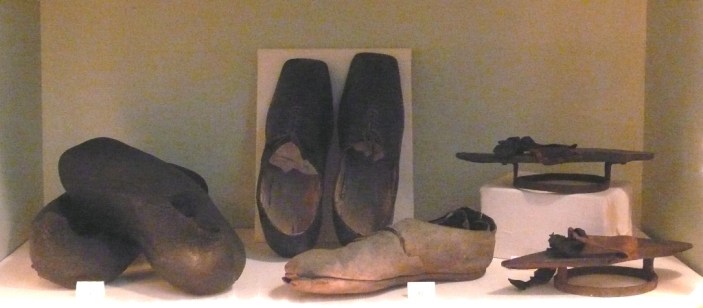
- Pair of men’s “gutta percha” shoes, an early type of rubber galoshes, c. 1840-50. Gift of the Prudden Family. COS-SH40.
- Men’s black leather shoes with square toes and brown shoe laces. c. 1810-1850. Gift of Robert Hurley. COS-SH31.
- Women’s wooden clog, or patten, with velvet strap and pointed toe. “Willard” written on bottom. c. 1700-1780. COS-SH46. Susan Barker Willard Bequest.
- Brown leather man’s shoe, c. 1750, well worn, found behind the chimney at 25 Ship St., which was built in 1753 by Jonathan Churchill.
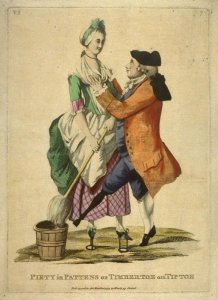
The pattens on the right side in the last picture deserve brief additional mention. In days when streets were unpaved and a woman’s dress fell all the way to the ground, these wood or metal platforms lifted her feet and clothing above the muck.
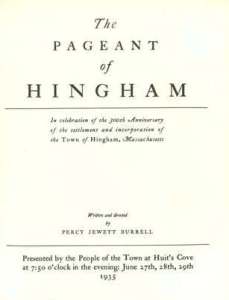 Hingham pulled out all the stops in preparation for its 300th anniversary celebration. Twelve hundred of the Town’s residents participated in a three-plus hour historical pageant, which was performed before 2,000 attendees on the evenings of June 27, 28, and 29, 1935. In the midst of the Great Depression, the Town appropriated an astonishing $14,000 for its tercentenary observance, which was written and directed by
 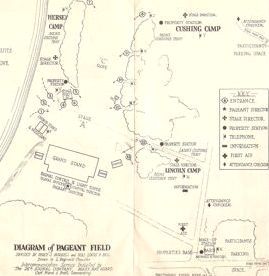 “The Pageant of Hingham” was performed on a sprawling outdoor set at what was then called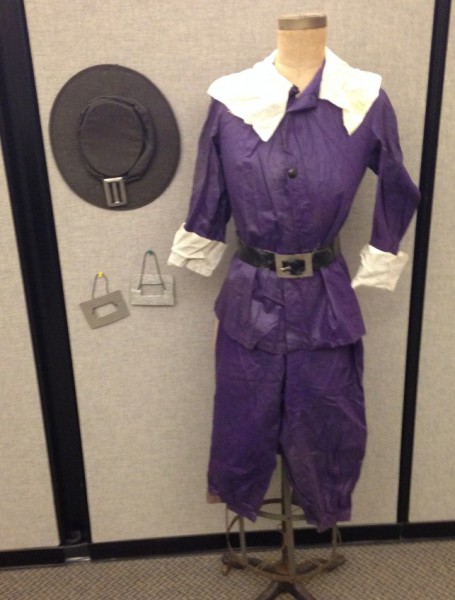
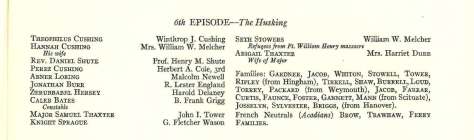 Young Newell and Herbert Cole, another Hingham boy also cast as an 18th century Hingham boy (Perez Cushing, 1746-1794), called out the names of the guests arriving at the Cushing farm. An example of their lines, taken from the Pageant Program:
 Out of the Archives