Battling “that Old Deluder, Satan” with a School

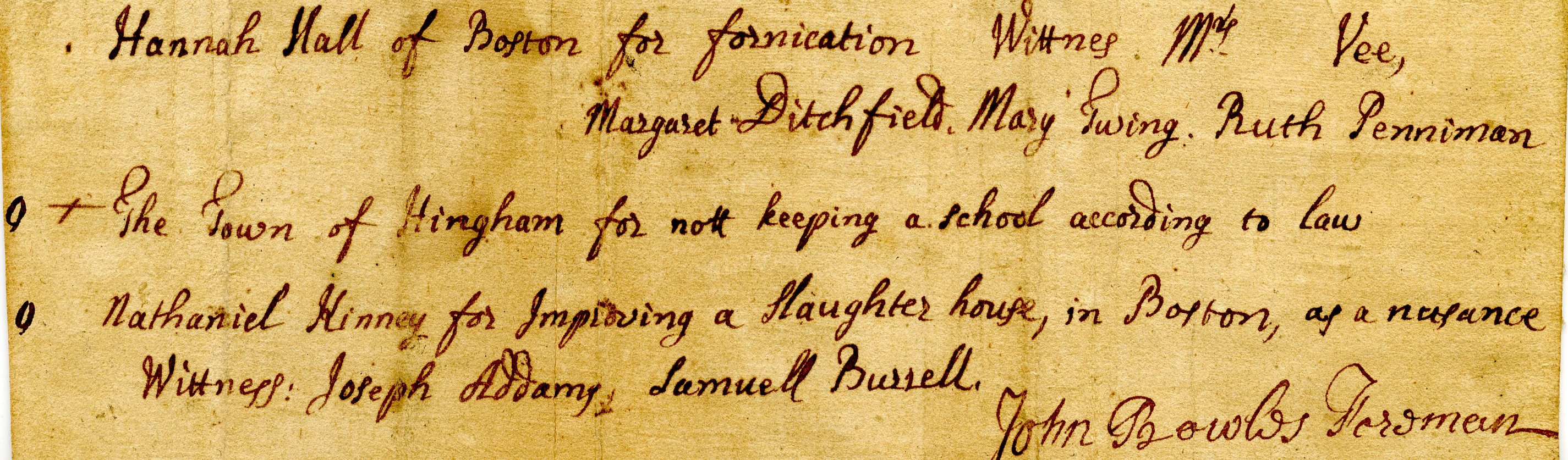
On April 6, 1714, a grand jury in Boston presented a series of charges against a number of individuals and entities.  Many of the offenses were exactly what we would expect from a group of 17th century Puritans:  “Richard Hancock of Boston for Selling Drink without license sundry times since last Session,” “Seth Smith of Boston for allowing unlawfull gaming,” “Nathaniel Ford of Weymouth for nott attending the publick worship of God,” and—a hat tip to Nathaniel Hawthorne—“Hannah Hall of Boston for fornication.”

MLD001One of the charges explains why this single-page manuscript came to Hingham, to be preserved in our archives:  “the Town of Hingham for not keeping a school according to law.”  This offense, as it turns out, is as characteristic of the Massachusetts Bay Puritans as the others charged on that day.
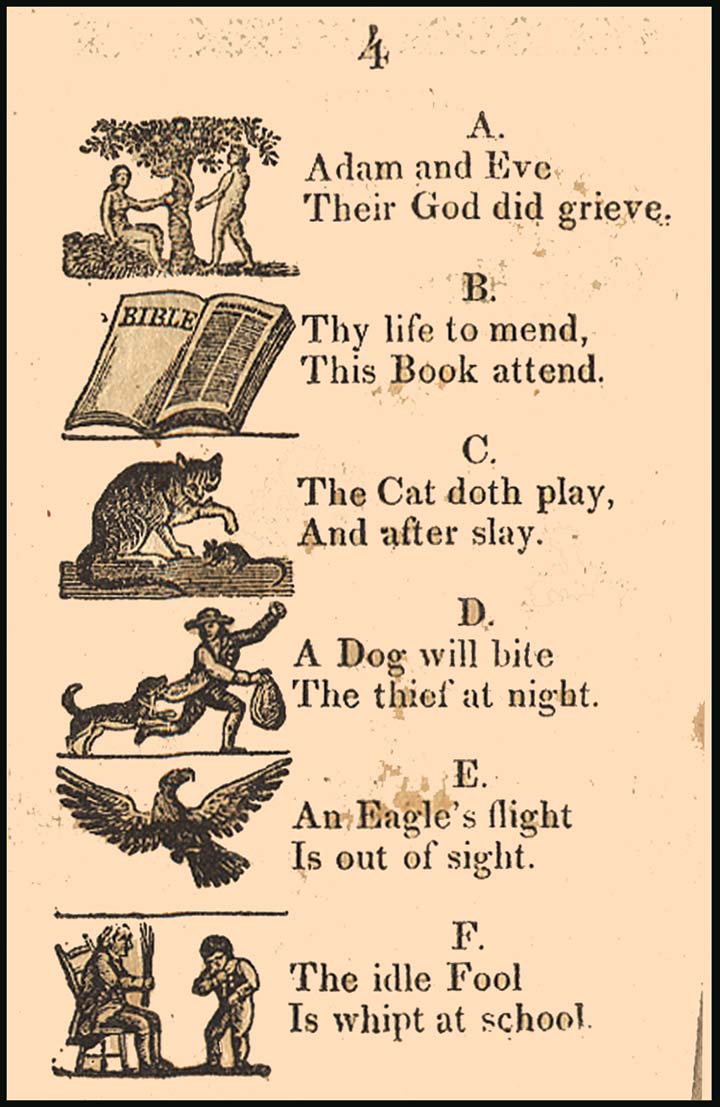
33447_2Education was very important to the founders of the Massachusetts Bay Colony.  The first public school in this country, Boston Latin School, was established in Boston in 1635, and the nation’s first university, Harvard College, was founded in Cambridge the next year.  In 1642, Massachusetts passed a law requiring parents to ensure that their children could read English or face a fine.

This concern with education grew from the very roots of Protestant theology:  the belief that Christian laity had the right–and a duty–to read the Bible in the vernacular and participate directly in the affairs of the church.  These fundamental goals are explained explicitly in the preamble to Massachusetts’ 1647 statute, sometimes called “The Old Deluder Satan Act,” that shifted the responsibility of education onto the growing towns:

It being one chief project of that old deluder, Satan, to keep men from the knowledge of the Scriptures, as in former times keeping them in an unknown tongue, so in these later times by perswading from the use of tongues, that so at least the true sense and meaning of the Originall might be clowded by false glosses of Saint-seeming deceivers; and that Learning may not be buried in the graves of our fore-fathers in Church and Commonwealth, the Lord assisting our indeavors: it is therefore ordered by this Court and Authoritie therof;

That every Township in this Jurisdiction, after the Lord hath increased them to the number of fifty Housholders, shall then forthwith appoint one within their town to teach all such children as shall resort to him to write and read, whose wages shall be paid either by the Parents or Masters of such children, or by the Inhabitants in general, by way of supply, as the major part of those that order the prudentials of the Town shall appoint. . . .

And it is further ordered, that where any town shall increase to the number of one hundred Families or Housholders, they shall set up a Grammar-School, the Masters thereof being able to instruct youth so far as they may be fitted for the Universitie. . . .

Hingham town records reference schoolteachers and a school building as early as the mid-1600s.  According to Francis Lincoln’s chapter on education in the 1893 History of the Town of Hingham, the increasing size of the town led to disagreements as early as 1708 and 1709 over where the school should be held.  Second Precinct—later Cohasset—wanted a rotation, so that school would sometimes meet in its area, as did “Great Plain”—South Hingham.  But there is no suggestion that HIngham’s school was ever closed.  Indeed, in a comprehensive list of the schoolmasters in Hingham from 1670 on, Lincoln reports that Jonathan Cushing was the schoolmaster from 1712-1713, after which the 1712 Harvard College graduate became the minister in Dover, New Hampshire.  Twenty-year old Job Cushing, Harvard College Class of 1714 succeeded him, remaining four year before becoming the first minister of the Shrewsbury church.
Bottom of documentPerhaps there was a lapse while the Town waited for Job Cushing to graduate.  There may have been complaints.  17th century grand juries could “present” charges based on their own knowledge and did not, as today, have to wait to be asked to hand down an indictment.  Was a disgruntled Hingham parent on that grand jury?  Perhaps we will learn more as we continue to dig through the archives.

A Resolution Reached At Town Meeting

ayrshireThe great thing about poking around in an archive as rich as ours at the Hingham Historical Society is that connections are there to be made.  Half the story might be in one document—and then the other half pops up.  A prior post on this blog (“An Appeal to Town Meeting”) was about the address of an unnamed 18th century farmer to Hingham’s Town Meeting.  The farmer had complained that he was unable to drive his livestock to pasture at the Great Lots, or bring off any produce, because  another Hingham farmer, Thomas Hersey, had built a stone wall across a public way.  The farmer had came to Town Meeting armed with evidence that, he claimed, proved that one hundred years previously the Town had authorized the laying out of a road to ensure the access to the very same Great Lots now blocked by Mr. Hersey.  And there the story ended.  The documents we were looking at were from the Hersey Family papers, and they left the identity of the petitioner and the outcome of the dispute unknown.

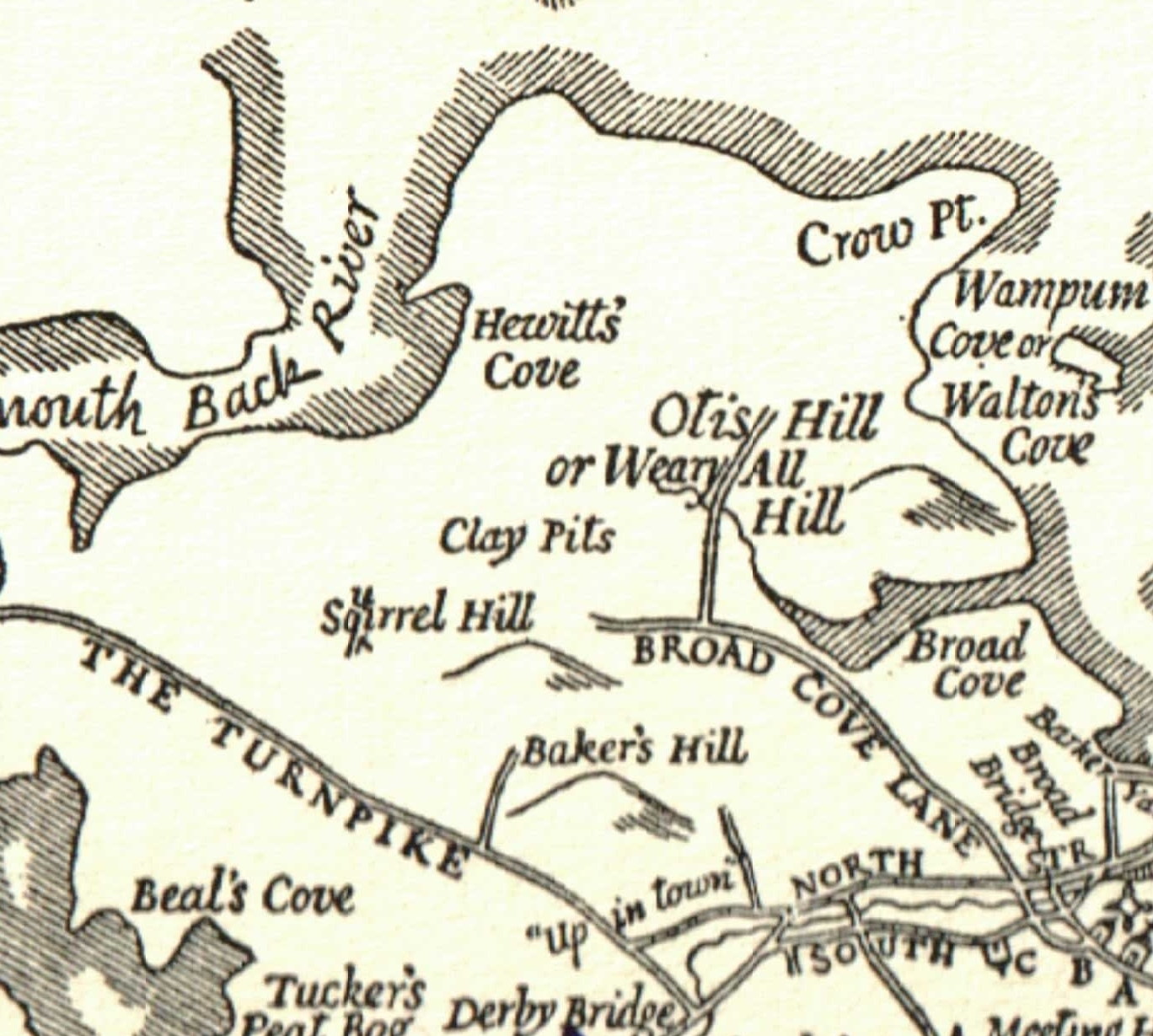
Detail from D.A. Dwiggins' map of Hingham, "The Old Place Names," 1935

Detail from “Historic Map of Hingham, Mass.,” Hingham Public Library Local History & Special Collections

But it turned out that the rest of the story was nearby, in our Thaxter Family papers, because the unhappy petitioner was John Thaxter, Sr., who left a memorandum describing the resolution reached at Town Meeting, together with the “true copy” of the 17th century Town Meeting vote upon which he relied.  John Thaxter presented the dispute to Town Meeting on December 17, 1794.  He presented evidence that in June 1694, almost exactly 100 years previously, Josiah Loring had complained to the Town Meeting that he could not access his own pasture at the Great Lots.  The solution he had proposed, which was accepted by the Town, was the laying out of a public way between Broad Cove Lane and Goles Lane (the “Turnpike”) adjacent to the Great Lots and the Squirrel Hill Lots.  According to Thaxter’s memorandum, written the next day, here is what happened:

At a Legal town meeting in Hingham June ye 19th 1794.  The within votes of the Town [i.e., the 1694 record] were presented to the Town by John Thaxter as a memorial that the high way from Goles Lane to Broad Cove Street which has been passed & repassed on time immemorial is now stopped up by Thomas Hearsy erecting a stone wall across the same whereby said Thaxter is deprived from going to his pasture at great Lotts in a great measure.  As the meeting was thin the town thought there was a probability of said Thaxter & Hearsy settling the difficulty subsisting between them and they labored for an accommodation.  Said Thaxter then made said Hearsy a proposal.  As both of them had said they would not remove the wall, that if said Hearsy would send a hand he would another to remove the wall, which said Hearsy agreed to.  Then said Thaxter withdrew the memorial and nothing further was acted by the Town.  The wall was removed the next day.

So, with some encouragement (or pressure) from their neighbors, John Thaxter and Thomas Hersey settled their dispute, agreeing to share the job of removing the stone wall which Thaxter had proved was an obstruction on a public way.

Thaxter and Hersey were contemporaries, born two years apart in the early 1730s.  Hersey lived on Lincoln Street, Thaxter on South Street; both spent their entire lives in Hingham, except for military service and Thaxter’s years at Harvard College.  They must have known each other very well.  We don’t know what their personal relationship was or how this incident fit into it.  They have, however, provided us a glimpse into how local land use disputes were handled in a long-ago era.

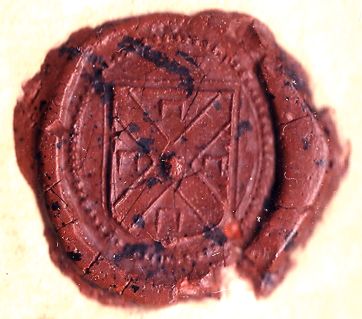
William Stoughton’s Seal

Many of the documents in our archives bear the author or signer’s personal wax seal.  William Stoughton placed his personal seal at the bottom of a deed from 1690, by which he conveyed several parcels of land in Hingham to Thomas Thaxter.  The deed was witnessed by Thomas Mawdesley, who signed his name, and Peter Hicks, who placed his mark on the deed.  Two years later, Stoughton executed an acknowledgement at the bottom of the document that the document reflected his true act and deed, likely to prepare it for recording with the Suffolk Registry of Deeds.  Stoughton’s acknowledgement was witnessed by Samuel Sewall on July 30, 1692.

WilliamStoughton-personalseal

William Stoughton’s seal

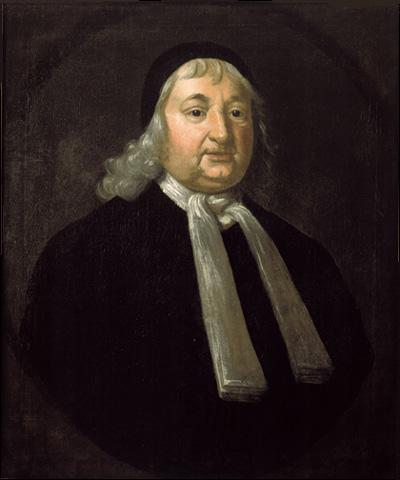
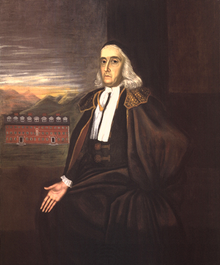
Stoughton and Sewall were two of the seven judges whom Governor Phipps appointed to the infamous Court of Oyer and Terminer.  Between June and September 1692, this Court convicted 27 men and women in and around Salem of witchcraft and executed 20 of them.  Stoughton was chief justice, and he is remembered for his defense of the Court’s reliance on spectral evidence (a witness’ testimony that the accused’s specter had appeared and tormented him or her) to prove a demonic pact.  Sewall sat as the clerk of the court, and history remembers him more charitably because, in 1697, he acknowledged his responsibility and asked public forgiveness for his role in the witch trials.

The appearance of the signatures of both of these Salem judges on the deed in our archives makes it a curiosity, as does Stoughton’s wax seal–the very same seal which Stoughton placed on the death warrants of the condemned witches..  However, the date of Sewall’s acknowledgement, July 30, 1692, is what really makes the document intriguing.  The Court of Oyer and Terminer was appointed in May 1692 and started sitting in June of that year.  The first to be tried for witchcraft was Bridget Bishop; she was convicted and hanged on June 10.   On June 29 and 30, 1692, five women—Rebecca Nurse, Sarah Good, Susannah Martin, Elizabeth Howe, and Sarah Wildes—were tried and convicted; they were hanged on July 19.   Four men and one woman—George Burroughs, Martha Carrier, John Willard, George Jacobs, Sr., and John Proctor—were convicted on August 5, 1692, and this group was hanged on August 19.  Stoughton acknowledged the conveyance of property to Thaxter and had Sewall witness it right in the midst of all this terrible activity.

Two men in public life took a few minutes to tend to their other, more mundane responsibilities during an extraordinary period in their lives and our history.  The document in our archives is not “important” and does not teach us about the Salem witch trials.  It is affecting because it forces us to think of these severe, black-clad Salem judges as individuals.

Samuel Sewall

Samuel Sewall

William Stoughton

William Stoughton