A Schoolboy Fan of the “Boston Game”


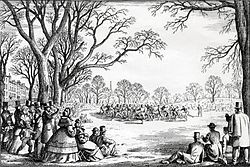
Artist's rendering of the Oneida Football Club in match play on Boston Common

Artist’s rendering of the Oneida Football Club in match play on Boston Common

Those interested in the history of American football know that the Oneida Football Club of Boston is often given significant credit for the development of the modern game. That team was formed by Gerrit S. Miller, one of a number of Boston schoolboys who played what was sometimes called the “Boston game” on Boston Common during the early 1860s. The game involved both running and kicking plays and developed a more consistent set of rules than prior versions of American football.

In 1925, a marker was erected on Boston Common to commemorate the Oneida Football Club.  It reads, “On this field the Oneida Football Club of Boston, the first organized football club in the United States, played against all comers from 1862 to 1865. The Oneida goal was never crossed.”
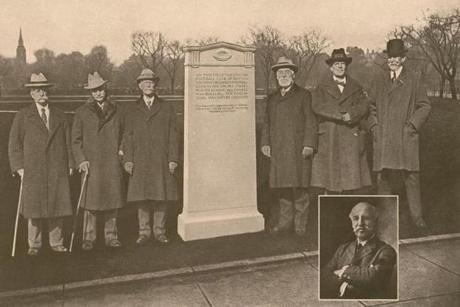
Oneida Football Club members at the dedication of the monument on Boston Common.  Lincoln's classmate, Gerrit S. Miller is immediately to the right of the monument.

Oneida Football Club members at the dedication of the monument on Boston Common. Lincoln’s classmate, Gerrit S. Miller, stands  immediately to the right of the monument. (Photo from W. Scudder, An Historical Sketch of the Oneida Football Club of Boston: 1862-1865)

Miller and other early players attended Epes Sargent Dixwell’s Latin School, a Boston preparatory school.  Francis Lincoln of Hingham was a classmate of theirs at Mr. Dixwell’s School and, if not a football player, certainly a fan. His high school diary, which is preserved in our archives, reports on football at Mr. Dixwell’s School. Here, on October 18, 1862, he reports on some intramural play:

The first class were challenged by the second for a match game of football. The first class were assisted by Thies and the second by G. S. Miller.
Two games out of three.
The second class beat. The first game was very hard and long—1 h. 6 m. with considerable lurking by Frank Peabody.

Louis Thies, like Gerritt Miller, was a member of the Oneida Football Club.   Both student coaches’ names appear on the Boston Common marker. (“Lurking,” of which Frank Peabody was guilty, was an early word for “offsides.”)

Lincoln also reports on a June 1862 football match between Mr. Dixwell’s School and the Boston Latin School. This was clearly considered an important event by more than young Lincoln, who pasted into his diary the results reported in four different newspapers:

The Boston Evening Traveller, June 6th:

MATCH GAME OF FOOTBALL.—A match game of football came off yesterday afternoon, on the Common, between the Latin and Mr. Dixwell’s school. The Latin school boys won three games in five, and were the challenged party. The best feeling prevailed on both sides. Each game was a specimen of splendid playing, and the last was prolonged to the unusual time of forty-two minutes—resulting in the victory of the Latin school.

The Boston Herald, June 6th:

FOOTBALL MATCH. A football match between seventeen boys of the Public Latin School and the same number from Mr. Dixwell’s school took place yesterday afternoon on the parade ground. The Latin school boys won three games in five and were therefore victorious.

The Boston Daily Advertiser, June 7th:

FOOTBALL MATCH.–A football match between seventeen boys of the Public Latin School and the same number from Mr. Dixwell’s school took place on Thursday afternoon on the parade ground. The Latin school boys won three games in five and were therefore victorious.

The Boston Journal, June 6th:

MATCH GAME OF FOOTBALL.–Seventeen boys of the Public Latin school, and a like number from Mr. Dixwell’s school, played on the parade ground on Thursday afternoon a match game of football, which resulted in the Latin school boys winning three games in five. Each game was a specimen of splendid playing, and the last was prolonged to the unusual time of forty-two minutes—resulting in the victory of the Latin school.

Francis Lincoln also gave an eyewitness report of this match in his diary. He can be forgiven if he has a slightly different take than the Boston newspapers on the disappointing result for his classmates in his entry for Thursday, June 5, 1862:

Seventeen fellows from our School challenged the same number of the Latin School to kick a match game of football. Our fellows beat the first game; Latin school, second; Our fellows, third; Latin School, fourth & fifth.
Some foul play on side of Latin School.
Our Religious Pamphlets Collection

Up in the archives, we have been busy indexing a collection of over 300 different religious pamphlets from the 18th and 19th centuries.  Most of these soft-cover, professionally printed booklets contain a single sermon given in a Hingham or South Shore church, although there are also religious tracts, catechisms, devotional literature, and Sunday School texts.  There is even a pamphlet of marital advice to husbands and wives.

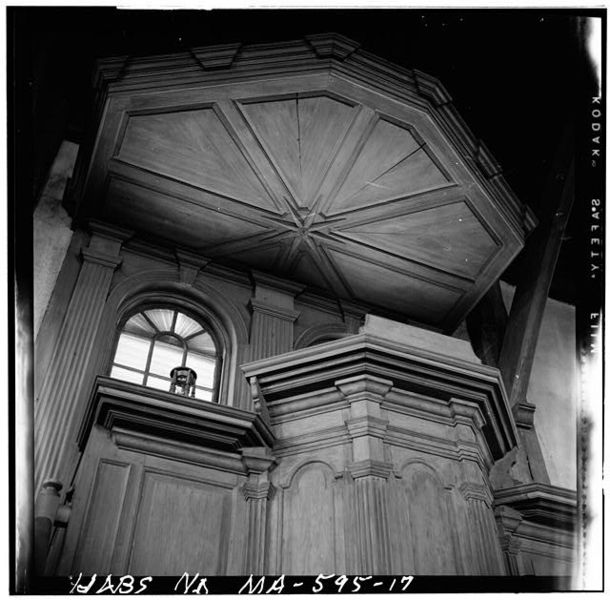
Pulpit in Old Ship Church (1941 photograph from Branzetti, Historic American Buildings Survey)

Pulpit in Old Ship Church (1941 photograph from Branzetti, Historic American Buildings Survey)

Our religious pamphlet collection provides a useful complement to the Hingham church records preserved both in our archives and at other institutions.  They tell an important story of the development of Protestant Christianity in this small corner of the country from the Great Awakening to the rise of liberal Christianity and Unitarianism to the evangelical reaction of the Second Great Awakening.  As the 19th century progressed, social issues such as abolition, temperance, and social inequality increasingly became the subject of sermons in Hingham and South Shore pulpits.

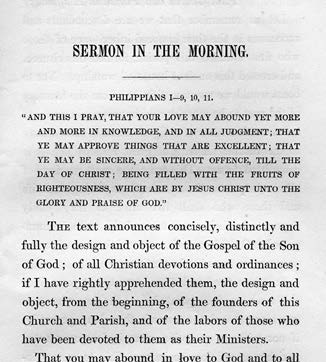
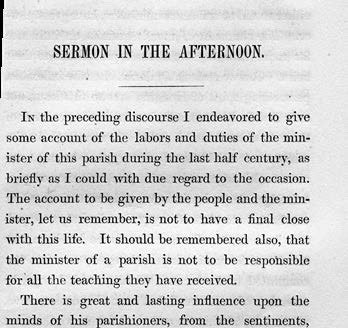
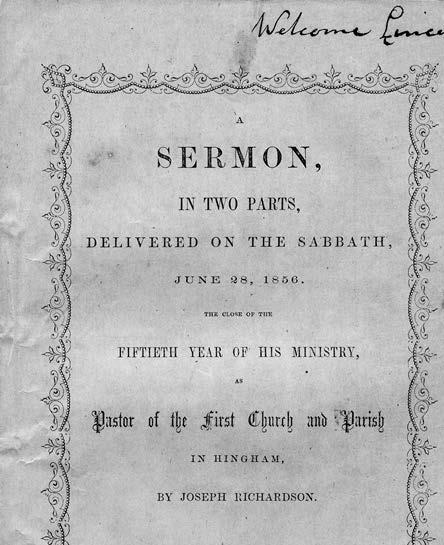
Joseph Richardson's "A Sermon in Two Parts," delivered Sunday, June 28, 1856

Joseph Richardson’s “A Sermon in Two Parts,” delivered Sunday, June 28, 1856

Preaching—whether written or delivered from the pulpit—was popular in 19th century Hingham, as the many multiple copies in our collection of certain “favorites” by local preachers Joseph Richardson (Pastor of First Parish or “Old Ship” Church from 1805to 1868) and Oliver Stearns (Pastor of Third Parish or “New North” Church from 1839 to 1856) attest.  Many of our copies of the sermons of Ebenezer Gay (Pastor of First Parish from 1718 to 1787) are reprints, demonstrating that he retained an audience for his sermons 50 years after his death.

Even in the mid-19th century, attending Sunday church services in Hingham was an all-day affair, and preaching was a central part of the services in our Protestant churches.  (The pulpit of Old Ship Church in the photo at the top of this post attests to this.) These sermons are long by contemporary standards, most of them 25-30 pages long.  A number of the sermons are in two parts:  one for the morning service and one for the afternoon. They are dense and closely-argued, raising the unhappy suspicion that our ancestors’ attention spans, or at least their listening skills, were better developed than our own.

Aldrich035

Sunday, June 28, 1858. The morning’s sermon . . .

Aldrich036

. . . and the afternoon’s sermon

Message in a Bottle

Between 1832 and 1841, forty vessels foundered on the rocks at Minot’s Ledge off Cohasset and Scituate, and in the late 1840s, a lighthouse was built on the ledge.  It was lit for the first time on January 1, 1850.

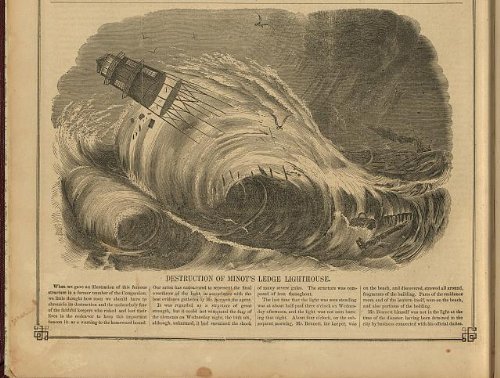
A fierce nor‘easter hit Cape Cod Bay on April 16, 1851, bringing with it the highest seas ever recorded to that time. Late that night, the newly-constructed Minot’s Ledge Lighthouse collapsed and toppled into the surf.

The lighthouse was manned that night by the lighthouse keeper’s two young assistants, Joseph Wilson and Joseph Antoine.  They kept the light burning into the night.

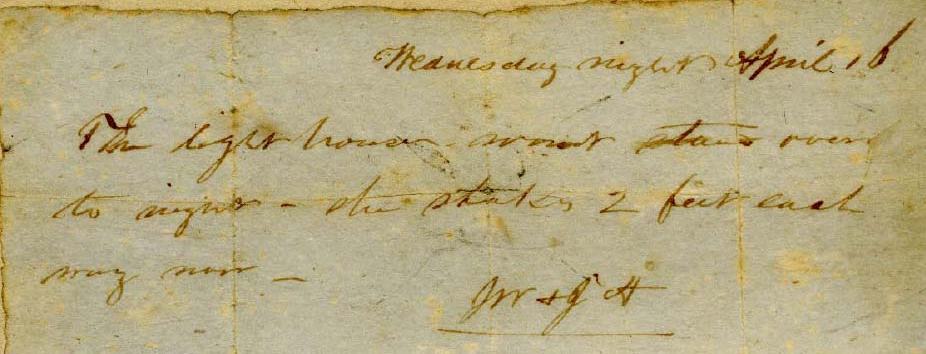
At some point in the evening, Antoine and Wilson placed a note in a bottle and dropped it into the waves below. The note was found the following day by a Gloucester fisherman.  It read:

The lighthouse won’t stand over to night. She shakes 2 feet each way now. — J.W. + J.A

Cropped Lighthouse Photo

The tide reached its height around midnight and around 1:00 a.m., the lighthouse’s bell was heard to ring repeatedly. Soon thereafter, the iron supports of the lighthouse snapped, and it toppled into the sea.

It appears as if Wilson and Antoine escaped the lighthouse structure into the water, although neither survived. Antoine’s body washed up at Nantasket; Wilson made it alive to Gull Rock in Cohasset Harbor but died of exposure before he was discovered the next day.

Lighthouse falling

The note in the bottle was given to the Hingham Historical Society in the 1920s by a local historian from Gloucester.

Visiting the Misses Barker

When she was young, Eliza Robbins of Milton enjoyed visiting the Barker sisters of Hingham. As an adult, she wrote a fond memoir of her visits to “The Misses Barker,” which she addressed to her younger sister, Sarah. Her essay, a typescript of which was placed in our archives by early society benefactress Susan Barker Willard, consists mainly of fond character sketches of the three maiden sisters who lived together on North Street in Hingham during the late 18th and early 19th centuries but also provides interesting glimpses of the Town of Hingham during that era.  According to Miss Robbins,

Deborah, Sarah and Bethiah Barker were daughters of Captain Joshua Barker of Hingham, Plymouth County, Massachusetts. Captain Barker belonged to a good family, when all the families were good—descendants of those primitive and pious colonists who first settled New England. He was a man of high honour, great benevolence and most amiable manner. . . . Mrs. Barker was the cousin of her husband and was the second of three sisters; the eldest died the widow of General Winslow and the youngest, Elizabeth, died single in the house of her nieces. The three sisters, especially the subject of this brief memo, never married.

Miss Robbins’ grandmother, Elizabeth Murray Inman, had owned a millinery business in Boston with the Barker sisters’ “Aunt Betsy” during the mid-1700s and, she explained, “between [the Murrays] and the Barkers an intimacy then commenced that was hereditary to the descendants of both the parties.”

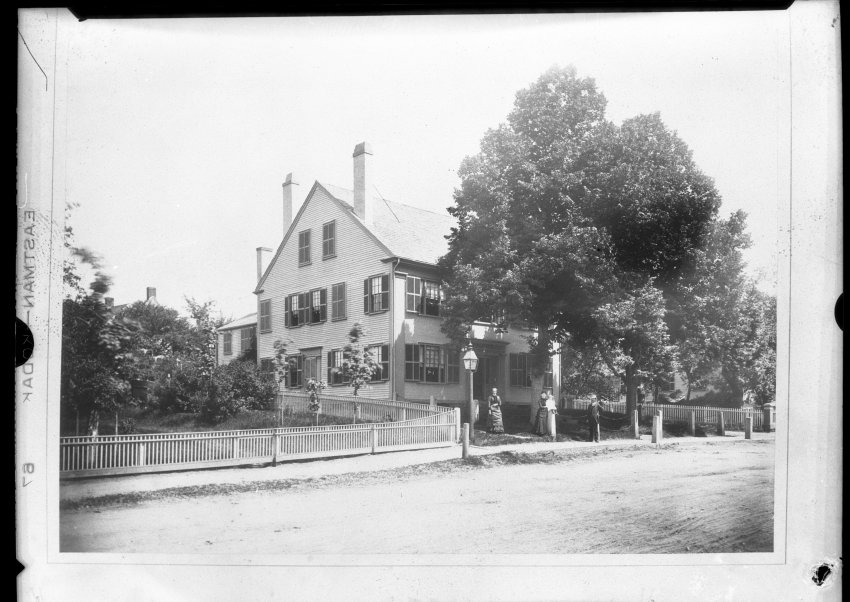
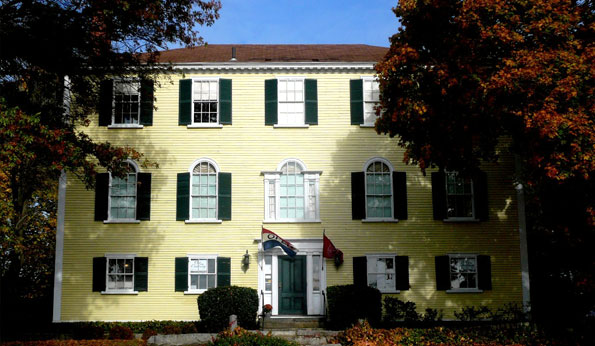
19th century photo of North Street Bank, 115 North Street, formerly the Joshua Barker home

19th century photo of North Street Bank, 115 North Street, formerly the Joshua Barker home

Remembering her visits to the Barker home, which was located on North Street in Hingham Square (next to the present-day Post Office), Miss Robbins wrote:

That parlour was a delightful south room. The fervent heat of the summer sun was broken by the thick shade of a wide spreading plane tree that stood near the house and the glossy tresses of a dangling woodbine hanging over the windows softened the light that entered it, leaving spaces sufficient to look through upon the street to which the ground before the house covered with short velvet grass descended in a gentle slope. On the further side of the street lay the vegetable garden of the neighbor, along the borders of a little brook that ran through them toward the sea, which though out of sight was not far off. Beyond the gardens lay another street—behind that stood a hill on the top of which the villagers bury their dead. On the right hand—onward to the limit of vision, along the path way ran houses, those of traffic and mechanic art—the Academy and the spire of an old Church. None of these objects were picturesque but they had a character, they represented life and death, learning and religion, industry and competency, security and contentment. . . .

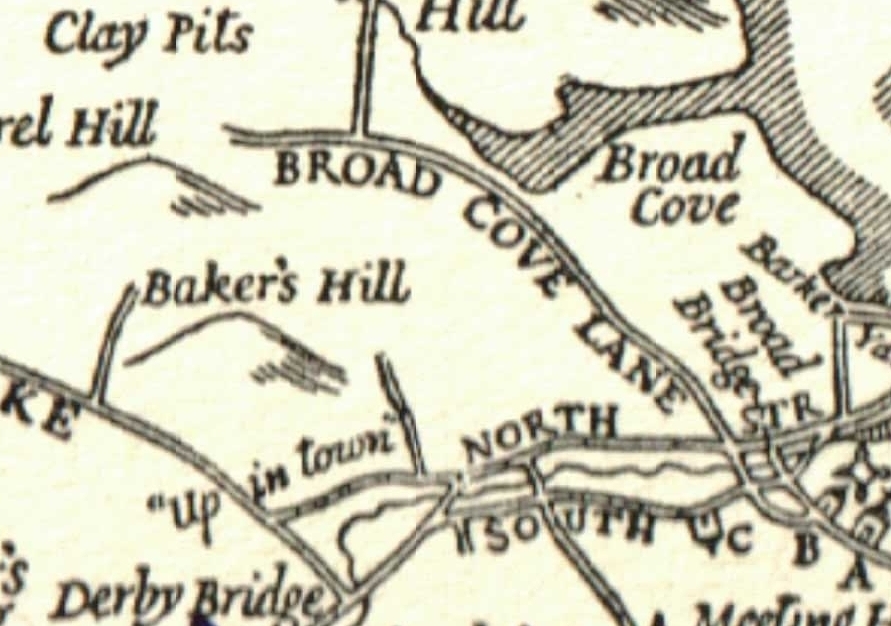
Detail from a map of historical names and places in Hingham.  ("Barker Shipyard" belonged to the sisters' uncle, Francis Barker.)

Detail from a map of historical names and places in Hingham. (“Barker Shipyard” belonged to the sisters’ uncle, Francis Barker.)

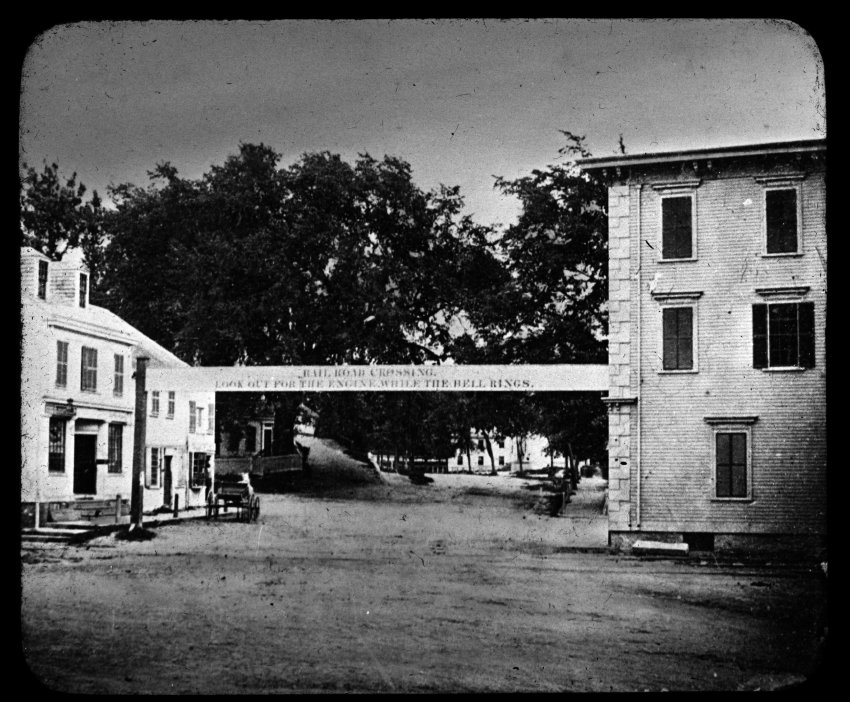
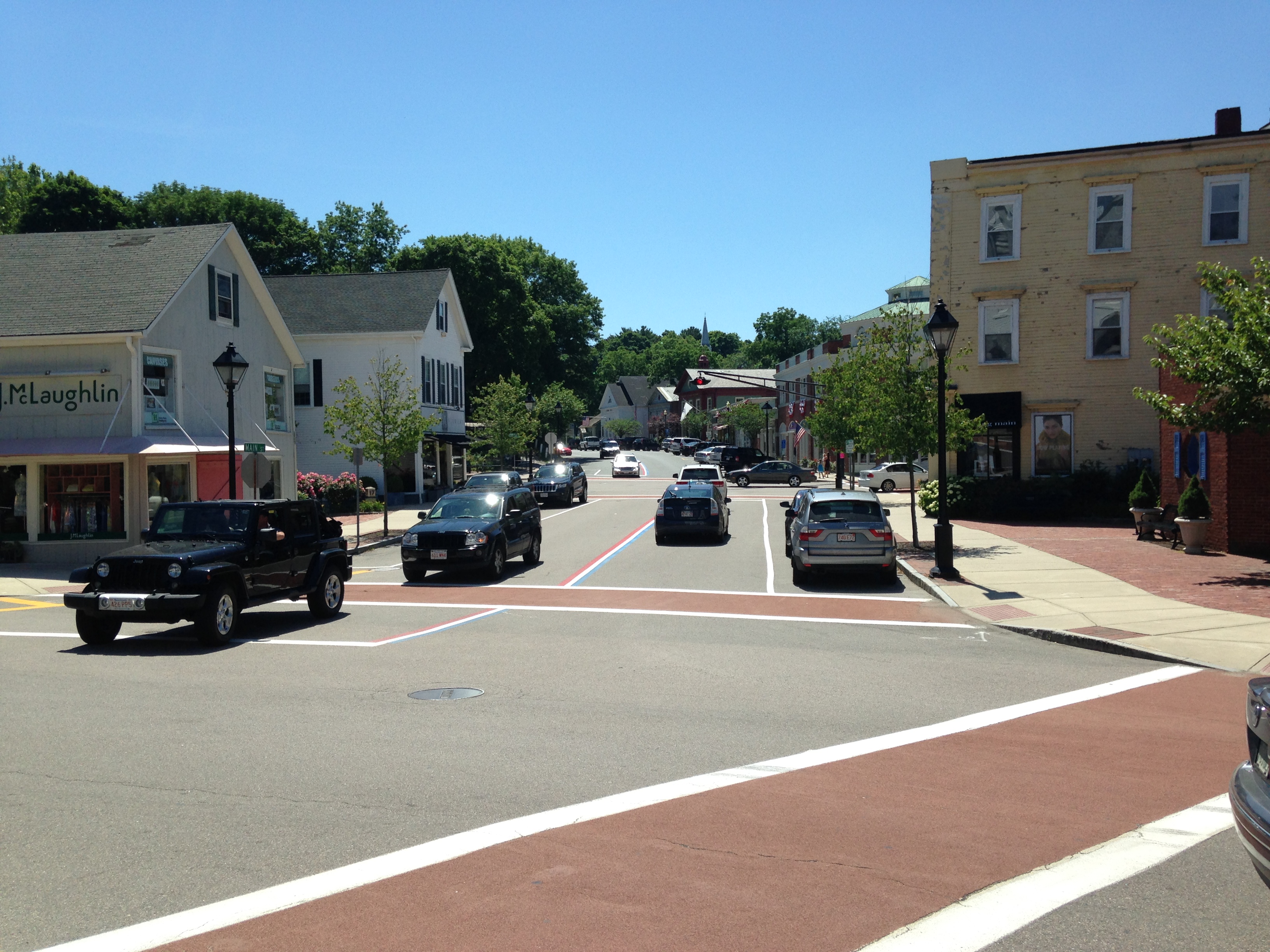
The basic layout that Miss Robbins describes is remarkably unchanged:  the house faces North Street, the bed of the former “Town Brook” (now the capped Greenbush train tunnel), and then South Street.  On the far side of South Street, Hingham Cemetery, Old Derby Academy, and Old Ship Church run south along Main Street ahead.

Hingham Square, looking south on Main Street, 1861.

Hingham Square, looking south on Main Street, 1861.


Hingham Square looking south on Main Street, today

Hingham Square looking south on Main Street, today

“Harrison Melodies” in Hingham

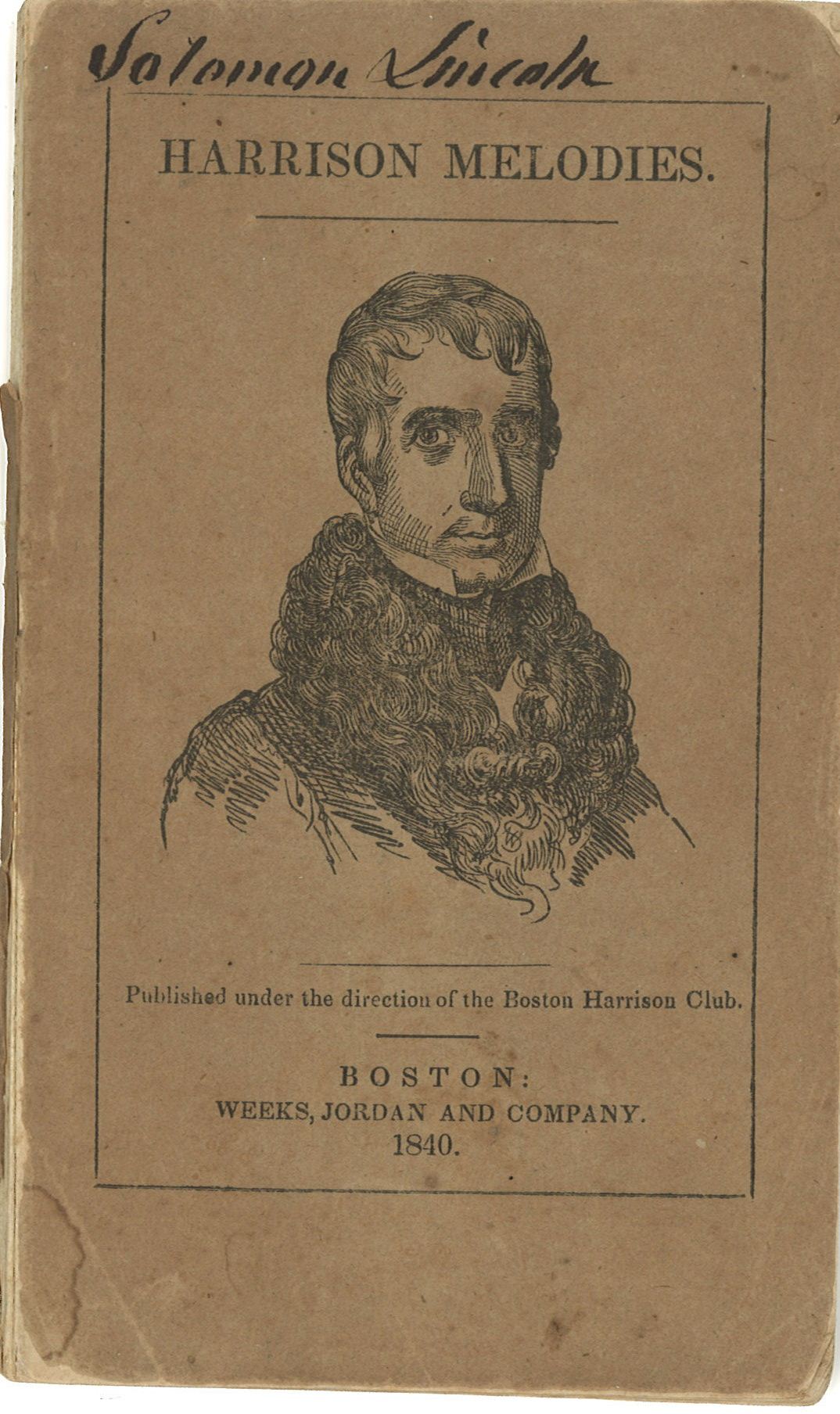
Harrison Melodies Cover

Solomon Lincoln’s copy of “Harrison Melodies.” Lincoln, a lawyer and banker, was active in Hingham politics.

We recently blogged about Jairus Lincoln’s 1843 “Anti-Slavery Melodies”—an anthology of songs to sing at abolition rallies (see The Songs of the Abolitionists). We were delighted to learn that the political singing did not end there, having recently discovered in our archives a second political songbook, only three years older, published by  local supporters of William Henry Harrison during the 1840 Presidential election campaign. This compilation of the lyrics of seventy pro-Harrison songs, the authors explained, filled a pressing need:  “The want of such a compilation has been for some time sensibly felt at . . . ‘Whig gatherings’” around Boston.

The Whig party was born out of opposition to Andrew Jackson’s Democratic party.  The ‘Age of Jackson” and “Jacksonian democracy” were built on increasingly broad white male suffrage as states eliminated poll taxes and property ownership requirements that once limited the vote to wealthier men.  Long before Abraham Lincoln, Andrew Jackson was famously born in a log cabin.  Jackson’s veto of a bill renewing the charter of the Second Bank of the United States divided Eastern mercantile interests and western farmers, debt-ridden in a tough economy.  Not surprisingly, Hingham was “Whig” country:  in their Hingham history Not All Is Lost, Russell and Lorena Hart report that Andrew Jackson won only 28 votes from Hingham during his first Presidential run and 32 votes as the incumbent four years later.

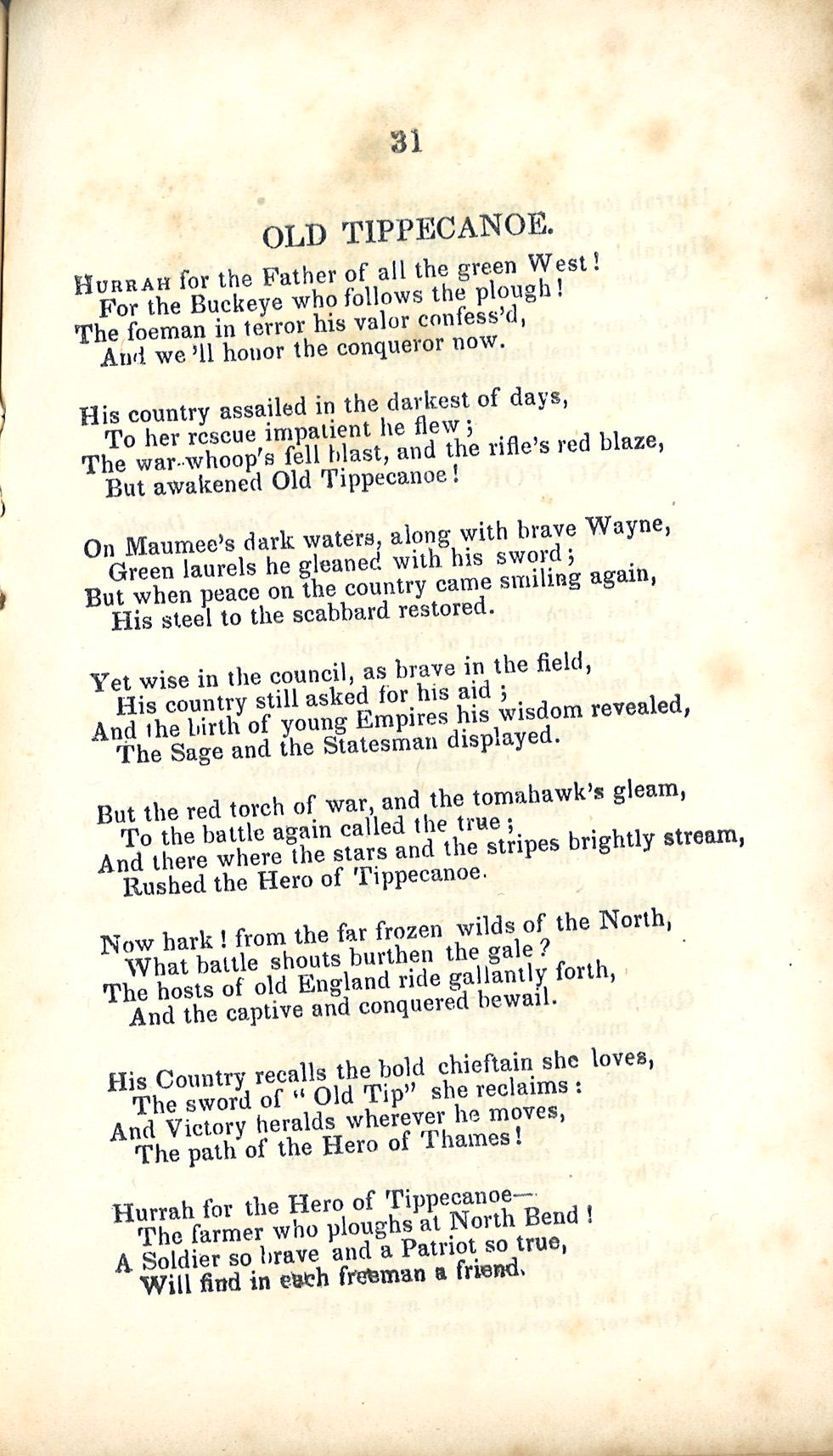
"Old Tippecanoe."  The campaign slogan "Tippecanoe and Tyler too" is still remembered.

“Old Tippecanoe.” The campaign slogan “Tippecanoe and Tyler too” is still remembered.

William Henry Harrison (1773-1841) was the Whig candidate for President in 1840. He had gained national fame defeating Native American forces at the 1811 Battle of Tippecanoe, served as the first territorial delegate to the U.S. Congress from the Northwest Territory, and was later elected congressman from the new State of Ohio. Taking a page from Andrew Jackson’s book (although he had been raised in a wealthy Virginia family), Harrison ran for President as a war hero and a man of the people. His supporters impugned his opponent, incumbent President and Democratic candidate Martin van Buren, as a New Yorker and wealthy elitist.  The Democrats in turn ridiculed Harrison as old and provincial, suggesting that he was most fit to sit in his log cabin, drinking hard cider. Harrison and as his vice-presidential candidate John Tyler seized upon these symbols, using images of log cabins and cider jugs in their campaign.

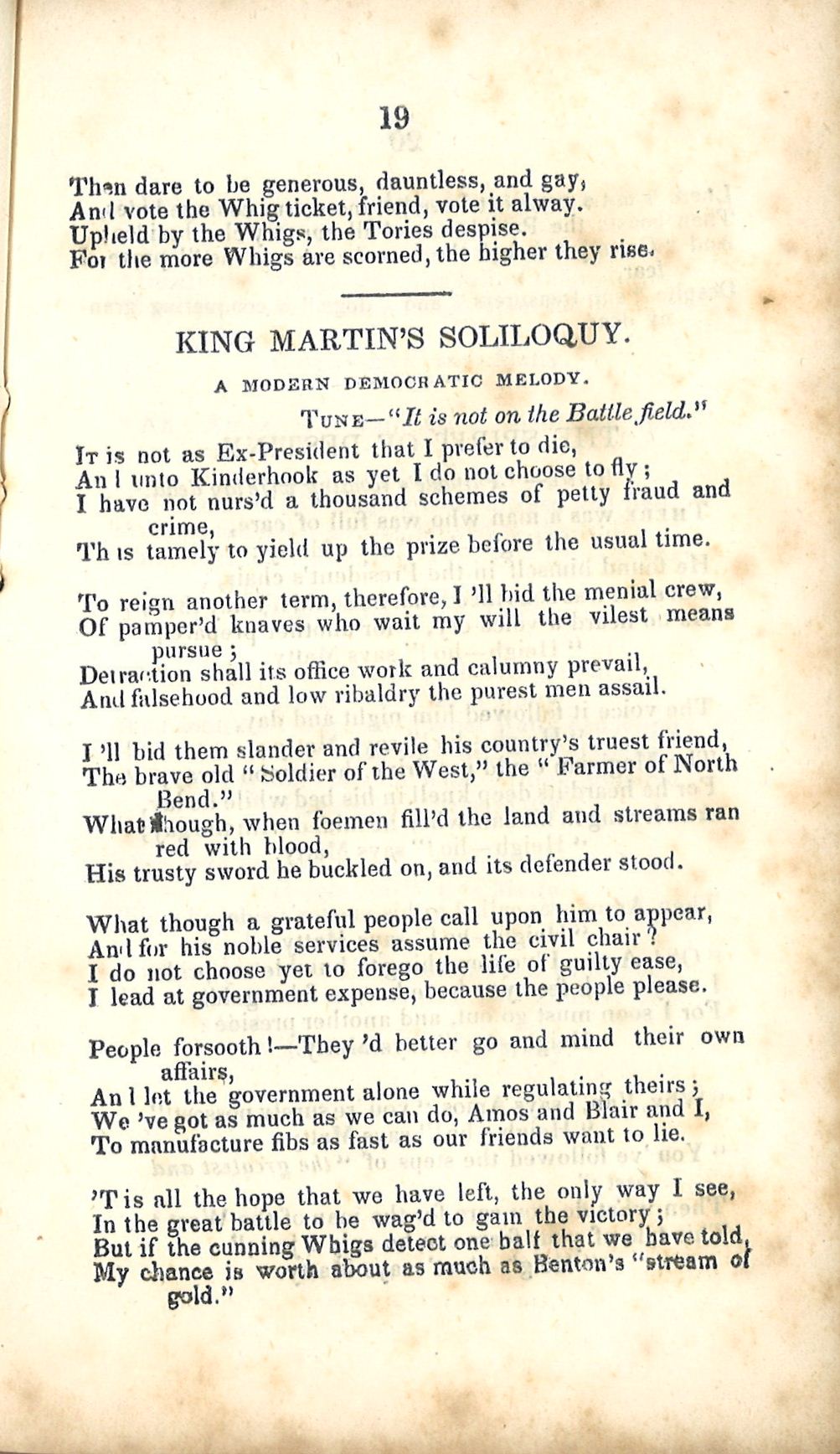
"King Martin's Soliloquy."  The Whigs chose the name of their party from that of the    18th century opponents of King George III.

“King Martin’s Soliloquy.” The Whigs chose the name of their party from that of the 18th century opponents of King George III.

The “Harrison Melodies” return repeatedly to the log cabin and hard cider theme, as well as Harrison’s Indian wars nickname, “Old Tippecanoe.”  Van Buren is referred to as “King Martin,” a reference to the Whig objection that Jacksonian Democrats wielded a dangerous amount of executive power.  (Jackson had killed the Second Bank of the United States not because he believed it unconstitutional but because he disagreed with it as a matter of policy.  This was a departure from prior Presidential vetoes.)

William Henry Harrison was elected President in 1840.  The Whigs’ joy was short-lived, however.  Harrison died after only a month in office.


One Family’s Tradition of Service, Part 2

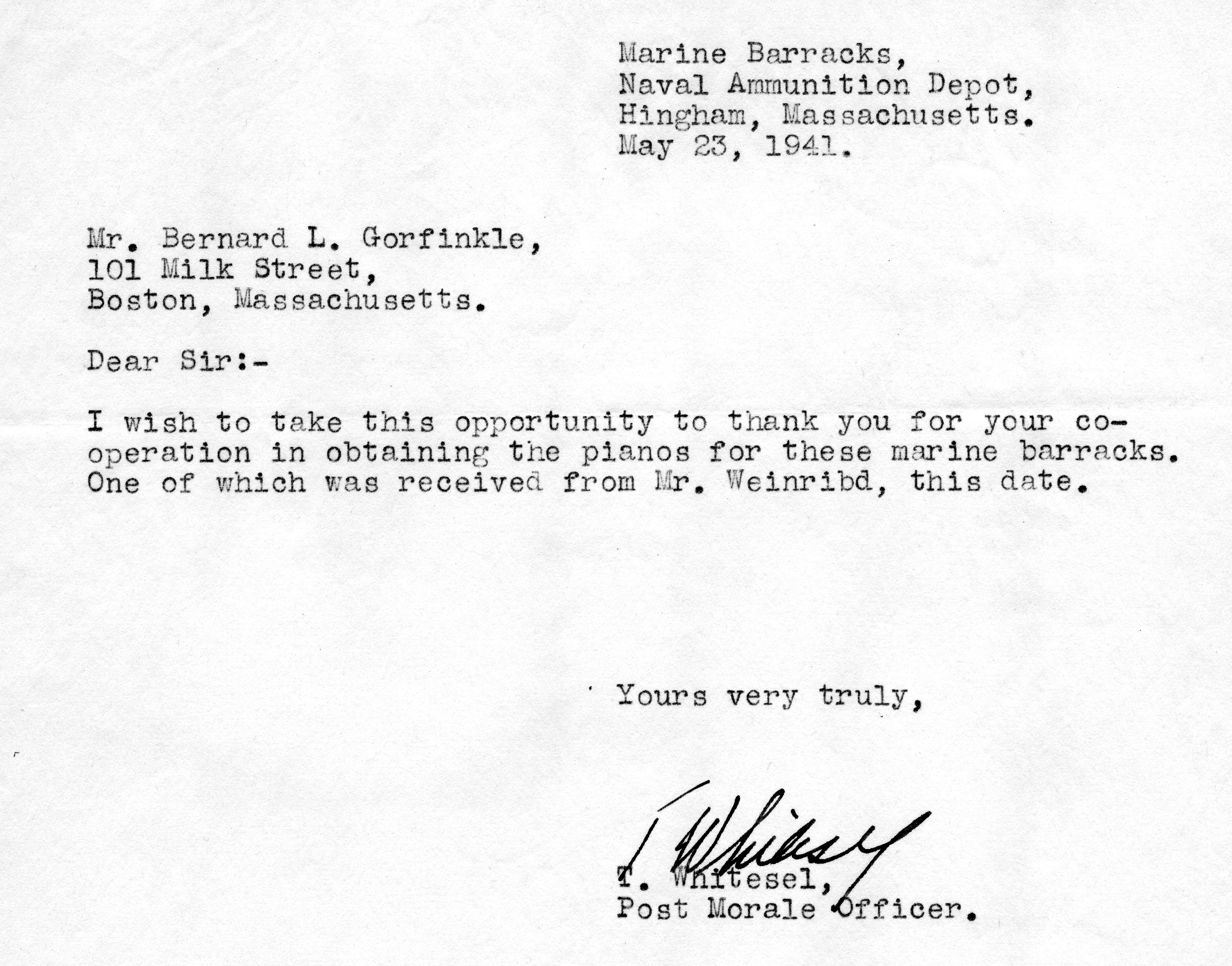
Captain Gorfinkle returned to America after his service with the Peace Delegation was complete and continued his military service as part of the reserves. Promoted to Lieutenant Colonel, he organized many philanthropic campaigns to aid military service people in the Boston area between World Wars. One charitable effort involved the donation of pianos to military bases throughout New England and beyond, including the Hingham Naval Ammunition Depot.

blghadnote

Colonel Gorfinkle continued his patriotic service in World War II, serving as a member of the War Manpower Commission, appointed by President Roosevelt to oversee the New England region. After the war, he remained active in the Reserves, serving as military attaché for Massachusetts governors Christian Herter (1953-1957) and John Volpe (1962-1965). He finally retired from Reserve service in December 1965—at the age of 71. Besides his law practice and military service, he was an active philanthropist in the Boston area, and chief among his interests were Beth Israel Hospital, the Newton Tennis & Squash Club, which he helped found, and Brandeis University.

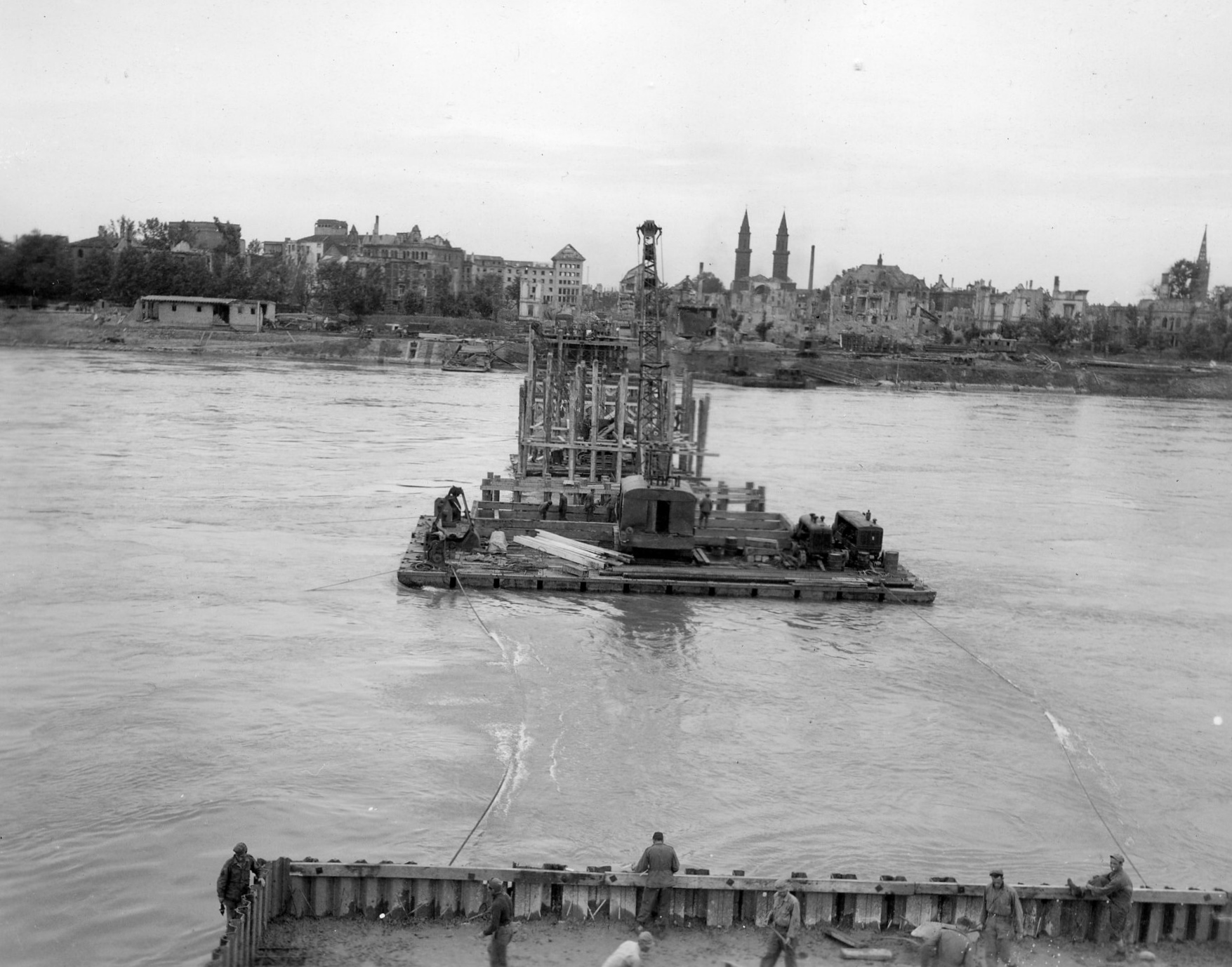
The Colonel’s son, Herbert J. Gorfinkle, continued the family tradition of military service and was also involved in this country’s efforts during World War II. He was a member of the 381st Engineers Combat Battalion, which deployed to Europe following D-Day, serving as Unit photographer. His unit stayed in Germany for a year after the war helping rebuild that country’s infrastructure. His collection contains many photos of bridges over the Rhine River which his unit was helping rebuild. It also includes letters home to friends and family.
hjgrhine1

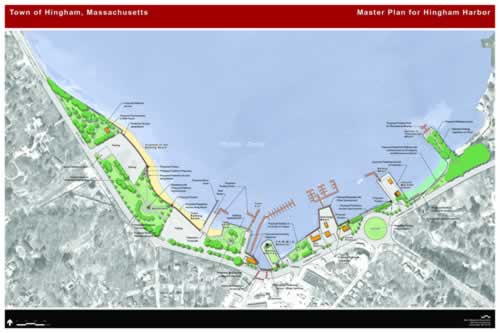
After the war, Herbert Gorfinkle completed his education at the University of New Hampshire in 1947 and then received a Master’s in Business Administration from New York University’s School of Retailing in 1948. He then started a successful career in the mercantile industry, serving as manager or founder for several successful retail chains including Jordan Marsh and the Edwards Stores of Boston. He and his wife, Connie, moved to Hingham from Braintree in 1972 and raised three daughters on Andrews Isle within the Home Meadows—near Hingham Harbor, which he helped champion as member (1983-1990) and Chairman (1988-1990) of the Harbor Development Committee. Herbert Gorfinkle was also a member of the Veterans of Foreign Wars Coast Guard Auxiliary and Commodore of the Metropolitan Yacht Club.
Hingham_Harbor_Proposed_500

One Family’s Tradition of Military Service

John Richardson of Hingham made the preservation of Hingham’s history his life’s work, amassing a large collection of Hingham-related books, furniture, artifacts, documents, and “ephemera.” He once wrote that he had “over 75,000 documents, diaries, journals, letters, surveys, maps, tax lists, photographs, etc.” in his collection, and the Hingham Historical Society was lucky enough to receive part of this treasure trove upon his death in 2011.  Three years later, we continue to work at cataloguing his substantial donations to our archives.

While most of the Richardson material chronicles the history of Hingham and lives of its citizens, some takes you into the lives of individuals outside of town and to places outside the country. One of these people was Colonel Bernard L. Gorfinkle (1889-1974) of Boston, whose father‘s family immigrated to the North End of Boston in the late 1800’s, when that neighborhood had a substantial Jewish population. Among the Richardson materials on which we are working are six three-ring binders and one box comprising the papers of Colonel Gorfinkle, as well as some of his son, Herbert J. Gorfinkle (1923-2000). The latter provided the Hingham connection, moving to town in 1972 and later giving these family papers to John Richardson.

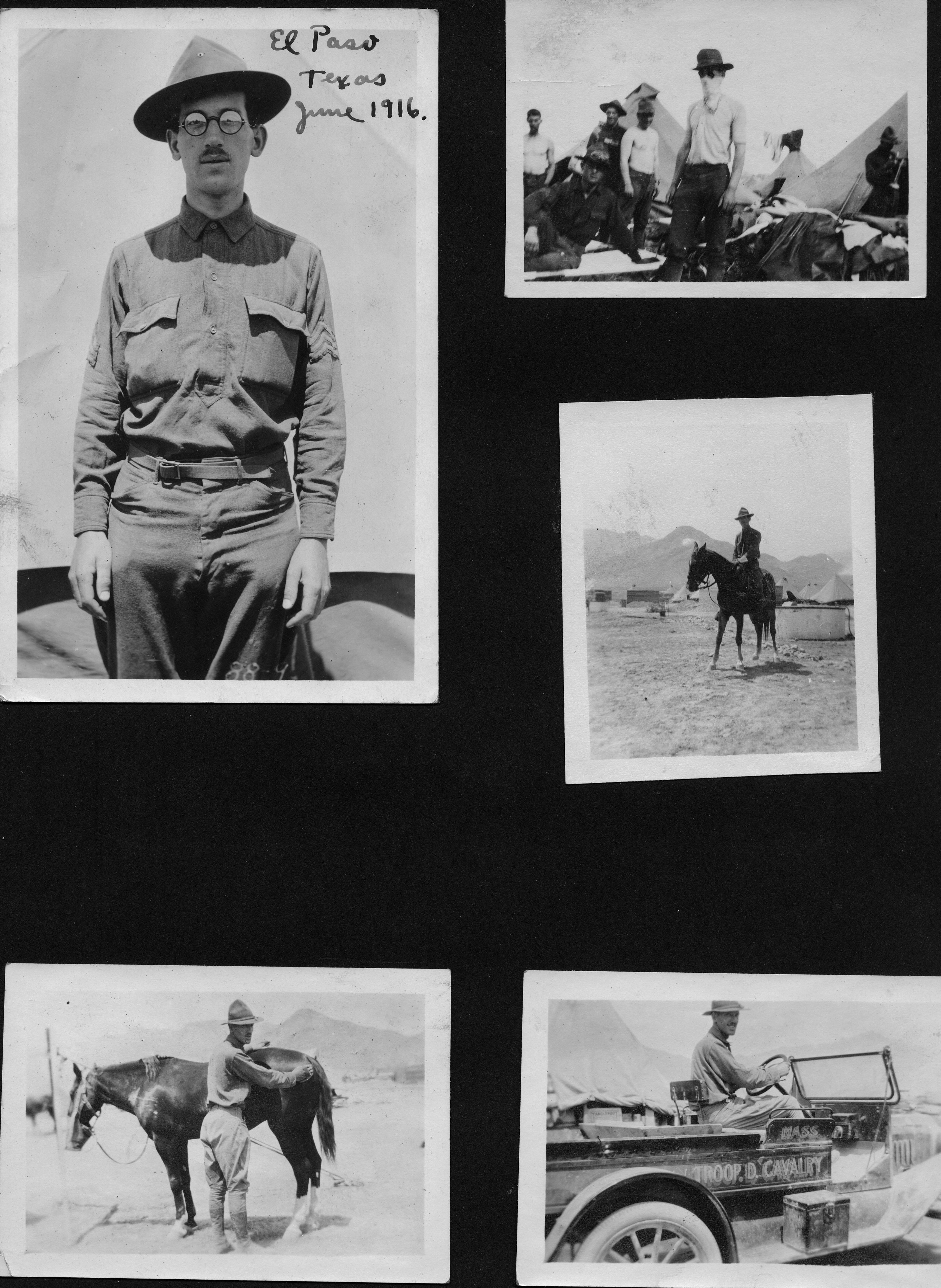
A page from Bernard Gorfinkle's scrapbook of photographs taken during his participation in the 1916 pursuit of Pancho Villa

Scrapbook photos taken during the 1916 expedition after Pancho Villa

Colonel Gorfinkle was a lawyer. He graduated from Boston University Law School in 1911 but soon found himself heavily involved with this country’s military history. First, his Massachusetts Cavalry unit was called up to help Gen. John Pershing hunt down Pancho Villa along the Mexico border in 1916. His papers include his letters home, photographs, and postcards from his train trips to and from Texas and provide an interesting glimpse of our country prior to World War I.

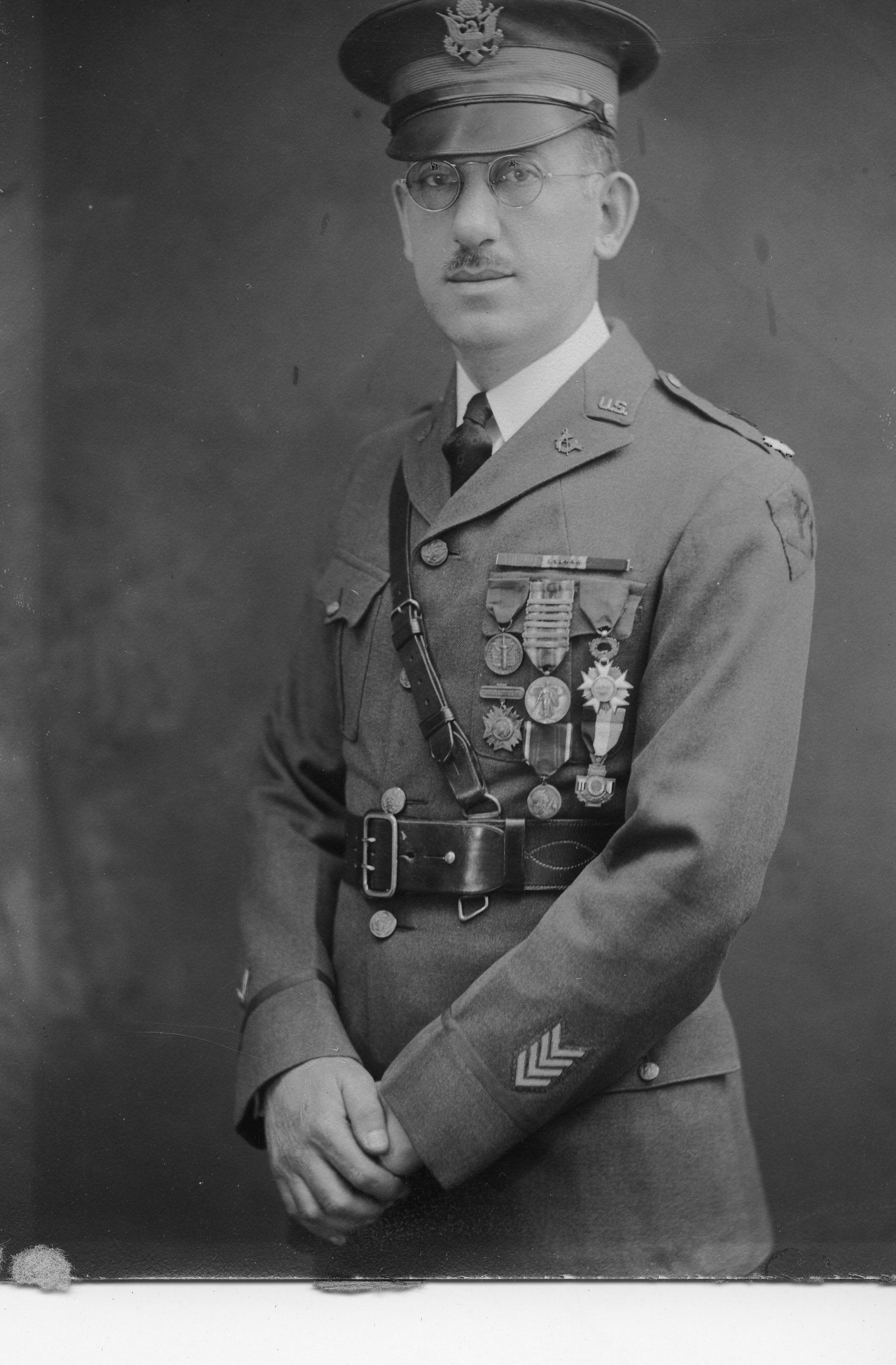
Captain Gorfinkle won a Purple Heart as part of the American Expeditionary Forces in France, 1917-1918

A decorated member of the American Expeditionary Forces in France, 1917-1918

Colonel Gorfinkle’s military adventures continued when he was again called up in 1917 to serve with the American Expeditionary Force in France after the United States entered World War I. Serving first as a lieutenant staff-member and then as Judge Advocate for the 106th Division, he was eventually promoted to Captain. He made many trips to the front, which he documented in letters and photos sent home, to participate in proceedings against both prisoners of war and American soldiers. His many letters, photos and postcards to family members recount both the exciting and the mundane aspects of life during war time. He spent the last months of the war in 1918 near the front in Verdun where he was wounded. For his service he received a Purple Heart, the American Service Award, plus five other military honors including those bestowed by France and Belgium.

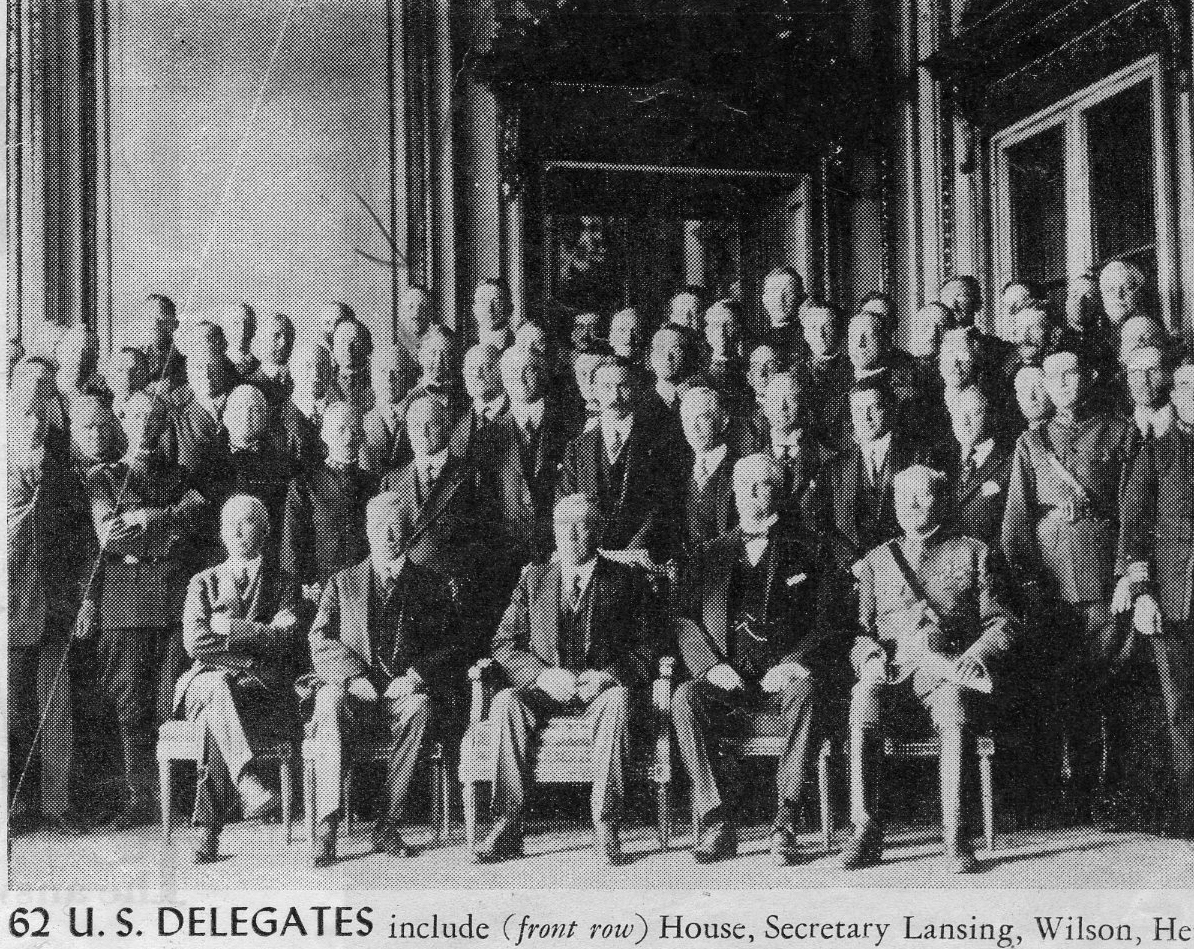
Captain Gorfnkle posing with the American Peace Delegation in Paris after World War I

Posing with the United States Peace Delegation in Paris

After the war, Captain Gorfinkle remained in France as part of the American Peace Commission delegation led by President Woodrow Wilson. He can be seen in the back row, under the arrow, of this photo of the United States delegation.

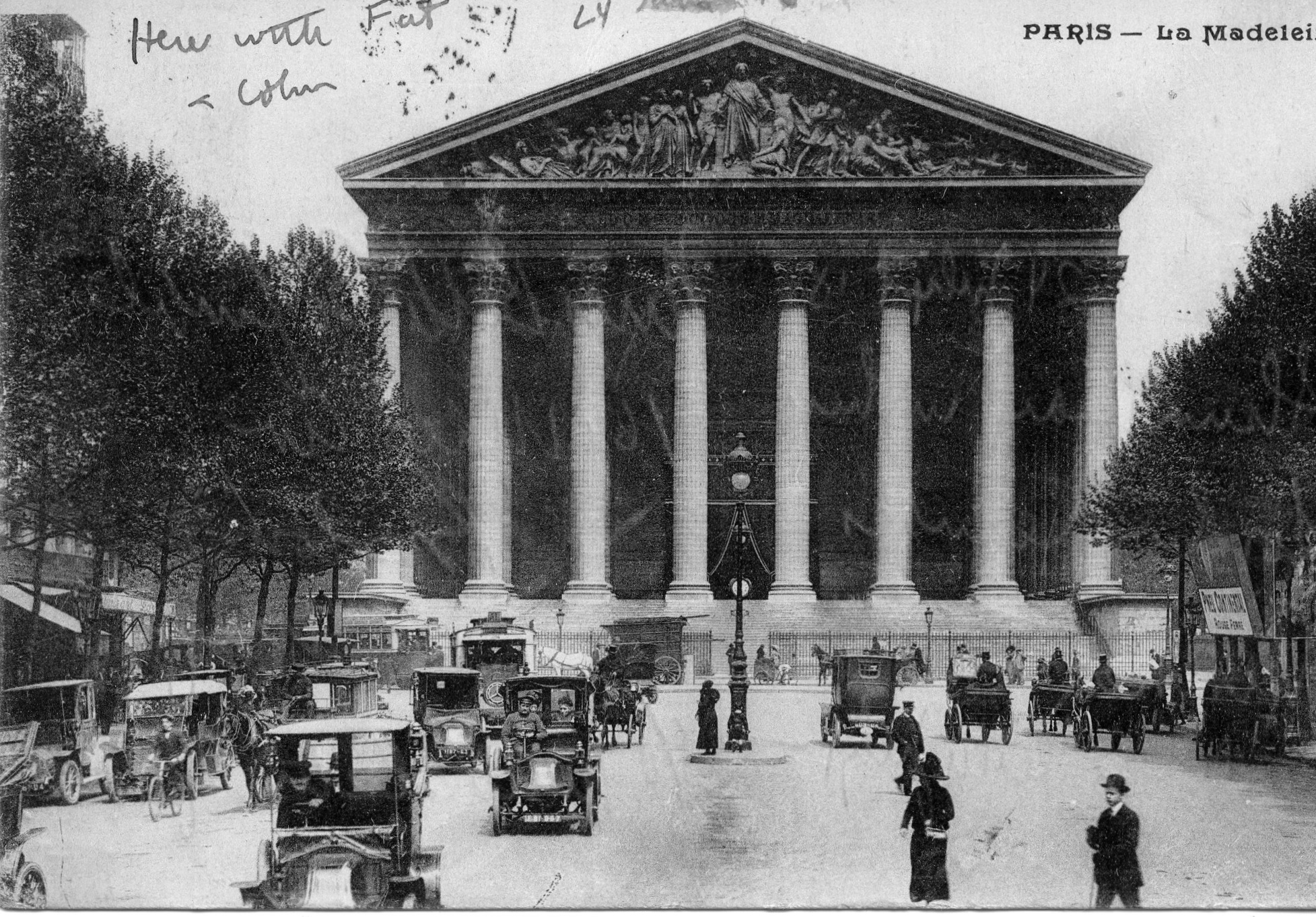
Postcard of La Madeleine, Paris, sent home by Bernard Gorfinkle

A postcard home from La Madeleine, Paris

The portion of the collection from Colonel Gorfinkle’s time spent in Paris contains copies of transcripts of the meetings at the conference regarding the final settlement with Germany. On a lighter side, he also saved many postcards of the French capital and the surrounding cities he visited.

[Captain Gorfinkle’s experiences–and those of his son–as memorialized in this collection will be continued in our next post.]


Happy 300th Birthday, Madame Sarah Langlee Hersey Derby

Today is the 300th anniversary of Madame Sarah Derby’s birth and a good time to post about a woman whose name looms large in Hingham history—and legend.

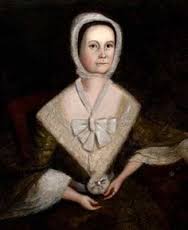
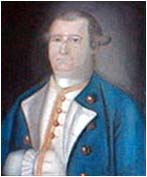
Portrait of Sarah Derby

Portrait of Sarah Derby

Born Sarah Langlee, daughter of a Hingham tavern keeper, she married well—twice. Her first husband was Dr. Ezekiel Hersey, a prominent and affluent Hingham physician. After his death, she married Richard Derby, a wealthy ship captain and merchant from Salem. (Richard Derby built Salem’s Derby Wharf in the 1750s.) She outlived Captain Derby as well and returned to Hingham to live on the large farm she inherited from Dr. Hersey.

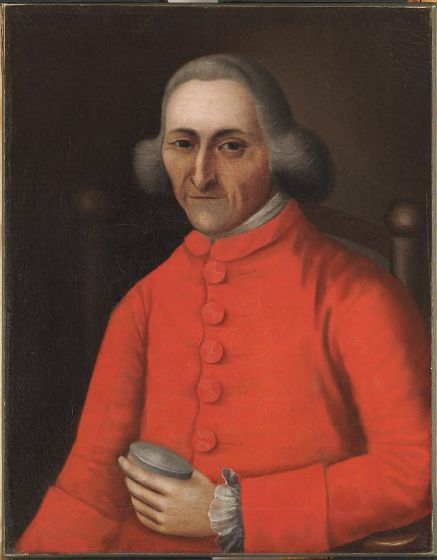
Dr. Ezekiel Hersey of Hingham

Dr. Ezekiel Hersey of Hingham

Local legend created from this a “rags to riches” story (in their Hingham history Not All Has Changed, Francis and Lorena Hart dub Sarah Derby “Hingham’s legendary Cinderella”):  a beautiful young girl growing up poor on the islands of Hingham Harbor, whose names—Ragged, Sarah, and Langlee—described her as a young girl.  Edward Rowe Snow, in his History of the Harbor Islands, put to rest the idea that the islands were named after “ragged Sarah Langlee,” however; these islands bore those names on nautical charts as early as 1700–well before Sarah Langlee was born.

Captain Richard Derby of Salem

Captain Richard Derby of Salem

But her portrait (made in later years) suggests youthful beauty, as do perhaps the two good marriages.  When he died in 1770, Ezekiel Hersey left his substantial estate to his wife on the condition that she give £1000 to Harvard College.  Sarah Derby added to this her own bequest in the same amount, and together their gifts endowed the Hersey Professorships of the Theory and Practice of Physic and of Anatomy and Surgery at Harvard, laying the foundation for the establishment of Harvard Medical School.

She remarried, to Captain Richard Derby, in 1771.  It is also a common misconception that this second marriage is what made her a wealthy woman.  In fact, she waived her dower rights when she married Captain Derby, who left his fortune to his family and bequeathed to Sarah Derby only an annual income (and two slaves, also commonly glossed over in legend).

When she returned to Hingham in 1783, Madame Derby was persuaded to endow a new school for Hingham. The school would be co-educational (one of the first co-educational schools in the country) for the instruction of boys “in the Latin, Greek, English, and French languages, and the sciences of Mathematics and Geography” and girls “in writing, and in the English and French languages, arithmetic, andthe art of needlework in general.” As discussed in a prior post (“A Trip to the Principal’s Office—in 1799”), a single preceptor had the charge of both sexes, although a “sensible, discreet woman” taught the girls their needlework.

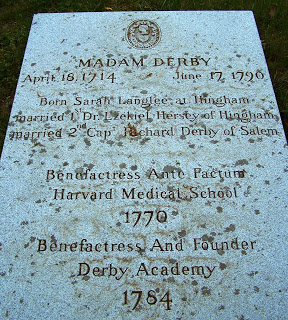
Sarah Derby's Gravestone, Hingham Cemetery

Sarah Derby’s Gravestone, Hingham Cemetery

Madam Derby died in 1784 and is buried in Hingham Cemetery, not far from the site of her school. She provided further funding for the school in her will and instructed that her clock and her portrait (the one appearing at the top of this post) be placed in the school building. The original school building was replaced, in 1818, by a Federal-style structure—Old Derby Academy, current home of our Hingham Historical Society.

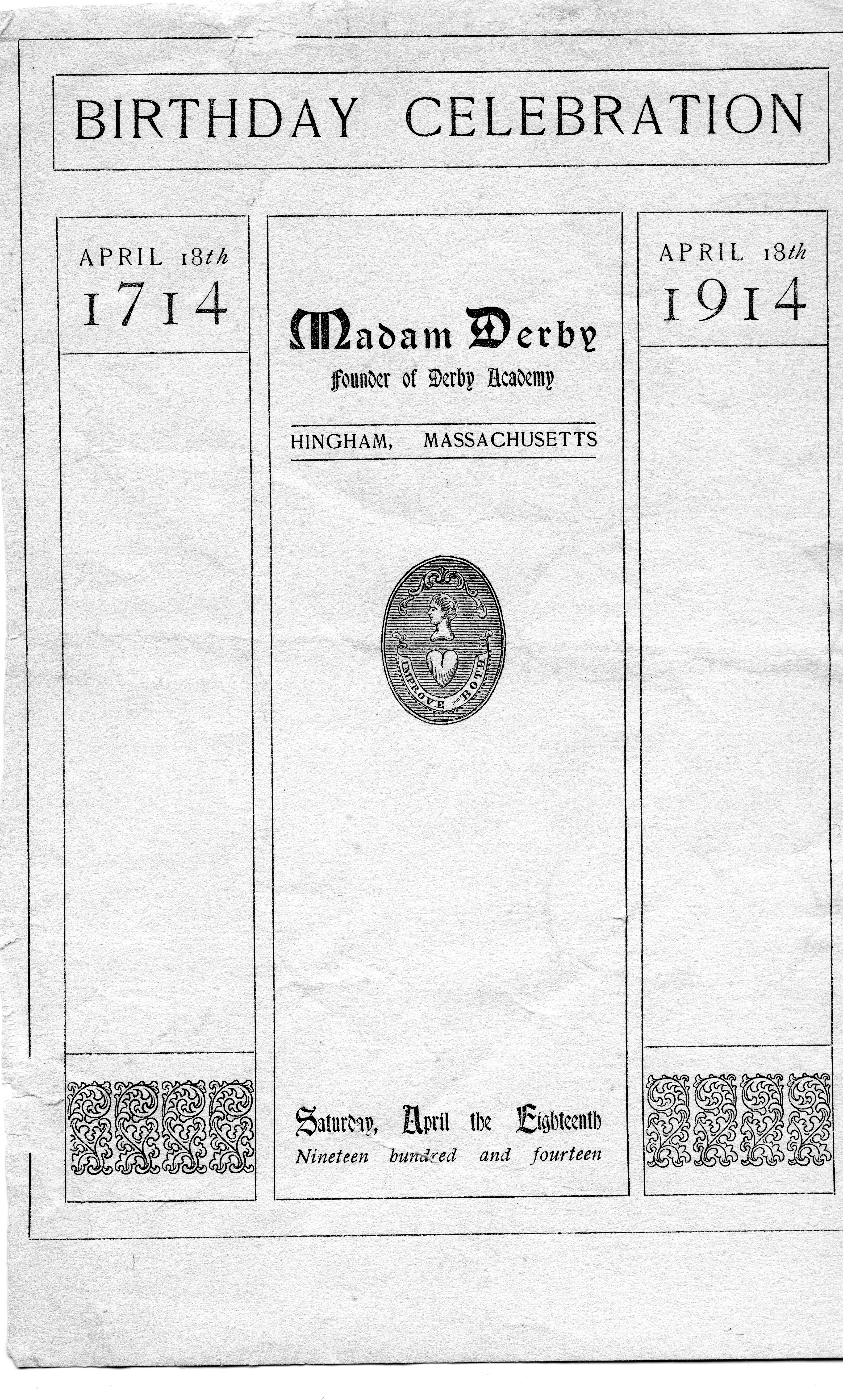
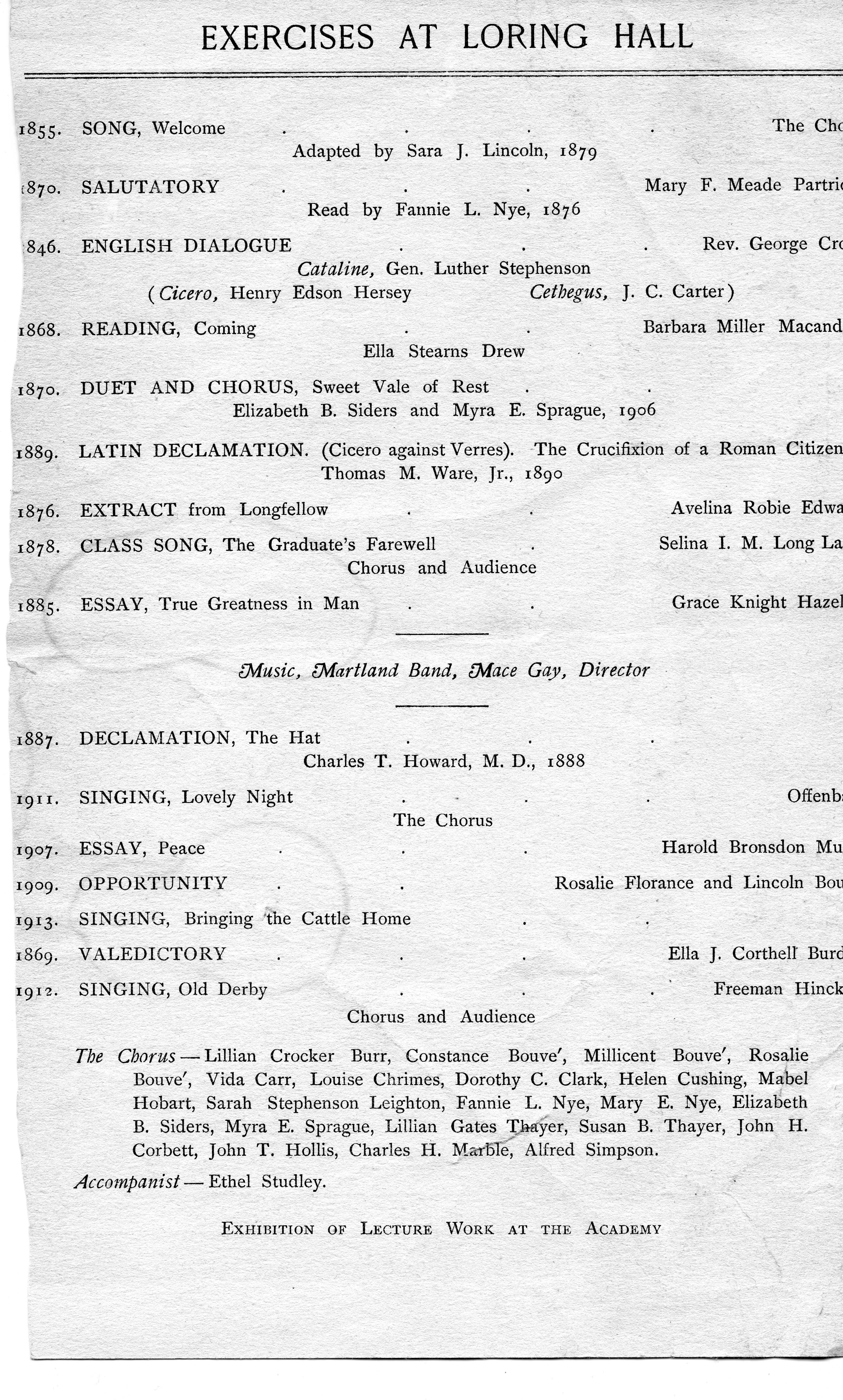
MLD013One hundred years ago today, on April 18, 1914, the Town of Hingham joined Derby Academy in celebrating Madame Derby’s bicentennial. A “Birthday Celebration” was held in her honor at Loring Hall. The program for the evening’s entertainment, preserved in our archives, included a local chorus, the Martland Band, from Brockton, English and Latin declamations by alumni, and poetry, essays, and other literary and musical offerings.

Happy Birthday, Madame Derby!


MLD014

The Songs of the Abolitionists

Jairus Lincoln of Hingham published his song book “Anti-Slavery Melodies: For the Friends of Freedom” for the Hingham Anti-Slavery Society in 1843.  Music was an important part of abolitionist meetings and rallies. In the foreword to his anthology, Lincoln noted the success that the temperance movement had enjoyed incorporating music into its message and urged the anti-slavery movement to follow the example: “[t]here are many who have not the gift of speech-making, but who can, by song-singing, make strong appeals, in behalf of the slave, to every community and every heart.”

Lincoln included the words and music to 57 anti-slavery songs, some original, some “standards” in the movement, and some taken from a previous anthology, “The Anti-Slavery Pick-nick.”  Many of the melodies are based on hymns that would have been very familiar to the audience, with lyrics based on anti-slavery poetry by John Pierpont, Elizabeth Margaret Chandler, John Greenleaf Whittier, and Henry Wadsworth Longfellow, among others. (To our 21st century sensibilities, the absence of any music influenced by the rich music–spirituals and field tunes–of the enslaved peoples themselves is striking.)

A few songs stand out.  Lincoln included a sharp parody of a familiar patriotic hymn:

My country! ’tis of thee,
Stronghold of slavery,
Of thee I sing:
Land where my fathers died,
Where men man’s rights deride,
From every mountainside,
Thy deeds shall ring.

My native country! thee,
Where all men are born free,
If white their skin:
I love thy hills and dales,
Thy mounts and pleasant vales,
But hate thy negro sales,
As foulest sin. . . .

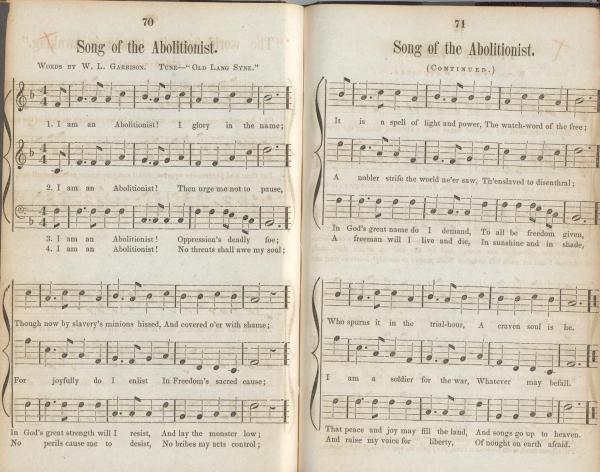
One well-known anti-slavery anthem, “The Song of the Abolitionist,” was written by William Lloyd Garrison, to be sung to the tune of “Auld Lang Syne”:

I am an Abolitionist! I glory in the name;
Though now by slavery’s minions hissed, And covered o’er with shame;
It is a spell of light and power, The watch-word of the free;
Who spurns it in the trial-hour, A craven soul is he.

I am an Abolitionist! Then urge me not to pause,
For joyfully do I enlist In Freedom’s sacred cause;
A nobler strife the world ne’er saw, Th’ enslaved to disenthral;
I am a soldier for the war, Whatever may befall. . . .

Words and music to "Song of the Abolitionist," from Lincoln's Anti-Slavery Songbook

Words and music to “Song of the Abolitionist,” from Lincoln’s Anti-Slavery Songbook

In From Abolition to Rights for All: The Making of a Reform Community in the Nineteenth Century, Professor John Cumbler writes that “[t]he social world of abolitionism also had its lighter side.”  The two examples with which he supports his assertion are close to home:  an 1844 meeting in Hingham, where New England abolitionists enjoyed a boat trip from Boston, the seaside, and the country air, and a “fishing party” to Cohasset during those same years. Perhaps after enjoying sunshine and a good meal, the abolitionists pulled out their copies of Lincoln’s “Anti-Slavery Melodies”–perhaps even the copy that is now in our archives.

A few years ago, a choral ensemble from Arizona State University recorded a number of the songs from Lincoln’s “Anti-Slavery Melodies.” Click here and scoll down the page to listen.


A Trip to the Principal’s Office — in 1799

Old Derby Academy, soon to become the Hingham Heritage Museum and Visitors Center.  It was built to house Derby Academy in 1818.

Old Derby Academy, soon to become the Hingham Heritage Museum and Visitors Center. It was built to house Derby Academy in 1818.

Derby Academy in Hingham, founded in 1784, is one of the oldest co-educational schools in the country. Its founder, Madam Sarah Derby, stipulated that the boys were to be educated in “the Latin, Greek, English, and French languages, and in the sciences of Mathematics and Geography”; the girls in “writing and in the English and French languages, arithmetic, and the art of needlework in general.” She directed that a “preceptor” be hired to teach these subjects to male and female students alike—with the exception of needlework, for which a “sensible, discreet woman” should be retained.  At Mrs. Derby’s request, the first Preceptor of Derby Academy was Abner Lincoln of Hingham. One of the many documents concerning Derby Academy found in our archives is his April 16, 1799 report to the Trustees of Derby Academy. Mr. Lincoln started his report with the academic progress of the school’s pupils:

The attention & improvement of the Lads, during the last term, have been pretty much as usual, no material difference. Some have been very industrious & some have been slack.  The young ladies have been more attentive than usual when they could attend with propriety. But a want of health & the peculiar badness of the passing, have caused many absences. I have not been able to pay them that attention which I expected.

The “principal’s office” in the 18th century does not appear to have been so different from the principal’s office today: by far the largest part of Lincoln’s report to the trustees involved disciplinary reports. “[T]he Lads” broke “a number of windows in a fit of snowballing” and were required to mend the windows. It was discovered that two boys had been stealing from local shops. Lincoln was ready to expel them l when he learned that

[t]heir mother was dead, their father absent at sea & they left under the care of their grandfather, Mr. Stephen Hall of Boston. He repeatedly urged me in a very earnest & feeling manner to receive them again. I finally consented on condition that the Lads would come & make a public confession of the enormity & heinousness of their crime, ask forgiveness of the scholars for the very bad example exhibited in their conduct & pray them to receive them again into their friendship. This was done & their request granted in a very affecting manner. . . .

The misbehavior of one of the girls at the school was particularly noteworthy:

Complaint was made by the Preceptress that Sally Wilder’s conduct in the Academy was very exceptionable & improper. After stating the charges, I observed that I could not with propriety make any inquiry respecting them, but begged that she would, which she accordingly did. It appeared by ample evidence that her conduct at times was such as will hardly bear explaining, that she had paid no regard to truth, that no Language, neither obscene nor profane was too gross for her frequently to use; some of the Misses absented themselves on her account; many were late because they did not wish to be entertained by her. The general character was despicable & there appeared no probability of reformation. It was our united opinion that she ought not to remain in the Academy . . . .

Co-education fell into the category of novel experiments when Abner Lincoln found himself confronted with Sally Wilder’s misbehavior, and his discomfort is evident. We are left wondering whether there were appeals for clemency, explanations in mitigation, or a decision by the trustees that she should remain in school after all. One suspects not.