While doing research for the Hingham Historical Society’s 2023-24 lecture series, Suburbia: The American Dream, I learned of the important contribution of late 19th/early 20th century electrical engineer and inventor Frank Julian Sprague to the electric streetcar—an engine critical to early suburban development in the U.S. The name Sprague caught my attention.
In his landmark book, Crabgrass Frontier: The Suburbanization of the United States, Kenneth Jackson pointed to the importance of the contributions of Franklin Julian Sprague:
By the turn of the century, half the streetcar systems in the United States were equipped by Sprague, and 90 percent were using his patents.

The Brothers Ralph and William Sprague (Hingham Historical Society archives)
Could this engineer and inventor, born in Connecticut and for most of his life a New Yorker, be part of the same family that produced the 19th century botanical illustrator Isaac Sprague and other notable Sprague family members here in Hingham? I needed to know more.
What my research revealed was a fascinating multi-generational story of an innovative, creative family. I was struck by the significant contributions made to both the arts and sciences by the descendants of the two-family lines–those of Ralph and William Sprague–that began with brothers who were among the original settlers of Charlestown in the Massachusetts Bay Colony. The impressive examples of creativity and innovation in these two Sprague lines got me thinking about the influences of both nature and nurture, as well as the close relationship between the creative arts and scientific inquiry and invention. Perhaps the story of this family will get you pondering too.
The Story Begins Along the Wey River in England
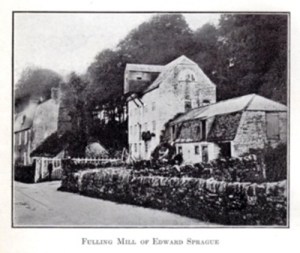 Brothers Ralph (1599-1650), Richard (1605-1668) and William Sprague (1609-1675), were sons of Edward Sprague (1576-1614), who operated a fulling mill on the river Wey, in Upwey, located between Dorchester and Weymouth, in the county of Dorset, England. (Edward’s mill, shown here, no longer exists.) After their father’s death, the three brothers joined a party of colonists emigrating for the Mass Bay Company to settle what became Charlestown, Massachusetts. It is unclear if religion was part of the Sprague brothers’ motivation to leave England. They arrived in Salem in 1628, then soon traveled on to Charlestown.
Fulling mills (“fulling” is part of the cleansing and thickening process when making cloth from sheep’s wool) were also common in the New England colonies, and there were three fulling mills in Hingham in 17th and 18th centuries: one on Crooked Meadow River in South Hingham, at what became known as Fulling Mill Pond; one off South Pleasant Street (near present-day Fulling Mill Road); and one at what was known as Beechwoods River or Mill River, flowing northeast from Accord Pond. As detailed in the 1893 History of the Town of Hingham, Massachusetts, these mills were operated by the Jacob and Cushing families, closely aligned through marriage.
Ralph Sprague emigrated, at 25, with his wife, Joanne Warren, and 4-year-old son John. He had trained as a fuller with his father in England, but apparently took up farming here. He also became a Selectman of Charlestown in 1637 and was elected Representative that same year, serving in both positions for several years. (Source: The History of Charlestown.) Just before Ralph died in 1650, he joined with others to petition successfully with for their own lands on the Mystic River side of Charlestown, later to be known as Malden. Ralph and his wife had several children. For generations, Ralph’s descendants lived in and around Charlestown and Malden.

The Spragues of Malden, Massachusetts (Hingham Historical Society archives)
In the early 20th century, two books, both focused on documenting the genealogy, were written about Ralph Sprague’s family line:
- The Ralph Sprague Genealogy, written by descendant Edward George Sprague and published in 1913, covered 10 generations who had lived by that time.
- The Spragues of Malden, written by the then-Secretary of the Malden Historical Society, George Walter Chamberlain, M.S., in 1928. A copy of this book, originally “printed for private circulation only” is in the collection of the Hingham Historical Society.
Richard Sprague, 23 at the time they left England, married in Charlestown in 1632. Richard became a merchant and owned a considerable amount of farmland and salt marsh and had shares in a couple of ships. He was a founding member of the church in Charlestown and a Selectman, Overseer of Highways, and Captain of the Military (local militia then.) Richard and his wife Mary Sharp had no children.
William Sprague, just 19 when he emigrated, married in 1635, while still in Charlestown, and moved to Hingham with his wife Millicent Eames 1636. There they joined others from England who were just one year into founding a town here. William and Millicent would have 11 children, 8 of whom would survive into adulthood. Some descendants stayed in Hingham for generations.

Genealogy of the Spragues in Hingham (Hingham Historical Society archives)
The book Sprague Families in America, written by descendant Warren Vincent Sprague, M.D., and published in 1913, includes a section on the genealogy of William Sprague and his descendants up to that time. The author credits The Ralph Sprague Genealogy, published the same year, for providing valuable family data; he apparently had not seen the earlier Genealogy of Spragues in Hingham, published in 1828 by Hingham’s Hosea Sprague (1779-1843), about whom you’ll learn more in the next part of this blog.
The connection between colonists in Charlestown and the early settlers of Hingham was established at the time of the town’s founding. In the 1827 History of the Town of Hingham, Plymouth County, Massachusetts, author Solomon Lincoln, after listing inhabitants who started to arrive in Hingham as early as 1633, noted:
. . . The others settled at Charlestown, and in 1635 removed to this place. . . . It was in June of that year that Rev. Peter Hobart arrived at Charlestown, and soon after settled in this place.
. . . In 1636, [there arrived] John Beal, senior, Anthony Eames, Thomas Hammond, Joseph Hull, Richard Jones, Nicholas Lobdin, Richard Langer, John Leavitt, Thomas Lincoln, Jr., miller, Thomas Lincoln, cooper, Adam Mott, Thomas Minard, John Parker, George Russell, William Sprague, George Strange, Thomas Underwood, Samuel Ward, Ralph Woodward, John Winchester, William Walker.
Division of Land Plots to Early Settlers (Hingham Public Library History Collection)
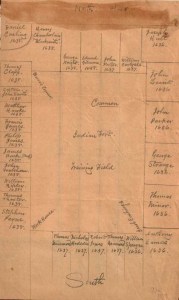
The Anthony Eames in this latter group was the father of William Sprague’s wife Millicent, and they would soon be granted adjacent parcels of land for their homes—as shown in the lower right corner of this 19th century plot chart created by local historian George Lincoln in his “Sketch of the Division of Land Plots to the Early Settlers of Hingham.”
From Ralph Sprague, of Charlestown and Malden, and William Sprague, of Charlestown and Hingham, descended a remarkably talented collection of 18th, 19th and 20th scientists/inventors/industrial innovators and artists/poets/craftsmen. The family lines have distinctions—with Ralph’s line most prominent as scientists and inventors while Wiliam’s descendants stand out as artists and poets and craftsmen.
Part 2 of this blog will focus on William’s line—and its noteworthy creators: poets, a maker of woodcut engravings, a botanical illustrator, several woodenware craftsmen and more.

 Out of the Archives
Great Article. William was my 8th GGF through Anthony. Recently proved lineage for General Society of Mayflower Descendant’s membership.
Is there a way to get a PDF of all 3 parts for my Genealogy file?
Hello, as the author of this blog series, I’m happy to figure out how to create a PDF of the 3-part series, but I don’t have an email address for “tesprague.” Can you send a note to my email (ecmcintyre71@gmail.com) so I can get you what you need? – Eileen