A Hurricane in Hingham

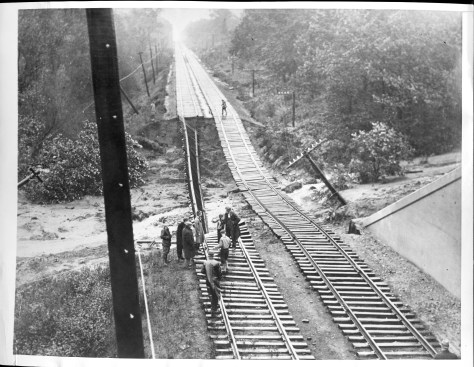
2016322-large-2On September 18, 1933, under the headline, “Railroad Tracks Washed Out During Storm Last Sunday,” the Hingham Journal reported:

Fully 500 feet of the New Haven tracks running from Hingham to Cohasset under the bridge of the Cohasset-Hingham new road were washed out and all trains held up during the height of the heavy gale and rain storm on last Sunday afternoon.

The break in the track was discovered by Daniel Magner, who told his grandfather, Thomas Magner, who in turn notified the railroad officials.  The last train over the line before it gave way was at 11:02 A.M.  The 2:52 P.M. from Boston carried just one passenger, who was transferred at the washout in an automobile. A downpour of water carried away enough roadbed to undermine about 50 feet of track.  Part of the track hung suspended in the air and part gave way. A full wrecking crew was called into action at once and work was continued all Sunday night. . . .  The force of the water took telegraph poles along with it, temporarily causing telephone disruption.  This was speedy repaired so that little inconvenience was caused.

The scene was viewed by thousands, police being on duty at the bridge to keep traffic moving.
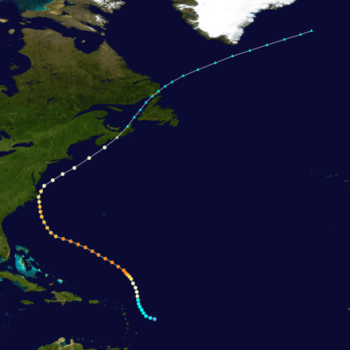
440px-1933_Atlantic_hurricane_13_trackThe storm that took out the railroad embankment is not as locally famous as the Hurricane of 1938 or 1954’s Hurricane Carol, both of which devastated the Northeast.  Later named the “1933 Outer Banks Hurricane,” it travelled from the Caribbean up the East Coast and into Canada between September 8-18, 1933.  It was the 13th storm of the Atlantic hurricane of the season that year.  The 1933 Atlantic hurricane season was one of the most active recorded, with the highest aggregate combined accumulated cyclone energy score (a measure used by NOAA to express cyclone activity through an approximation of wind energy) from 1851 (when hurricane activity was first recorded) to date.
Steppin’ Out

[The photos and text are from a 2011 exhibit put together by Mary Fitzmaurice and Suzanne Buchanan to showcase shoes, boots, and other footwear in our costume collection.]

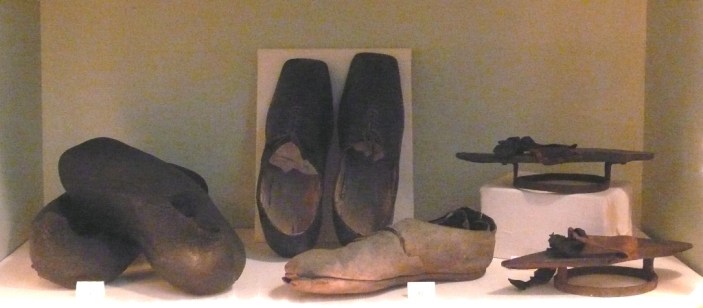
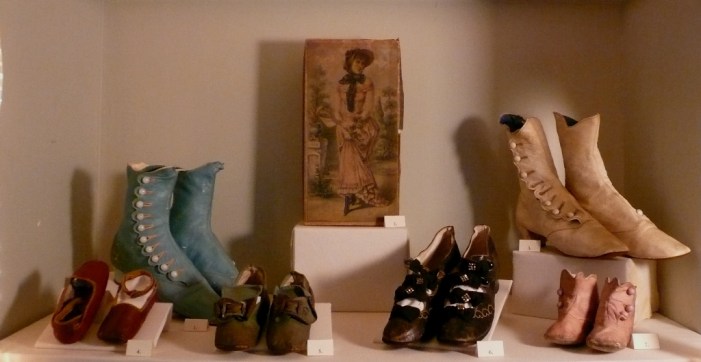
After farming, shoemaking was the most common occupation listed in the 1893 Hingham Genealogy.  Like aprons and stockings, the shoes that people wore every day rarely survived. They simply wore out. That explains why most of the shoes on display here are in pretty good condition. They probably were worn only on special occasions or by people who could afford more than one or two pairs of shoes.

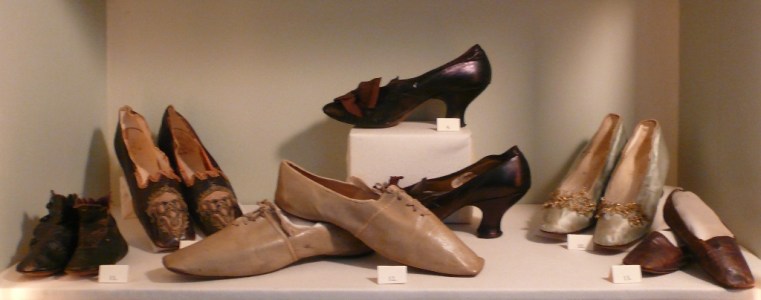
The well-worn working man’s shoe in the center of the bottom picture is the one exception to that rule. It is one of thousands of shoes that were hidden in chimneys and walls by New England families when they built new homes in the 1700s and 1800s. The origins of this tradition are murky, but shoes dating back to the 15th century have been found in the walls of houses in England, so we know that it came over with the Colonists. Some scholars think it was a way to bless the house or bring good luck. If you live in a historic house, you may have an old shoe in your wall, too.

First group 

  1. Light blue kid high-button boots, ca.1890, with a 1” Louis heel, ten milk-glass buttons, and scalloped button hole edges. COS-SH8
  2. Shoe box from T.E. Moseley & Co. of Boston, printed by August Gast & Co. of NY in 1887.  Gift of Mrs. Alfred Cushing.COS-SH23.
  3. Ivory kid high-button boots, ca. 1890.
  4. Red child’s shoe with ankle strap. Metal buttons center front. Made by Foster and Peabody of Boston, 1850-70.
  5. Green leather child’s shoe with metal buckles, 1890s
  6. Black leather girl’s shoe with 3 straps and bows, 1890-1910
  7. Child’s pink scalloped high-button shoes, c. 1900-20.  COS-SH33.  Gift of Wisconsin Historical Museum.

 Second Group

  1. Ladies’ black kid shoes with cut-out details and pink silk lining and gold chain stitching.  Made in Paris, Viault-Este, and sold in London by Thierry & Sons. c. 1850-1875.  Gift of Clara L. Barnes.  COS-SH26.
  2. Ladies’ bronze kid leather evening shoes with brown tie bows and vamp heel and a pink satin insert on each toe.  c. 1920-25.  Made in Paris by Viault-Este.  Gift of Mrs. J. Andrews. COS-SH29
  3. Ladies’ pale green satin slippers with gold and clear glass bead decoration over short, round vamps.  Ivory kid and cotton innersoles and lining.  Stamped on right innersole: Thayer McNeil  & Hodgkins, 41 Temple Place, Boston.  1890-1910.  Gift of Mrs. George F Bennett.  COS-SH21.
  4. Child’s black high-buttoned shoes with red leather lining, c. 1900-20.  COS-SH32
  5. Beige ladies’ leather tie shoes with silk ribbon ties, bound in silk grosgrain. c. 1810-1860.  COS-SH25.
  6. Child’s flat brown leather slippers with square toes and vamps.  From I.E. Moseley & Co.corner of Summer and Hawley Streets, Boston.  Late 19th century. COS-SH17.

Shoes Third group 

  1. Pair of men’s “gutta percha” shoes, an early type of rubber galoshes, c. 1840-50.  Gift of the Prudden Family.  COS-SH40.
  2. Men’s black leather shoes with square toes and brown shoe laces. c. 1810-1850.  Gift of Robert Hurley.  COS-SH31.
  3. Women’s wooden clog, or patten, with velvet strap and pointed toe.  “Willard” written on bottom.  c. 1700-1780.  COS-SH46.  Susan Barker Willard Bequest.
  4. Brown leather man’s shoe, c. 1750, well worn, found behind the chimney at 25 Ship St., which was built in 1753 by Jonathan Churchill.

Pattens-1

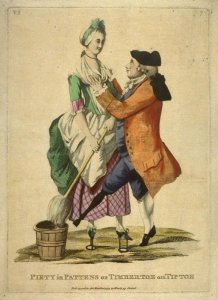
The pattens on the right side in the last picture deserve brief additional mention.  In days when streets were unpaved and a woman’s dress fell all the way to the ground, these wood or metal platforms lifted her feet and clothing above the muck.

Schooner Lizzie C. Lane

Schooner Lizzie C. Lane

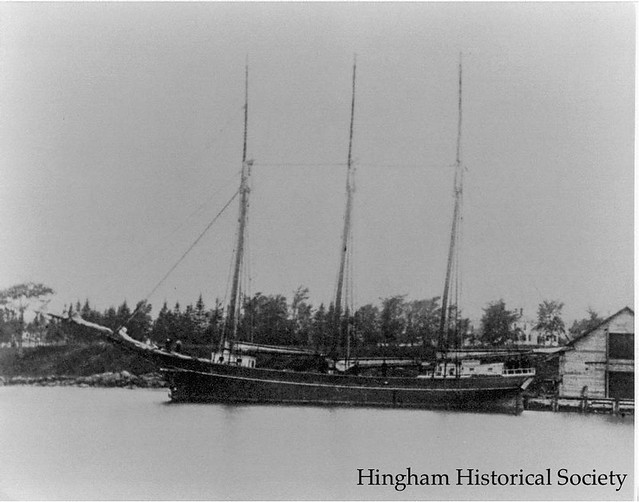
Howard Leavitt Horton (1904-1983) extensively annotated the back of this photograph of a three-masted schooner tied up at Hingham Harbor over one hundred years ago, melding an image, a business transaction, and a cherished childhood memory.

Schooner Lizzie C. Lane . . . Built at Searsport, Maine 1874. Burned at West Dublin Bay, Nova Scotia, June 3, 1921. 231 gross tons.  115.8’ x 29.8  x 9.2.  Crew of 5.

Called at Hingham – Geo Kimball Lumber Co. about 1914 or 15 as arranged by James Wiley Gilroy, lumber merchant and nephew of my grandmother Annie Eaton Horton of Elm Street (Mrs. Geo. W. Horton), my grandfather’s second wife, who was like a mother to me after my mother’s death in 1911.  I sat in Geo. Kimball’s office at the Harbor while Mr. Kimball and Mr. Gilroy made the business deal for a load of lumber shipped from Lunenberg, N.S.  I saw the schooner come into Hingham a couple of months later and dock at Kimball’s Wharf and went aboard. Mr. Hough, uncle of Karl Hough, was an employee of Kimball Lumber Co. at this time.

[Signed] Howard Leavitt Horton, Sr.

P.S. This was before World War I or before U.S.A. was involved.  I was in Lincoln School, 6th grade, so it was around 1914.