Christmas in Hingham, 1857

Christmas 1857.  Francis Henry Lincoln of Hingham was an 11-year old student at Derby Academy.  When school resumed in January, he wrote a composition, entitled “Christmas,” which is preserved in our archives.  Lincoln recounts how he and his older brothers Solomon and Arthur spent their “very merry Christmas.”

Christmas is the day on which the birth of Christ is celebrated.  It is a holiday.  In many parts of the world, the week in which the anniversary occurs, is devoted to amusements.  I had a very pleasant Christmas this year.  I will give you some account of it.  In the morning I awoke as usual and found in my stocking a very handsome present.  In the forenoon I went to Loring Hall to see the committee of arrangements prepare the tables for the party in the evening.  The First Parish usually have a special social gathering on that evening.  At noon I witnessed the firing at a target by two gentlemen in our neighborhood.

After enjoying a Christmas dinner Solomon Arthur & I went into the field in the rear of our house and fired at a target with Solomon’s gun.  I then read a while at home. In the evening I attended the Parish party at Loring Hall. There was dancing until eight o’clock, when there was an intermission; during that time the scholars connected with the Sunday School were collected in the saloon and marched into the Hall. Arthur acted as Marshall.

I had been appointed to present to my cousin Henry E. Hersey, the superintendent of the school, a writing desk in behalf of the scholars.  Mr. Hersey, being introduced, I made a short speech and presented the desk to him.  He made a short speech in reply, expressing his warm thanks to the scholars.  Dancing was then resumed.  Afterwards by an invitation of my Sunday School teacher, I went to his house and received from him a present of a very interesting book.  I then returned to the Hall and spent the remainder of the evening in dancing.  We had refreshments and excellent music.  I went home between twelve and one o’clock having spent a very merry Christmas.
A Letter From Daphney

Among the Deborah Barker letters to Christian Barnes in our archives (see post of October 28) is a well-worn manuscript dated May 13, 1787.  It is signed “Daphney,” and was originally indexed as authored by “Daphne Barker.”  Indeed, Deborah Barker’s frequent references to Daphne in her own letters call up the image of an elderly aunt who visits her Hingham relations from time to time.

But there is no Daphne in the Barker family tree.  We started looking at the Barnes family and, before long, realized that Daphne was the Barnes’ former slave, left behind when Loyalists Henry and Christian Barnes fled to England in 1775.

The letter is in Deborah Barker’s handwriting, but the voice is unmistakably Daphne’s.  She updates her former mistress on local news and describes a general economic malaise: “Everybody is very poor.  The streets are full of beggars and the people steal so that the jails are full.”  She fills Mrs. Barnes in on her Boston friends—and she is not afraid to dish the dirt.  “Mrs. Howe,” she writes, “was at Boston this winter.  She came in a shay.  She is grown as big as a great ox.”  When she saw Mrs. Howe, Daphne writes, she “enquired after Dolly Gate and Mrs. How told she had gone up to near Rutland and had another child by a married man.”   “John Parker’s sister Polly,” she reports, “went up to see him and came home with a child but no husband.”

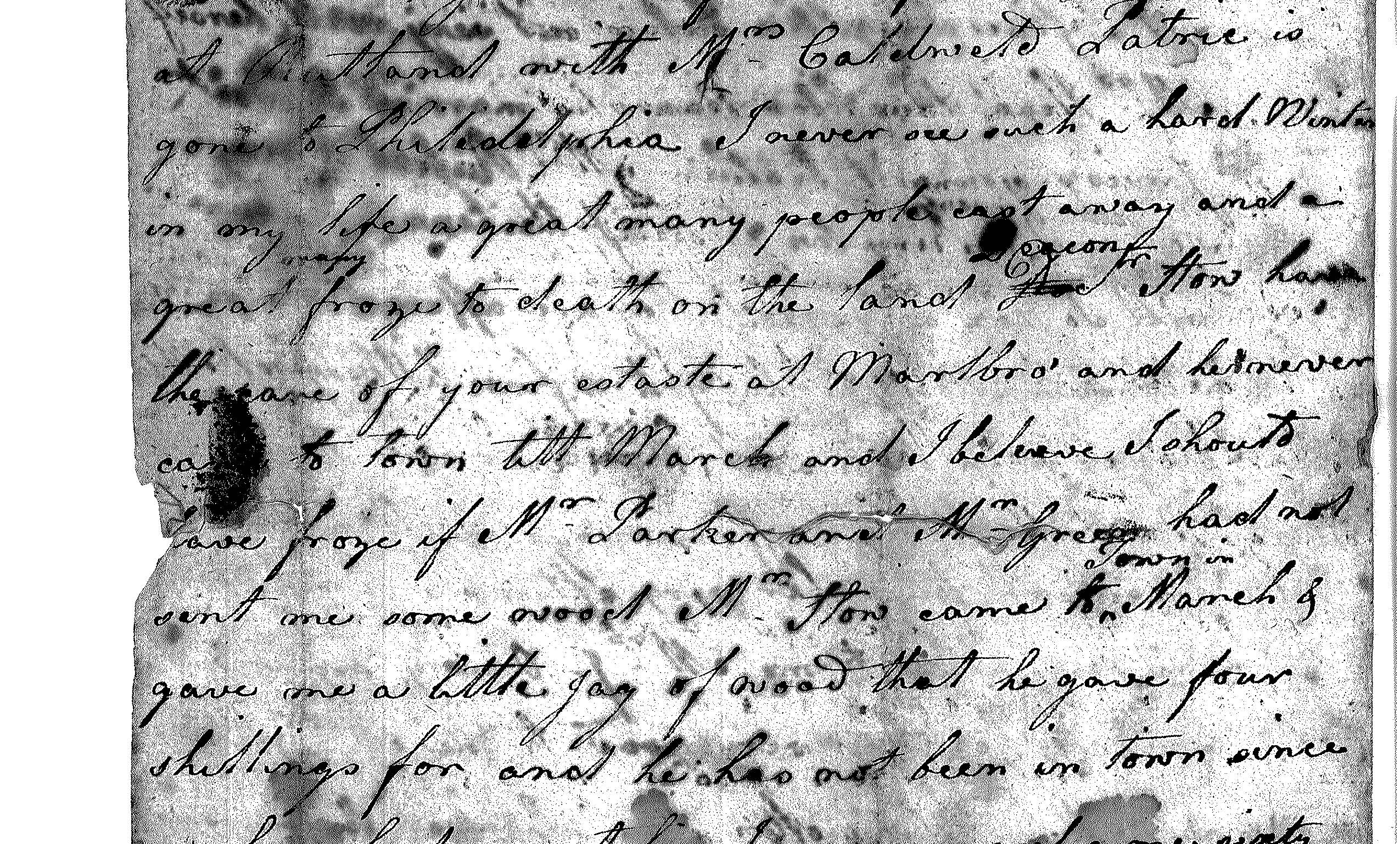
Daphne is vocal in her complaints about the support she is receiving from the General Court, which became responsible for her after it confiscated the Barnes’ Marlborough estate.  Simon Stow, a Marlborough lawyer, “has the care of your estate in Marlbro’ and he never came to town till March and I believe I should have froze if Mr. Parker and Mr. Green had not sent me some wood.  Mr. Stow came to town in March & gave me a little fag of wood that he gave four shillings for and he has not been in town since.”

Daphney's letter to Christian Barnes, May 13, 1787 (Hingham Historical Society archives)

Daphney’s letter to Christian Barnes, May 13, 1787 (Hingham Historical Society archives)

When Daphne wrote this letter, she was living on Rowe’s Lane in Boston (near today’s Bedford Street), renting from a black woman named Venus, according to legislative records at the Massachusetts Archives.  Deborah Barker did not approve:  she wrote that the money the General Court set aside for Daphne “would be a very comfortable support . . . could she be prevailed upon to live anywhere but in a negro house . . . .”

Daphne appears to have come to Hingham in the summer, as reflected in repeated references in Deborah Barkers’ letters:   “[Daphne] continues her annual visits to Hingham and we are fond of seeing her” (Aug. 5, 1783); “I expect [Daphne] every day as I promised to write for her as soon as I returned from my journey” (June 1788); “she spent a month with us the summer past but grew impatient to go home” (Nov. 12, 1790).  The letter in our archives was undoubtedly written on one of Daphne’s visits to Hingham.

Further research is needed to discover what Daphne’s ties were to Hingham.  Was she related to one of the Barkers’ slaves?  Was she raised on the South Shore?  Even without full context, her letter allows us to hear the voice of an individual which might otherwise have been lost and to ponder relationships we have trouble understanding.

Boston Greets the “King of America”

General Benjamin Lincoln may have stood in for General George Washington at Yorktown, accepting Lord Cornwallis’ sword, but not all of his Hingham neighbors and friends were on his side in the Revolutionary War.  A letter in our archives from Deborah Barker of Hingham describes the reception the newly inaugurated President Washington received when he visited Boston in October 1789–and leaves no question about what she thought of the new republic and its chief executive.

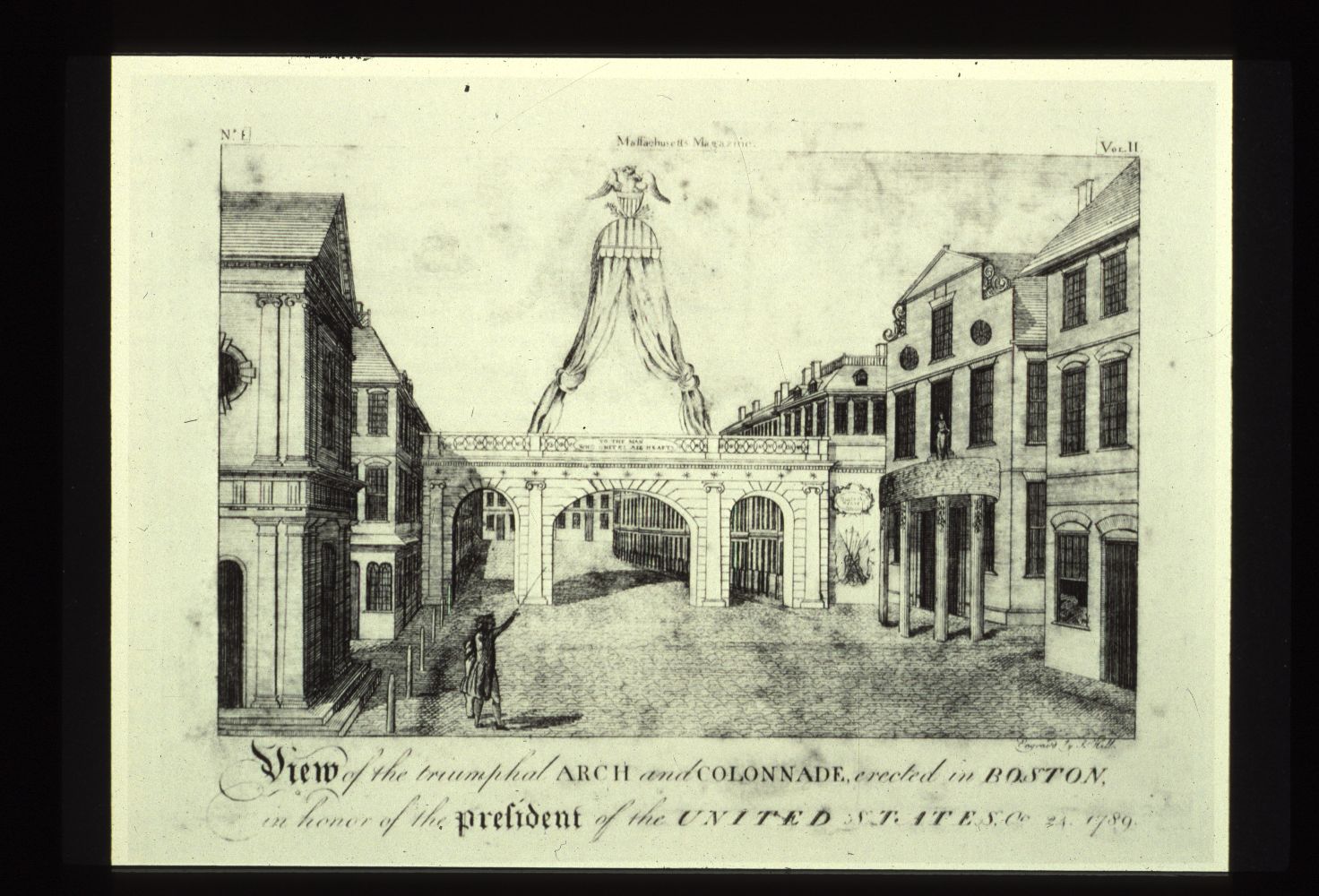
Washington  toured the New England states in the fall of 1789, arriving in Boston on October 24 to an elaborate public celebration.  As pictured below, a triumphal arch, designed by Charles Bulfinch, was constructed in Washington’s honor at the west end of the Old State House, over what was later renamed Washington Street.

1789_TriumphalArch_Boston_MassachusettsMagazine Larger

Engraving published in Massachusetts Magazine in 1789. Caption on the picture reads, “View of the triumphal Arch and Colonnade, erected in Boston in honor of the President of the United States, Oct. 24, 1789.”

Deborah Barker, one of three daughters of loyalist Joshua Barker, who fought for the Crown in the French and Indian War, was not among those impressed. She had been in Boston when Washington arrived and reported to Christian Barnes of Bristol, England, her mother’s cousin, that “[t]he General as President of the United States (or in other words as the King of America) thought proper to visit the northern part of his territories.”  She continued in the same sarcastic vein:

. . . Such a movement could not be performed secretly. It was no sooner announced that he intended visiting Boston than every breast beat with rapture, joy, and exultation. The mechanicks were employed, some in erecting triumphal arches, some in painting flags expressive of their several branches of business, which the most respectable of the order were to carry forth . . . . All of the superior orders were busy in forming addresses expressive of his transcendent merit, and their great love and respect for him. The poets in writing odes and other poems asserted their abilities. . . . The military were all in motion and made a superb appearance. Thus after a week’s preparation and expectation the great the important day (in honor of which everything that an infant world could do was to be done for the Man that many of them fancyed themselves under the greatest obligation to) arrived. The people met in the Mall, formed themselves into a regular processing, each man following the flag bearing a device expressive of his employment, first the merchants, then the clergy, doctors, lawyers, & sea captains, the mechanics alphabetically, thus proceeded by the select men (they you know must always be first) they marched down prison lane and up the main street . . . .

Barker knew she had an appreciative audience for her colorful description. Christian Barnes and her husband, Henry, had been forced to flee Massachusetts in 1775 because of Henry’s British trading activities and had forfeited their substantial estate.  Banished by an Act of the General Court, they had settled in Bristol. Portraits of Christian and Henry Barnes hang in the parlor of our Old Ordinary House Museum. Christian’s has two slashes across it and Henry’s a hole in the middle of the chest; tradition claims that these inflicted by the Marlborough patriots who seized the Barnes estate. It is through Deborah Barker that these paintings came to rest in Hingham.