William Stoughton’s Seal

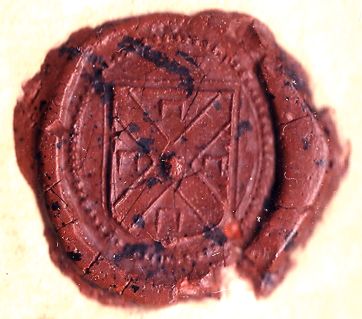
Many of the documents in our archives bear the author or signer’s personal wax seal.  William Stoughton placed his personal seal at the bottom of a deed from 1690, by which he conveyed several parcels of land in Hingham to Thomas Thaxter.  The deed was witnessed by Thomas Mawdesley, who signed his name, and Peter Hicks, who placed his mark on the deed.  Two years later, Stoughton executed an acknowledgement at the bottom of the document that the document reflected his true act and deed, likely to prepare it for recording with the Suffolk Registry of Deeds.  Stoughton’s acknowledgement was witnessed by Samuel Sewall on July 30, 1692.
WilliamStoughton-personalseal

William Stoughton’s seal

Stoughton and Sewall were two of the seven judges whom Governor Phipps appointed to the infamous Court of Oyer and Terminer.  Between June and September 1692, this Court convicted 27 men and women in and around Salem of witchcraft and executed 20 of them.  Stoughton was chief justice, and he is remembered for his defense of the Court’s reliance on spectral evidence (a witness’ testimony that the accused’s specter had appeared and tormented him or her) to prove a demonic pact.  Sewall sat as the clerk of the court, and history remembers him more charitably because, in 1697, he acknowledged his responsibility and asked public forgiveness for his role in the witch trials.

The appearance of the signatures of both of these Salem judges on the deed in our archives makes it a curiosity, as does Stoughton’s wax seal–the very same seal which Stoughton placed on the death warrants of the condemned witches..  However, the date of Sewall’s acknowledgement, July 30, 1692, is what really makes the document intriguing.  The Court of Oyer and Terminer was appointed in May 1692 and started sitting in June of that year.  The first to be tried for witchcraft was Bridget Bishop; she was convicted and hanged on June 10.   On June 29 and 30, 1692, five women—Rebecca Nurse, Sarah Good, Susannah Martin, Elizabeth Howe, and Sarah Wildes—were tried and convicted; they were hanged on July 19.   Four men and one woman—George Burroughs, Martha Carrier, John Willard, George Jacobs, Sr., and John Proctor—were convicted on August 5, 1692, and this group was hanged on August 19.  Stoughton acknowledged the conveyance of property to Thaxter and had Sewall witness it right in the midst of all this terrible activity.

Two men in public life took a few minutes to tend to their other, more mundane responsibilities during an extraordinary period in their lives and our history.  The document in our archives is not “important” and does not teach us about the Salem witch trials.  It is affecting because it forces us to think of these severe, black-clad Salem judges as individuals.
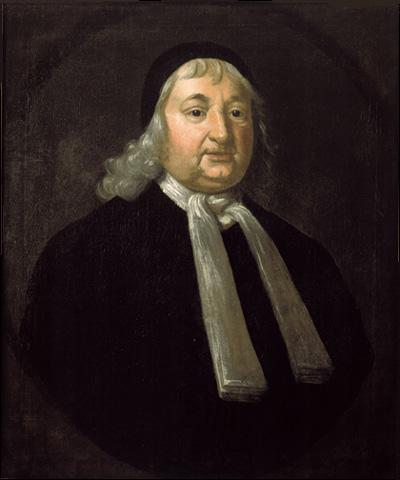
Samuel Sewall
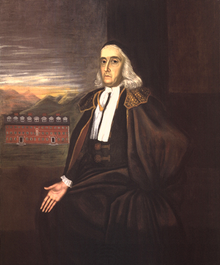
Samuel Sewall

William Stoughton

William Stoughton

Boston Greets the “King of America”

General Benjamin Lincoln may have stood in for General George Washington at Yorktown, accepting Lord Cornwallis’ sword, but not all of his Hingham neighbors and friends were on his side in the Revolutionary War.  A letter in our archives from Deborah Barker of Hingham describes the reception the newly inaugurated President Washington received when he visited Boston in October 1789–and leaves no question about what she thought of the new republic and its chief executive.

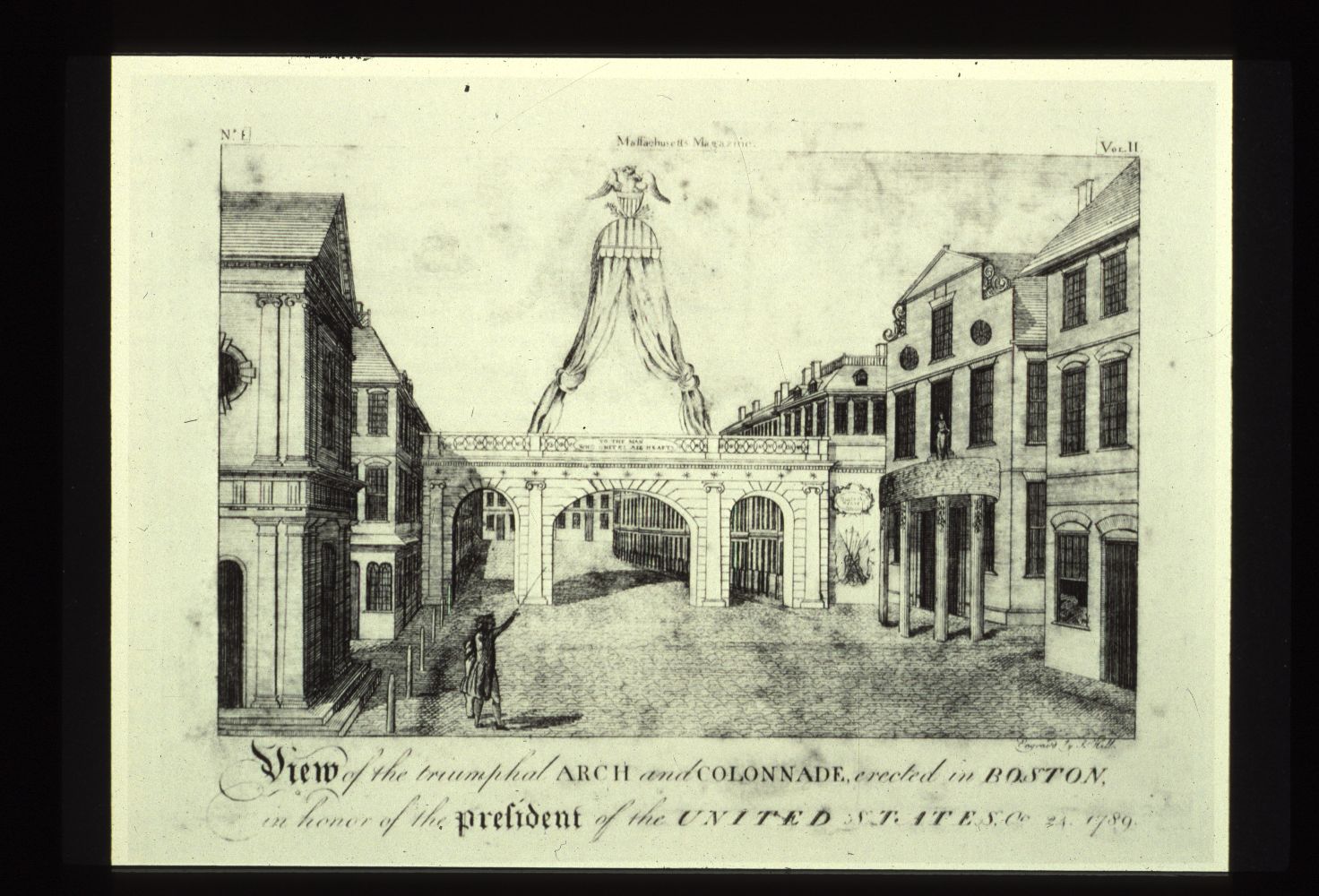
Washington  toured the New England states in the fall of 1789, arriving in Boston on October 24 to an elaborate public celebration.  As pictured below, a triumphal arch, designed by Charles Bulfinch, was constructed in Washington’s honor at the west end of the Old State House, over what was later renamed Washington Street.

1789_TriumphalArch_Boston_MassachusettsMagazine Larger

Engraving published in Massachusetts Magazine in 1789. Caption on the picture reads, “View of the triumphal Arch and Colonnade, erected in Boston in honor of the President of the United States, Oct. 24, 1789.”

Deborah Barker, one of three daughters of loyalist Joshua Barker, who fought for the Crown in the French and Indian War, was not among those impressed. She had been in Boston when Washington arrived and reported to Christian Barnes of Bristol, England, her mother’s cousin, that “[t]he General as President of the United States (or in other words as the King of America) thought proper to visit the northern part of his territories.”  She continued in the same sarcastic vein:

. . . Such a movement could not be performed secretly. It was no sooner announced that he intended visiting Boston than every breast beat with rapture, joy, and exultation. The mechanicks were employed, some in erecting triumphal arches, some in painting flags expressive of their several branches of business, which the most respectable of the order were to carry forth . . . . All of the superior orders were busy in forming addresses expressive of his transcendent merit, and their great love and respect for him. The poets in writing odes and other poems asserted their abilities. . . . The military were all in motion and made a superb appearance. Thus after a week’s preparation and expectation the great the important day (in honor of which everything that an infant world could do was to be done for the Man that many of them fancyed themselves under the greatest obligation to) arrived. The people met in the Mall, formed themselves into a regular processing, each man following the flag bearing a device expressive of his employment, first the merchants, then the clergy, doctors, lawyers, & sea captains, the mechanics alphabetically, thus proceeded by the select men (they you know must always be first) they marched down prison lane and up the main street . . . .

Barker knew she had an appreciative audience for her colorful description. Christian Barnes and her husband, Henry, had been forced to flee Massachusetts in 1775 because of Henry’s British trading activities and had forfeited their substantial estate.  Banished by an Act of the General Court, they had settled in Bristol. Portraits of Christian and Henry Barnes hang in the parlor of our Old Ordinary House Museum. Christian’s has two slashes across it and Henry’s a hole in the middle of the chest; tradition claims that these inflicted by the Marlborough patriots who seized the Barnes estate. It is through Deborah Barker that these paintings came to rest in Hingham.