Fearing Burr of Hingham kept a journal from 1840, when he was 25 years old, until his death in 1897. We are fortunate to have all fifteen volumes in our archives. Burr recorded his day-to-day observations about the weather; town and church affairs; his mercantile pursuits, which included the shop in Centre Hingham which he ran with his brother ; and the horticultural interests for which he is remembered.
In an entry penned on Christmas Eve, 1872, this life-long bachelor wrote about Christmas gift-giving, noting how customs had changed since he was young. Indeed, these were the years when the Christmas holiday began to take the shape we know today!
Burr wrote:
Was very busy in the sale of gifts for the holidays – it’s an illustration of the great change that has gradually taken place since Peter and I first began to sell goods. We are satisfied that the sale of confectionaries for one week of 1872 was very largely in excess of the gross sales of this article for one year from 1825 to 1830 and after. My brother affirms that some of his young patrons in this line expend one dollar per week. The change in the quantity and costly character of gifts of other descriptions is scarcely less noticeable. I recall the days of my early boyhood when my holiday gifts were summed up in three or four copper cents – presents which so far from creating any feelings of dissatisfaction were regarded as truly munificent. Today it is by no means rare that a parent who is wholly dependent on his daily labor invests in toys or articles for amusement, from one dollar upwards, for each of the little ones comprising his family. The change in the general distribution and enjoyment of the more important articles of human comfort and luxury is almost equally great.


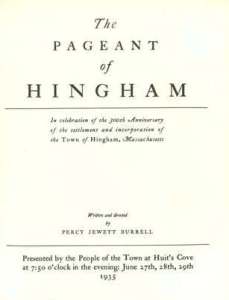 Hingham pulled out all the stops in preparation for its 300th anniversary celebration. Twelve hundred of the Town’s residents participated in a three-plus hour historical pageant, which was performed before 2,000 attendees on the evenings of June 27, 28, and 29, 1935. In the midst of the Great Depression, the Town appropriated an astonishing $14,000 for its tercentenary observance, which was written and directed by
 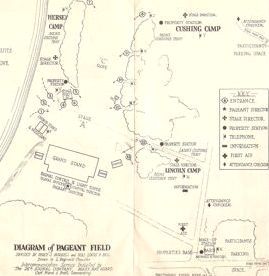 “The Pageant of Hingham” was performed on a sprawling outdoor set at what was then called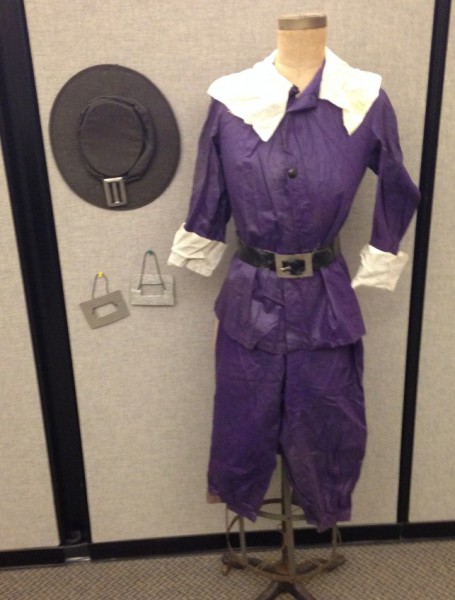
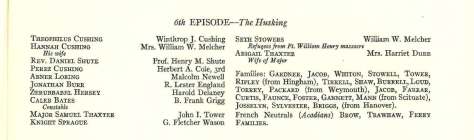 Young Newell and Herbert Cole, another Hingham boy also cast as an 18th century Hingham boy (Perez Cushing, 1746-1794), called out the names of the guests arriving at the Cushing farm. An example of their lines, taken from the Pageant Program: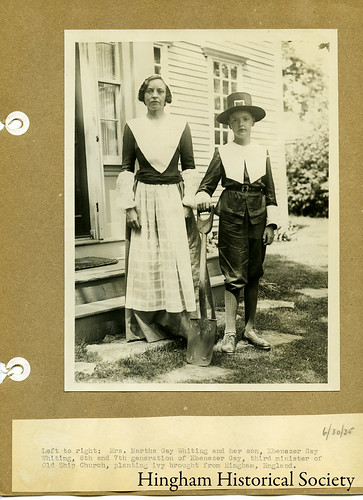
 Out of the Archives