A Soldier Writes Home

Unlike 20th century soldiers, whose mail home traveled for free—or 21st century soldiers, with access to email—Civil War soldiers typically had to purchase their own stationery, envelopes, and stamps in order to write to their loved ones at home.  Our collection of letters which John Barker of Hanson sent home between December 1861 and January 1863—and their envelopes—help tell that story.  Writing materials and stamps were not always easy to come by.  In an 1862 letter home from East Point, VA, Barker wrote:

I suppose that the girls have begun their school.  I would wright them but I have only one stamp and the letters will not go without them now.   I should like to have you send me some if you have them for they cannot be got hear for love nor monney.
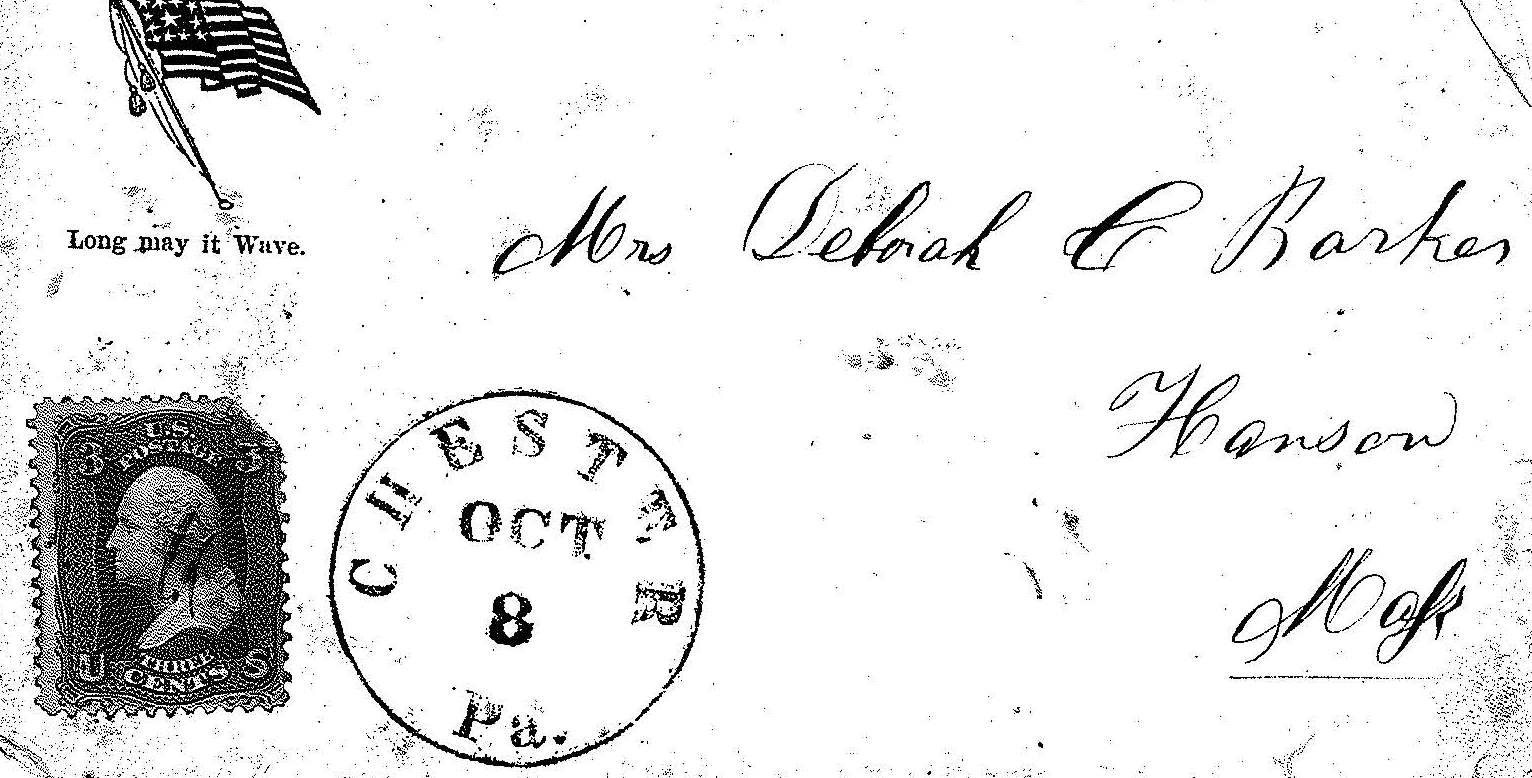
StampedBarker apologized for his poor writing materials when writing from camp (“Do not know as you can read this for it is poorly written and my pencil is short”) while in a later letter from a military hospital in Pennsylvania, he remarked upon the quality of his stationery (“I must stop now for I have filled this great white sheet of paper”).  A first-class stamp for a letter sent east of the Mississippi cost three cents.  The 3¢ stamp with Washington’s profile used on Barker’s envelopes was issued after Fort Sumter and used throughout the war.
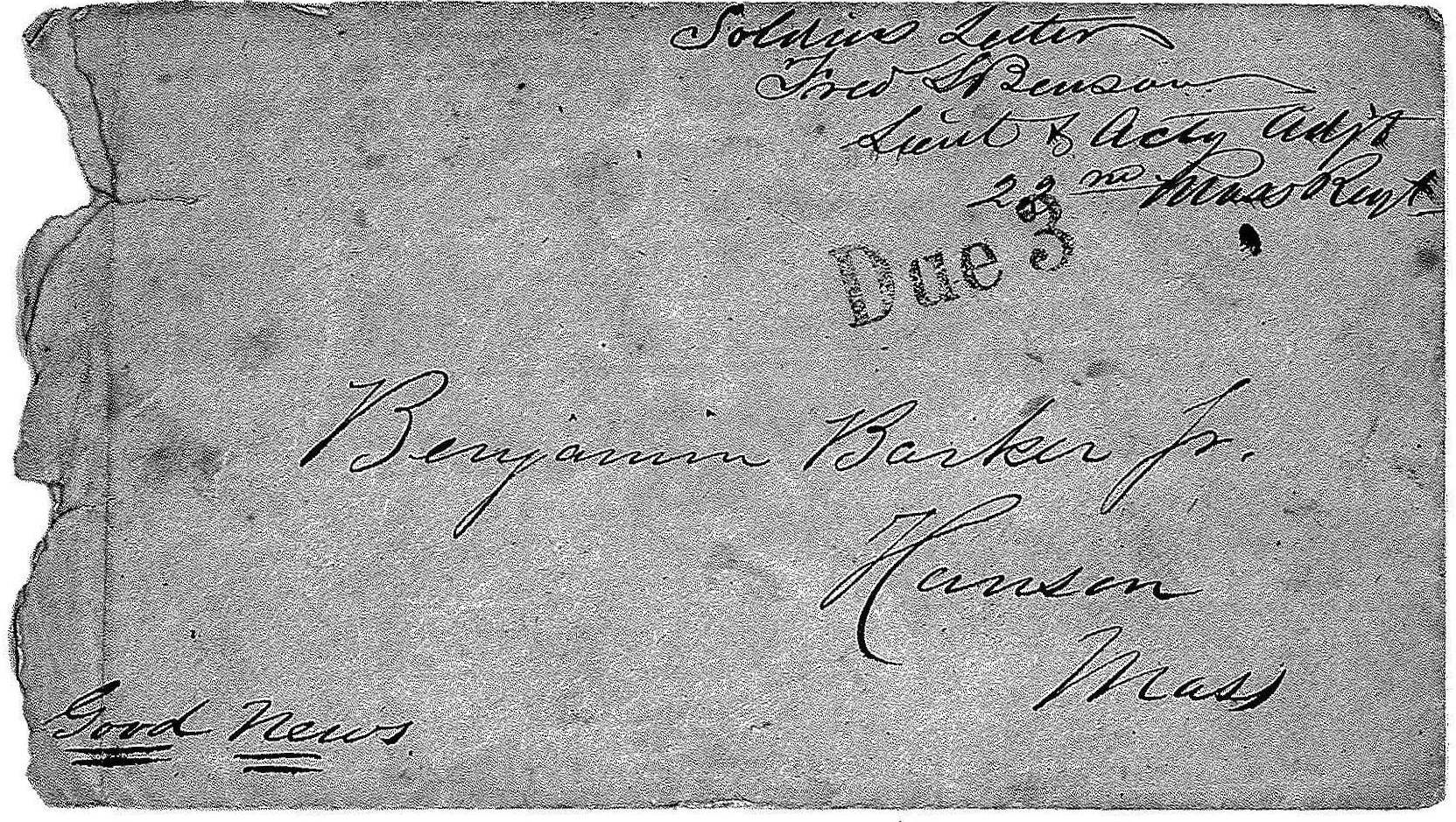
Mixter EnvelopeStamps were not always available, as Barker notes.  Letters would be delivered if labeled “Soldier’s Letter” and accompanied by a soldier’s name and regimental information.  The postage due was stamped on the outside of the envelope, to be paid by the recipient.  Barker was taken prisoner in the summer of 1862 and after his commanding officer learned that he was well and would be sent North in a prisoner exchange, he wrote the family a letter.  Marked “Soldier’s letter” and inscribed with an officer’s name, it was stamped “Due 3” and delivered to the Barkers.  (Note the handwritten note, “Good news,” in the lower left hand corner of the envelope, a reminder of what a terrifying prospect a letter from a soldier’s commanding officer would have been in the circumstances.)
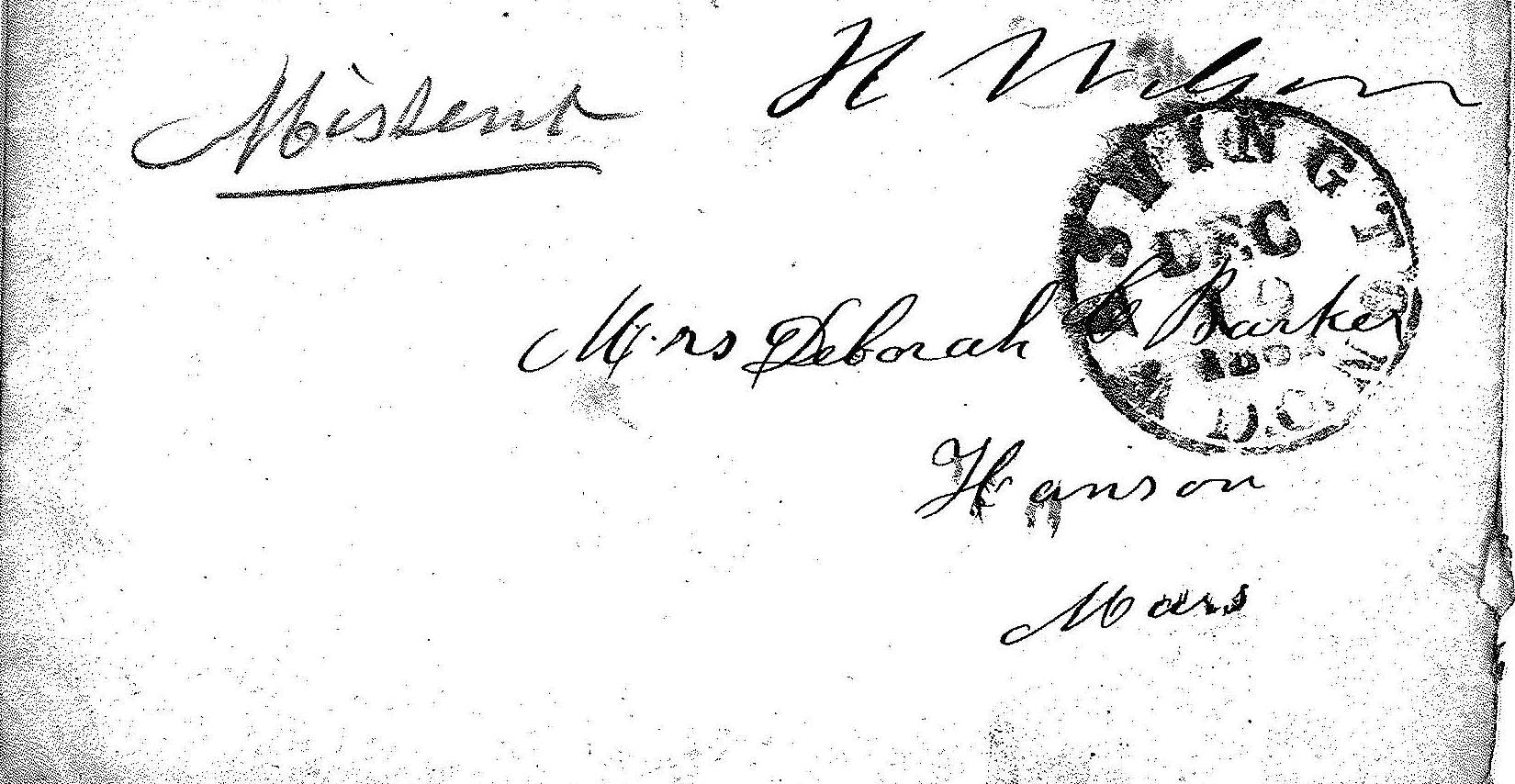
FrankedInterestingly, Barker did for a period of time have the opportunity of sending letters without buying stamps.  He served in the Massachusetts 22nd Regiment, which was organized by Henry Wilson, then a sitting United States Senator from Massachusetts (and later Vice President under President Ulysses S. Grant).  Barker’s first letter home, from training camp at Hall’s Hill, Virginia, has no stamp.  Instead it was “franked,” i.e., Henry Wilson’s signature appears in the upper right hand corner in place of a stamp.  Union military officers did not ordinarily enjoy franking privileges; presumably, Barker was able to send some early letters without postage because his commanding officer was a sitting member of Congress.
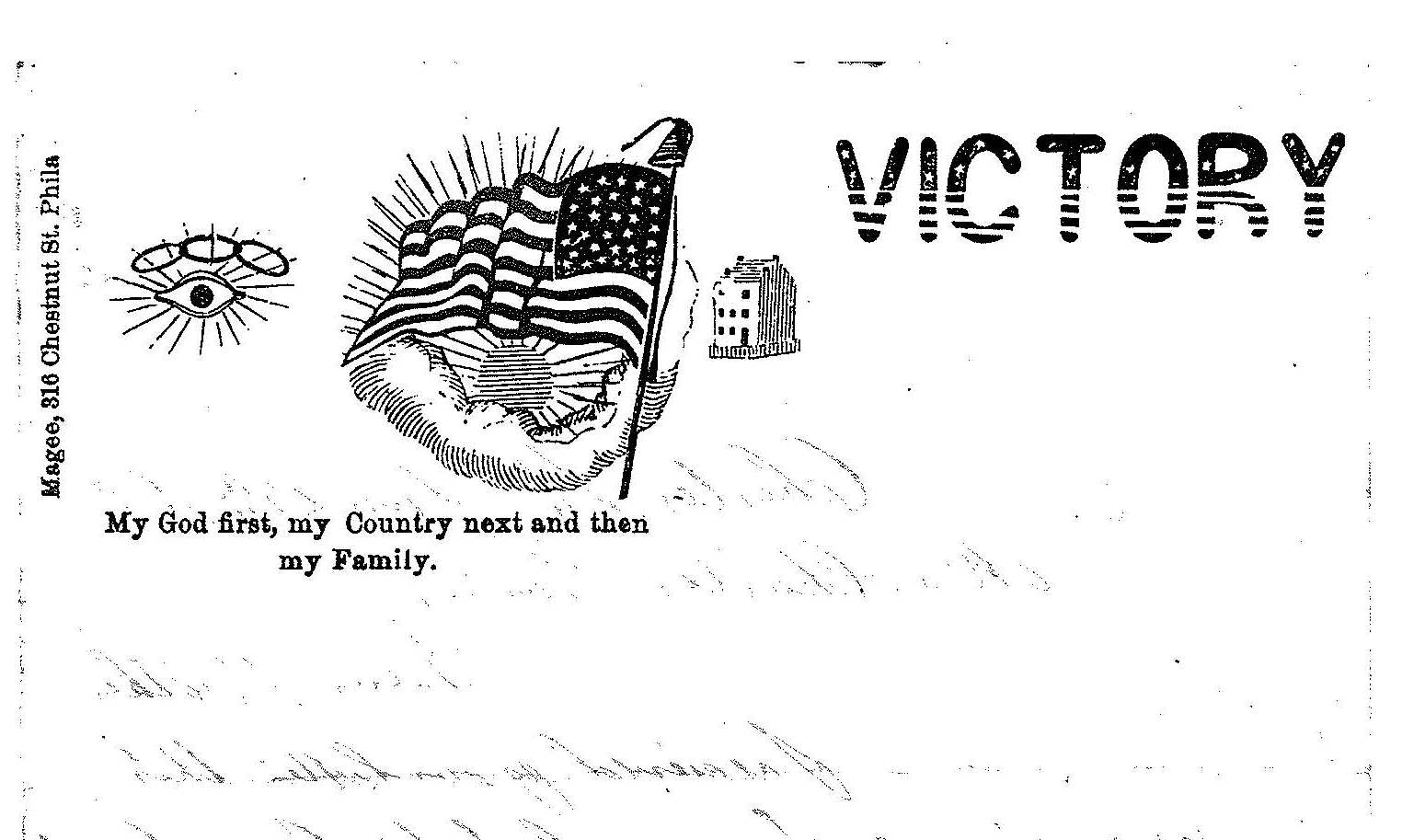
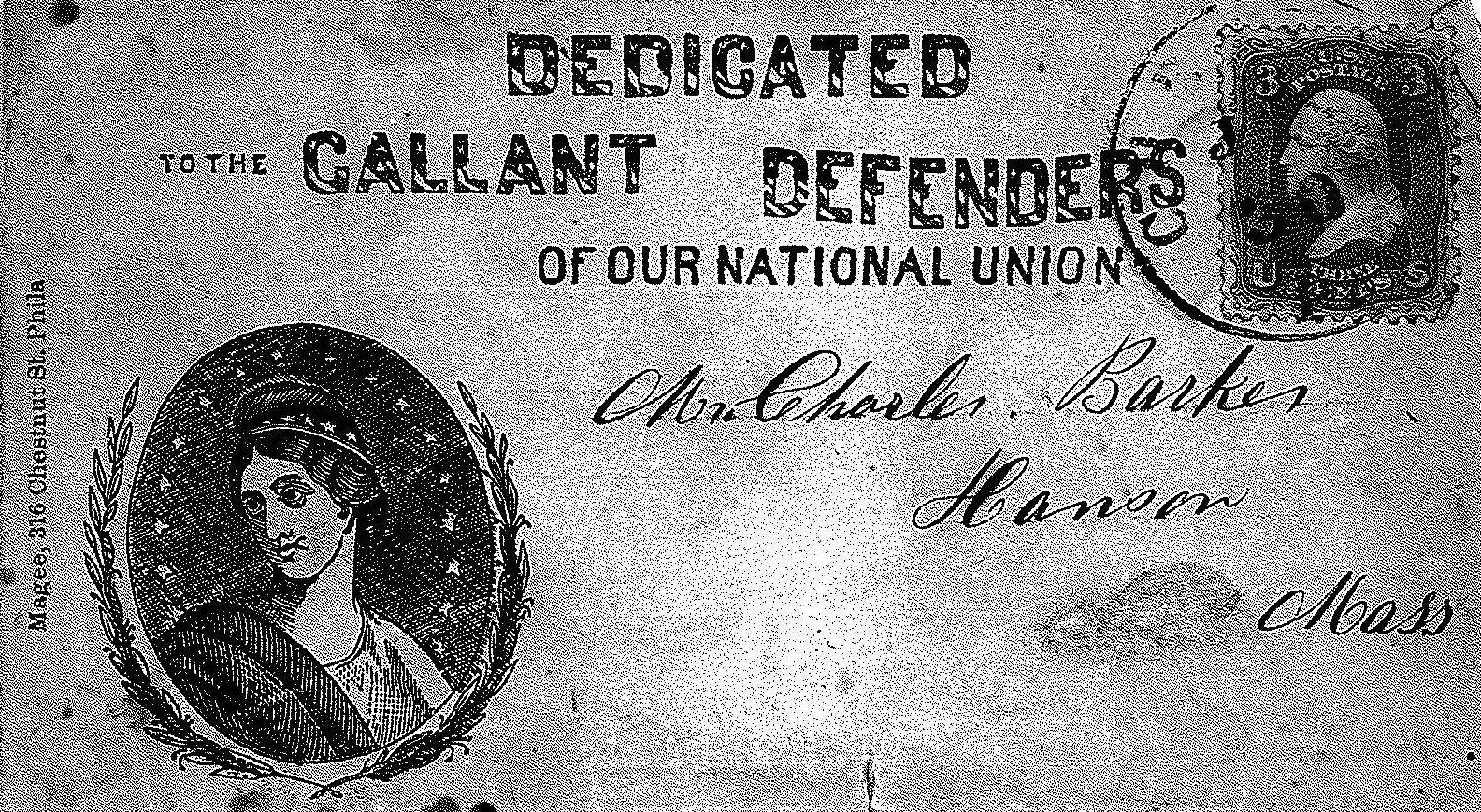
SlogansStationery companies met the demand for stationery and envelopes by manufacturing numerous designs and styles for the soldiers’ use.  Elaborate patriotic pictures and slogans were common.  John Barker wrote home on stationery and envelopes featuring portraits of General Burnside and Columbia; drawings of  flags, eagles, and the Masonic “all-seeing eye;” and slogans such as “One Flag, One Government,” “My God first, my Country next and then my Family,” “Victory,” and “Dedicated to the Gallant Defenders of our National Union.”Columbia
An Appeal to Town Meeting

The terminology used in these 18th century manuscripts will be familiar to any contemporary participant in Hingham’s Town Meeting:  “Mr. Moderator,” the first opens, “As I requested the article in the warrant we are now upon to be inserted, [I] suppose it is expected I should shew for what reason it is inserted . . . .”  We do not know who is addressing Town Meeting or who made these notes, but we understand immediately what’s happening.

The speaker explains that he enjoys the use of 27 acres of land at “Great Lotts,” half “tillage and mowing land” and half pasture, “to no part of either of which can I carry any manure or bring off any produce or drive my oxen or cows but upon sufferance.”  The problem, as he describes it, is that when the town laid out the “Great Lotts” and “Squirrel Hill Lott” one hundred years previously, the intention had been to lay out a road running between Goles Lane and Broad Cove Street, to allow access to the lots.  (Broad Cove Street is now called Lincoln Street and Goles Lane, also formerly called the Turnpike, is now Beal Street.  The Great Lots were survivals of the practice, in the earliest days of settlement, of assigning settlers planting lots and pasture at a far remove from the thickly-settled residential center of town.)

A town committee was appointed, the speaker claims, to lay out this road, and ¾ of its roughly one-mile route was fenced.  The task was not completed, however, and recently Thomas Hersey had built a stone wall where the road ran across his property.  For the speaker, the stakes were high:  “if I cannot get to my Land [I] shall be reduced to the hard necessity of keep[ing] two cows & driving my oxen to the worlds end & keep[ing] a horse the greater part of the summer at the barn.”

It demonstrates just how old our town is that this 18th century Hingham farmer was basing his argument on what he claimed were the Town’s mid-17th century actions.  Remarkably, he appears to have had documentary evidence to support his contention.  A second set of notes in the same handwriting, perhaps of a second application to the Town, opens:

Mr. Moderator.  What I propose by Laying before the Town the record that has now been read is to shew the sentiments of the Town respecting a highway from Goles Lane to Broad Cove Street 100 years ago, which the Inhabitants have passed  & repassed since time immemorial but is now entirely stopped up by Mr. Thomas Hersey . . . .

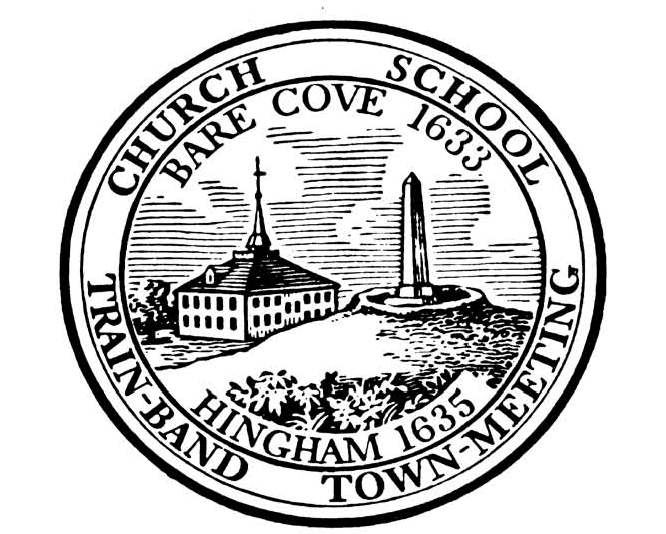
Hingham’s town seal pays tribute to the four pillars upon which the town was founded and grew:  Church, School, Train-Band (the militia), and Town-Meeting.  These two manuscripts remind us of the central role played by Town Meeting, which, as the legislative branch of our municipal government, has offered individual citizens a direct voice in municipal government for close to four centuries.

William Stoughton’s Seal

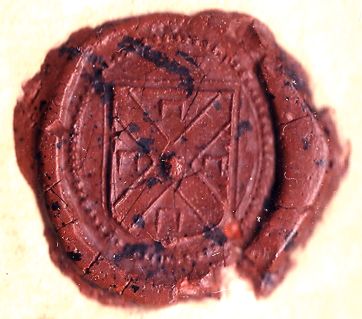
Many of the documents in our archives bear the author or signer’s personal wax seal.  William Stoughton placed his personal seal at the bottom of a deed from 1690, by which he conveyed several parcels of land in Hingham to Thomas Thaxter.  The deed was witnessed by Thomas Mawdesley, who signed his name, and Peter Hicks, who placed his mark on the deed.  Two years later, Stoughton executed an acknowledgement at the bottom of the document that the document reflected his true act and deed, likely to prepare it for recording with the Suffolk Registry of Deeds.  Stoughton’s acknowledgement was witnessed by Samuel Sewall on July 30, 1692.

WilliamStoughton-personalseal

William Stoughton’s seal

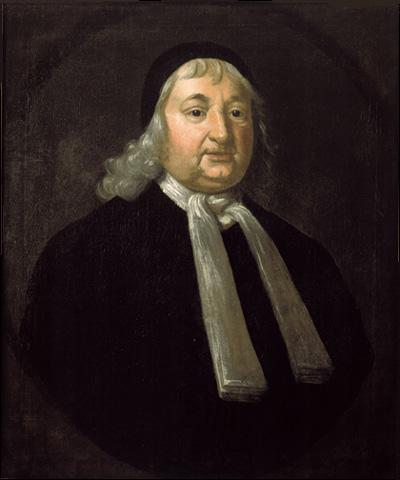
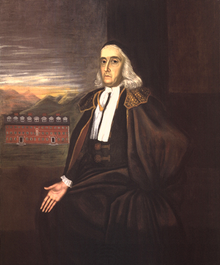
Stoughton and Sewall were two of the seven judges whom Governor Phipps appointed to the infamous Court of Oyer and Terminer.  Between June and September 1692, this Court convicted 27 men and women in and around Salem of witchcraft and executed 20 of them.  Stoughton was chief justice, and he is remembered for his defense of the Court’s reliance on spectral evidence (a witness’ testimony that the accused’s specter had appeared and tormented him or her) to prove a demonic pact.  Sewall sat as the clerk of the court, and history remembers him more charitably because, in 1697, he acknowledged his responsibility and asked public forgiveness for his role in the witch trials.

The appearance of the signatures of both of these Salem judges on the deed in our archives makes it a curiosity, as does Stoughton’s wax seal–the very same seal which Stoughton placed on the death warrants of the condemned witches..  However, the date of Sewall’s acknowledgement, July 30, 1692, is what really makes the document intriguing.  The Court of Oyer and Terminer was appointed in May 1692 and started sitting in June of that year.  The first to be tried for witchcraft was Bridget Bishop; she was convicted and hanged on June 10.   On June 29 and 30, 1692, five women—Rebecca Nurse, Sarah Good, Susannah Martin, Elizabeth Howe, and Sarah Wildes—were tried and convicted; they were hanged on July 19.   Four men and one woman—George Burroughs, Martha Carrier, John Willard, George Jacobs, Sr., and John Proctor—were convicted on August 5, 1692, and this group was hanged on August 19.  Stoughton acknowledged the conveyance of property to Thaxter and had Sewall witness it right in the midst of all this terrible activity.

Two men in public life took a few minutes to tend to their other, more mundane responsibilities during an extraordinary period in their lives and our history.  The document in our archives is not “important” and does not teach us about the Salem witch trials.  It is affecting because it forces us to think of these severe, black-clad Salem judges as individuals.

Samuel Sewall

Samuel Sewall

William Stoughton

William Stoughton

A Letter From Daphney

Among the Deborah Barker letters to Christian Barnes in our archives (see post of October 28) is a well-worn manuscript dated May 13, 1787.  It is signed “Daphney,” and was originally indexed as authored by “Daphne Barker.”  Indeed, Deborah Barker’s frequent references to Daphne in her own letters call up the image of an elderly aunt who visits her Hingham relations from time to time.

But there is no Daphne in the Barker family tree.  We started looking at the Barnes family and, before long, realized that Daphne was the Barnes’ former slave, left behind when Loyalists Henry and Christian Barnes fled to England in 1775.

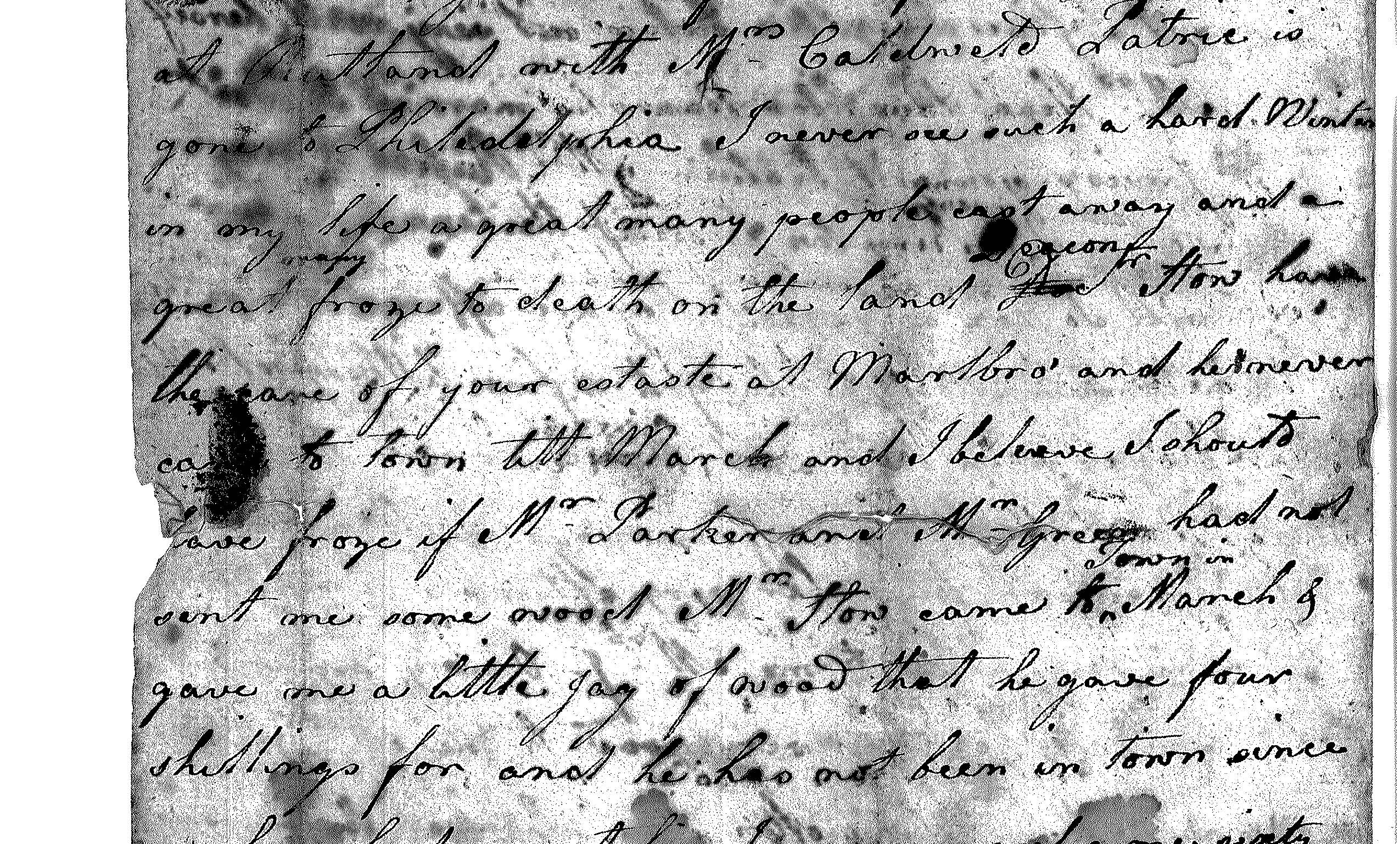
The letter is in Deborah Barker’s handwriting, but the voice is unmistakably Daphne’s.  She updates her former mistress on local news and describes a general economic malaise: “Everybody is very poor.  The streets are full of beggars and the people steal so that the jails are full.”  She fills Mrs. Barnes in on her Boston friends—and she is not afraid to dish the dirt.  “Mrs. Howe,” she writes, “was at Boston this winter.  She came in a shay.  She is grown as big as a great ox.”  When she saw Mrs. Howe, Daphne writes, she “enquired after Dolly Gate and Mrs. How told she had gone up to near Rutland and had another child by a married man.”   “John Parker’s sister Polly,” she reports, “went up to see him and came home with a child but no husband.”

Daphne is vocal in her complaints about the support she is receiving from the General Court, which became responsible for her after it confiscated the Barnes’ Marlborough estate.  Simon Stow, a Marlborough lawyer, “has the care of your estate in Marlbro’ and he never came to town till March and I believe I should have froze if Mr. Parker and Mr. Green had not sent me some wood.  Mr. Stow came to town in March & gave me a little fag of wood that he gave four shillings for and he has not been in town since.”

Daphney's letter to Christian Barnes, May 13, 1787 (Hingham Historical Society archives)

Daphney’s letter to Christian Barnes, May 13, 1787 (Hingham Historical Society archives)

When Daphne wrote this letter, she was living on Rowe’s Lane in Boston (near today’s Bedford Street), renting from a black woman named Venus, according to legislative records at the Massachusetts Archives.  Deborah Barker did not approve:  she wrote that the money the General Court set aside for Daphne “would be a very comfortable support . . . could she be prevailed upon to live anywhere but in a negro house . . . .”

Daphne appears to have come to Hingham in the summer, as reflected in repeated references in Deborah Barkers’ letters:   “[Daphne] continues her annual visits to Hingham and we are fond of seeing her” (Aug. 5, 1783); “I expect [Daphne] every day as I promised to write for her as soon as I returned from my journey” (June 1788); “she spent a month with us the summer past but grew impatient to go home” (Nov. 12, 1790).  The letter in our archives was undoubtedly written on one of Daphne’s visits to Hingham.

Further research is needed to discover what Daphne’s ties were to Hingham.  Was she related to one of the Barkers’ slaves?  Was she raised on the South Shore?  Even without full context, her letter allows us to hear the voice of an individual which might otherwise have been lost and to ponder relationships we have trouble understanding.

Boston Greets the “King of America”

General Benjamin Lincoln may have stood in for General George Washington at Yorktown, accepting Lord Cornwallis’ sword, but not all of his Hingham neighbors and friends were on his side in the Revolutionary War.  A letter in our archives from Deborah Barker of Hingham describes the reception the newly inaugurated President Washington received when he visited Boston in October 1789–and leaves no question about what she thought of the new republic and its chief executive.

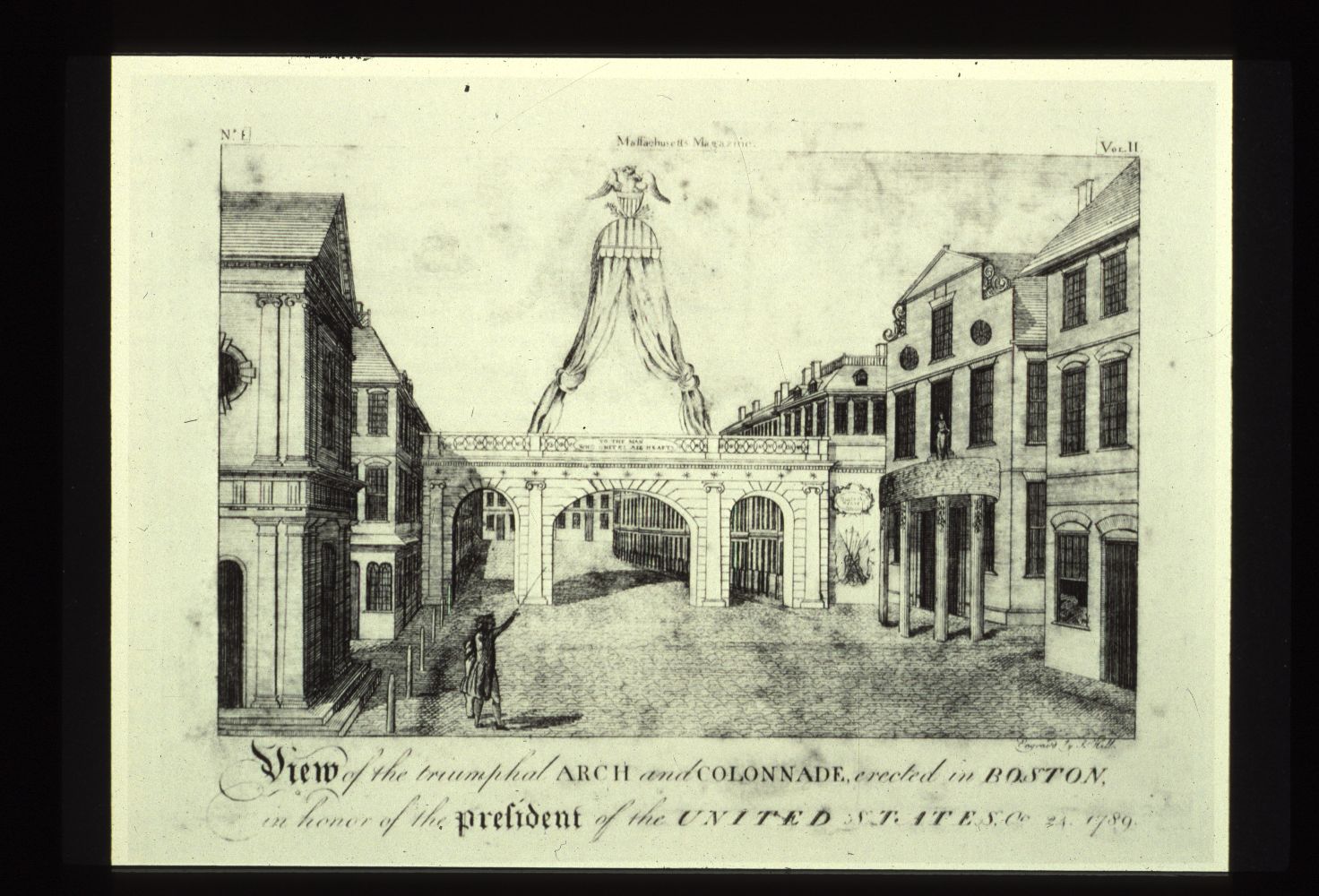
Washington  toured the New England states in the fall of 1789, arriving in Boston on October 24 to an elaborate public celebration.  As pictured below, a triumphal arch, designed by Charles Bulfinch, was constructed in Washington’s honor at the west end of the Old State House, over what was later renamed Washington Street.

1789_TriumphalArch_Boston_MassachusettsMagazine Larger

Engraving published in Massachusetts Magazine in 1789. Caption on the picture reads, “View of the triumphal Arch and Colonnade, erected in Boston in honor of the President of the United States, Oct. 24, 1789.”

Deborah Barker, one of three daughters of loyalist Joshua Barker, who fought for the Crown in the French and Indian War, was not among those impressed. She had been in Boston when Washington arrived and reported to Christian Barnes of Bristol, England, her mother’s cousin, that “[t]he General as President of the United States (or in other words as the King of America) thought proper to visit the northern part of his territories.”  She continued in the same sarcastic vein:

. . . Such a movement could not be performed secretly. It was no sooner announced that he intended visiting Boston than every breast beat with rapture, joy, and exultation. The mechanicks were employed, some in erecting triumphal arches, some in painting flags expressive of their several branches of business, which the most respectable of the order were to carry forth . . . . All of the superior orders were busy in forming addresses expressive of his transcendent merit, and their great love and respect for him. The poets in writing odes and other poems asserted their abilities. . . . The military were all in motion and made a superb appearance. Thus after a week’s preparation and expectation the great the important day (in honor of which everything that an infant world could do was to be done for the Man that many of them fancyed themselves under the greatest obligation to) arrived. The people met in the Mall, formed themselves into a regular processing, each man following the flag bearing a device expressive of his employment, first the merchants, then the clergy, doctors, lawyers, & sea captains, the mechanics alphabetically, thus proceeded by the select men (they you know must always be first) they marched down prison lane and up the main street . . . .

Barker knew she had an appreciative audience for her colorful description. Christian Barnes and her husband, Henry, had been forced to flee Massachusetts in 1775 because of Henry’s British trading activities and had forfeited their substantial estate.  Banished by an Act of the General Court, they had settled in Bristol. Portraits of Christian and Henry Barnes hang in the parlor of our Old Ordinary House Museum. Christian’s has two slashes across it and Henry’s a hole in the middle of the chest; tradition claims that these inflicted by the Marlborough patriots who seized the Barnes estate. It is through Deborah Barker that these paintings came to rest in Hingham.